Linea is up to something again—here's how to earn Linea Surge points and a quick guide for efficient participation
TechFlow Selected TechFlow Selected
Linea is up to something again—here's how to earn Linea Surge points and a quick guide for efficient participation
Last 6 months PUA, no witch hunt, speed-read the Linea Surge points LXP-L acquisition methods and efficient participation guide.
 Navigating Web3 tides with focused insights
By Karen, Foresight News
On May 17, the Linea Surge event officially kicked off. Linea launched Volt 1, the first phase of its Linea Surge points program, aiming to drive ecosystem growth by attracting more users and increasing TVL on the network—potentially ushering in a new chapter of Linea’s growth flywheel.
Although sparking some controversy and criticism within parts of the community over perceived PUA tactics, Linea has previously emphasized that Linea Surge represents the final piece before embarking on its journey toward decentralization—to build a network truly owned and operated by the community.
As part of the initiative, Linea will reward participants with LXP-L points for holding assets on Linea and deploying them into DeFi protocols. Linea Surge will run for six months (six Volts) or until the network’s TVL reaches $3 billion. With each successive phase, the allocation of LXP-L points will decrease by 10%, meaning earlier participation yields higher rewards. According to Linea, users can earn LXP-L points hourly simply by bridging assets to Linea, keeping them on-chain, and deploying them into designated protocols.
Users who had existing liquidity exceeding 0.1 ETH prior to the final block at 07:59 on May 16 will receive an early adopter multiplier for Volt 1 as an additional bonus. Additionally, during the Linea Surge campaign, liquidity deployed within a single protocol must be greater than or equal to $24 for points to be counted. Notably, Linea stated there is no need to sybil-check—the same number of points will be awarded whether a user concentrates all liquidity in one wallet or spreads it across thousands of addresses.
There are three main ways to earn LXP-L points: Ecosystem Points, Referral Points, and Veteran Points. Ecosystem Points primarily incentivize users to bridge or deposit assets into Linea and interact across various ecosystem protocols; Referral Points are distributed through Linea Surge's referral mechanism; Veteran Points offer extra rewards for users with significant historical activity and contributions on the Linea platform.
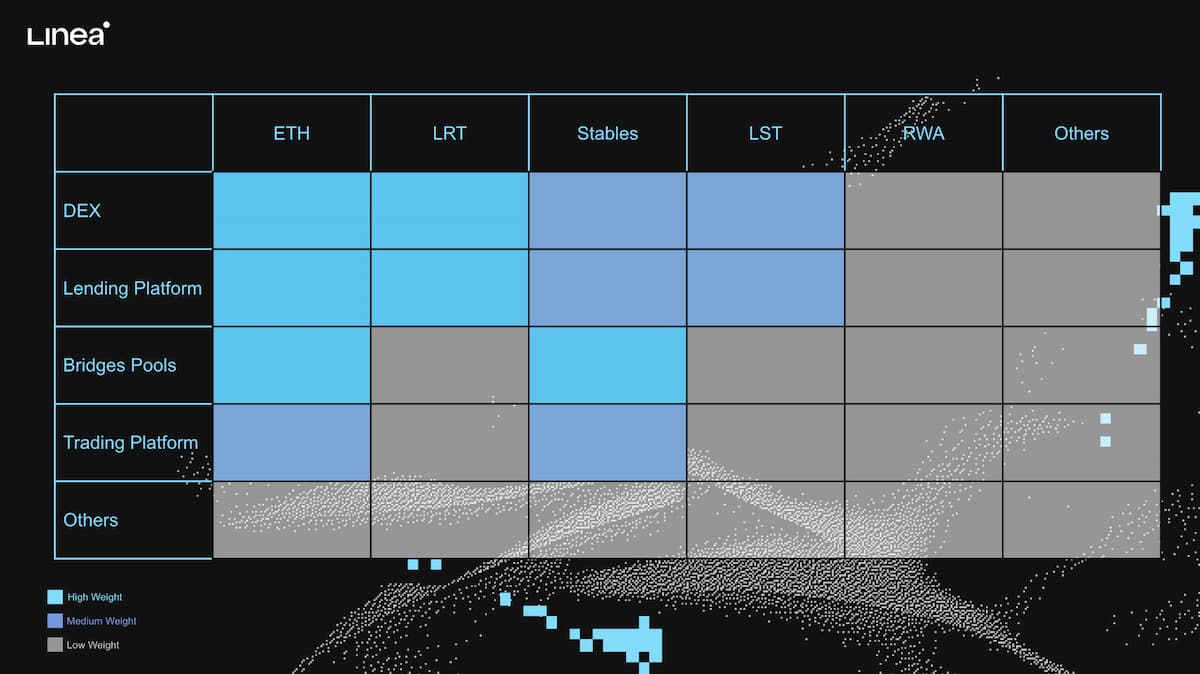
The chart below shows the weighting system for Ecosystem Points, where points for ETH and LRT liquidity on DEXs and lending platforms, as well as ETH bridging activities, carry the highest weight, while stablecoins, LSTs, and RWAs have lower weights.
Which tokens are whitelisted in Linea Surge?
The following tokens have been whitelisted for the Linea Surge campaign:
-
ETH, wETH, WBTC, nextwETH, mBTC, SolvBTC;
-
LRT/LST: weETH, wrsETH, uniETH, ezETH, inETH, ankrETH, wstETH, mpETH, STONE, frxETH;
-
RWA: sUSDE, wDAI, EURO3, LUSDC, agEUR, USD+, USDT+;
-
Stablecoins: USDC, USDT, DAI, alxUSDC, nextUSDC, nextUSDT, nextDAI, USDE, GRAI, Added, LYU.
21 protocols participating in Linea Surge
Teahouse Finance: A multi-chain DeFi asset management platform focused on concentrated liquidity provision on Uniswap V3;
PancakeSwap: A multi-chain DEX protocol;
Secta: A DEX and launchpad within the Linea ecosystem. It has not yet issued a platform token or launched its launchpad, but Secta’s first launchpad project will issue its own platform token, SECTA. The primary use case of the SECTA token is to secure allocations in projects it incubates and launches.
Tokenomics: 57% allocated to the community, 5% for public sale, 15% to investors (fully locked for 6 months, linearly released over 24 months), 3% to advisors (fully locked for 12 months, then linearly released over 24 months), and 20% to the team (fully locked for 12 months, then linearly released over 24 months).
Mendi Finance: A lending protocol in the Linea ecosystem that has introduced the Mendi Loyalty Points (MLP) program. MLP is a soulbound ERC-20 token proportionally distributed to users of the lending and staking protocols. Mendi Finance stated that if any potential airdrops are directed toward Mendi in the future, MLP will serve as the accounting mechanism to fairly distribute those airdrops to holders. To boost liquidity, Mendi Finance will bribe Lynex weekly, distributing earned oLYNX to MENDI stakers. Mendi Finance launched its token at the end of last year; details on its tokenomics and distribution model can be found here.
Connext: A Layer 2 interoperability protocol;
Overnight: An asset management protocol offering passive yield products based on delta-neutral strategies for conservative stablecoin investors.
Sushi: A multi-chain DEX protocol;
Lynex: A liquidity engine in the Linea ecosystem aggregating Automated Liquidity Managers (ALMs). Every transaction on Lynex generates fee revenue used to reward active voters and strengthen the Lynex treasury. Lynex has already issued a token.
SyncSwap: A DEX protocol operating across zkSync Era, Linea, and Scroll ecosystems; no token has been issued yet.
Deri Protocol: A decentralized derivatives protocol that has issued a token.
Velocore: A veDEX protocol based on Velodrome in the zkSync Era and Linea ecosystems; has issued a token.
SpartaDEX: A gamified DEX in the Arbitrum One and Linea ecosystems; has issued a token.
iZUMi Swap: A multi-chain DeFi protocol providing one-stop Liquidity-as-a-Service (LaaS); has issued a token.
Stargate: A cross-chain bridge that has issued a token.
Celer Network: A cross-chain bridge that has issued a token.
NILE: A DEX protocol that has issued a token.
Gravita Protocol: An ETH-centric multi-chain LST lending protocol that has not yet launched a governance token.
Lyve Finance: A stablecoin project in the Linea ecosystem allowing users to mint the LYU stablecoin using ETH or LSTs, with support for circular borrowing; has issued a governance token.
ZeroLend: A decentralized lending protocol on zkSync, Manta Network, Blast, and Linea; has issued a token.
Renzo: A restaking protocol that has issued a token.
Clip Finance: An automated yield solution that will unlock CLIP tokens for the first time when TVL reaches $1 million and is about to launch a points system. CLIP token holders can stake their tokens to enhance liquidity mining and participate in governance. Tokenomics details are available here.
Maximize gains: How to efficiently participate in Linea Surge?
How can you maximize capital efficiency to earn the most LXP and position yourself for potential airdrops? Here are some suggested strategies:
Path 1: Bridge ETH to Linea via a cross-chain bridge, stake ETH in a staking protocol, and deposit LRT or LST tokens into a lending protocol. For example, supplying wrsETH (an LRT token issued by Kelp DAO) on ZeroLend allows you to earn double Kelp Miles, Linea LXP-L points, 5% Turtle Club Turtle (virtual liquidity protocol) LXP-L points, and TurtleDAO points. Alternatively, borrow the overcollateralized debt token GRAI (issued by Gravita Protocol) using ether.fi’s weETH on Gravita Protocol, then provide liquidity on NILE—this creates a capital-efficient way to maximize LXP earnings.
Path 2: Bridge ETH to Linea via a cross-chain bridge, then deposit liquidity and LP tokens into DEX protocols. For instance, bridge ETH via Connext and deposit liquidity into Velocore while staking LP tokens to earn LXP-L points, pre-mine rewards (LVC) from Velocore, and Carrot points from Router Nitro.
Join TechFlow official community to stay tuned
Telegram:https://t.me/TechFlowDaily
X (Twitter):https://x.com/TechFlowPost
X (Twitter) EN:https://x.com/BlockFlow_News
 Foresight News