
Why These Five Core Projects Are Worth Watching: The Narrative of zkEVM Evolving into zkVM
TechFlow Selected TechFlow Selected
Why These Five Core Projects Are Worth Watching: The Narrative of zkEVM Evolving into zkVM
A zero-knowledge virtual machine (zkVM) is a general-purpose computing platform based on zero-knowledge proofs.
 Navigating Web3 tides with focused insights
Author: 0XNATALIE
In the pursuit of solutions for blockchain scalability and computational efficiency, zero-knowledge proof (ZKP) technology plays a critical role. The zkVM (Zero-Knowledge Virtual Machine) is one specific application of this technology. As a general-purpose computing platform based on ZKPs, zkVM can verify the correctness of computations without revealing execution details, and supports off-chain processing of computationally intensive tasks, submitting only verification results to the blockchain—greatly enhancing blockchain scalability. Currently, multiple projects such as a16z, Taiko, and ZKM are developing zkVM solutions.
Introduction to zkVM
zkVM is a general-purpose computing platform based on zero-knowledge proofs capable of executing various computational tasks, including smart contract execution, data processing, and complex algorithm operations. Its core function is generating zero-knowledge proofs that verify computational correctness without disclosing execution details. Using SNARKs technology, these proofs can be verified off-chain, allowing verifiers to avoid re-executing the entire computation on-chain at high computational cost.
Moreover, zkVM’s design extends beyond cryptocurrency transactions. Its versatility enables deployment across diverse applications such as medical data processing, supply chain management, and private voting systems—scenarios requiring both data security and validation of processing logic correctness.

zkVM vs. Other Virtual Machines
Traditional virtual machines (VMs) typically refer to complete computational environments virtually simulated on physical hardware. Their primary function is simulating hardware environments, enabling multiple operating systems or applications to run on the same physical machine. These VMs rely on hardware virtualization techniques and OS-level isolation, generally not involving encrypted verification of applications or data running within them.
In contrast, zero-knowledge virtual machines (zkVMs) use zero-knowledge proof technology to ensure program execution correctness. This approach applies to any program compilable and executable within a virtual machine. zkVMs are designed as universal computational verification platforms suitable for various applications and supporting multiple programming languages such as Rust, C/C++, and Go—allowing developers to build applications using familiar languages. However, the computation and verification processes in zkVMs are often more time-consuming than traditional VMs, as generating zero-knowledge proofs is highly computation-intensive and demands significant resources—largely limiting transaction throughput (TPS). While current zk technologies have made notable progress in single-proof generation, their ability to handle large-scale transactions under heavy loads remains limited. Proof generation may take several seconds to minutes, posing constraints for high-throughput applications like large-scale payment processing systems.
zkEVM is a specific implementation of zkVM, designed specifically for the Ethereum ecosystem to enhance Ethereum's scalability via zero-knowledge proofs. It maintains full compatibility with Ethereum smart contracts and development tools such as Solidity and Vyper, allowing existing Ethereum applications to migrate seamlessly to zkEVM without modifications. Thus, zkEVM functions more like an optimized version of Ethereum.
Notable zkVM Projects
Despite technical challenges associated with zk technology, several projects have demonstrated strong technical capabilities in developing zkVM solutions.
Jolt: High Performance
On April 9, a16z released a preliminary implementation of its zkVM solution Jolt. Jolt is a new type of zkVM known for fast execution speed and improved developer extensibility and code auditability.
Unlike other STARK-based zkVMs, Jolt leverages Lasso lookup arguments and sumcheck-based techniques. This innovative approach simplifies the implementation of new virtual machine instructions while improving overall system speed. Jolt emphasizes usability and efficiency, featuring a highly streamlined codebase—each CPU instruction in Jolt requires only about 50 lines of Rust code. Additionally, Jolt delivers outstanding performance: in initial benchmarks, it generated zero-knowledge proofs over five times faster than RISC Zero and twice as fast as SP1.
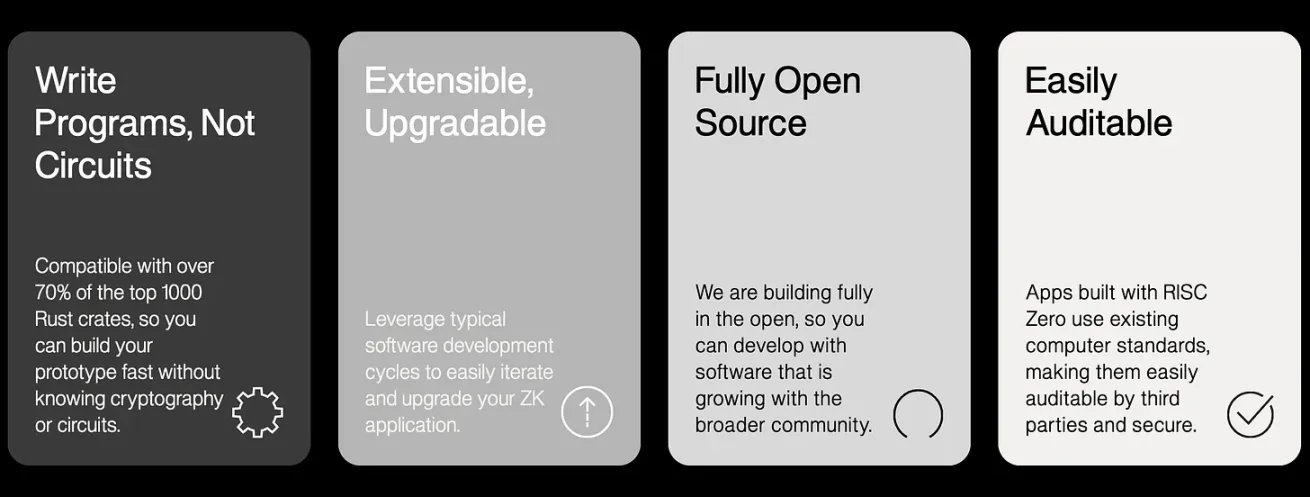
RISC Zero: Efficient Handling of Complex Computations
RISC Zero is a zkVM with a recursive SNARK structure, utilizing a recursive method that allows proofs to be nested within each other. In SNARK technology, recursion breaks down complex proofs into smaller, more manageable ones. These smaller proofs can be independently verified and later combined into a single comprehensive proof without compromising validity. RISC Zero’s uniqueness lies in how it implements recursion—seamlessly integrating multi-layered proofs into a single proof chain, reducing computational load and data volume while maintaining security and integrity throughout multi-step verification processes.
Another distinguishing feature of RISC Zero is its use of the RISC-V instruction set—an open-standard ISA (Instruction Set Architecture) designed for scalability and adaptability. This choice allows RISC Zero to leverage a broad ecosystem of tools and support, making it more accessible and easier to integrate into existing systems compared to zkVMs relying on proprietary or less universal architectures.
Last year, the team successfully raised $40 million in Series A funding, led by Blockchain Capital, with participation from prominent investors including Bain Capital Crypto, Galaxy Digital, IOSG Ventures, RockawayX, Maven 11, Fenbushi Capital, and Delphi Digital.
Succinct: Developer-Friendly
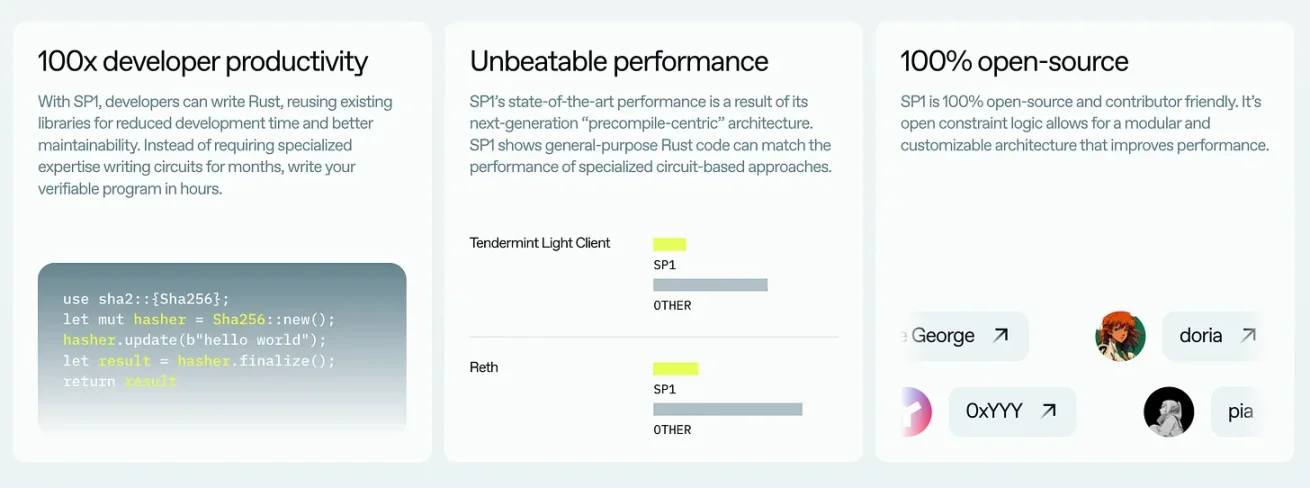
Succinct developed zkVM SP1, customized for executing code written in Rust or any other language compilable via LLVM, offering higher flexibility and ease of use. SP1 features a modular architecture that allows developers to customize and extend functionality through "precompiles." Precompiles are specific modules that developers can add or modify to enhance the core VM's capabilities, enabling more efficient handling of specialized tasks or operations.
Additionally, SP1 has built a decentralized prover network that simplifies proof deployment and execution, lowering the barrier to using advanced cryptographic methods. This network enables developers to generate proofs efficiently with just one click, providing a streamlined experience.
In March, Succinct secured $55 million in funding led by Paradigm, with participation from Robot Ventures, Bankless Ventures, Geometry, and angel investors including Eigenlayer’s Sreeram Kannan and Polygon co-founder Sandeep Nailwal. On May 13, Succinct announced the launch of the SP1 testnet.
Taiko: Multi-Proof System
Taiko has begun transitioning from zkEVM to zkVM. Its zkVM stands out through its implementation of a multi-proof system—a concept proposed by Vitalik. Taiko claims to be the first project implementing this idea, planning to directly support the multi-proof system upon mainnet launch at the end of May. This system allows Taiko’s zkVM to generate multiple types of proofs, enhancing system security and robustness. If one proof type fails, others can continue ensuring normal operation and promptly detect erroneous state transitions. Additionally, Taiko employs the Halo2-KZG proof system, maintaining high efficiency and low costs when handling complex computations and large-scale transactions.
In March, Taiko completed a $15 million Series A round co-led by Lightspeed Faction, Hashed, Generative Ventures, and Token Bay Capital, with participation from Wintermute Ventures, Flow Traders, Amber Group, OKX Ventures, and GSR.
ZKM: Simple and Stable MIPS Architecture
ZKM is a zkVM project incubated by the Metis Foundation, combining the MIPS architecture with zero-knowledge proof technology to create a zk virtual machine. This design aligns ZKPs more closely with internal system computation methods, accelerating operations and reducing computational overhead associated with standalone ZKP protocol implementations. While most zkVMs today use Rust, ZKM provides native support for Golang.
MIPS (Microprocessor without Interlocked Pipeline Stages) is a first-generation RISC (Reduced Instruction Set Computer) architecture. The MIPS instruction set is relatively simple and stable, widely used in various computing devices and embedded systems, offering excellent universality and adaptability. A zkVM based on the MIPS architecture like ZKM is thus easier to develop and deploy.
zkMIPS divides an entire MIPS program into multiple segments, then categorizes instructions in each segment into four types and assigns them to corresponding module tables. Using STARK proof methodology, zkMIPS independently verifies instructions in each module table to ensure every operation is correct and that each instruction is properly included. It then validates that the execution sequence of all program segments matches the full program execution. Through this method, even off-chain executed programs can be verified on-chain, increasing transparency and trust in program execution.
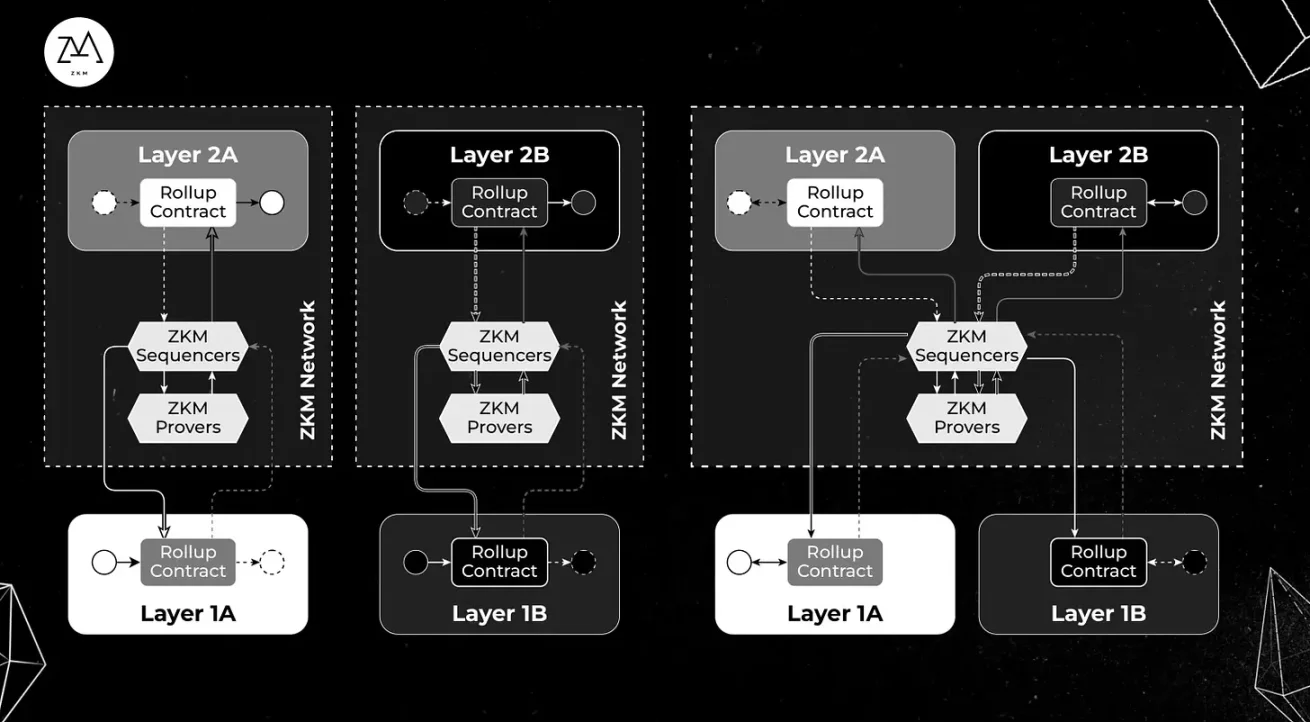
Recently, ZKM introduced Entangled Rollups—a new trust-minimized multichain interoperability infrastructure—leveraging zkMIPS to build a trustless, decentralized multichain interoperability framework. Unlike third-party zk bridges that only validate asset transfers via snapshots, Entangled Rollups enable verification of all computations, making it highly secure. The key to this interoperability is a universal proof mechanism that generates proofs on one blockchain and verifies them on another. One key distinction of ZKM is its ability to generate a single zero-knowledge proof applicable to all operations. By embedding security into the CPU/MIPS architecture at the foundational level, all software built atop this architecture inherits the same security, eliminating the need for individual zero-knowledge proofs per application.
Additional features of ZKM include:
-
Compatibility with all virtual machines: Positioned beneath other VMs, ZKM integrates with various blockchain smart contract engine VMs such as MoveVM (zkMVM), WASM (zkWASM), and RustVM (zkRVM).
-
Plug-and-play: Developers can adopt ZKM without modifying existing codebases, enabling low-cost integration and support for different smart contract languages or even traditional programming languages.
-
Long-term stability: The MIPS instruction set remains stable and does not require changes in response to evolving EVM updates, providing a more consistent development environment.
Future Outlook for zkVM
As blockchain technology matures and leading companies continue exploring innovations, zkVM performance continues to improve. We can anticipate zkVM playing an increasingly vital role in the crypto world, becoming a key technological component. Particularly amid growing demand for data sensitivity and cross-chain security, zkVM offers capabilities well-aligned with market needs. We look forward to overcoming technical hurdles such as circuit optimization and improvements to proof systems themselves, ultimately delivering zkVMs perfectly adapted to various programming languages and welcoming more developers into the Web3 era.
Join TechFlow official community to stay tuned
Telegram:https://t.me/TechFlowDaily
X (Twitter):https://x.com/TechFlowPost
X (Twitter) EN:https://x.com/BlockFlow_News
 @ChainFeedsxyz