
Introducing Heroglyphs: When Validator Nodes Can Mint Coins, Is Ethereum's Inscription Moment Approaching?
TechFlow Selected TechFlow Selected
Introducing Heroglyphs: When Validator Nodes Can Mint Coins, Is Ethereum's Inscription Moment Approaching?
HeroGlyphs aims to incentivize people to become full validators by giving them the exclusive ability to mint tokens that only they can mint.
 Navigating Web3 tides with focused insights
Author: ELI5 of TLDR
Compiled by: TechFlow
Introduction
While Bitcoin's inscriptions and runes projects have attracted significant attention, Heroglyphs on the Ethereum platform is pioneering a unique alternative token opportunity. This project not only challenges traditional token minting models but also contributes fresh ideas toward decentralizing Ethereum.
Heroglyphs introduces so-called "elite coins" by granting exclusive token minting rights to Complete Validators. These tokens differ from typical meme coins; they represent real value tied to network security and technical contributions.
As Ethereum gas fees decline and expectations shift back toward ETH, the Heroglyphs project may offer a new perspective.
Below is the full translation.
I mean, would you rather buy a token created by a king or one created by a farmer?
This article will briefly explain Heroglyphs—a project I believe offers something better than Runes.
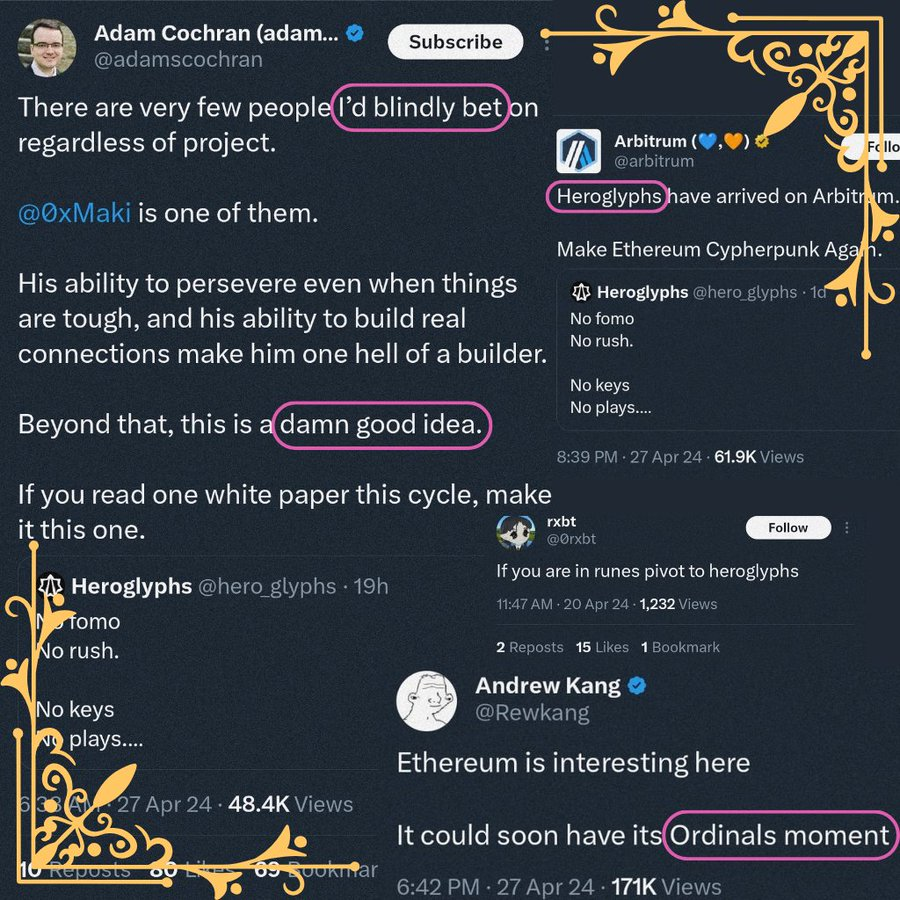
Heroglyphs is a new protocol on the Ethereum blockchain—not designed for ordinary crypto enthusiasts, but specifically for Complete Validators. Validators are the ones who keep Ethereum alive.
Heroglyphs allows Complete Validators to create (or mint) their own special tokens—and only they can create such tokens.
There won’t be many of them. They will be “elite tokens,” not random meme coins or similar novelties, but assets with deeper meaning and greater purpose.
Ethereum faces risks of centralization. In an industry built on decentralization, centralization is problematic. If just three large validators hold most of the “power,” we could face serious issues.
Due to the rising popularity of liquid staking, we now have many “economic validators” who don’t actually contribute to network security. These “economic validators” stake ETH purely for rewards, while their staked ETH is managed by a single protocol.
Even if these protocols have good intentions, centralization remains dangerous. Centralization is centralization—it brings multiple risks.
Thus, Heroglyphs is a protocol designed to incentivize individuals to become Complete Validators, aiming to decentralize the validator ecosystem as much as possible.
Currently, becoming a Complete Validator doesn't seem very profitable unless you already possess a large amount of ETH. Holders with more ETH have a higher chance of being selected to propose blocks and earn rewards.
Although the validator selection process is technically random, those with large ETH holdings can run multiple validator clients to increase their odds. In practice, this means liquid staking protocols and large validators are contributing to Ethereum’s centralization.
Now enters Heroglyphs—crafted by crypto masters—with a bold idea: incentivizing people to become Complete Validators by giving them exclusive rights to mint tokens that only they can create.
It’s like owning tokens created by the rulers who control and sustain the network. Right now, anyone can create a token—it literally takes just a few clicks.
But Heroglyphs opens a new path for token creation: elite tokens made by Complete Validators—those who genuinely protect network security.
Heroglyphs aims to tap into the speculative and degen culture of cryptocurrency to generate additional revenue streams.
Everyone comes to crypto to speculate. How many of you have already minted a Heroglyphs token without fully understanding it? Don’t be shy—admit it. We’re all fumbling our way through.
Alright, but how does it actually work?
A randomly selected validator proposing a block can "inscribe" (similar to runes/ordinals) a small piece of data—up to 32 bytes—into the block. It can be anything.
The Heroglyphs protocol consists of two parts: one for encoding information and another for decoding it.
It's difficult to fit all the necessary information for creating a token within just 32 bytes, so we must establish some short markers, or “glyphs.”
These glyphs will be short tags that CMs (validators with specific permissions) can rent and use to mint more tokens (and perform other token-related management tasks).
Yes, rent—not buy. The system operates based on the Harberger tax principle.
You set a price based on what you believe your glyph is worth and pay a percentage of that value at regular intervals.
Do you think your glyph is worth 5 ETH? Fine. But if someone else values it more and is willing to pay higher, then say goodbye to your glyph.
How do validators earn rewards? According to the project whitepaper, all Complete Validators receive equal rewards—the minting rewards are distributed evenly.
This is an interesting approach—one that benefits both ordinary crypto investors and the entire Ethereum network by enhancing its security.
Not long ago, Ethereum co-founder Vitalik wrote about meme coins and their potential.
By investing in NFTs/memes created by Ethereum validators, you contribute to a better, more decentralized future. Complete Validators are heroes—but so are you!
Join TechFlow official community to stay tuned
Telegram:https://t.me/TechFlowDaily
X (Twitter):https://x.com/TechFlowPost
X (Twitter) EN:https://x.com/BlockFlow_News
 @explain_briefly