Get an early look at the future of the Monad ecosystem and its projects
TechFlow Selected TechFlow Selected
Get an early look at the future of the Monad ecosystem and its projects
Monad has the potential to become an industry-changing blockchain for building decentralized, high-performance trading platforms, trading systems, and various practical tools.
 Navigating Web3 tides with focused insights
Author: Peter Schöllauf
Translation: TechFlow
Monad Ecosystem
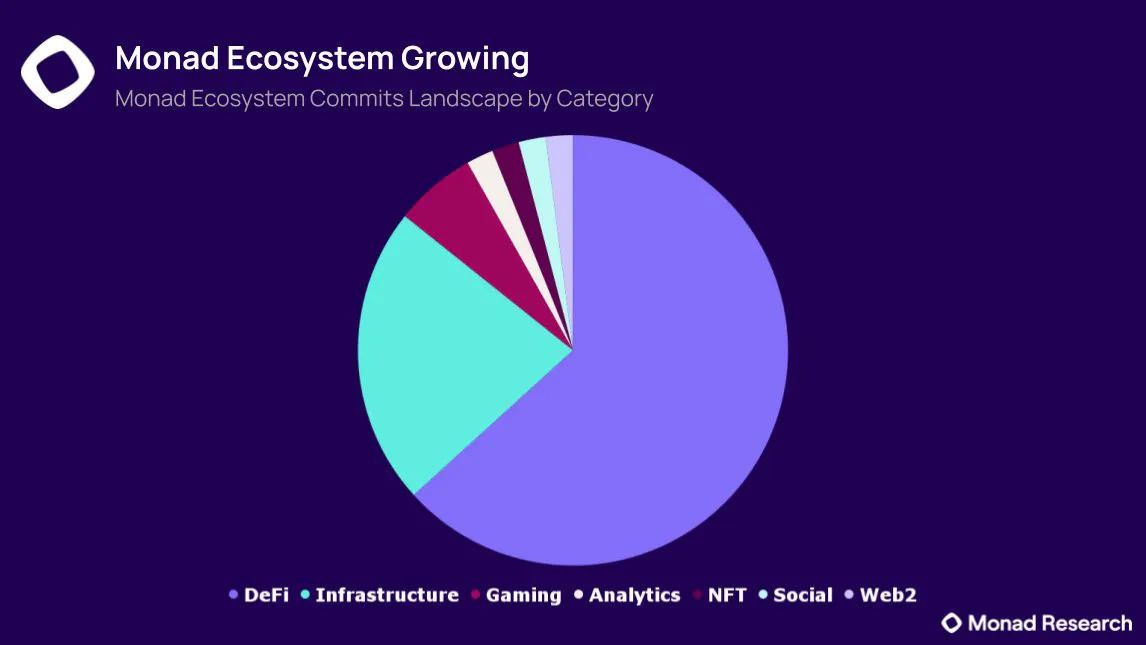
Since the Monad blockchain has not yet launched on mainnet, its ecosystem is still in development. As of February 2024, over 80 independent protocols and dApps have committed to building on the platform. With the mainnet launch approaching, this number is expected to reach around 150 or even 200.
One of the earliest major participants to integrate with Monad is LayerZero, an industry-leading protocol designed for cross-platform messaging and interoperability across various blockchains and system types. The integration between LayerZero and Monad will enable seamless interconnectivity with 50 to 60 (and growing) of the most prominent blockchains in the space.
Additionally, the integration will allow data to be sent to Monad via LayerZero endpoints for use cases such as governance voting, loan contract calls, arbitrary data exchange, and more. It will also enable the exchange of ERC-20 tokens and native gas tokens as wrapped assets on Monad, with further LayerZero-connected utilities set to be released in the coming months.
The Monad–LayerZero collaboration marks a significant milestone for both projects, helping to alleviate current cross-chain interoperability challenges in today’s blockchain landscape.
Notably, Monad recently announced a partnership with Pyth Network as well. This will allow Pyth to leverage Monad’s highly scalable, low-gas design to deliver more reliable price data. More frequent price feed updates mean more accurate data, which in turn leads to more efficient DeFi applications.
Other protocols building on the network include:
-
Orderly Network: A cross-chain liquidity layer and DEX frontend deployment platform
-
Pike Finance: A cross-chain lending platform and decentralized money market
-
Switchboard Oracles: A decentralized oracle network enabling verifiable randomness, functions, and price feeds
Furthermore, Monad has recently welcomed several other projects into its ecosystem, including Notifi Network (a notification and customer engagement infrastructure layer), Swaap Finance (a non-custodial, interoperable market-making infrastructure), Catalyst (an interoperability protocol for cross-chain AMMs), Wombat Exchange (a multichain, single-sided DEX), TimeSwap Labs (an oracleless lending protocol for creating ERC-20 money markets), and Aori (a high-performance orderbook protocol).
In addition, projects such as Dyson Finance (a DEX allowing retail investors to seamlessly provide liquidity), Ambient Finance (a DEX for diversified stable liquidity), AIT Protocol (an AI data platform using a train-to-earn model), ACryptoS (a DEX, yield-bearing liquid staking platform, and decentralized money market), and Monadians (an NFT collection focused on Monad) are among the other recent collaborators with Monad.
Moreover, Monad recently announced integration with Wormhole, a cross-chain interoperability and bridging protocol, to establish robust connections with multiple blockchains such as Solana. The collaboration enables Monad to unlock cross-chain interoperability with numerous blockchains connected to the Wormhole ecosystem.
Roadmap and Future Plans
-
February 2022: Monad founded in New York City
-
February 2023: Monad raised $19 million in funding from several leading crypto VCs
-
September 2023: Monad documentation released, first detailed overview of Monad blockchain architecture
-
Second half of 2024: Monad testnet launch
-
End of 2024 or early 2025: Monad mainnet launch
Although Monad's protocol has not yet launched on mainnet, it is difficult to determine its exact roadmap. Nevertheless, the platform is likely to launch its mainnet by the end of 2024, after which its direction should become clearer.
Comparative Analysis
Monad is a Layer 1 smart contract platform designed for extreme scalability. In fact, many speculate it could become the most scalable platform launched in the next 18 to 24 months, with technology rivaling industry leaders like Solana.
Nevertheless, as a broad-reaching network like Solana—boasting high total value locked (TVL) and a large user base—has not yet been matched by new platforms like Monad that haven't launched on mainnet. Undoubtedly, once Monad launches, it will rapidly grow its user base, but it still has a long way to go in terms of real-world adoption.
One key differentiator for Monad compared to many other fast chains is its combination of parallel execution (similar to Aptos, Sui, Solana) with EVM compatibility. While Aptos, Sui, and Solana demonstrate parallel execution, they lack Ethereum compatibility, meaning developers face ongoing challenges porting their applications to these networks. Monad eliminates this friction.
Solana
According to many blockchain experts, Solana may currently be the most scalable blockchain in existence. However, Monad aims to match—and potentially surpass—Solana in terms of network scalability and transaction throughput.
Many consider Solana a clear industry leader in speed and scalability, and one of the most widely used platforms in blockchain. However, some argue its design is relatively centralized compared to emerging platforms like Monad.
Solana uses a proof-of-stake (PoS) consensus mechanism called Tower BFT, which enhances Practical Byzantine Fault Tolerance (PBFT) and incorporates a clock-based timing mechanism known as Proof of History (PoH) to reduce message overhead and latency.
The platform also employs Sealevel, a parallel execution framework designed to modify smart contracts through a single system to ensure operation at ultra-high speeds.
Solana can confirm blocks within 0.4 seconds and scale up to 65,000 transactions per second (TPS), with transaction costs typically just fractions of a cent. Additionally, Solana is preparing to launch Firedancer, a specialized validator client infrastructure that some believe could enable the network to handle up to a million TPS—though this remains to be seen.
One of Solana’s biggest drawbacks is the lack of Ethereum Virtual Machine (EVM) compatibility, meaning developers cannot use Solidity to write Ethereum-style smart contracts. While direct Solidity development on Solana is impossible, it supports Ethereum dApps via the Wormhole bridge. Still, Monad holds a distinct advantage here due to its full EVM compatibility.
NEAR
NEAR is considered by many to be one of the highest-throughput blockchains in the space, with finality times of one second and transaction fees lower than most competitors.
The NEAR Protocol is a proof-of-stake (PoS) blockchain conceptually designed as a community-operated cloud computing platform. NEAR leverages sharding and other technological innovations to significantly boost network transaction throughput.
Once its proprietary Nightshade sharding infrastructure is fully implemented, NEAR claims it can process at least 100,000 transactions per second.
As a major competitor to Hedera Hashgraph, Monad, Avalanche, and Solana, NEAR positions itself as an extremely fast, energy-efficient, secure, and adaptable blockchain aimed at enterprise applications, DeFi, and a wide range of utilities.
To achieve this, NEAR helped build Aurora, its EVM-compatible development framework, the Octopus Network interoperability framework, and the Rainbow Bridge—a mechanism for transferring assets between Ethereum, Aurora, and NEAR. Despite Aurora’s EVM integration, NEAR itself is not natively Ethereum-compatible.
Similar to how macOS, Windows, and Linux made computers user-friendly, NEAR recently launched its Blockchain Operating System (BOS)—a framework enabling developers to build and use decentralized front-end applications across any blockchain network.
Despite these innovations, Monad adopts pipelining technology within an EVM-compatible environment—something NEAR does not. This single technical advantage alone could allow Monad to eventually outperform platforms like NEAR in decentralization, network throughput, and scalability.
Other Highly Scalable Networks
Ethereum-compatible, scalability-focused chains include Avalanche, BNB Smart Chain, Fantom, Injective Protocol, and emerging networks like Sei Network and Shardeum. However, these chains are generally considered less efficient than Monad in balancing scalability, decentralization, and EVM compatibility.
Other blockchains claiming high scalability include Ripple, Stellar, Algorand, Kadena, Aptos, Sui, MultiversX, and Cardano.
Additionally, some speculate that once its sharding capabilities are fully realized, Ethereum could eventually handle over 100,000 TPS. However, this remains unproven, and the sheer scale of the network may make such an achievement difficult.
Many experts also believe Ethereum’s infrastructure is relatively outdated and difficult to modify, meaning it may struggle to keep pace with the scalability of newer blockchains. Again, only time will tell whether Ethereum can overcome these challenges in the long term.
Assessing Monad’s Future Potential
Despite being very new, Monad represents a blockchain with exceptionally high long-term potential. Its combination of decentralization, extreme scalability, and Ethereum compatibility makes it a disruptive force in the blockchain space. Specifically, its parallel execution and superscalar pipelining architecture, along with other cutting-edge innovations, place Monad in a strong technical position.
Monad’s ability to achieve 10,000 transactions per second sets a powerful benchmark compared to many existing chains. Since 10,000 TPS is just the starting point, Monad could theoretically scale to hundreds of thousands of TPS in the coming years.
Nonetheless, Monad faces a formidable challenge in adoption—gaining significant market share during its first one or two years against already established, large-scale competitors.
On the other hand, the platform has already formed strong foundational partnerships with major players like LayerZero, Pyth Network, and Wormhole, indicating that its ecosystem of over 80 projects will grow substantially over time, with expectations of around 150 projects building on the platform by mainnet launch.
However, the launch of many major Layer 2 platforms in the first half of 2024 (alongside numerous existing ones) may make it difficult for many Layer 1 platforms to gain traction.
Regardless, it is clear that Monad has the potential to become an industry-changing blockchain for building decentralized, high-performance trading platforms, exchange systems, and a wide array of utilities.
Join TechFlow official community to stay tuned
Telegram:https://t.me/TechFlowDaily
X (Twitter):https://x.com/TechFlowPost
X (Twitter) EN:https://x.com/BlockFlow_News
 @daic_capital