How to turn old phones and old computers into treasures? 9 Web3 projects to help you easily get started
TechFlow Selected TechFlow Selected
How to turn old phones and old computers into treasures? 9 Web3 projects to help you easily get started
9 Web3 Projects to Give Your Idle Devices a Second Life
 Navigating Web3 tides with focused insights
By Karen, Foresight News
As the pace of iteration for smartphones and computers accelerates, it has become common for individuals to own multiple old phones and outdated computers. While these idle devices may no longer meet high-performance demands, their value hasn't completely disappeared. On the contrary, within the Web3 ecosystem, they can be revitalized as powerful tools for mining, running nodes, or sharing computing resources—earning users tokens or points in return—all while avoiding risks related to data leaks or misuse.
This article compiles nine Web3 projects that enable users to transform old phones and computers into valuable assets, offering readers a guide for exploration.
io.net
io.net is a Solana-based DePIN project aiming to aggregate GPU resources for artificial intelligence and machine learning companies. In March 2024, io.net announced a $30 million Series A funding round led by Hack VC, with participation from Foresight Ventures, SevenX, Multicoin Capital, 6th Man Ventures, M13, Delphi Digital, Solana Labs, Aptos Labs, Longhash, ArkStream, Animoca Brands, Continue Capital, MH Ventures, OKX Ventures, and angel investors including Solana founder Anatoly Yakovenko, Aptos founders Mo Shaikh and Avery Ching, Yat Siu of Animoca Brands, and Jin Kang from Perlone Capital.
io.net’s vision is to establish IO as a computational currency powering an ecosystem of products and services, enabling access to computation as both a resource and an asset. Its four core functionalities include batch inference and model serving, parallel training, parallel hyperparameter tuning, and reinforcement learning.
On March 1, io.net launched its first points rewards program, "Ignition," which ran until April 28. The program awards points based on users' contributions of GPU power to the network. The reward algorithm considers various factors such as hours of work completed, node bandwidth, GPU model, and uptime. However, io.net has relatively high configuration and setup requirements for personal computers; detailed specifications are available in the official documentation.
Ignition features three independent reward pools: Worker Rewards, Community Task Rewards, and Discord Role Rewards. For Worker Rewards, a node’s score is calculated based on activity from November 4, 2023, to April 25, 2024, tracking accumulated points per node i throughout the full reward period and summing across user accounts a. At the end of the reward period, all accumulated points will be aggregated and converted into proportional rewards distributed according to each user's share of total points.
For Community Task Rewards, io.net has set up multiple tasks on Galxe—completing fixed and daily tasks earns corresponding points. For Discord Role Rewards, users earn roles based on contributions to bounties, content creation, and other activities.
Website: https://io.net/
ola
ola is a Layer-2 ZK programmable privacy and scaling project leveraging ZKVM+DePin+AI. With the emergence of Massive, blockchain modular design now includes: ZKRollup (off-chain computation), DA (off-chain transaction storage), ZKVaaS (off-chain verification), and L1 (state updates). The architecture is illustrated below:
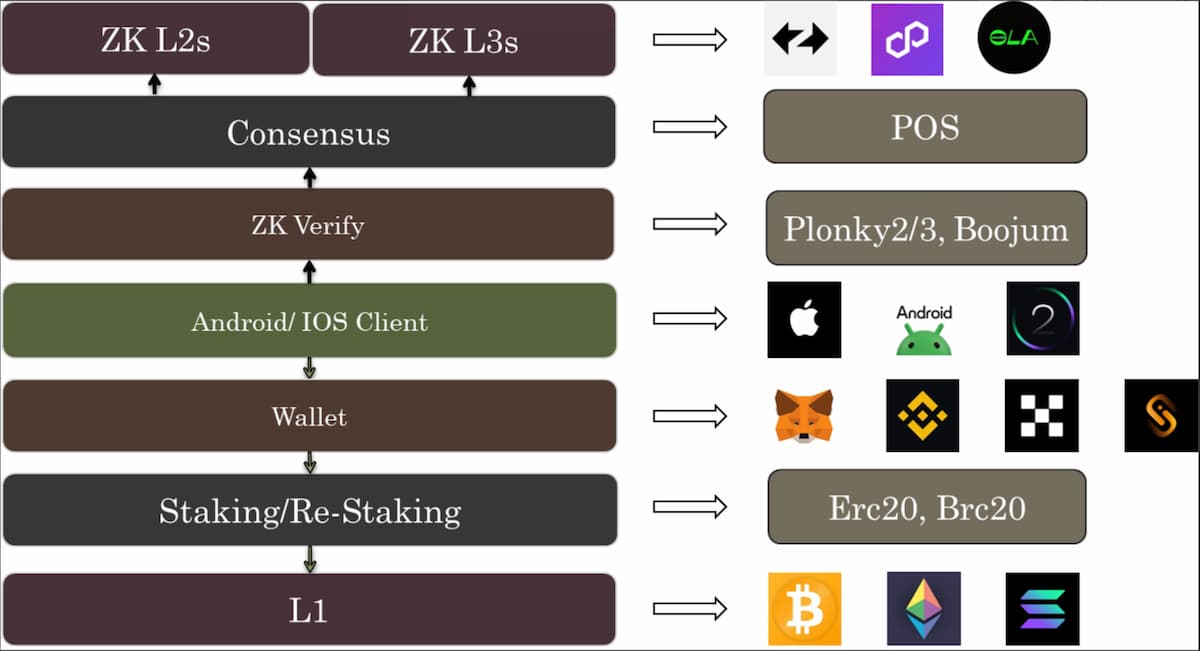
ola emphasizes that every user participates and contributes equally on the Massive platform, ensuring fairness across the system. ola has launched its mobile mining app, Massive, introducing a "validation-as-mining" model. Android users can download it now, with iOS support coming soon. ola has increased the originally planned 10% token allocation for the Massive module to 13%, and the pre-allocation of tokens for Massive during the testnet phase will rise from 1% to at least 2%.
To participate, users first connect to the network and unlock subsequent mining rewards after accumulating a certain number of initial rewards. They can also stake assets to become Massive nodes. Depending on the underlying L1 chain type, users can stake different assets. For example, for BTC L2/L3 services on the Massive network, users can stake BRC-20 and BTC assets; for Ethereum-based L2/L3 chains, users can stake ERC-20 and ETH assets.
In July 2023, Ola raised $3 million in seed funding co-led by Web3.com Ventures and Foresight Ventures, with participation from Token Metrics Ventures, J17 Capital, Skyland Ventures, LD Capital, CatcherVC, and others.
Website: https://olavm.org/
Grass
Launched in June 2023, Grass focuses on transforming public web data into AI datasets, making it easier for open-source AI projects to access public internet data. Grass’s solution involves building an L2 data rollup, enabling a mechanism to record metadata capturing the provenance of all datasets.
This L2 will be a sovereign rollup composed of nodes, routers, validators, ZK processors, and a data ledger, capable of batching metadata for validation. The Grass Data Ledger is where all data is ultimately stored. Proofs of dataset metadata will be stored on Solana’s settlement layer, and the settlement data itself will also be accessible via the ledger.
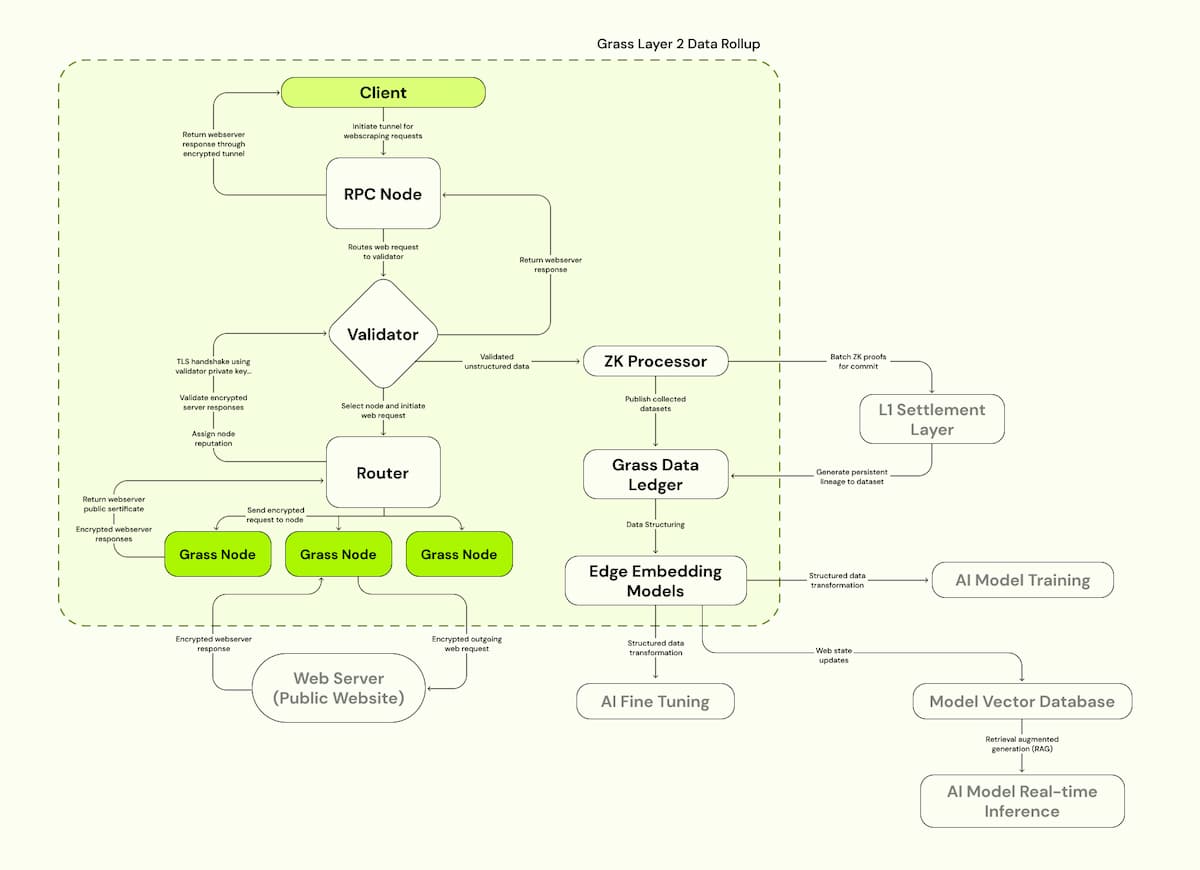
The ZK processor enables the creation of metadata proofs recording the origin of Grass datasets, providing builders and users with a way to verify whether AI models have been properly trained.
Wynd Network, the team behind Grass, raised $3.5 million in seed funding in December 2023, led by Polychain Capital and Tribe Capital, with participation from Bitscale, Big Brain, Advisors Anonymous, Typhon V, Mozaik, and others. Wynd’s total funding now stands at $4.5 million.
Regarding participation, Grass has released an incentivized test version allowing users’ devices (currently via browser extension) to function as Grass nodes. The Grass network uses unused internet bandwidth from devices to scrape web data and offers rewards in return. Additionally, users can earn points by inviting others. At the time of writing, Grass points were trading at $0.00287 per point on Whale Market’s points marketplace.
Website: https://app.getgrass.io/
Over Protocol
Over Protocol is a lightweight Layer-1 blockchain node protocol designed to allow anyone to run a node using a PC and become a validator by reducing storage requirements, thereby lowering the cost of maintaining blockchain nodes.
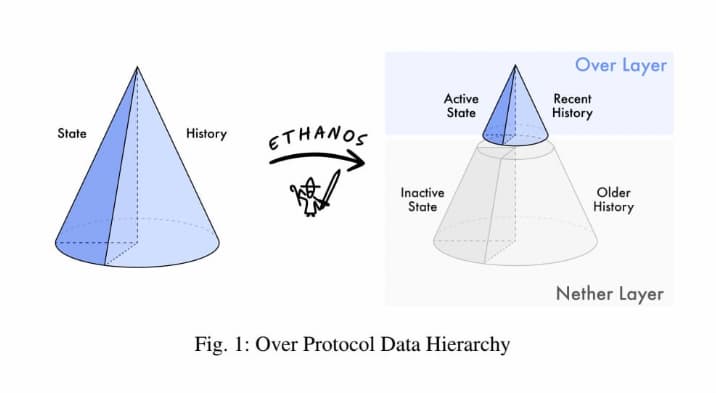
Over Protocol employs Ethanos technology to implement its data hierarchy, organizing data into three main layers: the Over layer, Nether layer, and External layer. The Over layer stores critical blockchain operation data, while the Nether layer holds auxiliary data that enhances consensus but isn’t essential.
In July 2023, Superblock, the developer of Over Protocol, announced it had raised $8 million through two financing rounds. Investors were primarily South Korean firms, including SK, Netmarble, DSC, E&Investment, Schmidt, SpringCamp, and NaverZ.
Over Protocol is currently in the testnet phase, with two participation methods:
1. Home-Staking: Stake OVER tokens and operate a node via OverNode (higher rewards).
2. Palm-Staking: Earn OVER test tokens daily by checking in on the OverWallet mobile app and participate in staking (lower rewards; previously a points-based activity).
Regarding tokenomics, in January 2024, Over Protocol stated its total token supply would be one billion, with 15% allocated to the Community Access Program (OCAP) for early participants and contributors through airdrops. The airdrop formulas for OverWallet and OverNode will be published before mainnet launch. Additionally, 40% of tokens are reserved for staking rewards, to be gradually distributed over the next 10 years.
Website: https://over.network/
Nodle
Nodle is a decentralized IoT network that uses smartphones as nodes to support key applications such as media verification, asset tracking, and location proofing.
Users can start earning NODL token rewards simply by downloading the app, enabling Bluetooth, granting location permissions, and keeping the Nodle app running in the background. The Nodle app uses Bluetooth Low Energy, consuming approximately 10–15% of battery per day on average. Nodle states that device location is used only to calculate rewards based on network coverage contribution and to locate Bluetooth devices upon owner request.
At the time of writing, the Nodle token price was $0.009154, with a circulating market cap of about $32.8 million and a fully diluted market cap of $78.8 million.
https://www.nodle.com/nodle-app
UpRock
UpRock describes itself as a human-centric AI DePIN network built around a Knowledge Abstraction Layer (KAL)—a fusion of advanced web crawling, intelligent routing, and LLM data extraction technologies.
UpRock allows users to earn UpRock tokens (UPT) by sharing unused internet bandwidth and contributing to the UpRock network. It currently supports Android and macOS, with iOS support coming soon. Reward rate = (upload speed factor × download speed factor × connection type factor × freedom factor) × total mining time.
UpRock has not yet launched its token but has disclosed its tokenomics on its website. The maximum supply of UPT is one billion, with 15% allocated to the team, 50% to the community, 4% to VCs, DAOs, and angel investors, 5% to exchanges and market makers, 10% for token launch, and 1% to advisors.
https://uprock.com/#home_install
Kuzco
Kuzco is a distributed GPU cluster for LLM inference on Solana, designed to facilitate efficient and cost-effective inference for large language models like Llama2 and Mistral. Currently compatible with macOS and Linux, Kuzco allows users to contribute idle computing power to the network and receive compensation (currently in points).
By harnessing idle computing resources contributed by network participants, Kuzco enables users to access and utilize these models via OpenAI-compatible APIs. Setup instructions and tutorials are available here.
Website: https://kuzco.xyz/
Nimble
Nimble Network is a composable AI protocol building a decentralized AI framework that enables AI models and data to be combined and reused. The protocol can scale into complex applications across any medium involving IP, creators, advertising, personalization, and chatbots.
Six key technologies developed by Nimble Network include “Proof of Gradient” (PoG)—a PoS-style mechanism for AI, the AI validation protocol Sandhill, the horizontal scheduling network Rainstorm, modular incentives Orchestrator for AI markets, the universal network database Bandwagon, and the distributed AI ledger HashTrail. At the heart of PoG are AI requests. Network validators reach consensus on AI processing and message scheduling using a PoS-like consensus algorithm. Miners earn network token rewards through gradient-learning-based proof-of-work. Nimble Network claims this innovation enables developers to build decentralized data markets (e.g., Google), ride-hailing platforms (e.g., Uber), e-commerce marketplaces (e.g., Amazon), and more.
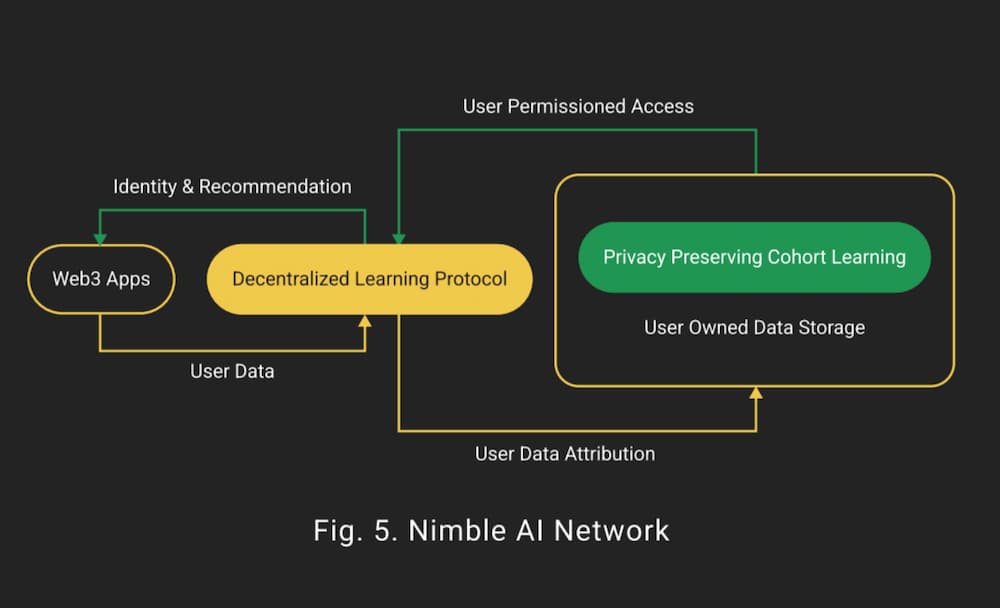
The Nimble Network team consists of serial entrepreneurs and researchers from Apple, Meta, Uber, Palo Alto Networks, and Robinhood. Last month, the project was selected for Binance Labs’ Season 7 MVB Accelerator Program and launched its mainnet, opening mining participation. Device requirements and guidelines for mining on Nimble Network are available at https://docs.nimble.technology/#system-specs, supporting Linux, Windows 11, and Mac.
According to Nimble Network’s tokenomics, the NIMBLE token will be issued in Q2 this year, with an initial supply of 50 million and a total supply of one billion. Allocations include 10% for the ecosystem, 40% for miner rewards, 10% for the community, 20% for projects or individuals contributing to core components of the Nimble stack, and 20% for private investors. However, the current token distribution plan appears inconsistent with the FAQ document published by Nimble Network.
Website: https://www.nimble.technology/
Acurast
Acurast is a decentralized serverless cloud and a Layer-1 blockchain that supports providing computational power in exchange for rewards.
Specifically, Acurast offers a modular architecture separating the consensus layer, execution layer, and application layer. The Acurast Coordinator is embedded in the consensus layer and includes a purpose-built reputation engine to ensure reliability and incentivize honest behavior. The permissionless Acurast protocol allows developers to join without trust dependencies, enabling them to deploy applications. Processors—individuals providing computational power—can use Android mobile devices and have the opportunity to earn rewards for their contributed resources. Interested users can learn how to become an Acurast Processor via this guide.
Acurast has publicly stated that early community contributors, such as processors, will be eligible for rewards.
Website: https://acurast.com/
Join TechFlow official community to stay tuned
Telegram:https://t.me/TechFlowDaily
X (Twitter):https://x.com/TechFlowPost
X (Twitter) EN:https://x.com/BlockFlow_News
 Foresight News