Galaxy: Exploring the Evolution Cycle and Development Trends of DeSoc Applications
TechFlow Selected TechFlow Selected
Galaxy: Exploring the Evolution Cycle and Development Trends of DeSoc Applications
This article delves into the narratives and growth strategies driving the adoption of DeSoc applications, particularly Farcaster's adoption.
 Navigating Web3 tides with focused insights
Author: Gabe Parker
Translation: Luffy, Foresight News
DeSoc, short for "decentralized social networks," is an evolving sector in the cryptocurrency industry that leverages blockchain technology to establish a new standard for digitally sharing ideas and information. Like many applications across the broader crypto space, these apps aim to promote values such as data ownership, transparency, and censorship resistance. The emergence of blockchain-based social media platforms dates back to 2016, when Steemit, the first blockchain-powered DeSoc application, launched on the Steem blockchain.
Unlike traditional social media apps that typically require email login, DeSoc applications use private key signatures from blockchain wallets for authentication. After logging into a DeSoc app via a blockchain wallet, users can share content, follow others, and collect digital items in the form of fungible and non-fungible tokens. Ownership of user data is controlled by the user's wallet and is typically stored on decentralized file storage systems—contrasting with centralized data hosting services like AWS and Google Cloud used by major social media giants such as Facebook and Twitter. Some DeSoc apps also offer data portability, providing users with a unified experience across various applications without the hassle of creating new profiles. Crucially, the technical architecture of DeSoc apps ensures seamless integration between users’ profile data and their blockchain wallets.
This report analyzes on-chain activity from the most popular DeSoc applications since 2021—including Farcaster, Friend.tech, and DeSo. It also dives into the narratives and growth strategies driving adoption of DeSoc apps, particularly focusing on Farcaster, a relatively new entrant that accounted for over 30% of all DeSoc-related transaction activity in 2024.
Active Users
In 2016, the first DeSoc app, Steemit, launched on its own blockchain (Steem). Since then, DeSoc apps have accumulated over 8.7 million users and completed more than 82 million transactions across Ethereum, Optimism, Arbitrum, Polygon, BSC, and other Layer 1 blockchains. As of April 6, 2024, the total number of monthly active users across DeSoc stands at approximately 550,000 (defined here as unique wallet addresses that interacted with a DeSoc app’s smart contracts within the past month). Distinguishing active from inactive users remains challenging for most crypto applications. In this report, “active users” are defined as those who have interacted with an app’s smart contract at least once during its lifetime.
The top DeSoc apps collectively account for about 0.15% of Twitter/X’s monthly active user base. Notably, the two DeSoc apps with the highest cumulative user counts were launched between 2020 and 2021, giving them a longer runway compared to newer entrants like Friend.tech and Farcaster. DeSo, a Layer 1 blockchain launched in June 2021, has the highest number of registered users among DeSoc apps, reaching 3 million. Cyber Connect, a decentralized social graph supporting all EVM-compatible chains launched in September 2021, ranks second with 1.5 million users having interacted with it since inception.
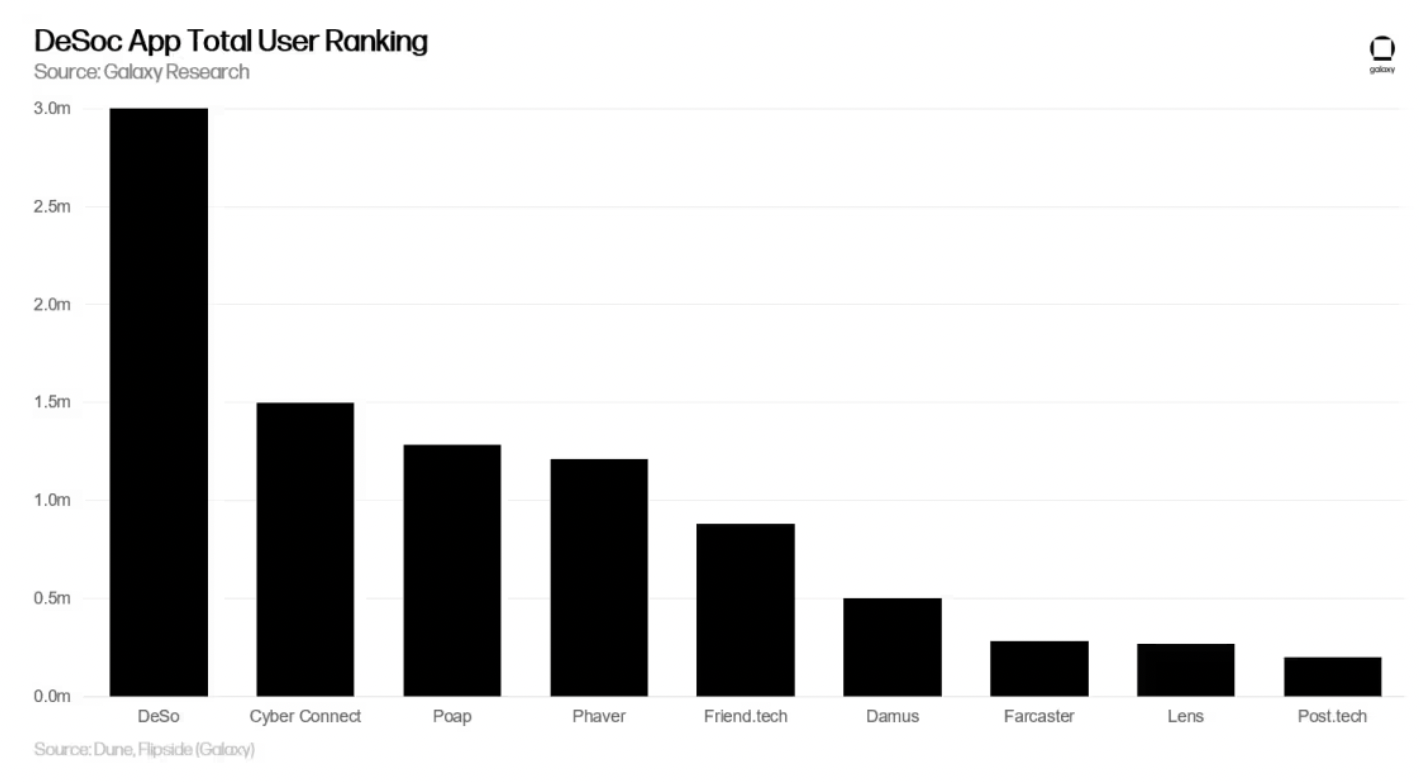
The top five DeSoc apps account for 85% of total registrations. As of April 6, 2024, DeSo alone accounts for 32% of total DeSoc app registrations. Farcaster experienced a surge in users starting late January 2024 and, despite being a relatively new platform, already represents 3% of total DeSoc registrations.
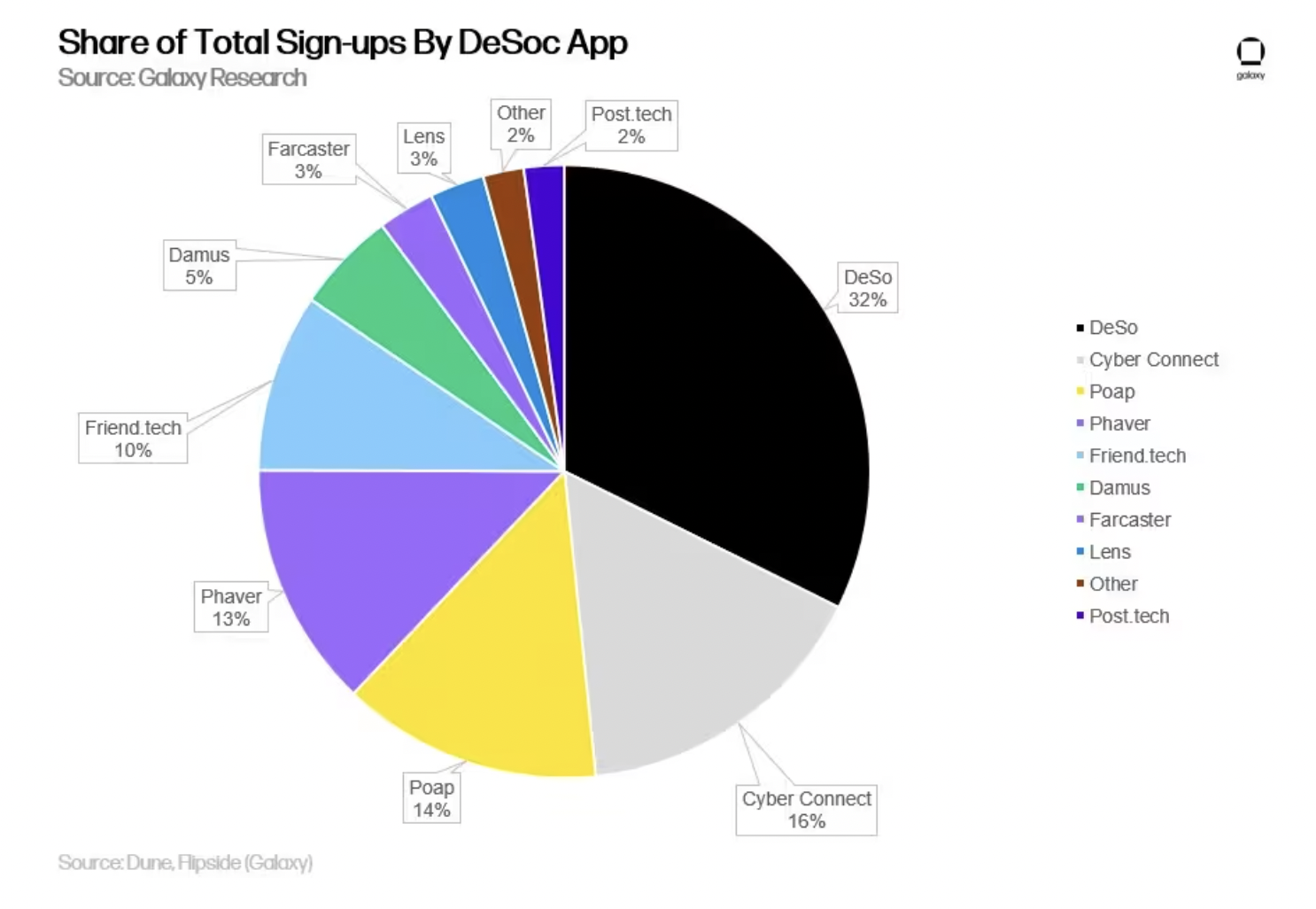
Distribution of DeSoc apps by share of total registrations
Different DeSoc apps offer distinct user experiences and focus areas. Below are the most prominent DeSoc apps categorized by type:
-
Traditional Social Media: User experience includes public posting, commenting, liking, and private messaging.
-
Social Finance: User experience revolves around purchasing assets that grant access to gated content (e.g., Friend.tech keys) or represent partial ownership of social media content (e.g., post.tech).
-
Collectibles: User experience centers on collecting digital assets, primarily NFTs.
-
Others: User experiences that do not fall into the above three categories.
Traditional social media DeSoc apps are currently the most common in the DeSoc landscape, accounting for 67% of total registered users. There are four representatives in this category, while only POAP represents the collectibles category. Notably, the social finance category emerged only in August 2023 and ranks third in terms of user registration. Although activity on social finance DeSoc apps like Friend.tech has sharply declined, their rapid success and competitive challenge to older DeSoc platforms are significant.
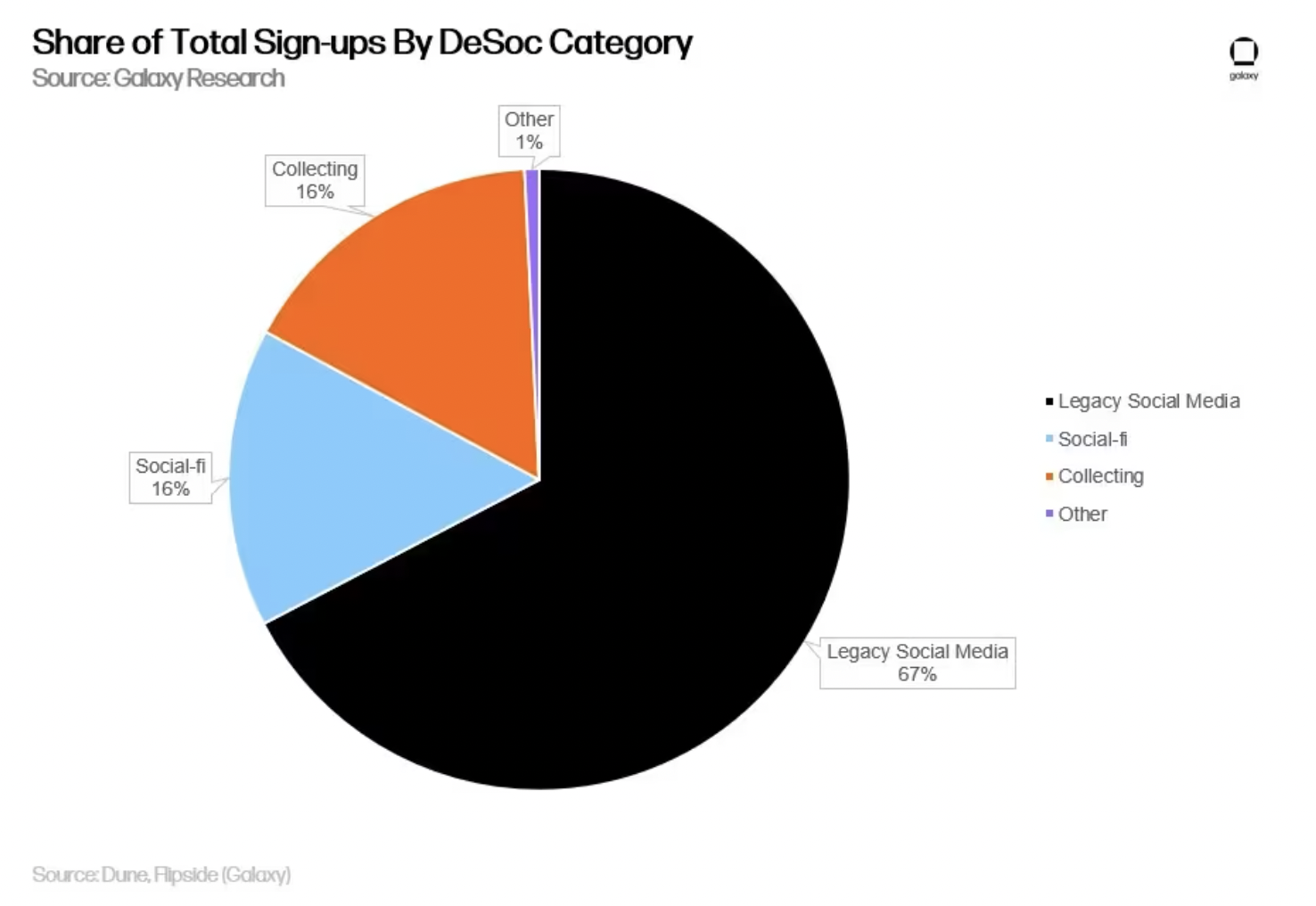
Distribution of total registrations by DeSoc category
From September 1, 2023, to April 1, 2024, DeSoc accumulated 2.9 million new users, largely driven by the launch of Friend.tech, a social finance DeSoc app built on the Base rollup. Between August 10, 2023, and January 1, 2024, Friend.tech added over 800,000 users, significantly contributing to overall DeSoc user growth. Despite its short-lived success, Friend.tech clearly sparked a revival across other DeSoc platforms. After Friend.tech user growth stabilized in late October 2023, new user trends rose noticeably on other DeSoc platforms such as Cyber Connect, Farcaster, POAP, and Lens, as shown in the chart below:
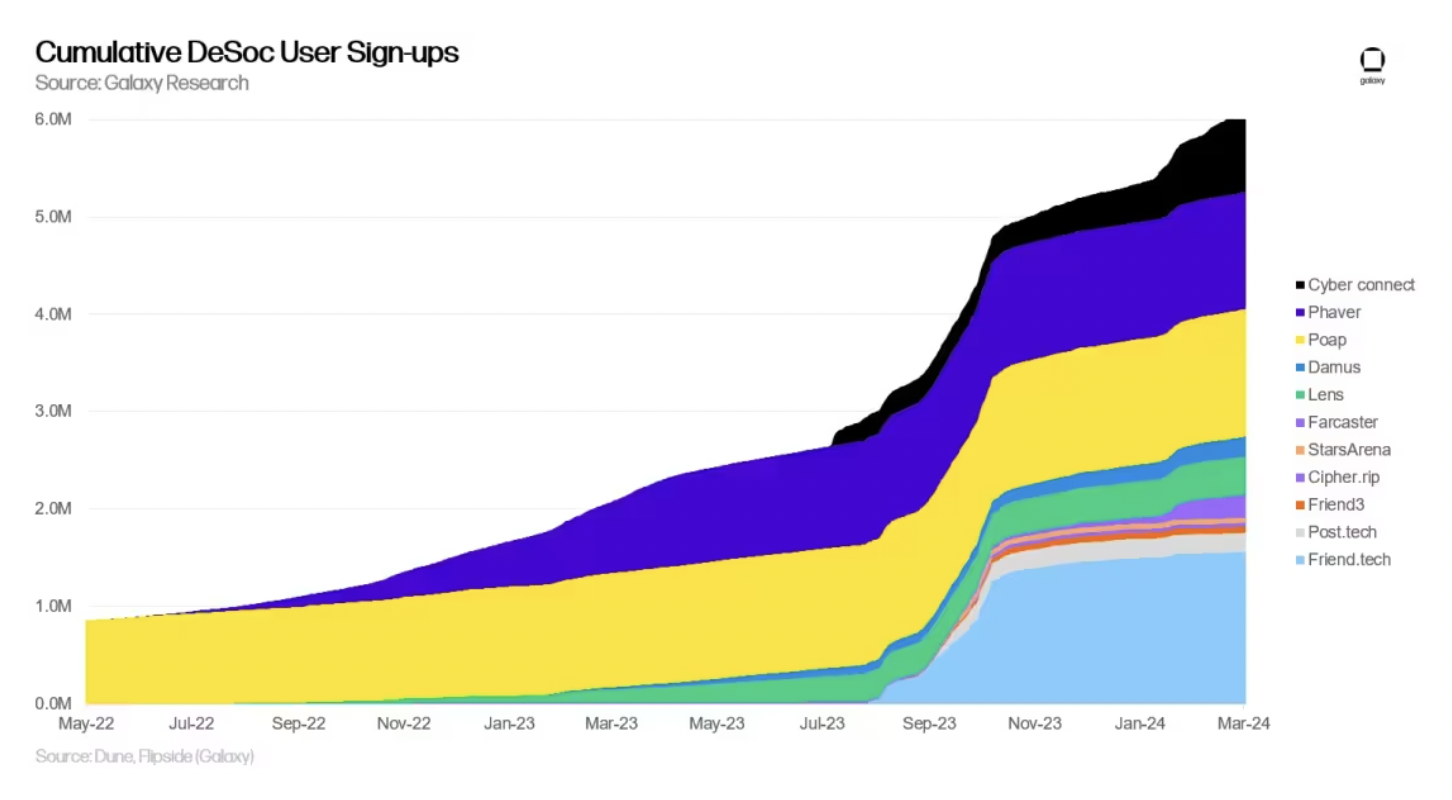
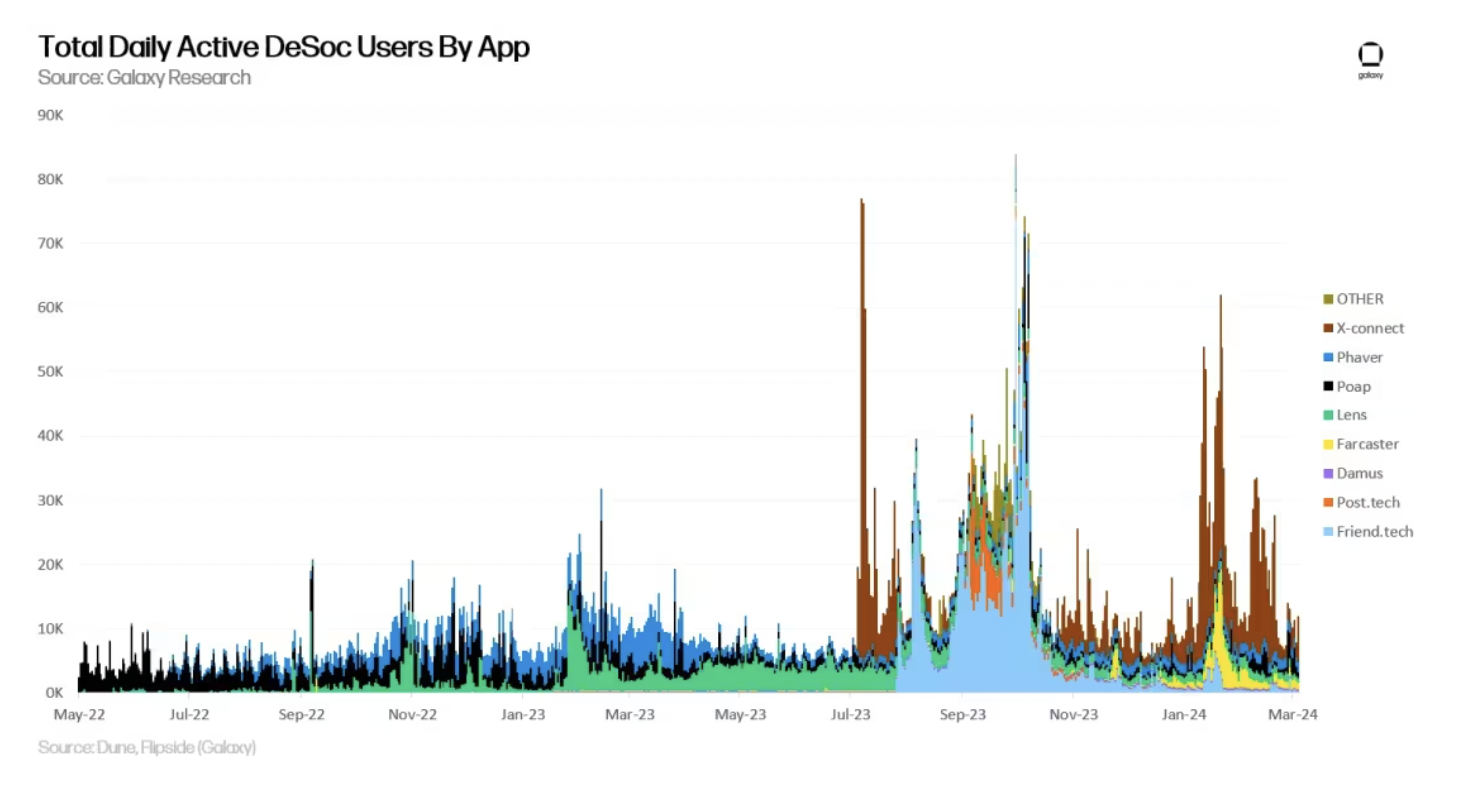
Friend.tech’s explosive growth in 2023 made DeSoc a focal point of Web3 for the year. The app’s user base grew 620-fold in just three months and generated over $27 million in revenue. This surge was fueled by anticipation of a token airdrop from Friend.tech. However, as of April 6, 2024, there are still no signs of an airdrop from the team, leading to declining user activity. In October 2023, Friend.tech averaged 22,700 daily active users per month; by January 2024, this dropped to just 1,000.
Transaction Volume
Users on DeSoc apps often need to sign on-chain transactions to publish posts, comment on others’ content, repost, or perform other actions. Therefore, transactions interacting with DeSoc app smart contracts serve as a proxy for usage levels.
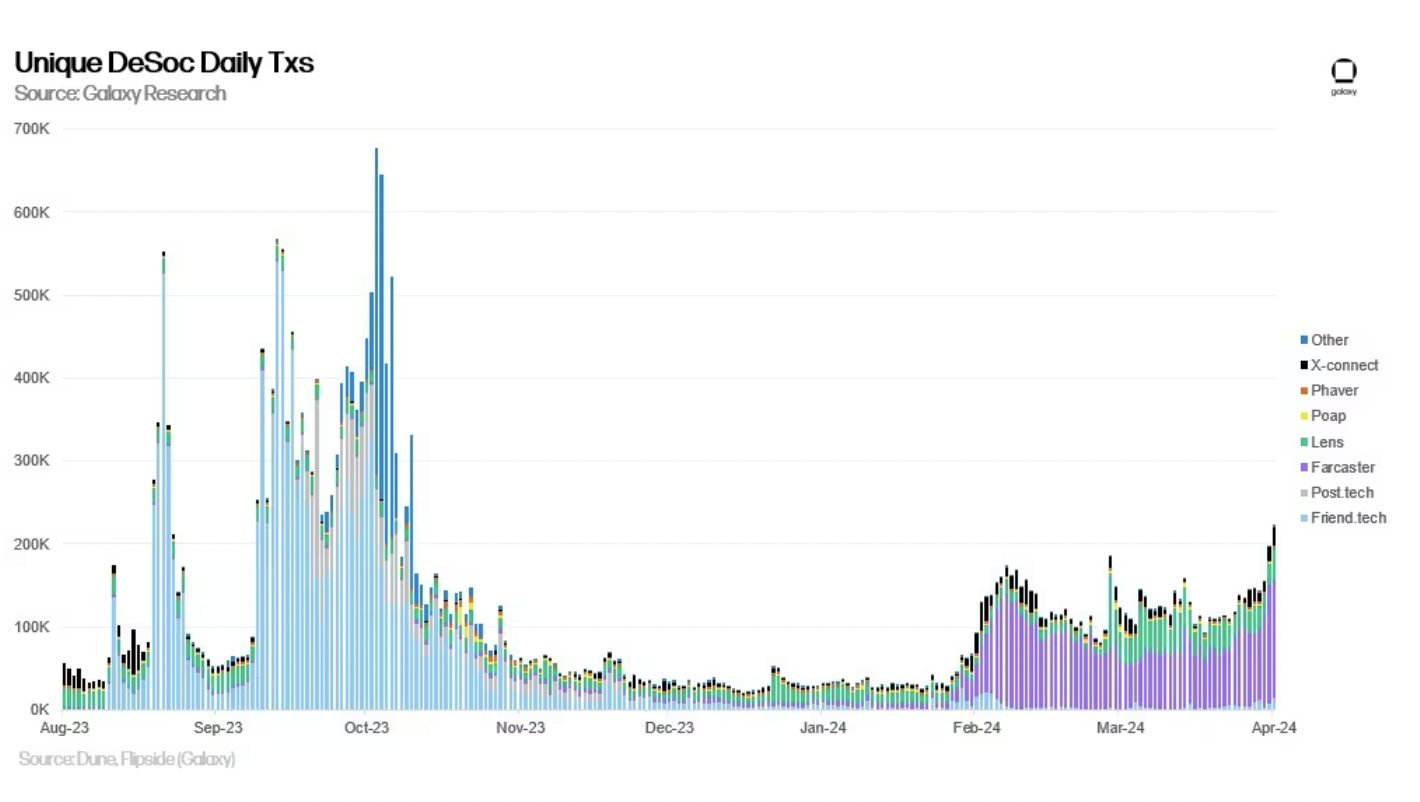
From November 2023 to January 2024, user transaction activity and daily active user counts across DeSoc apps remained stagnant. A promising uptick in daily transaction volume did not begin until February 1, 2024, rising threefold compared to the prior two weeks. This increase was partly driven by renewed engagement from Farcaster users seeking potential airdrops from sub-communities.
Farcaster is a traditional social media DeSoc app built on Ethereum L2 Optimism, launched in September 2022. Channels on Farcaster are forums centered around specific topics. For example, the Bitcoin channel is where Farcaster users interested in Bitcoin can share and discuss related ideas. On January 28, 2024, Degen—the fastest-growing channel on Farcaster—announced an airdrop of its $DEGEN token to all participants. It should be noted that the creators of the Degen channel and the $DEGEN token are not affiliated with the Farcaster team.
The spike in Farcaster’s transaction volume in mid-February 2024 was also boosted by the launch of Frames—a new feature allowing users to embed web-based applications directly within Farcaster posts. With Frames, users can create token launchpads, interactive games, and voting polls inside Farcaster threads. Riding on Farcaster’s momentum, minor resurgences in transaction activity were also observed on other DeSoc apps such as Lens and X-Connect. As of April 6, 2024, Farcaster exceeds 6 million daily unique transactions.
Growth strategies leveraging exclusive access to users and social content have delivered the highest initial returns for DeSoc apps. Friend.tech amassed 820,000 users within two months—far faster than Instagram (three months) and Twitter (two years) achieved similar milestones. However, regardless of financial incentives, DeSoc apps struggle to retain users over medium to long timeframes, a topic we explore further in the next section on DeSoc narrative cycles.
DeSoc Narrative Cycles
Historically, surges in DeSoc activity tend to follow a power law distribution—where one app dominates the majority of activity across all DeSoc platforms. These boom-and-bust cycles highlight weak user stickiness and a tendency for users to quickly migrate to the next trending DeSoc app. The last three major activity peaks between 2022 and 2024 are particularly illustrative, demonstrating how DeSoc activity is driven by cyclical narratives.
The first meaningful surge in DeSoc activity occurred in March 2023, primarily driven by Lens, a traditional social media DeSoc app on Polygon, and X-Connect, another traditional social app on Binance Smart Chain. At the time, decentralized social media apps mimicking Web2 platforms captured market share within the DeSoc ecosystem. The second surge in September 2023 was attributed to Friend.tech, which introduced a new category—“social finance.” As previously mentioned, social finance involves purchasing access rights to gated content or acquiring partial ownership of user-generated content.
The third surge in February 2024 stemmed from renewed interest in Farcaster. Farcaster’s recent rise signifies a revival of the decentralized traditional social media movement—an echo of the resurgence seen in March 2023 with Lens and X-Connect.
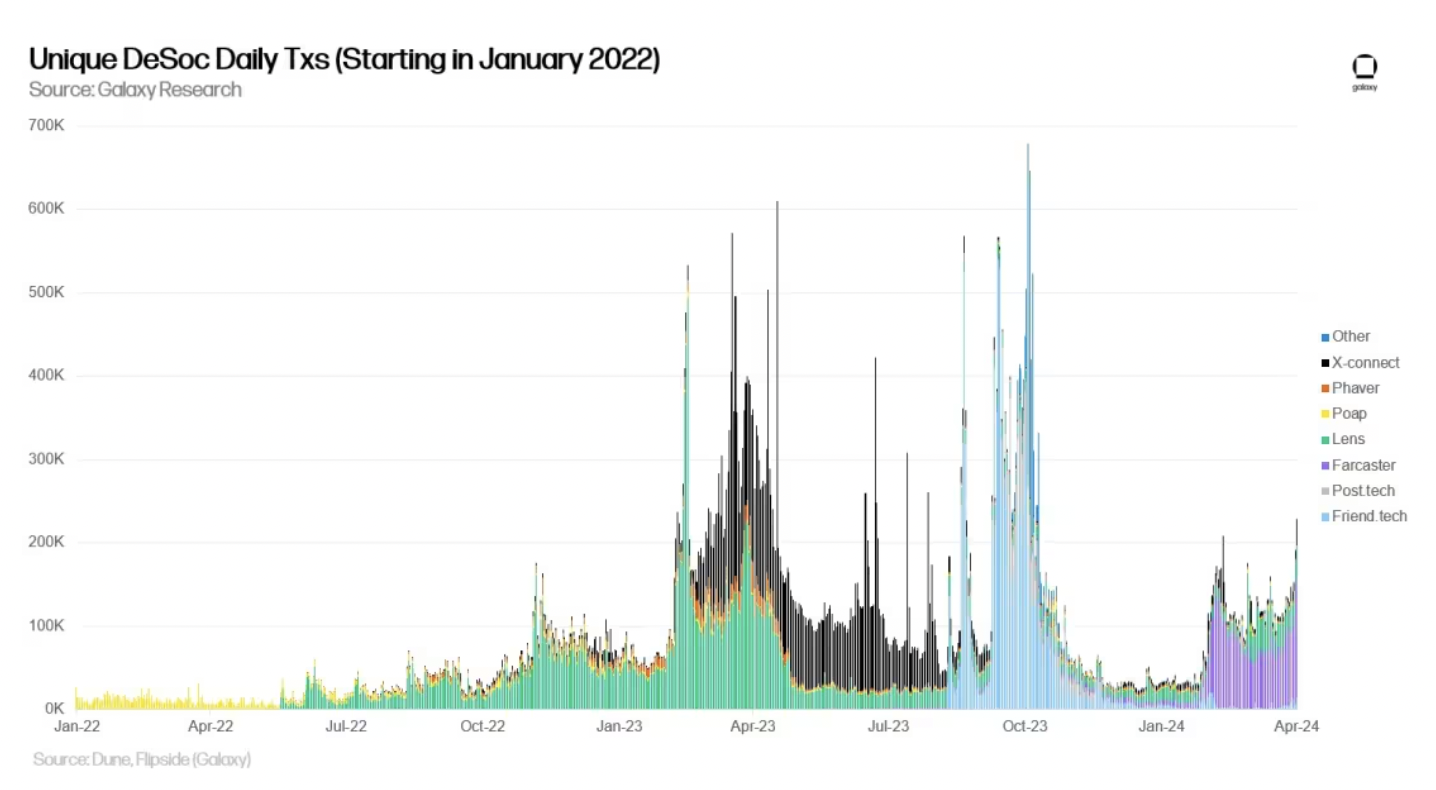
If history repeats itself, Farcaster’s on-chain activity may decline within three to four months, following the same trajectory as previous leading DeSoc apps after their respective peaks. However, due to its modular architecture that encourages continuous innovation by channel creators, Farcaster stands out with the potential to sustain high levels of user engagement.
Like Lens and X-Connect, Farcaster enables third-party developers and content creators to easily build and launch their own DeSoc apps. Existing Farcaster users can connect to Farcaster-based apps without creating new accounts, lowering the barrier to experimentation. Furthermore, with the introduction of Frames, channels and apps outside the core Farcaster ecosystem can enhance user engagement by building custom tokens, voting mechanisms, and interactive games. This programmability gives Farcaster’s user experience immense potential to drive sustainable user growth and ongoing activity in the DeSoc space.
Conclusion
Signs of mass adoption for DeSoc remain absent, yet the sector’s resurgence over the past 12 months cannot be ignored. Over roughly four years, DeSoc apps have grown by 8.7 million registered users. As global crypto ownership expands over the coming decade, we expect DeSoc user numbers to grow accordingly. Like NFTs, gaming, and DeFi, DeSoc represents a sub-sector within the crypto industry with the potential to drive mainstream adoption of blockchain technology and cryptocurrencies. Looking ahead, Farcaster emerges as a standout DeSoc application due to its focus on creator-driven features and content creation aimed at attracting users and enabling sustainable growth strategies.
Join TechFlow official community to stay tuned
Telegram:https://t.me/TechFlowDaily
X (Twitter):https://x.com/TechFlowPost
X (Twitter) EN:https://x.com/BlockFlow_News
 @galaxyhq