The Intersection of Blockchain and AI: A Deep Dive into Fetch.ai's Decentralized Machine Learning Platform
TechFlow Selected TechFlow Selected
The Intersection of Blockchain and AI: A Deep Dive into Fetch.ai's Decentralized Machine Learning Platform
The previous rise in FET price can be attributed to the launch of DeltaV, an open platform for the new AI economy.
 Navigating Web3 tides with focused insights
Author: Chain Tea House
Fetch.ai is a blockchain-based decentralized machine learning platform whose open-source software project aims to build infrastructure for developing modern, decentralized, and peer-to-peer (P2P) applications. Leveraging artificial intelligence (AI) and automation technologies, Fetch.ai provides various tools and frameworks to create and connect intelligent agents capable of performing complex tasks within the digital economy. Intelligent agents are autonomous software codes that can act on behalf of humans, organizations, or machines. A key feature of the platform is democratizing access to artificial intelligence (AI) by creating permissionless networks. Anyone can connect to this network to use and contribute datasets for autonomous AI operations. This setup is particularly beneficial across multiple domains, including DeFi trading services, transportation, and smart energy systems.
The Fetch.ai network is a cross-chain protocol built on Cosmos-SDK, enabling advanced cryptography and machine learning logic on-chain. Fetch.ai also has its own token called FET, with a current circulating supply of 746 million and a maximum supply of 1.153 billion.
Core Technology
A key aspect of the Fetch.ai protocol is its integration of distributed ledger technology (DLT), machine learning (ML), and trust protocols to create intelligent, agent-driven systems. This system enables dynamic, automated, and efficient transaction networks, promoting disintermediation and direct exchanges among economic actors. The Fetch protocol aims to reduce transaction and contract costs while shortening delivery times, unlocking potential in emerging markets based on the immediacy and granularity of service delivery.
Key features include:
Autonomous Economic Agent (AEA) architecture is a distributed intelligent agent framework designed to build networks of autonomously collaborating agents. AEA stands for Autonomous Economic Agent—digital entities capable of automatically executing tasks such as data collection, negotiation, or trading based on their environment and market conditions. AEAs can represent services, individuals, or devices. The core idea is combining AI and blockchain technologies to construct a decentralized intelligent economy that enables smart, autonomous, and decentralized economic interactions.
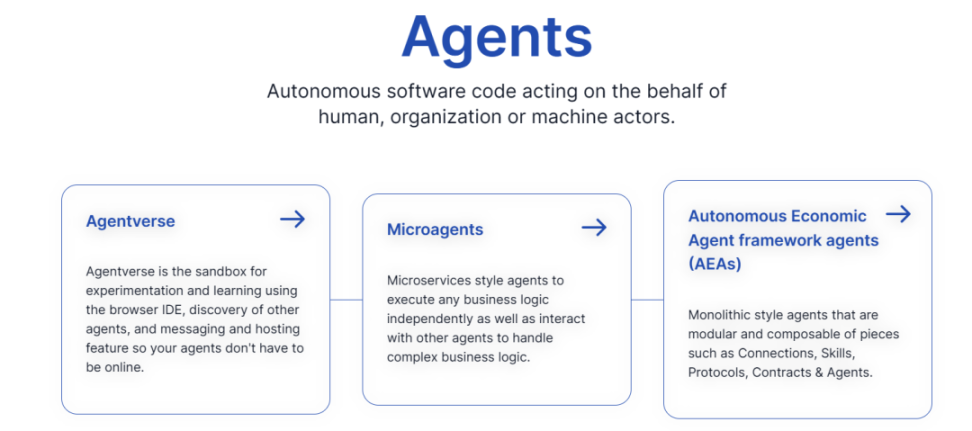
Open Economic Framework (OEF): OEF, short for Open Economic Framework, serves as a space where AEAs discover, search, communicate, and trade with one another. It defines a virtual environment providing APIs (some free, some paid, using FET tokens). For example, an AEA labeled 001 owns certain data (a data provider) and declares its availability on the network. Another AEA labeled 002 needs this data for machine learning purposes, finds it through the network, purchases it from 001, completes a trade, and uses it for machine learning.
Smart Ledger: Fetch.ai employs a high-speed, scalable blockchain that securely and decentralistically coordinates large volumes of transactions and interactions between agents.
Machine Learning and Artificial Intelligence: The platform integrates AI and machine learning technologies to support predictive analytics, decision-making, and intelligent agent behavior.
FET Token
The FET token is an integral part of the Fetch.ai ecosystem, serving as the primary medium of exchange facilitating transactions between agents, agent deployment, and compensation for provided services. As of the latest update, the FET token price is approximately $0.289, with a market cap of around $243,346,673. The 24-hour trading volume for FET is about $30,949,090. Out of a total supply of 1,152,997,575 FET, the circulating supply is 840,755,479, resulting in a fully diluted market cap of $3,337,214,349.
FET plays a crucial role in the Fetch.ai network, with specific uses and functionalities including:
Transaction Fees: FET is used to pay transaction fees on the Fetch.ai network. This includes costs associated with deploying and executing smart contracts, conducting transactions, and interacting with the network.
Staking: Participants in the Fetch.ai network can stake FET tokens to contribute to network security and governance. Staking FET qualifies holders to receive rewards distributed for helping secure the network, validate transactions, and maintain overall platform integrity.
Resource Access: FET tokens can be used to access or purchase resources within the Fetch.ai ecosystem. This includes buying computational power, data, and other digital assets or services offered by autonomous economic agents (AEAs) on the platform.
Governance: FET holders may also have governance rights, allowing them to vote on proposals affecting the development and direction of the Fetch.ai network. This includes decisions on protocol changes, network upgrades, and community fund allocations.
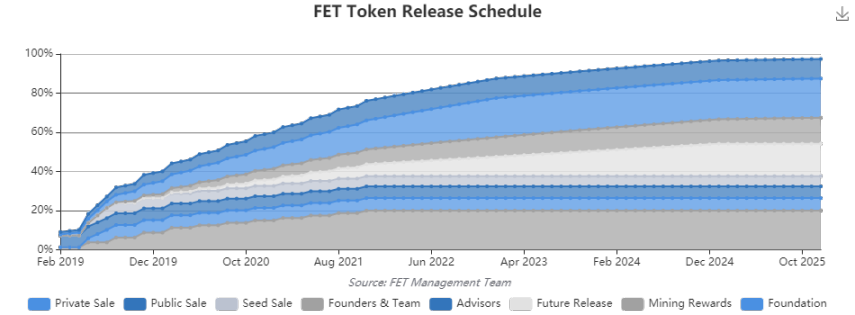
Token Release: As shown in the figure below, approximately 1.04 billion FET are currently in circulation, representing about 90% of the total token supply. The current price is $0.236, with a circulating market cap of approximately $247 million.
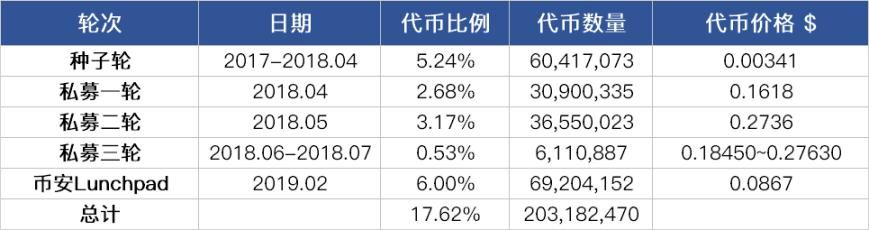
Token Fundraising: As illustrated in the figure below.
Token Distribution: Currently, FET tokens exist on three blockchains—Ethereum, BSC, and Fetch—with Ethereum being the dominant chain. According to blockchain explorer data, over 25% of FET (Ethereum + BSC) is held in Binance Exchange, indicating relatively dispersed holdings across the chain.
Profit/Loss Ratio: On-chain data shows that currently over 91% of holder addresses / more than 98% of on-chain tokens are in profit. However, since over 30% of FET is held across exchanges rather than in independent on-chain addresses, this data should be taken as reference only.
Team / Partnerships / Funding
Most members of the Fetch development team are graduates of prestigious universities or come from Fortune 500 companies, and are leading experts in AI or algorithm-related fields.
Humayun Sheikh: CEO and Co-founder, early investor in DeepMind, founded itzMe in 2014, launched uVue in 2016—a blockchain network driven by machine learning and AI focused on drones. Founded Fetch.ai in August 2017, and launched Mettalex, a DEX built on Fetch, in June 2020.
Fetch has numerous partners, primarily in IoT and AI. These include global industry leaders such as Bosch, Festo, Telekom Innovation Laboratories, Datarella, and Yoti; prominent blockchain projects like IOTA and Conflux; and healthcare enterprises and institutions including GE Healthcare, Pfizer, and the Poznan Supercomputing and Networking Center in Poland. Additionally, Fetch is a member of several organizations: the European Blockchain Alliance (including Ripple, NEM, Cardano), the MOBI Consortium (including automakers BMW, Ford, General Motors, and tech firms Accenture, IBM), and Warwick Business School.
In terms of funding: In March 2021, Toronto-based digital asset firm GDA Group invested $5 million. In March 2022, Fetch launched a $150 million development fund to incentivize developers building on its ecosystem, led by MEXC Global with participation from Huobi and Bybit. In March 2023, DWF Labs invested $40 million, with funds allocated toward deploying decentralized machine learning, autonomous agents, and network infrastructure. In an enterprise financing round on April 28, 2023, Fetch raised €91 million, led by Bitget.
Current Status and Future Outlook
Initially, Fetch.ai was considered quite complex. Its technology was too niche, making it difficult for people to understand its purpose. After an initial price surge in 2019, Fetch.ai experienced a downturn. However, following the 2021 bull market, the project made a significant comeback. With gains exceeding 1000%, it first captured community interest. Since then, Fetch.ai has gone through multiple peaks and troughs, and recently, Bitcoin’s price rise pushed its value close to the $0.50 mark.
However, the recent rise in FET prices can also be attributed to the launch of DeltaV, Fetch.ai’s new open AI economy platform. Fetch.ai’s AI agents power this search-based AI chat interface, which understands written conversations and delivers relevant answers. Beyond offering a simple user interface and precise responses, DeltaV allows users to register any AI service they wish to monetize.
Currently, challenges facing the project mainly include its technical complexity. Sustained R&D investment and innovation are required to maintain its competitive edge. Furthermore, education and improving user adoption remain major hurdles. Secondly, competition from other blockchain and AI projects poses a threat to Fetch.ai. Continuous innovation and differentiation are key to maintaining competitiveness. Additionally, uncertainty surrounding the global regulatory environment could impact Fetch.ai’s development, especially regarding cross-border transactions and digital asset regulations.
Join TechFlow official community to stay tuned
Telegram:https://t.me/TechFlowDaily
X (Twitter):https://x.com/TechFlowPost
X (Twitter) EN:https://x.com/BlockFlow_News