Quick Overview of Hybrid L2 BOB: Merged Mining, Combining Bitcoin Security with EVM Liquidity
TechFlow Selected TechFlow Selected
Quick Overview of Hybrid L2 BOB: Merged Mining, Combining Bitcoin Security with EVM Liquidity
BOB has launched the BOB Fusion Season 1 Points Program to encourage users to actively participate and contribute to the development of the BOB ecosystem.
 Navigating Web3 tides with focused insights
By Karen, Foresight News
Bitcoin boasts robust security, but its limitations in liquidity have long constrained its development. Particularly as Bitcoin approaches its halving event, miners' revenues are set to decline significantly—posing a major challenge to the entire Bitcoin ecosystem. In this context, Bitcoin L2 solutions like BOB aim to boost miner earnings. What happens when Bitcoin’s security is combined with EVM-based liquidity? Hybrid L2 BOB offers a compelling answer, leveraging merged mining to allow Bitcoin miners to simply validate without additional PoW or extra electricity costs—potentially injecting new vitality into the Bitcoin ecosystem.
What is BOB?
BOB stands for "Build on Bitcoin," an L2 technology stack designed to support DeFi innovation and ecosystem growth on Bitcoin. It inherits Bitcoin's PoW security, supports native Bitcoin protocols such as Ordinals, Lightning, and Nostr, and is fully EVM-compatible. Currently deployed on Ethereum’s Sepolia testnet, BOB plans to launch its mainnet around the time of the Bitcoin halving.
In terms of accessibility, BOB enables users to interact with Bitcoin on its network via MetaMask Snap called “BOB Bitcoin Snap.” This allows actions such as transferring Bitcoin, signing Bitcoin transactions, inscribing and transferring Ordinals directly within MetaMask. According to BOB documentation, the BOB MetaMask Snap is currently undergoing official review for listing by MetaMask. Additionally, BOB uses meta-transactions and account abstraction to let users pay gas fees using cross-chain BTC and other ERC-20 tokens.
BOB’s co-founder Alexei Zamyatin is a Bitcoin enthusiast, researcher, and software developer, and also co-founded Interlay, a Bitcoin DeFi project. As for the other co-founder mentioned by BOB, @domiki0_, limited public information is currently available.
Yesterday, BOB announced it raised $10 million in seed funding. The investment round attracted prominent overseas Bitcoin-focused VCs and Bitcoin OGs, led by Castle Island Ventures. Other investors include Mechanism Ventures, CMS Ventures, Bankless Ventures, Alliance, Antalpha Ventures, Asymmetric, Bitcoin Frontier Fund, UTXO Management, Web3.com Ventures, Zee Prime Capital, ViaBTC Capital, Lucky Friday, Modular Capital, Daedalus, IOSG Ventures, Hypersphere, DFG, and Nexo. Angel investors include Dan Held and Domo, creator of the BRC-20 token standard.
How Does BOB Work?
Initially, BOB launched on the OP Stack and inherits Bitcoin's security through a merged mining protocol (bitcoin restaking), with the ultimate goal of settling directly on Bitcoin L1—potentially achieving full state validation via ZK Rollups in the future.
Technically, BOB’s merged mining protocol OptiMine follows a hybrid consensus model, enabling any sidechain or rollup connected to the L1 chain to inherit PoW security from Bitcoin miners. OptiMine decouples block production from proof-of-work (PoW), allowing BOB to retain Bitcoin miners’ security while eliminating reliance on centralized sequencers—and maintaining fast block times (2 seconds).
Specifically, in BOB’s merged mining setup, the sequencer creates and signs blocks, while participating Bitcoin miners only perform validation. Since blocks are generated by the sequencer and miners only verify them, even if the sequencer stops producing blocks in a worst-case scenario, it cannot create forks or invalid blocks—thus preventing attacks by malicious Bitcoin miners.
For EVM compatibility, BOB uses the EVM to create and execute smart contracts, primarily developed in Solidity. Most Bitcoin stack components and applications built around it—including core SDKs, Lightning, and Ordinals—are implemented in Rust. BOB supports Bitcoin’s Rust libraries and leverages RISC Zero zkVM to enable off-chain execution of Rust programs, using ZK proofs to verify correct execution within EVM smart contracts. BOB states that this could eventually serve as a path toward ZK Rollups directly on Bitcoin, where BOB itself can be proven inside a zkVM and verified via Bitcoin consensus.
Additionally, BOB provides trustless access to Bitcoin block and transaction data via a BTC light client, enabling EVM contracts to process BTC transactions (e.g., P2P BTC swaps, Ordinal auctions, hashpower tokenization) and supporting various Bitcoin bridges. BOB also plans to launch a bidirectional lightweight BTC bridge powered by BitVM.
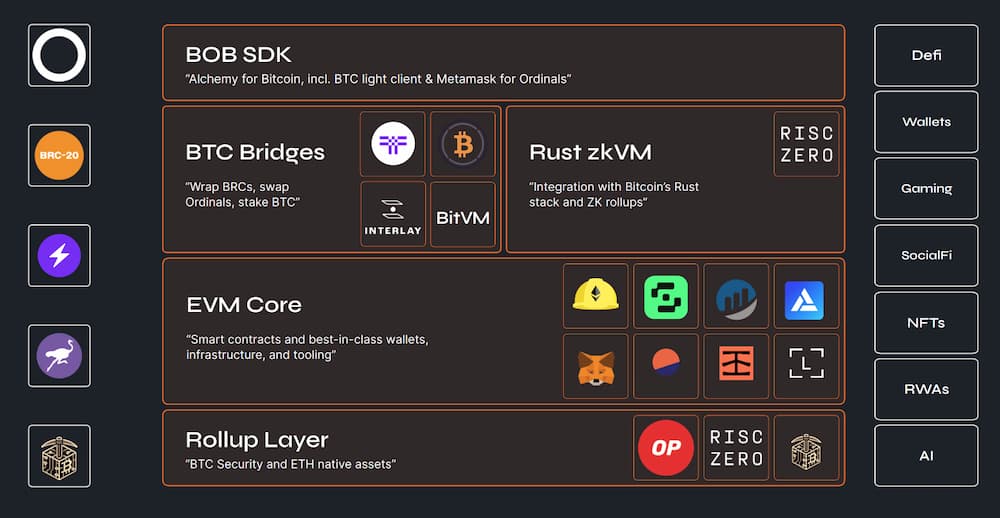
BOB Stack
BOB Fusion Season 1 Points Campaign
On the same day it announced its funding news, BOB also launched the first season of its BOB Fusion points program, encouraging users to actively participate and contribute to building the BOB ecosystem. During Season 1, users can lock assets and invite others into a non-custodial BOB Fusion timelock contract on Ethereum mainnet to earn BOB Spice points. These points represent contributions to the BOB ecosystem.
For asset locking, users earn 1 Spice point per dollar of assets locked per day. Depositing tBTC or WBTC earns 1.5x bonus points. Specifically, supported assets include:
1. Bitcoin-pegged assets: tBTC, WBTC (1.5x points);
2. Stablecoins and Ethereum liquid staking tokens: DAI, eDLLR, rETH, STONE, USDC, USDT, wstETH (1.3x points);
3. ALEX, ETH, eSOV (1x points).
Reminder: Do not send funds directly from exchanges to the BOB FUSION smart contract address.
In addition to asset locking, users can earn more points through referrals. After making an initial deposit, users can generate a personal referral code to invite others. Referrers receive 15% of the first-level invitee’s Spice points and 7% of the second-level invitee’s points.
The BOB Fusion Season 1 campaign will end after the mainnet launch in April. At that time, deposited assets will unlock around the Bitcoin halving and can be migrated to the BOB mainnet to continue participating in Season 2. According to the BOB website, there are 25 days remaining until the end of Season 1. If the mainnet launch is delayed, assets will automatically unlock by May 15, 2024 at the latest due to the use of a timelock contract.
BOB Roadmap
BOB has released a detailed roadmap outlining multiple stages—from public testnet to Multi-ZK-Rollup. The BOB L2 rollout consists of six phases: Phase 0 – Public Testnet; Phase 1 – Bootstrapping BOB: Optimistic ETH Rollup; Phase 2 – Inheriting Bitcoin security via a new merged mining protocol (PoW restaking); Phase 3 – Upgrading from Optimistic Rollup to ZK verification; Phase 4 – Achieving BTC-staked sequencers via BitVM, one-time signatures, and ZK proofs; Phase 5 – Multi-ZK-Rollup (connecting both ETH and BTC simultaneously).
As previously noted, BOB initially operates as an Optimistic ETH Rollup using the OP Stack. The BOB sequencer processes transactions and blocks, then submits data containing PoW commitments to Ethereum L1, where Ethereum verifies DA and PoW commitments, and settlement occurs on Ethereum L1. Native L1/L2 bridging enables access to stablecoins (USDT, USDC), ETH/stETH, and ERC-20 assets. BOB also tracks Bitcoin’s state via a BTC light client, verifying block headers and accepting transaction inclusion proofs—enabling trustless cross-chain swaps, auctions, and contract execution.
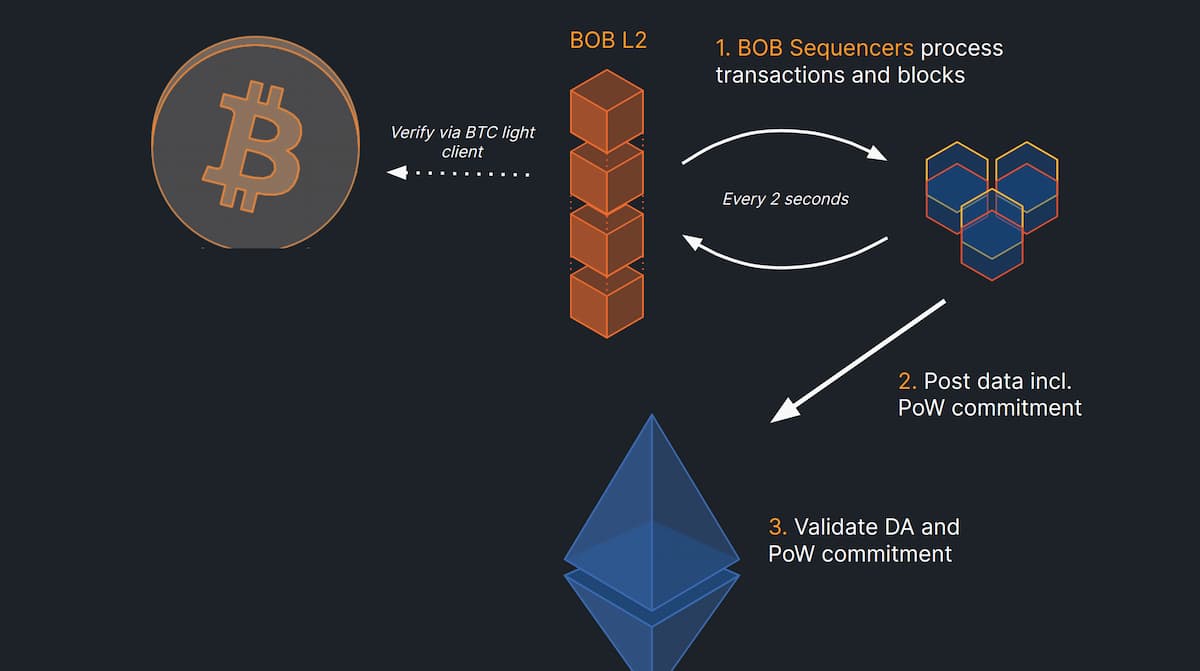
It should be emphasized that compared to the standard OP Stack, BOB has made numerous modifications and optimizations: BOB will have its own governance mechanism for community-driven decision-making and upgrades; it explores alternatives beyond Ethereum for data availability (such as Bitcoin and Celestia); adds merged mining functionality even in a single centralized sequencer setup; and introduces a feature allowing Bitcoin miners to validate the sequencer’s work.
In Phase 2, BOB brings Bitcoin PoW security to the ETH Rollup. After the BOB sequencer processes transactions and blocks, Bitcoin miners verify the state of the BOB Rollup and only include the commitment as part of PoW if the state transition is valid—minimizing trust in the sequencer. The sequencer then submits data covering the PoW commitment, which is finally validated by an Ethereum smart contract checking both DA and PoW commitments.
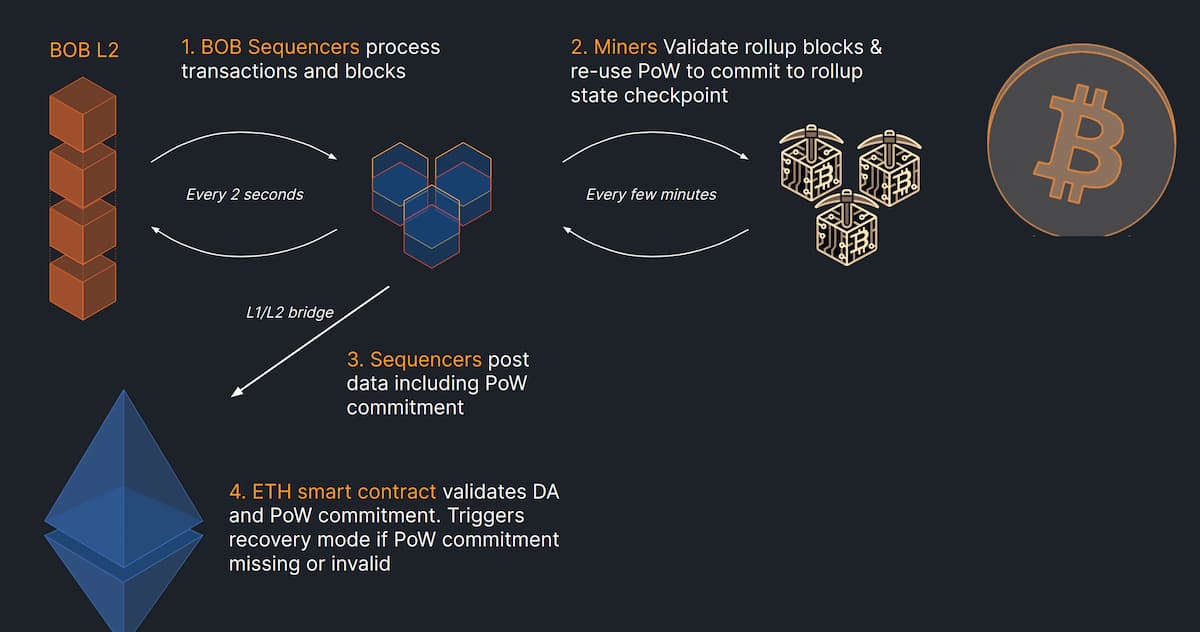
BOB aims to introduce Bitcoin as the settlement layer for BOB—a concept still under research. This may require introducing ZK compression to BOB, likely as part of a fraud proof mechanism, potentially in collaboration with ZK infrastructure providers like RISC Zero. BOB states its vision is clear: Bitcoin-secured assets on Rollup should be protected by Bitcoin, while ETH assets remain secured by Ethereum.
Recently, BOB formed a strategic partnership with Anduro, a Bitcoin sidechain development platform launched by crypto mining firm Marathon Digital. Applications from LayerBank, IceCreamSwap, bitSmiley, and iZUMi Finance are also expected to deploy on BOB.
In summary, as an innovative L2 technology stack, BOB not only inherits Bitcoin’s security but is also EVM-compatible. As it launches on mainnet and continues enhancing its features, whether BOB can ignite a wave of Bitcoin L2 adoption and emerge as a key force in Bitcoin DeFi—driving broader ecosystem growth and prosperity—remains to be seen.
Join TechFlow official community to stay tuned
Telegram:https://t.me/TechFlowDaily
X (Twitter):https://x.com/TechFlowPost
X (Twitter) EN:https://x.com/BlockFlow_News
 Foresight News