








DeMR: A Rising DePIN Star in the Solana Ecosystem's MR & AI Sector
TechFlow Selected TechFlow Selected
DeMR: A Rising DePIN Star in the Solana Ecosystem's MR & AI Sector
As an early project in the MR spatial computing field, DeMR has the potential to become a well-known project in a future popular sector.
 Navigating Web3 tides with focused insights
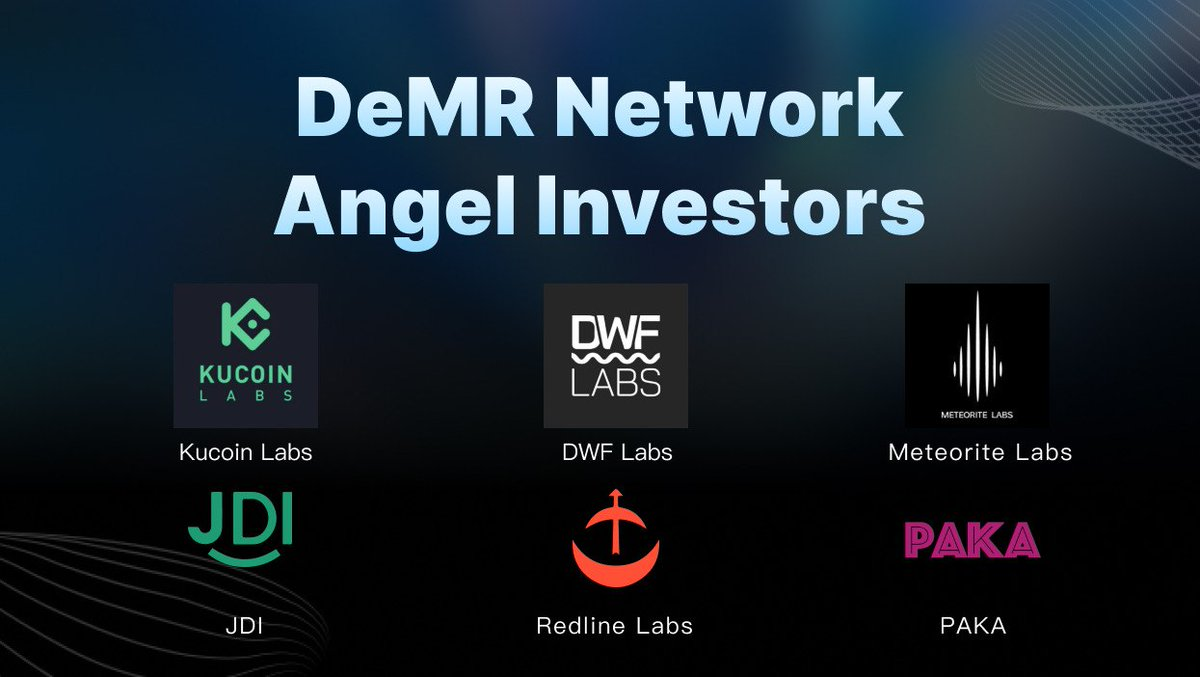
On March 13, 2024, DeMR Network, an infrastructure project in the MR & DePIN sector, announced the completion of its angel round financing involving Kucoin Labs, DWF Labs, LD Capital, JDI, Redline Labs, Meteorite Labs, Paka, and others.
On December 31, 2023, DeMR officially launched its first NFT initial offering, releasing 6,600 NFTs. All were minted within 15 minutes during the public minting phase. A total of 3,582 addresses participated in the sale, with the floor price rising from 1 SOL to a peak of 1.98 SOL. Over a thousand NFTs were traded within the first hour. More than 30 well-known Twitter influencers globally promoted the DeMR NFT, reaching over one million Twitter followers collectively. On February 26, 2024, DeMR launched Compass NFT staking on its official website, achieving a staking rate exceeding 85%. Community and user feedback has been strong, reflecting high confidence and anticipation for DeMR's future development.
Recently, DeMR has also conducted extensive global marketing campaigns across major media platforms including Yahoo Finance, CoinDesk, CoinMarketCap, Bezinga, and Trading View, as well as leading Chinese cryptocurrency media outlets, achieving a total reach of 194 million impressions. On January 17, 2024, DeMR co-hosted a DePIN Ecosystem Space online conference together with KuCoin, IoTeX, and Helium, attracting over 1,000 participants. This marks significant progress in DeMR’s brand visibility and community consensus building.
1. What is DeMR?
DeMR is a decentralized Mixed Reality (MR) infrastructure network (MR-DePIN) built on the Solana blockchain. Users can participate in constructing MR spatial environments through a decentralized, distributed concurrent architecture, helping build infrastructure and providing Web3 infrastructure services for massive MR applications and global users. Leveraging MR & AI spatial computing technologies, DeMR enables full interconnectivity and decentralization of an MR application ecosystem and real-virtual symbiotic scenarios. The digital world created by MR & AI spatial computing allows people to enter a beautiful new interconnected spatial reality anytime, anywhere.
2. Technical Advantages
Developed over five years by a world-class MR & AI technology team, DeMR Network offers the following key advantages:
1) Ultra-High Precision
Thanks to advanced computer vision deep learning models, DeMR supports centimeter-level spatial positioning and interaction.
2) Multi-Environment Support
Through large-scale data-trained AI models, DeMR achieves high scalability and adaptability, suitable for various indoor and outdoor scenarios.
3) Multi-Device Support
DeMR has implemented extensive technical optimizations to support most MR devices, including Android/iOS smartphones, AR and MR glasses. It will also prioritize compatibility with Apple Vision Pro in the future.
4) Large-Scale Multiplayer Experience
DeMR enables massive global users to simultaneously join the network, locate each other, and interact in real time, enjoying rich interactive MR experiences.
5) AI Automation Pipeline
DeMR’s core technological advantage lies in its decentralized AI processing automation pipeline used to construct semantic spatial MR scenes.
6) Distributed and Decentralized
Leveraging advanced pipelines and high-definition, low-cost CV and MR algorithms, anyone can become a contributor.
7) Open Ecosystem
DeMR is committed to building an open Web3 ecosystem for all MR developers and users worldwide. DApps within the ecosystem enable real-time exchange and interaction of data assets among users, forming a truly decentralized spatial internet.
3. Contributors
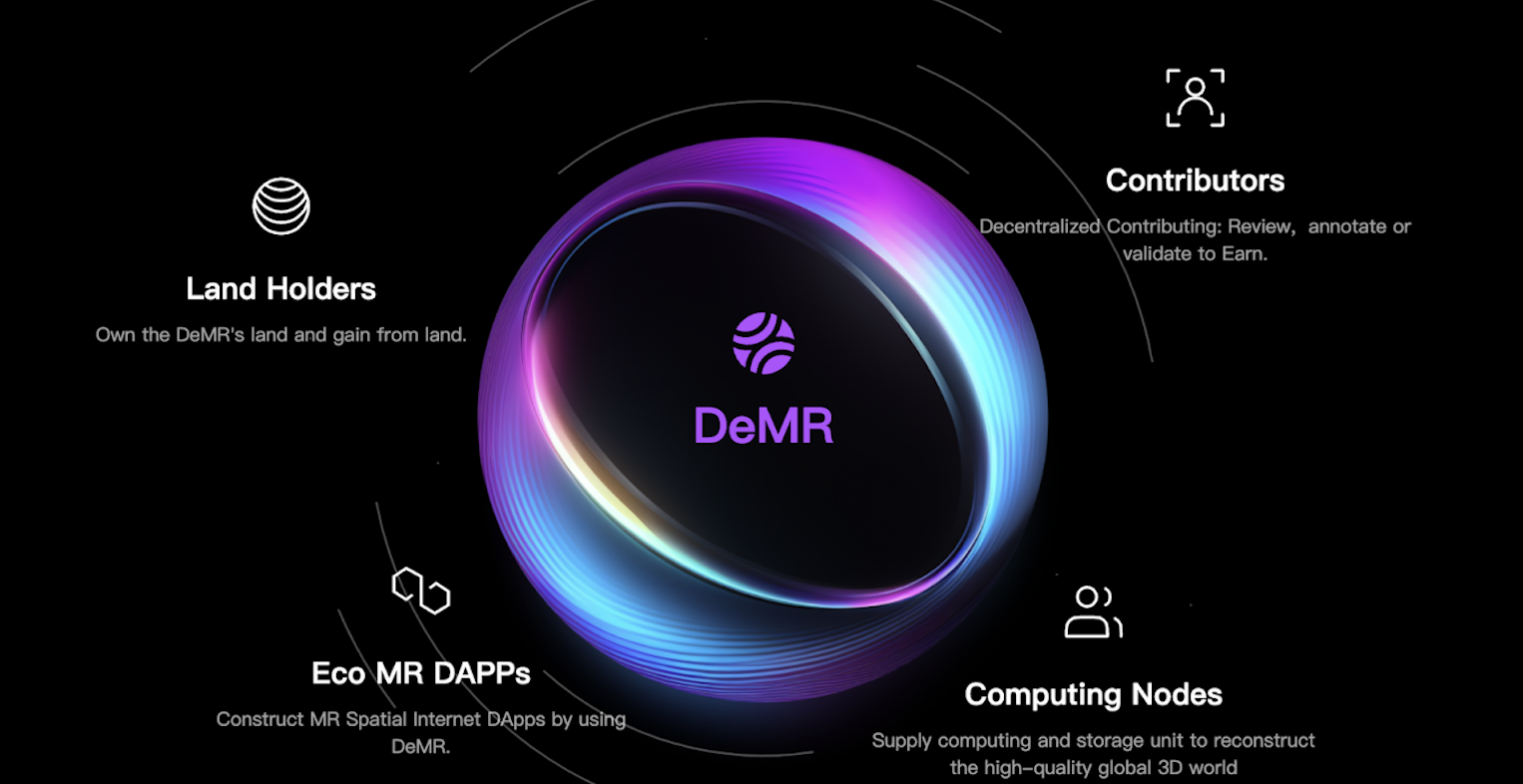
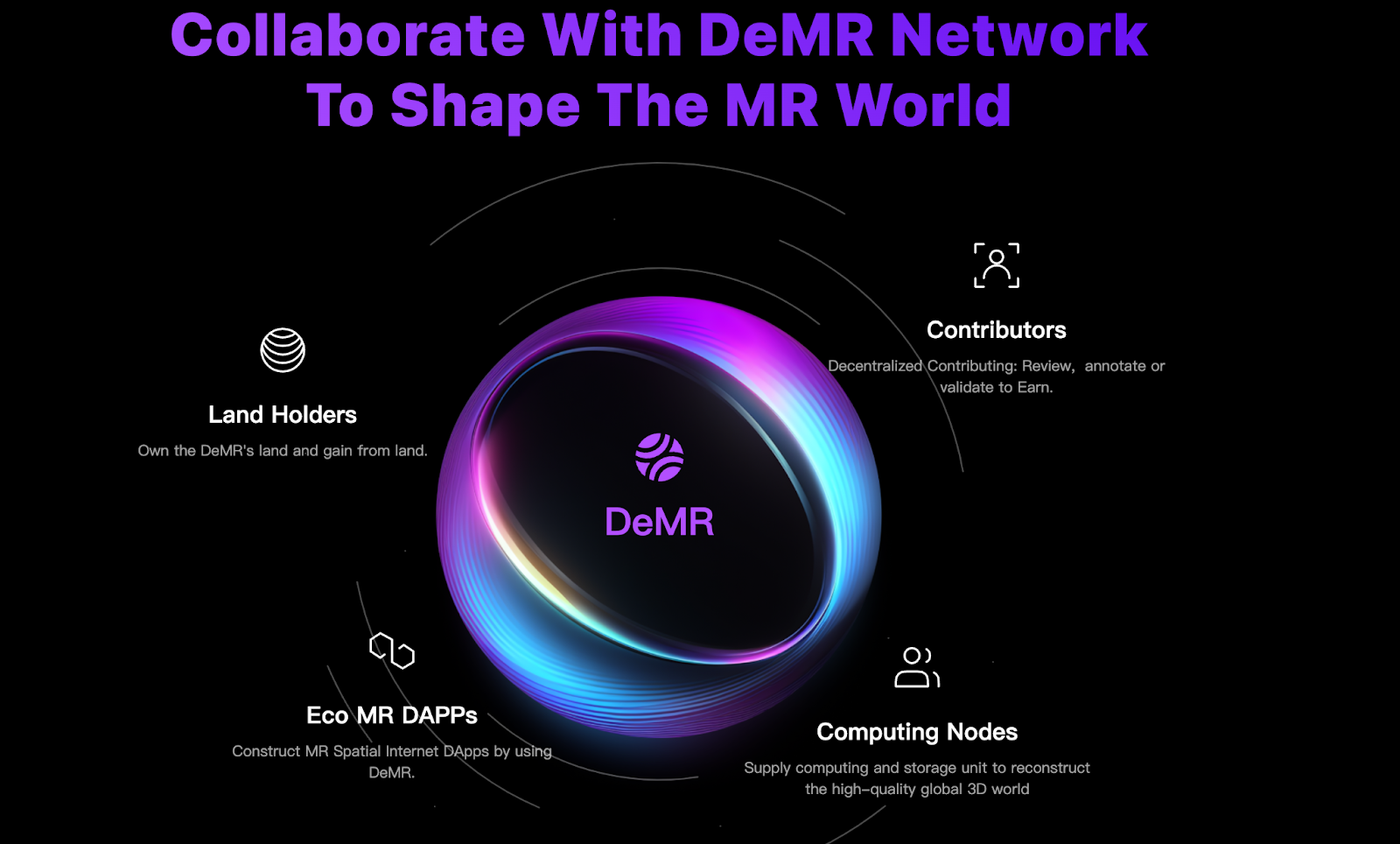
To ensure decentralized collaboration, DeMR Network features multiple Contributor roles that work together within the network and pipeline, including: ➔ Annotator ➔ Reviewer ➔ Validator ➔ Trainer.
4. Compute Nodes
DeMR compute nodes are critical computing and storage units within the DeMR network. They store input data on a distributed ledger, perform large-scale parallel AI computations, and ensure data accuracy and reliability. Using CPU+GPU+NPU heterogeneous parallel computing, DeMR compute nodes conduct massive AI operations, providing services for MR spatial scene construction, cloud server storage resources, and real-time spatial positioning capabilities. Each DeMR compute node earns DMR tokens by contributing computational resources to the DeMR network.
5. Land Holders
DeMR Land represents infrastructure rights in the Web3 spatial internet, corresponding to unique, scarce real-world assets, and potential commercial rights for future MR content ecosystems. Land Holders play a vital role in DeMR; their active participation generates greater economic incentives for the community, enabling a more engaging, interconnected, and vibrant MR world.
6. DeMR NFTs
DeMR NFTs consist of three components: Compass NFT, Node License NFT, and Land NFT:

1) Compass NFT
The Compass NFT is the core NFT in DeMR and a necessary identifier for contributors—like a sword for a warrior, shoes for a runner, or a staff for a wizard. Anyone wishing to become a network contributor must purchase a DeMR Compass. In early stages, DeMR will release these NFTs in limited quantities via its official website, allowing users to directly purchase them and obtain associated rights. The higher a user’s DCC reputation score (see DCC section), the higher their NFT reward multiplier.
2) Node License NFT
Building the future MR world requires massive spatial computing, real-time perception, and interactive rendering, necessitating vast computing and storage units. To ensure node security and reliability, compute resources must hold a certain amount of DMR tokens and mint them to obtain a Node License NFT—a credential confirming node identity—and thus become a DeMR compute node. Each node continuously contributes computing resources to the DeMR network and receives DMR rewards.
3) Land NFT
To accelerate MR spatial computing infrastructure development, DeMR defines adjacent hexagonal land plots in specific regions. Each plot is represented as a DeMR Land NFT. Seven adjacent plots can be combined into a larger area, meaning Land NFTs support both merging and splitting. These NFTs serve not only as spatial coordinate systems for VR and MR content but also as foundational digital assets in the future world. Their scarcity and tradability generate stronger economic incentives for sustainable community growth.
7. DeMR Virtual IP Themed Cities
DeMR and its ecosystem partners create region-specific IP-based MR experiences using famous landmarks, revolutionizing MR interactions. DeMR will select only a few compliant regions (excluding restricted countries/regions such as the U.S., China, and private areas), such as a virtual Web3 Singapore City, Tokyo Anime City, or Universal Studios-themed scenes. Every landmark—from plazas to shopping malls—is meticulously mapped and minted as a Land NFT, with dedicated MR scenes developed for use by MR applications. In its first phase, DeMR will launch Land NFTs based in Singapore, building a virtual financial city IP. Offline iconic landmarks like Merlion Park and Marina Bay Sands will bring natural value consensus to DeMR.
8. Tokenomics
DMR is a utility token used for governance and other functions within the DeMR Network, with a fixed maximum supply of 100 billion tokens. The primary uses of DMR include:
1) DAO Governance: DMR holders can submit governance proposals and participate in community voting
2) Mining Rewards: Incentivize all DeMR contributors to build and maintain DeMR’s data and network
3) Node Staking: Compute nodes must stake and lock DMR tokens to maintain eligibility for Node License NFTs
4) Service Access: Developers burn DMR tokens to generate DDCs to pay for DeMR services
9. Economic Flow Diagram
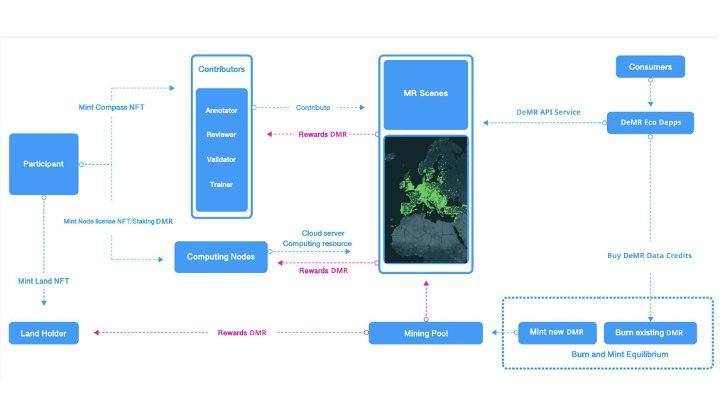
As shown in the diagram above: Participants in the DeMR ecosystem can mint different types of NFTs under certain conditions to obtain corresponding role identities (e.g., requiring substantial DMR to become a compute node). The main roles are Contributors, Compute Nodes, and Land Holders. Minting a Compass NFT allows you to become a creator, participate in MR spatial scene creation, and earn DMR token rewards from the mining pool. By minting a Node License NFT, users become DeMR compute nodes, providing computing and cloud server resources for MR scene construction and earning DMR tokens from the pool. Users can also become DeMR Land Holders by minting DeMR Land NFTs. When data from their respective land plots is used by DeMR’s ecosystem DApps, landholders receive DMR tokens from the mining pool.
10. Summary
With the development of Apple Vision Pro, the MR sector is poised to become as popular as the AI sector. As an early-stage project in MR spatial computing, DeMR has the potential to emerge as a leading player in this upcoming trend. Currently still in its early phase, consider this comparison: only about 5% of DMR tokens are initially in circulation. Even at a $100 million valuation, the initial circulating market cap would be just several million dollars. Compared to many high-market-cap projects currently thriving in the DePIN and AI sectors, DeMR’s circulating value remains dozens of times smaller. Therefore, the earlier one participates in the DeMR ecosystem, the greater the potential investment returns from its growth journey.
Join TechFlow official community to stay tuned
Telegram:https://t.me/TechFlowDaily
X (Twitter):https://x.com/TechFlowPost
X (Twitter) EN:https://x.com/BlockFlow_News


