Mint Ventures: Preparing for the Bull Market's Main Surge — My Phased Thoughts on This Cycle
TechFlow Selected TechFlow Selected
Mint Ventures: Preparing for the Bull Market's Main Surge — My Phased Thoughts on This Cycle
The cycle still exists, but has clearly shifted forward.
 Navigating Web3 tides with focused insights
Author: Alex Xu, Research Partner at Mint Ventures
Introduction
Last week, BTC reached a new all-time high against the US dollar, signaling that we have officially entered the bull market phase of this cycle. Compared to the rebound and recovery from bear market lows, market sentiment will further heat up during the formal bull phase, accompanied by increased volatility.
Each bull market's official stage shares common characteristics, such as:
-
A transition from BTC-led rallies to altcoin-led rallies, with Bitcoin’s market dominance declining
-
Faster price increases and more extreme gains across various cryptocurrencies
-
Heightened attention on social media and search engines, with rapidly increasing public interest
In this article, I attempt to logically analyze how this cycle may differ from previous ones, sharing my thoughts and strategic considerations.
The views expressed here represent my current thinking as of publication and are subject to change. They are highly subjective and may contain factual, data-related, or logical errors. Please do not use them as investment advice. Feedback and discussion from industry peers are welcome.
Below is the main content.
Bull Market Catalysts and Alpha Sectors in Crypto
Bull Market Catalysts
After BTC reaches a certain market cap scale, reviewing the past three cycles shows that bull markets have been jointly driven by multiple factors, including:
-
BTC halving (expectations around supply-demand adjustments), which will occur in April this year
-
Monetary policy easing or expectations thereof; consensus has formed that peak interest rates are behind us, with strong anticipation for rate cuts starting next quarter
-
Regulatory relaxation. This cycle has seen U.S. accounting standards updated to allow crypto assets to be reported at fair value on corporate balance sheets, along with the SEC’s loss in court against Grayscale leading to ETF approvals.
-
New asset models and business model innovations
So far, this bull run already exhibits the first three of these four drivers.
Alpha Sectors in Each Bull Cycle
Meanwhile, in every bull market cycle, the biggest gainers tend to be new species emerging—or experiencing their first breakout—during that period. For example, during the 2017 bull market, ICOs were rampant, and the top performers were ICO platforms (smart contract blockchains) like Neo and Qtum. In the 2021 bull market, DeFi, GameFi & metaverse, and NFT assets led the charge—2020 was the "year one" of DeFi, while 2021 marked the dawn of NFTs and GameFi.
However, so far in this cycle, no new asset or business model has emerged with the same significance as smart contract platforms in prior cycles or DeFi.
Current sectors such as DeFi, GameFi, NFTs, and DePIN—whether established or newer projects—have seen little evolutionary progress in product design or narrative compared to the last cycle. Most developments are merely functional iterations or fixes. Simply put, they remain “old concepts.”
The relatively novel categories that have emerged in this cycle are mainly two:
-
BTC ecosystem: Inscription-based assets represented by ORDI and “Node Monkeys,” as well as Layer-2 projects built on BTC
-
Web3 AI projects: Including distributed computing projects that existed in the previous cycle (e.g., Akash, Render Network), and newly emerged AI-focused projects like Bittensor (TAO)
Strictly speaking, however, AI is not a native crypto sector. The Web3 AI space largely stems from the broader AI boom triggered by GPT in 2023 spilling into the crypto industry—it can only loosely qualify as half of a “new species” in this cycle.
Outlook and Strategy for This Bull Market
Potentially Misjudged Alpha Sectors
In many investment portfolio recommendations I’ve seen for this bull market, altcoins in sectors like GameFi, DePIN, and DeFi are commonly included. The rationale is that, as smaller-cap and more elastic crypto assets, they can significantly outperform BTC and ETH during the official bull phase (after BTC hits new highs), delivering alpha returns.
However, as previously noted, “in each bull market cycle, the strongest performers are typically new species born—or first exploding—during that cycle.” Since DeFi, GameFi, NFTs, and DePIN fail to meet the criteria of being a “new asset or business category” in this cycle, and given they’re entering their second cycle, we shouldn’t expect them to replicate their first-cycle price performance. An asset class only enjoys massive valuation bubbles during its debut bull run.
When a new business or asset model emerges in its first bull market, its primary challenge is avoiding falsification—a difficult task amid bullish euphoria. But when similar projects reappear in the second bull market, they face the burden of proof: proving their business ceilings remain high and their growth potential still vast. This is equally challenging, because convincing people to believe the same story twice is hard—especially when memories of getting burned near previous cycle highs linger.
Some might argue that L1 blockchains were top performers in both the 2017 and 2021 bull markets—doesn’t that contradict this view?
Not quite.
During the 2021 bull market, demand for L1s experienced exponential growth. The simultaneous explosion of DeFi, NFTs, and GameFi created rapid expansion in both user and developer bases, generating unprecedented demand for block space. This not only boosted Ethereum’s valuation but also fueled the rise of alternative L1s. In fact, 2021 was truly the “year one” for alt-L1s.
Can this cycle replicate the explosive growth in DApp and asset categories that drove L1 demand last time?
Currently, there’s no sign of it. Therefore, the conditions enabling last cycle’s L1 surge simply don’t exist today. Expectations for alt-L1s should thus be tempered accordingly.
BTC and ETH Offer Better Risk-Reward in This Cycle
Currently, the biggest driver of this bull market appears to be capital inflows through ETFs and optimistic expectations about sustained long-term inflows. As such, the primary beneficiaries are BTC and potentially ETH (as a future ETF candidate). Given the above analysis of GameFi, DePIN, DeFi, and L1s, chasing alpha in this cycle will likely be harder than before. A core allocation to BTC + ETH now offers a better risk-reward profile than in the previous cycle.
Then, between BTC and ETH—both benefiting from ETF dynamics—which is the better choice?
In my view, in the short term, ETH may have an edge. BTC’s ETF expectations are already priced in, and post-April halving, BTC lacks immediate catalysts. In contrast, ETH/BTC exchange rate remains low, and rising expectations around a potential ETH ETF improve ETH’s near-term risk-reward proposition relative to BTC.
Looking longer term, however, BTC may be the superior holding. Overall, ETH increasingly resembles a tech stock—its value lies in providing block space services, akin to a Web3 cloud infrastructure provider. This space is fiercely competitive, constantly threatened by other block space providers (L1s, Rollups, DA projects) and new technological solutions eroding its narrative and market share. If Ethereum takes a wrong technical turn or lags in product iteration, capital may vote with its feet.
Conversely, BTC’s positioning as “digital gold” is becoming increasingly solidified alongside its growing market cap and the opening of ETF channels. Consensus around its role as a value reserve asset hedging against fiat inflation is gradually gaining acceptance—from financial institutions and listed companies to small nations.
The once-popular argument that “ETH could surpass BTC in value storage” is now rarely heard.
Summary of Bull Market Strategy
While I believe overweighting BTC and ETH offers better risk-adjusted returns this cycle, this doesn’t mean we should ignore altcoins altogether—only that we must carefully consider allocation ratios.
Overall, my current strategic framework is as follows:
-
Higher allocation weights to BTC and ETH
-
Controlled exposure to legacy sectors such as DeFi, GameFi, DePIN, and NFTs
-
For alpha-seeking positions, focus on emerging sectors introduced in this cycle, such as:
-
Meme coins: The ultimate speculative vehicle. Each cycle brings renewed narratives and astonishing wealth stories, making memes the easiest category to understand and go viral beyond crypto circles
-
AI: A new Web3 business category continuously energized by external commercial momentum
-
BTC ecosystem: Including inscription assets and BTC L2s. I’m relatively more bullish on the former, as it represents a genuinely new asset class in this cycle, whereas BTC L2s are essentially repackaged versions of Ethereum rollup concepts—“same wine, new bottle”
-
Market Cycles Still Exist, But Have Clearly Shifted Earlier
Additionally, regarding timing, I believe this cycle deviates from the historical pattern where “the main upward leg occurs one year after halving.” Instead, the strongest phase of this bull market is likely to be 2024, not 2025.
Previous BTC halving years were 2012, 2016, and 2020, with the current cycle’s halving occurring in 2024.
Last year, Tonghuashun Finance analyzed the performance of major financial assets over the past decade, with results shown below:
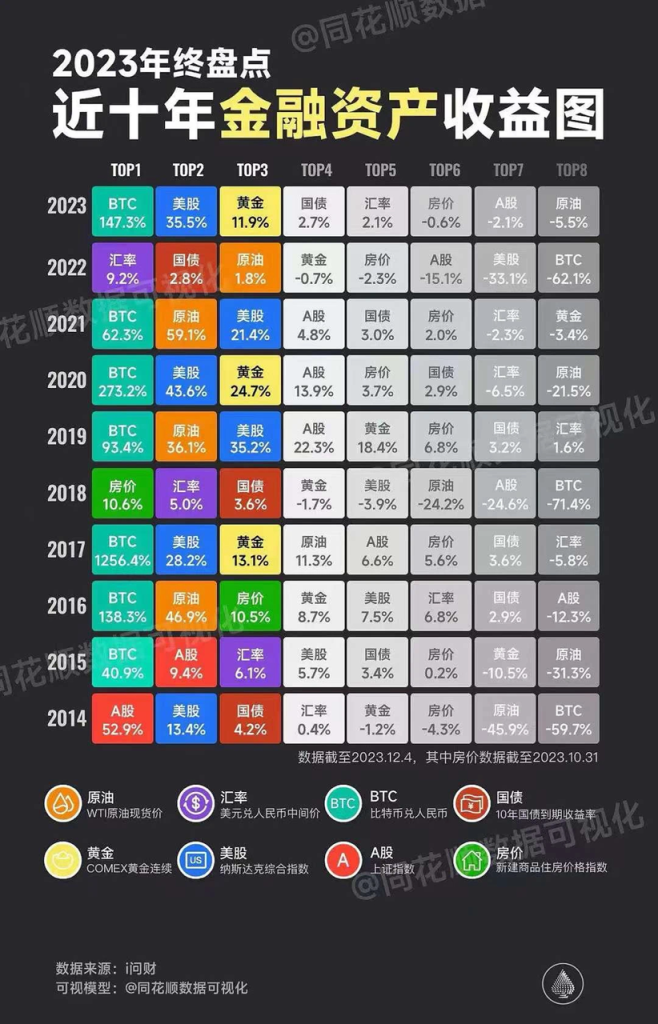
Overall, BTC has historically followed a “three years up, one year down” pattern: rising the year before halving, the halving year itself, and the year after, followed by a down year.
In the first BTC halving cycle, BTC rose 186% in the halving year (2012) and surged 5,372% the following year (2013). A similar trend occurred in 2017. Thus, prior to the most recent cycle, BTC generally followed the pattern of modest gains pre-halving and explosive moves one year post-halving.
This pattern began shifting in the last cycle: 2019 (the year before halving) saw a significant gain of 93.4%—higher than 2015’s 40.9%. Then, in the halving year 2020, BTC rose 273%, exceeding the 62.3% gain in 2021 (the year after halving).
This trend of earlier bull market onset has intensified in the current cycle. In 2023—the year before halving—BTC already gained 147.3%, surpassing the previous pre-halving year (2019). And with Q1 2024 not yet complete, BTC has already risen nearly 60%.
I believe it’s highly likely that 2024 will be the primary bull market year. Don’t wait for a big move in 2025—increasing exposure now may be the wiser strategy. By 2025, we may instead be in harvest-and-exit mode.
Finally, wishing everyone a successful hunt and bountiful returns in this bull market.
Join TechFlow official community to stay tuned
Telegram:https://t.me/TechFlowDaily
X (Twitter):https://x.com/TechFlowPost
X (Twitter) EN:https://x.com/BlockFlow_News
 Mint Ventures