








A Deep Dive into the High-Performance Bitcoin Sidechain MVC
TechFlow Selected TechFlow Selected
A Deep Dive into the High-Performance Bitcoin Sidechain MVC
MVC, a BTC sidechain based on the UTXO model and PoW consensus, offers low fees, high performance, and security, with an already rich ecosystem implementation, aiming to enable large-scale innovative applications within the Bitcoin ecosystem.
 Navigating Web3 tides with focused insights
Author: Nan Zhi, Odaily Planet Daily
Introduction
Since Ordinals ushered in a spring for the Bitcoin ecosystem, various protocols and applications built directly on Bitcoin have flourished, giving rise to BRC-20, Atomicals, Rune, and other protocols natively operating on the Bitcoin network. However, due to inherent limitations of Bitcoin's architecture, it struggles to support large-scale application development and adoption. Transaction fees on the Bitcoin network once exceeded 500 sats/vB, and minting costs for several high-volume popular inscriptions reached millions of dollars.
On the other hand, with Bitcoin’s halving approaching, enthusiasm and demand for ecosystem development are growing stronger than ever. The market urgently needs practical and effective scaling solutions to sustain ongoing development and operations, leveraging fee revenue to support Bitcoin's long-term functionality. Imagine a network that inherits Bitcoin’s security and core characteristics while also supporting high-concurrency user demands and enabling seamless asset migration—developers could then freely build mass-market applications, making widespread adoption of Bitcoin and its ecosystem no longer distant. Fueled by the momentum of spot ETFs, such an ecosystem could even achieve global普及.
Bitcoin Scaling Solutions
Throughout Bitcoin’s evolution, exploration into scaling solutions has never ceased. Especially toward the end of 2023, a surge of BTC Layer 2 projects emerged, each adopting vastly different technical approaches. These can be categorized into three main architectural types:
-
Bitcoin-isomorphic solutions;
-
EVM-based solutions with cross-chain asset bridges to Bitcoin;
-
Other non-Bitcoin-isomorphic and non-EVM solutions, such as the Lightning Network and Stacks.
MVC (MicrovisionChain) stands out as one of the few truly Bitcoin-isomorphic scaling solutions, matching Bitcoin in UTXO model, consensus algorithm, and 1:1 token ratio, allowing users, developers, and miners from the Bitcoin network to migrate seamlessly. Specifically, compared to other scaling approaches, Bitcoin-isomorphic scaling offers the following key advantages:
-
Highly compatible assets and ecosystem: For sidechains, native asset interoperability across sidechains and Layer 2s depends on their underlying design. MVC supports not only Bitcoin transfers but also a full range of assets like BRC-20. This compatibility eliminates the need for tedious redevelopment, enabling rapid migration and user access, facilitating fast user growth;
-
Seamless user experience: Users manage assets across both Bitcoin and its scaling networks using the same private keys, reusing familiar tools. Infrastructure is highly adaptable, so users don’t need to change habits when moving between Bitcoin’s mainnet and scaling solutions;
-
Scalable computational security: By adopting a Bitcoin-isomorphic design, MVC uses Bitcoin’s SHA-256 mining algorithm. This allows the vast number of existing Bitcoin miners to potentially migrate and serve as security providers for the sidechain/Layer 2.
High-Performance BTC Sidechain MVC
Returning to the topic of scaling, let us examine several fundamental questions to understand the basic requirements and goals: Why does Bitcoin need scaling? What improvements are required? And what must be preserved during scaling?
Why scale? Because Bitcoin transactions are expensive, execution times are long, and the system lacks Turing completeness (i.e., smart contracts);
What needs improvement? Lower fees, faster speeds, more flexible asset issuance methods, and smart contract capabilities;
What must be preserved? Network security and decentralization.
In short, the optimal scaling solution should reduce barriers while preserving the decentralized nature of the network, enabling mass adoption. Without decentralization—relying instead on a few high-performance nodes—we fall back into the Web2 paradigm. Without performance enhancements, universal usability cannot be achieved.
MVC addresses these challenges through innovative mechanisms:
Security
MVC is a BTC sidechain based on the UTXO model and PoW consensus. Beyond inheriting Bitcoin-like network properties—including security and high decentralization—it also delivers high performance and low fees. Testnet data shows MVC achieves over 10,000 TPS, capable of supporting massive user adoption.
First, regarding network security, MVC uses the same SHA-256 algorithm as Bitcoin, enabling it to absorb the vast miner base. Moreover, MVC has already achieved milestone-level growth in hashpower. According to MiningPoolStats, MVC currently ranks 12th among all SHA-256 networks, surpassing BSV and eCash (XEC), trailing only BCH, with hashpower reaching 81% of BCH’s—up from just 20% six months ago. This substantial hashpower fully ensures network decentralization and security, fulfilling the foundational requirement of any scaling solution.

Performance Enabled by Innovative Mechanisms
MVC introduces the concept of BVM (Bitcoin Virtual Machine), extending smart contract functionality atop the UTXO model and PoW consensus. Its goal is to build a smart contract system within the Bitcoin ecosystem that rivals Ethereum, expanding functionality for Bitcoin users and creating possibilities for mainstream adoption. This vision is realized through a suite of innovative underlying mechanisms, including MetaTxID for performance enhancement, the MetaContract smart contract framework, and the MetaID identity solution. Together, these innovations enable smart contracts and network scaling.
MetaTxID – Performance Boost & Smart Contract Foundation: MetaTxID is an innovative transaction identifier generation method and a core differentiator of MVC from other UTXO public chains. Using MetaTxID preserves the full parallelism capability of the UTXO model. Through verification data pruning, it reduces the data volume needed for contract validation and enables lightweight data traceability, making Layer 1 contracts on pure UTXO models feasible.
MetaContract – High-Performance Smart Contract Framework: A high-performance, low-cost smart contract framework based on the UTXO model. Compared to mainstream global-state-based contract models, it offers the following advantages:
-
Scalability: Different UTXO contracts can be executed and validated in parallel across MVC nodes, effectively utilizing modern multi-core processors to greatly accelerate contract execution and increase network TPS.
-
Low Latency: MVC features zero-confirmation capability—contract execution results are returned immediately upon transaction arrival at a miner node’s memory, without waiting for block confirmations.
-
Security: Due to the chained dependency characteristics of UTXO contracts, the system inherently resists MEV and prevents reentrancy attacks.
MetaID – On-Chain Decentralized Identity Protocol: Designed to enable data interoperability across different cross-chain applications. With this decentralized ID protocol, the complexity and barriers to developing Web3 apps on MVC are significantly reduced, paving the way for explosive growth in Web3 applications.
Through the synergistic effect of these innovative mechanisms, MVC’s high-performance network frees developers from performance constraints, offering benefits such as easy testing and maintenance, high memory utilization, and clean code. For users, it means accessing the ecosystem at extremely low cost while enjoying secure, seamless, and efficient Web3 experiences.
Tokenomics
MVC’s native token SPACE has a total supply of 21 million, with no pre-sale or IDO. SPACE serves as both network gas and governance token. Of the total supply, 35% is allocated via PoW mining, 10% is linearly unlocked over 10 years for ecosystem builders, and the remaining 55% is distributed via PoB (Proof of Build) through community DAO voting. The allocation breakdown is shown below.

This design aims to establish a positive economic cycle through two complementary mechanisms: ecosystem incentives and sustainable miner income.
By distributing tokens via PoB, MVC encourages technologists and marketers to contribute to ecosystem building, while also establishing a reserve fund for future incentives. A prime example is Arbitrum, which attracted numerous high-quality projects through multiple rounds of STIP (Short-Term Incentive Programs), used incentives to draw users, and retained them through project growth, ultimately achieving a closed-loop ecosystem now leading all Layer 2s in TVL, number of projects, and activity levels. With substantial funds reserved for ecosystem development, MVC has the potential to replicate this success and rapidly grow its own ecosystem.
On the other hand, traditional mining reward models compensate early miners when user activity is low, gradually reducing subsidies over time. In contrast, MVC’s economic model anticipates that in later stages, most miner income will come from transaction fees. Targeting massive Web3 applications and users, MVC expects—through its previously described ecosystem framework—that per-block transaction fee revenue will surpass block rewards within a few years, becoming the primary income source for miners. This shift ensures miner revenue remains healthy and self-sustaining throughout the network’s lifecycle.
According to CoinGecko, SPACE currently has a market cap of just $73 million, appearing undervalued compared to newly launched BTC Layer 2 projects valued in the hundreds of millions. Unlike typical mine-and-dump cryptocurrencies, MVC’s focus on ecosystem development helps control sell pressure and may even drive token buybacks and circulation back into the ecosystem, reinforcing a virtuous cycle.
Comprehensive Ecosystem
MVC’s ecosystem is already taking shape, with over twenty live protocols including DEX MVCSwap, domain service MetaName, SocialFi project Show 3, and stablecoin Space Dollar. The ecosystem covers a broad spectrum of functionalities and is well-rounded.
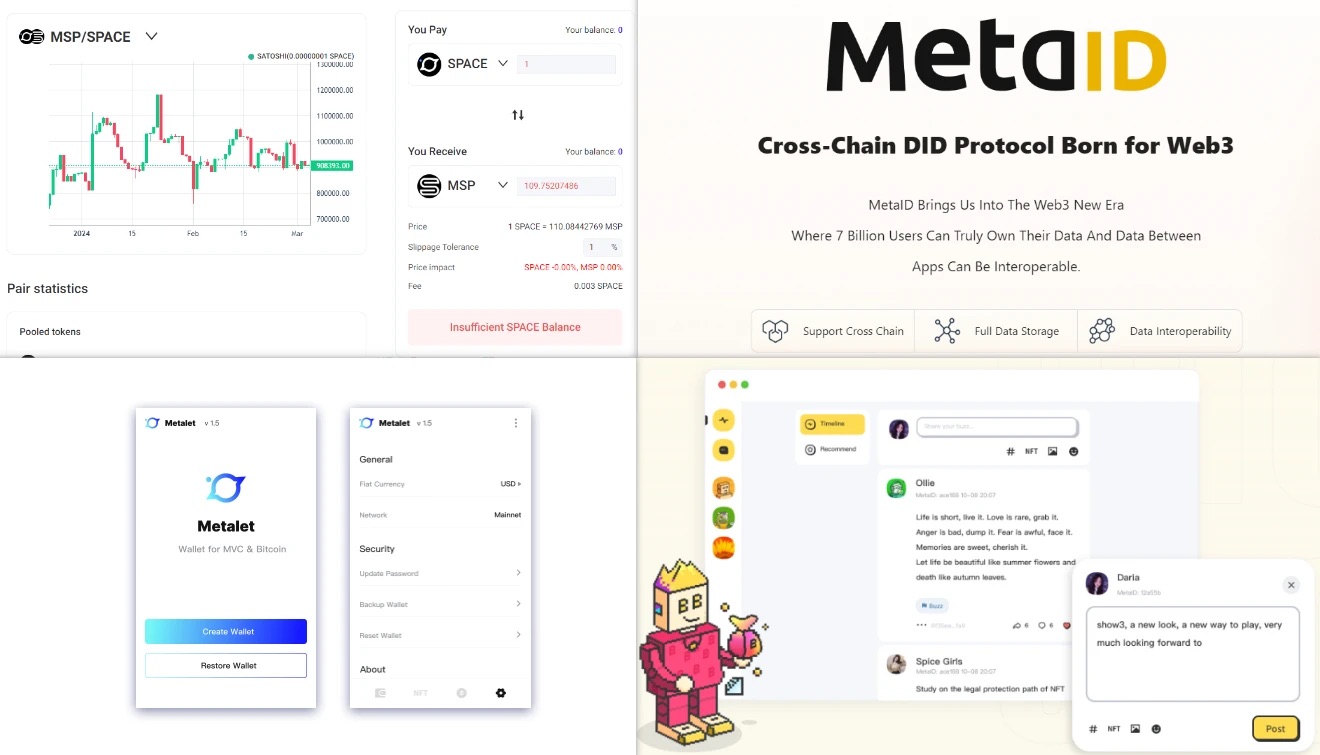
Notably, orders.exchange—the first order-book DEX in the BTC ecosystem—is set to launch on MVC, serving as a bridge between the Bitcoin network and MVC.
MVC’s roadmap reveals major plans scheduled for Q1 deployment, including an asset cross-chain bridge that will enable the seamless transfer capabilities discussed earlier. Two Bitcoin-compatible wallets will soon integrate MVC support, along with a series of performance upgrades. Once implemented, these will open smooth channels for ecosystem liquidity, driving a new wave of user growth and setting MVC on a path toward asset and ecosystem prosperity.
Aiming for the Stars—MVC’s Ultimate Scaling Vision "100 MVC"
As previously noted, MVC offers high performance, low cost, parallel processing, and high compatibility. MVC now aims to further leverage these strengths to become Bitcoin’s ultimate scalability solution.
Phase one: MVC nodes are expected to upgrade between March and April this year, activating seamless cross-chain asset channels. The standalone MVC network has already solved scalability—tested TPS exceeds 10,000, with transaction fees under $0.001, capable of supporting massive user influx.
Next, MVC plans to introduce a rapid replication feature called “100 MVC,” enabling developers to spin up a cloned version of MVC within half an hour. While maintaining the core UTXO structure and底层 functions, parameters can be customized as needed, ensuring future compatibility with both MVC and BTC. Similar to AltLayer’s Rollup-as-a-Service, 100 MVC allows developers to quickly deploy tailored networks based on specific use cases, eliminating foundational setup work and letting them focus on application logic—greatly enhancing Bitcoin’s scalability and utility.
Finally, leveraging its parallel execution and high-compatibility features, MVC envisions creating a globally unified scalable ecosystem for Bitcoin. Having 100 MVC instances would mean having 100 Bitcoin-isomorphic UTXO networks. MVC will upgrade to support interconnectivity among these 100 MVC instances and various third-party Bitcoin-based Layer 2s, sidechains, and ecosystems, exponentially increasing capacity and ultimately positioning itself as Bitcoin’s definitive scalability solution.
Conclusion
With Bitcoin’s halving imminent and capital inflows from spot ETFs showing no signs of slowing, another explosive phase of growth for the Bitcoin ecosystem is on the horizon. Unlike hyped projects still lacking real deployment, MVC—having spent years deeply building on Bitcoin—has already established a robust ecosystem. By adding smart contract capabilities to Bitcoin while maintaining strong security and high performance, MVC is forging a new path, paving the way toward a new era of mass-adoption Bitcoin.
Join TechFlow official community to stay tuned
Telegram:https://t.me/TechFlowDaily
X (Twitter):https://x.com/TechFlowPost
X (Twitter) EN:https://x.com/BlockFlow_News
 Odaily


