








20 ETH Denver Attendee Takeaways: DeFi Is No Longer Crypto's Only Use Case, Interoperability Emerges as a Key Topic
TechFlow Selected TechFlow Selected
20 ETH Denver Attendee Takeaways: DeFi Is No Longer Crypto's Only Use Case, Interoperability Emerges as a Key Topic
Denver's vitality is better than it has been in years.
 Navigating Web3 tides with focused insights
By: CRV.MKTCAP.ETH
Translation: TechFlow
ETH Denver recently took place, a massive event even larger than ETH-CC.
As a result, the entire event essentially became a "choose your own adventure" experience where you could craft your own information bubble.
We had a better idea to capture the broader experience. We asked everyone we encountered during the event to share their takeaways. Most told me to get lost, but 21 people were willing to tell me theirs.
Here are their accounts.
Scoopy Trooples, founder of Alchemix

ETH Denver is a huge celebration.
We’ve exited the bear market, friends and colleagues have reunited, excited about what we’re building and the future of our industry.
With each bear market endured, our bonds grow stronger. The sheer scale of developments in the Ethereum ecosystem is staggering—frankly, it’s hard to keep up with how fast things are moving.
We thank everyone who attended our Alchemix event co-hosted with Rare Evo, Premia, Silo, and Certora. See you next year, Denver.
LogarithmicRex, member of StrangeH2OPod
ETH Denver once again delivered on its promise: bringing together the Western crypto community for face-to-face interaction. It's hard to overstate the importance of in-person meetings for this industry, perhaps because we're so accustomed to online events. No other event matches ETH Denver in terms of participant density and momentum.
Specifically, a key takeaway from ETH Denver 2024 was that most energy shifted from the main event to single-day or half-day side events—so many, in fact, that I’d say there were too many. Everyone felt they missed something important. The main event also suffered, being much smaller with less impressive booths. I wonder how long ETH Denver can maintain its dominant position.
Finally, I noticed this year’s focus leaned more heavily toward infrastructure and ZK; while DeFi still had strong presence, I’m starting to see signs we’re moving past the era of “DeFi as crypto’s only use case.”
DeFi Dave, member of Flywheel DeFi

My two takeaways:
DeFi as a domain within crypto is rapidly maturing and evolving. Conversations at Stable Summit mostly revolved around RWA—you’ll see more institution-friendly projects and participants emerging. It may not be as wild as before, but it’s more sustainable, suggesting that as long as we preserve our core spirit of openness, positive-sum collaboration, rather than bowing too much to the old world, we can grow.
Crypto x AI isn’t a gimmick—it’s real synergy. Just as blockchain enabled self-sovereign money, it also enables self-sovereign intelligence. As centralized AI risks threaten our privacy and our children’s understanding of the world, this becomes increasingly critical. I hope we still have time to correct course, but for now, it’s in our interest not to flinch every time AI comes up and instead conduct due diligence on meaningful efforts.
Jack Melnick, Head of DeFi at Polygon
Main takeaway: The energy in Denver was better than it’s been in years. People are clearly euphoric after escaping a long bear market, enjoying the thrill of exploration and creativity after prolonged heads-down building (same for me!)
My favorite part was exploring new areas that will clearly become major themes this cycle:
-
Native yield
-
Rollups/L2s
-
Cross-chain messaging / modular interoperability
-
PvP gaming and new Ponzi economies
-
More thoughtful consumer-facing products
-
A wave of new DeFi applications
One of my biggest takeaways is that we have too many general-purpose L2s. Ultimately, sequencing fees for these generic chains will trend toward zero over a 3–5 year (or longer) timeframe.
Therefore, you should really aim for some degree of specialization—either as an app chain or a vertically focused chain—rather than competing in the same arena as everyone else. A million identical L2s will only lead to fragmentation, no matter how you spin it.
So, by extension, what fascinated me most was improvising with brilliant minds at the conference—people clearly motivated to contribute again after burning out last cycle. In just two days, we probably brainstormed over 25 new CDK chain ideas, all highly specialized.
Darren Camas, CEO and Co-founder of IPOR Labs

ETH Denver feels like a bazaar—market sentiment is somewhat excited, but infrastructure is oversupplied while DApps and end-users are underrepresented. Around the main venue, I was shocked by the dominance of infrastructure projects ranging from L2s to app-specific chains to cross-chain infrastructure.
What’s missing are users actively engaging on-chain beyond memecoin speculation. This reflects VC investment patterns in infrastructure, where the best DApps can generate multiplicative returns, yet infrastructure secures billion-dollar valuations. I can’t help but compare it to ghost cities—everyone buys property, roads are paved, sewers installed, high valuations—but nobody lives there. When people start selling off their ghost city real estate, we’ll see economic contraction back to safe levels.
My main area of interest is the re-staking narrative. As LRTs drain liquidity from DeFi, re-staking is inevitable, given the field’s overemphasis on points while neglecting returns—and more importantly, risk. Some leading LRT protocols claim to be participants in an emerging bond market, featuring different credit ratings and structures—from open marketplaces to highly curated validator sets.
Our work at IPOR Labs focuses on understanding, quantifying, and contextualizing interest rate or re-staking rate risks. The current lack of data availability represents both a massive opportunity and a significant challenge in risk assessment—one that most market participants remain unaware of. I suspect several major fund losses may occur before the market begins properly pricing re-staking opportunities. That’s where the IPOR Protocol comes in—it aims to become a credit default swap market for LRTs.
Corey Caplan, founder of Dolomite_io

Overall, it was a strong conference. While I expected recent price action to attract more "moon boys," it actually encouraged more builders to attend. There’s a lot of innovation happening, and the whole industry is eager to collaborate and push progress forward.
I also noticed increased attention to risk management and greater self-awareness about what’s being built and how risks are introduced.
Eomji Park, Head of Research & Operations at Encode Club

ETH Denver demonstrated the resilience and vitality of the community, persisting through bear markets. The highlight of the event was the dedicated builders deeply engaged in technological innovation.
The focus remains more on infrastructure than applications, notably lacking compelling apps. There’s broad recognition of the need to bring more developers into the ecosystem, yet shortcomings exist in sustaining this growing influx of activity and opportunity. Addressing this is everyone’s responsibility.
Despite challenges, the presence of intelligent and passionate individuals committed to advancing web3 is inspiring. Their efforts may impact technological fields beyond the boundaries of web3.
Wavey0x, core developer at Yearn Finance

We’re still early. Much of the technology people boast about isn’t ready for real-world use yet.
As always, the best part of ETH Denver is the people. Interacting with those deep in the same DeFi niche as you is unmatched.
Prioritize meeting people over attending main sessions.
Also, I think EigenLayer is overhyped.
Marco Worms, Yearn Finance Documentation

The ETH Denver hackathon was a major catalyst for EVM talent—in my view, the best part of this event was connecting with technical people.
Despite ongoing struggles between the U.S. and crypto, Americans seem determined to stay at the forefront thanks to events like this. Many excellent developers attended, and I'm glad to be here.
Navy Innovator
ETH Denver felt quieter than last year, which was surprising. I’m not sure why, but as an experience, it was better—many talks had only dozens (or fewer) attendees, making post-talk conversations with speakers easier. I love meeting people at conferences and consider it the best part, but I don’t need to meet 25,000 people. A smaller crowd somehow left me less exhausted.
AI was more prominent in talks this year—even more so than at ETH CC six months ago, when account abstraction was the main focus. In one talk, a speaker spun up a permissionless GPT in five minutes, leveraging idle A100 resources for rent. Crypto gaming and Farcaster were also hot topics.
Bitcoin enthusiasts showed up in force, finally seeing serious construction happening on L2s. We love to see it—true decentralization includes multiple technologies.
Overall, the space is growing larger, developers increasingly niche—even subcategories like Curve-based DeFi are impossible to fully track. The point of ETH Denver is making friends; it makes the entire crypto experience more meaningful than price rallies (though we do love those too).
Figue, member of Paladin Vote

This conference was a perfect example of a calm ending and a stormy beginning. Every project is launching, people are getting excited again. Real users are finally returning, along with genuine institutional interest—far more advanced than mere experimentation.
I see signs that this year will get very wild.
Billy, co-founder of Term Labs
Seeing BTC surge to $60k Wednesday morning on my flight, I knew there would be lots of energy. The builders’ vibe and optimism were almost as high as the price.
Beyond price gains, key themes included: founders discussing successful fundraising, LPs wanting to deploy more capital into DeFi, EigenLayer reshaping Ethereum’s landscape, LRTs, risks associated with AVS launches, people farming points, what Ethena’s success means for perpetual funding rates, Blast’s launch, massive shifts from Bitcoin ordinals, and Bitcoin’s promise to become more expressive via L2s.
Derek, verifier at Certora

Compared to last year, ETH Denver was bustling. There were countless side events, numerous new protocols and startups, and a solid group of institutions that survived the crypto winter. The event’s energy seemed to match the sharp rise in BTC and ETH prices during the same period. Winter is over—we’re in a thriving crypto spring.
Most interesting to me was the aesthetic of venues, companies, and attendees. In some ways, it felt more corporate than any previous crypto conference I’ve attended. The 80s-style interface of Curve.fi is outdated, replaced by sleek, clean, Apple-like corporate aesthetics (especially Coinbase, which set up a booth resembling an Apple Store). Companies are growing in adoption, revenue, legitimacy, and mainstream cultural integration.
Most importantly and joyfully for all of us, we’re still surrounded by incredibly smart and proactive builders. The previous hype bubbles seem to have largely dissipated—most ideas I encountered were genuine, research-driven innovations spanning ZK proofs and verified computation, rollup-based scalability and interoperability, and formal tools for auditing and formal verification. The vibe might be playful and informal, but we’re here building real things.
Kostiantyn, FinTech Product Lead at Dev.Pro

-
Stablecoins now carry risk profiles, so anyone can find one matching their needs:
-
Circle: conservative, doesn’t share profits with holders
-
Ondo: conservative, but shares profits
-
Ethena: party mode, offering 25% APY
USDT + USDC = 96% of stablecoin market cap = industry concentration and centralization risk. It shouldn’t be this way.
-
Tokenization in 2024: Treasuries and stablecoins will dominate trading volume. Real estate and art will lead innovation.
-
Interoperability is king. Blockchains and protocols should seamlessly transact.
-
Asia will be the primary driver of blockchain and crypto in 2024.
-
Institutions are catching up: Citi ran a digital asset pilot, JPMorgan processes tens of billions in daily volume.
-
Industry agnosticism? Can you truly be industry-agnostic today? – Uncertain.
-
Private networks are yesterday’s news. Today, public networks with permissions and privacy layers are real.
-
Building tech alone isn’t enough. Getting regulators to approve it is a big deal.
-
RWA isn’t really a retail product. In bull markets, retail isn’t interested in 5% APY. That changes in bear markets.
-
Prediction (or hope): U.S. regulation for stablecoins in 2024.
-
In 2017, tokenization’s brand promise was better liquidity. Today we see that’s not true. Liquidity has improved, but it’s not good—real-world illiquid assets remain illiquid on-chain. The real value of tokenization lies in efficiency, cost optimization, speed, transparency, and security.
-
Tokenization benefits things that can only exist physically. For things that can be digital-native, they should be digital-native. Money is a great example—it should ultimately be digital-native, not tokenized.
-
A digitally native generation is coming of age—accustomed to the speed, convenience, and low cost of the digital world. Imagine their reaction when they try opening a U.S. bank account, paying 3% wire fees, and waiting five days for funds to arrive. They’ll resist—and that resistance will further drive blockchain adoption.
Alan Scott, admin of RAILGUN_Project
My interactions with crypto enthusiasts and builders are usually online—on Discord, Telegram, Twitter, and if I’m lucky, some video calls. That’s what makes events like ETHDenver so compelling: hackers, speculators, and VCs converge in one city to share their adventures in this space.
I’m still digesting the week’s “alpha”—conversations over deafening music and speeches at panels. One thing is certain: memes are back in full force. $MOG, $PEPE, $WIF, random NFT collections—everyone has something they’re excited to pitch. I still chuckle at those trying to figure out how to “invest in Bera.” All of this tells me people are excitedly speculating again.
My real reason for coming was to meet other developers in the space. Most interesting conversations happened during quiet lunches. My most thought-provoking discussions were about privacy, smart contract design, malicious holders, etc.
Above all, I’m most intrigued by web3 security protocols—especially those claiming to front-run malicious transactions. Also, wallets with transaction simulation and rapid alert features to detect traps, plus various companies’ data aggregation efforts to better serve the community. More end-user security means (hopefully) greater adoption, but I worry it might encourage worse architecture—like sending millions to anonymous multisigs due to hype.
I have mixed feelings about ETH Denver. I’m slightly annoyed playing “Lu.ma Go Fish” with my “online friends.” The lack of Uber and expensive food feel like downsides, but I know I’ll come back. Thousands of like-minded people gathering in one city is almost inexplicably compelling.
Zach, founder of Party Action People

We were stunned by the response to unStable Summit. Nearly 600 people attended, with representation from nearly every major L1, L2, stablecoin, and lending protocol. A clear takeaway: serious people see stablecoins and RWA as key narratives.
As my first time attending the broader ETHDenver, I finally understand the hype—these two weeks were among the most productive conference weeks we’ve ever had. Everyone was here. Denver is also an amazing city, and we caught great weather.
Taariq Lewis, member of Volume Finance
My conclusion from ETHDenver: we’re racing for “higher-yielding ETH”! What will the world look like when every ETH tries to outperform regular staked ETH for maximum yield and points?
ETH Denver showed that LRT and LST activities drew large crowds—EigenLayer’s founder was jokingly called crypto’s “Brad Pitt.” Driven by security and financial leverage, the race for highest-yield ETH has begun.
Aiham, founding team member of Silo Finance

ETH Denver was a huge success. Most members of Silo’s core contribution team met in person for the first time since SiloDAO’s formation. We connected with many partners, users, and community members—especially valuable for our engineering team, who rarely interact with the community.
Our takeaways:
-
We received immense support and care from teams, projects, and the wider community, motivating us to better serve the DeFi ecosystem.
-
For the first time in two years, we felt overwhelmingly positive sentiment across the entire ecosystem.
-
Innovation has returned to the ecosystem.
Tao, member of Aladdin DAO

This was my second time attending ETH Denver.
Last time, I came as a developer. The main event wasn’t well-prepared—poor connectivity, expensive food. But hacker houses fostered the developer community, especially Huma Finance’s. They offered free coffee, free meals, fast internet, and prizes—they clearly understood what developers needed. I thank them for making ETHDenver more developer-friendly.
This year, I served more in Aladdin DAO’s business development role, promoting our latest product, f(x) Protocol’s $fxUSD. It was also my first time speaking at Unstable Summit. I was thrilled to meet all the DeFi enthusiasts.
Although DeFi may not be as hot a topic this year as AI or BTC L2s, the entire DeFi industry is still growing rapidly.
Samuel McCulloch, member of Flywheel and Leviathan News

Everything about ETH Denver can be summed up by this chart showing monthly VC funding amounts over the past three years.
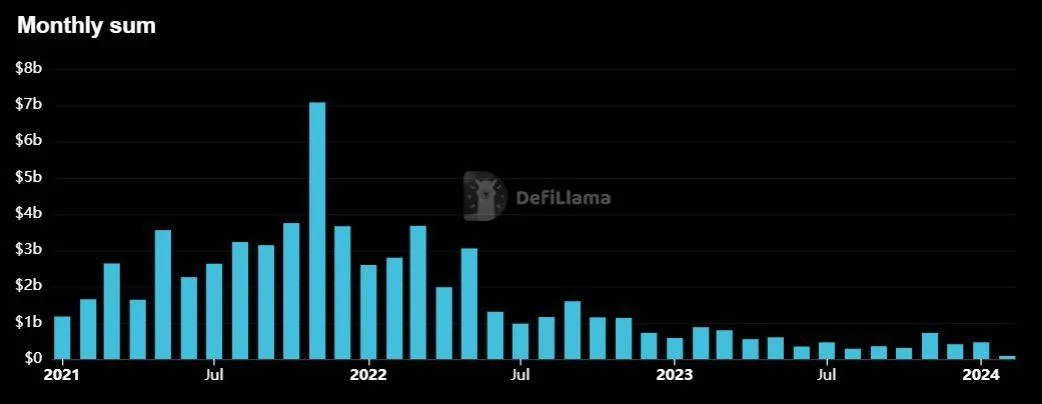
After peaking in 2021/22, new funding for projects has essentially dried up—the impact on America’s largest crypto event is evident. Lavish parties disappeared (except Berapalooza), main event booths decreased, attendance dropped.
Low-key. That’s how I felt about this year’s ETH Denver. Despite record-high prices, new capital hasn’t flowed into major projects at the scale seen in the last bull run. I suspect we’re still haunted by FTX’s collapse, and U.S. regulation isn’t better than before. DeFi isn’t the big narrative this year—it’s AI and re-staking. The former hasn’t been tested through cycles, resting solely on OpenAI’s $7 trillion valuation. The latter is just industrial-scale airdrops—no revenue, no use cases, a multi-billion dollar farm.
That’s not to say things won’t change, but the week’s sober mood was palpable.
Alex Golubitsky, founder of MetaLeX

Another great ETH Denver! Although I bought a main event pass, I never actually attended the main conference. Side events were as excellent as always. My biggest takeaways from this event:
-
Governance is top of mind for projects
-
Stablecoins generated strong interest among market participants, particularly basis-swap-denominated stablecoins
-
ZK remains a key narrative
-
Interest in L2s and alternative L1s remains high
Regarding the event itself, my biggest concern is that it’s no longer a single event but a series of related ones. While side event quality may be the best ever, I worry the community is becoming siloed, reducing collaboration opportunities between groups that don’t normally interact.
Join TechFlow official community to stay tuned
Telegram:https://t.me/TechFlowDaily
X (Twitter):https://x.com/TechFlowPost
X (Twitter) EN:https://x.com/BlockFlow_News
 @CurveCap











