
24-Hour Surge Over 50%: Is Arweave Becoming the "Ethereum Killer" Again?
TechFlow Selected TechFlow Selected
24-Hour Surge Over 50%: Is Arweave Becoming the "Ethereum Killer" Again?
After nearly two years of planning, Arweave is transitioning to a Web3 full-stack protocol.
 Navigating Web3 tides with focused insights
Authors: Joyce, Kaori
In the storage sector, after FIL's surge, it's AR's turn.
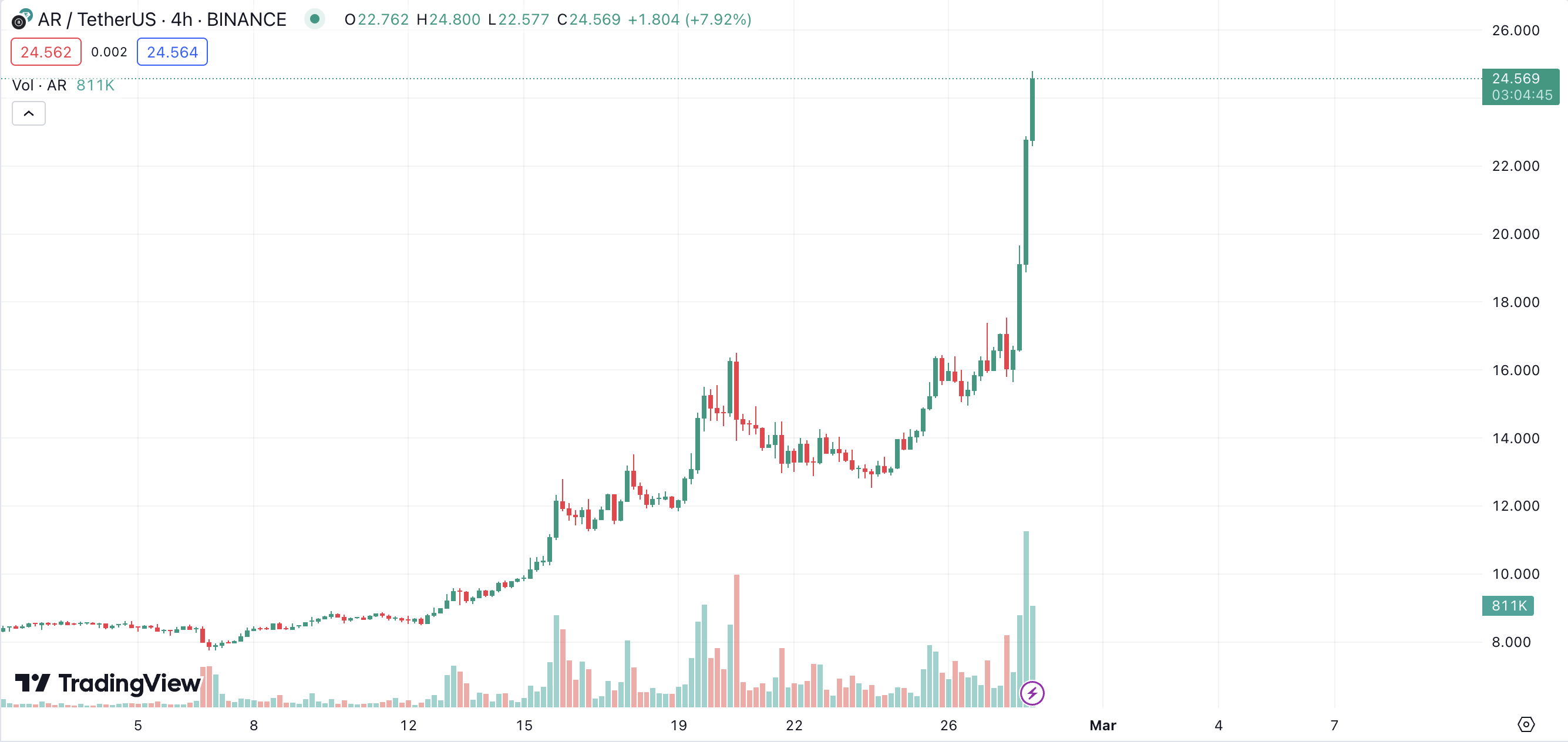
Yesterday, blockchain storage protocol Arweave launched its public testnet Arweave AO, designed as a computing layer for social media and AI applications. Following the announcement, its native token AR surged in price, breaking through $24 at the time of writing—an increase of 51% within 24 hours.
Zhixiong Pan, founder of ChainFeeds, posted on X: "Arweave is the most promising crypto protocol to make large-scale decentralized data storage a reality. We live lives fundamentally different from our ancestors solely because we inherit and leverage the knowledge and experience accumulated over tens of thousands of years. Perhaps this new technology will place an ENIAC inside a reborn Library of Alexandria."
So what mission does Arweave aim to accomplish with this newly launched testnet? Arweave founder Williams has even claimed that Arweave AO is confident enough to compete with Ethereum, dubbing itself an "Ethereum competitor." But what exactly is Arweave AO?
Massive Scale + Verifiability: Arweave AO’s Vision of a Supercomputer
Arweave focuses on "permanent information storage," a decentralized data storage protocol based on blockweave technology. Its mainnet launched in June 2018, utilizing the BlockWeave data structure and SPoRA consensus mechanism to offer a novel solution to permanent data storage. With its one-time payment, lifetime usage model, Arweave eliminates the need for recurring subscriptions. The team has even promised users at least 200 years of storage service.
The newly introduced Arweave AO testnet represents a new approach to infinitely scalable blockchains capable of handling larger computational workloads. "AO is a hyper-parallel computer—a decentralized computing environment that allows you to run any number of processes simultaneously in parallel. Previous decentralized computing systems could either support massive computation or verifiable computation. AO can do both at once," said Arweave founder Williams in the launch video.
This signifies Arweave’s expansion into the computing domain—similar to Ethereum’s “world computer” vision—and Arweave AO could even allow AI and large language models (LLMs) to run directly within smart contracts.
In an interview, Williams highlighted how Arweave AO differs from other high-performance blockchains like Aptos and Sui: its ability to store vast amounts of data, such as AI models. "This is largely because the project is fundamentally built upon a data storage platform."
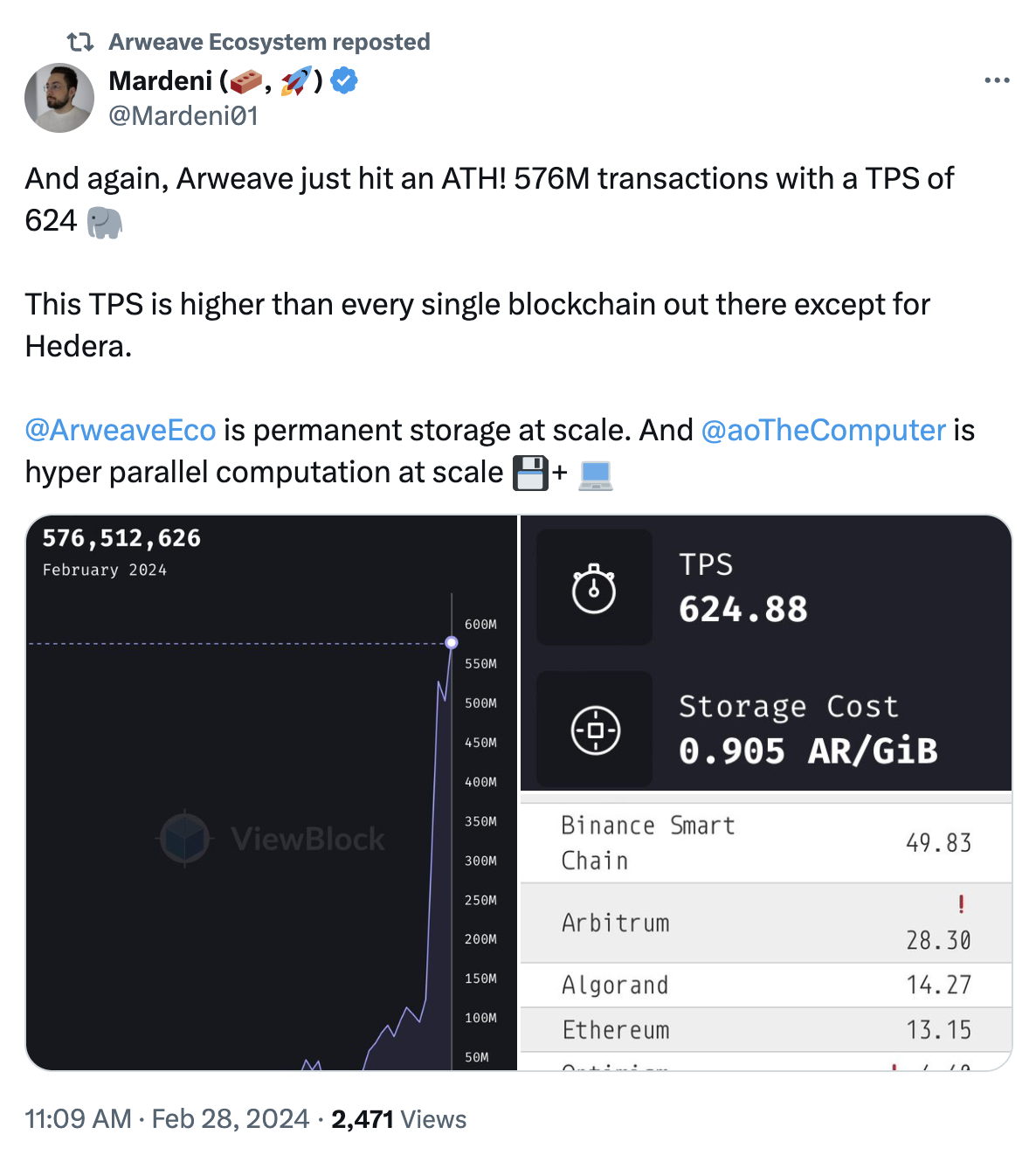
Mardeni, CEO of decentralized database WeaveDB, noted on social media that Arweave hit an all-time high in transaction volume today, with TPS far exceeding most blockchains. As for how Arweave AO will perform in the future, we’ll have to wait and see.
But before reaching this point, Arweave went through many exploratory phases.
From Storage Origins to Transformation: Arweave’s Evolution
Founded in 2017, Arweave began as a blockchain-based file storage protocol offering one-time payment for permanent file storage. Through a simple economic incentive model, it encourages miners to store data long-term. By 2021, over 200 applications had been built on the Arweave network, spanning categories including social networks, infrastructure, content distribution, and verification tools.
Over the following two years, influenced by the NFT market and the growth of the Web3 creator economy, Arweave saw significant business growth. By the end of 2022, Arweave’s stored data volume was nearly triple that of the previous year, up 192% year-on-year. At that time, Arweave’s 30-day network revenue approached $300,000, ranking first among Web3 infrastructure protocols—surpassing notable projects like Storj and Helium in both storage and DePIN sectors.
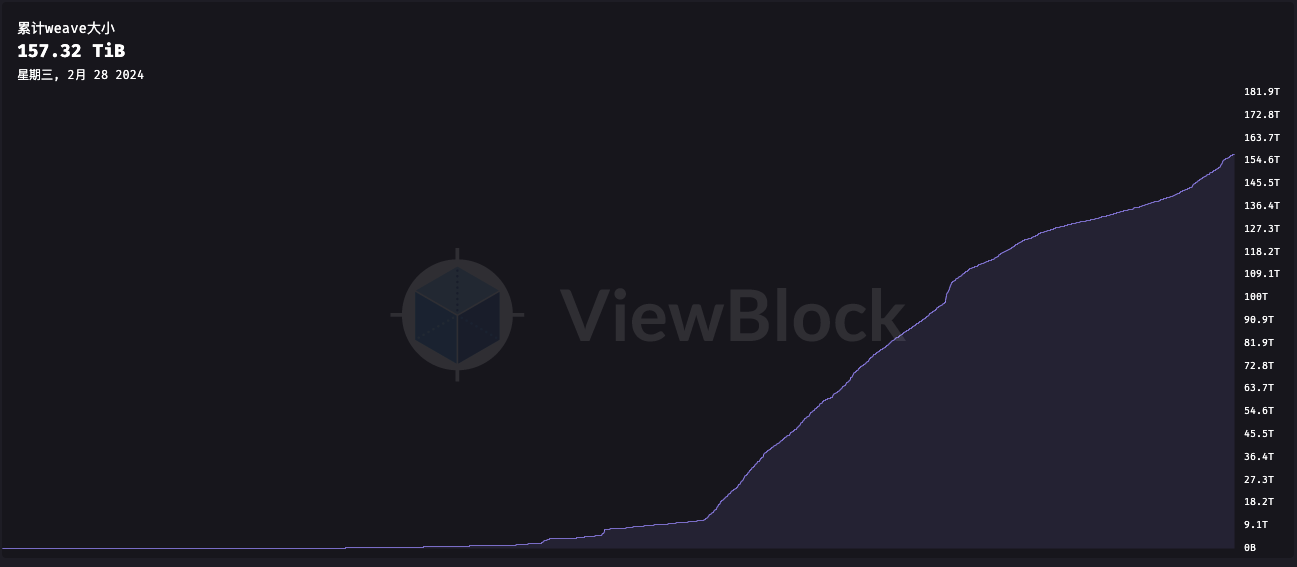
Source: https://viewblock.io/zh-CN/arweave/stat/cumulativeWeaveSize
However, starting in 2023, Arweave’s storage business growth noticeably slowed. At the time of writing, Arweave’s total stored data stands at 157TB—only a 30% increase over the past year—with declining revenues from storage services.
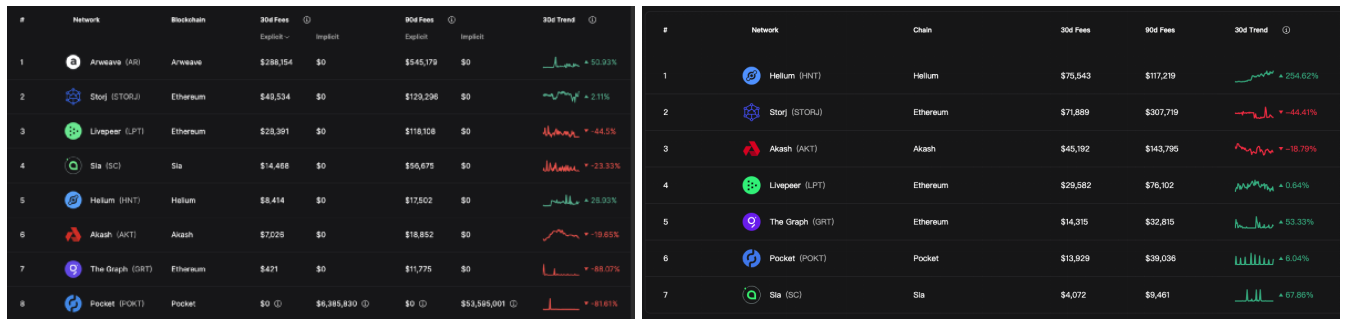
Source: https://web3index.org/
Left: Early 2022; Right: Early 2024
According to a 2023 Arweave ecosystem report published by the PermaDAO community, Arweave’s annual network storage volume in 2023 underperformed compared to 2022, totaling only 32.96 TiB—a 55.78% decline year-on-year. Monthly storage volumes fluctuated between 2–4 TiB throughout 2023, with the lowest recorded in June at just 1.43 TiB.
Meanwhile, the Arweave network remained exceptionally active in 2023, with smart contract growth serving as another key metric. Contract deployments surged by 1063% compared to 2022.
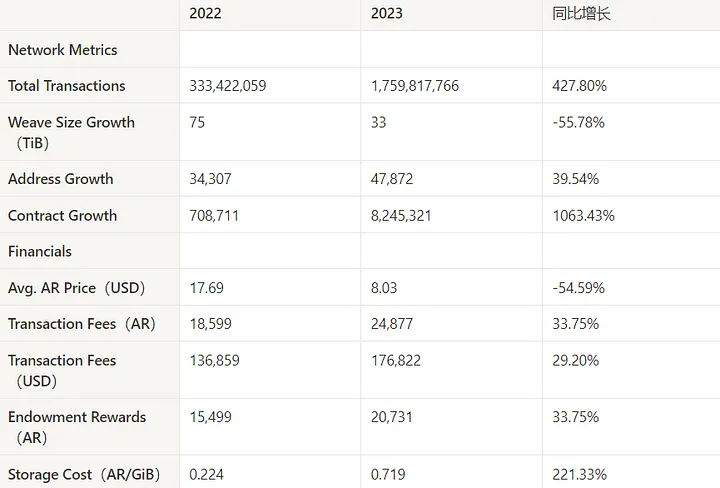
These metrics reflect Arweave’s current dilemma: while many projects use Arweave’s storage services, few are fully built on top of Arweave. It remains difficult for Arweave to generate strong network effects based solely on storage. Yet, the explosive growth in new contracts also signals considerable potential ahead.
It is widely recognized that low-cost on-chain storage is crucial to the success of blockchain and Web3. In a conversation with ArDrive founder Philip Mataras, Arweave founder Sam Williams revealed a striking cost comparison: storing a 13 GB file on Arweave costs only $87, whereas storing the same data would cost approximately $35,620,000 on Bitcoin and $780,000,000 on Ethereum.
As a permanent storage project, Arweave itself is inherently visible, publicly transparent, and permanently accessible. Its storage-based consensus paradigm (SCP) enables off-chain scaling without sacrificing on-chain finality. Any system adhering to SCP’s scaling theory can become part of Arweave to fulfill specific functions.
In essence, Arweave does not face inherent scalability challenges. Azriel, author of the PermaDAO report, believes "it's only a matter of time before Arweave moves from behind the scenes to center stage." Public blockchains have long struggled with computation and storage costs, yet Arweave has already demonstrated its potential to drive full decentralization of DApps. Arweave’s role extends beyond being a decentralized storage platform—it aims to be a full-stack Web3.0 protocol enabling complete DApp decentralization.
After the release of Arweave AO, founder Sam Williams stated in an interview: "We’ve built a hyper-parallel computer—a machine capable of running an unlimited number of threads simultaneously in parallel. Its scalability is incredible."
It’s not just the founders who hold this grand vision—believers exist throughout the Arweave community. Developers and the community view Arweave as a data availability layer directly supporting DApp development. During a 2022 Twitter Space, Bear Wei, founder of everFinance in the Arweave ecosystem, joked: "Arweave’s starting point is Ethereum’s endgame."
It's hard to assess precisely how much disruption Arweave AO will bring to the current public chain landscape, but after nearly two years of planning, Arweave has successfully transitioned from a storage-focused project to a full-stack Web3 protocol. A 50% surge in price within 24 hours is attention-grabbing enough. One thing is certain: Arweave’s entry will make the competition among public chains even more exciting.
Join TechFlow official community to stay tuned
Telegram:https://t.me/TechFlowDaily
X (Twitter):https://x.com/TechFlowPost
X (Twitter) EN:https://x.com/BlockFlow_News
 BlockBeats