
What is AI Agent disrupting after AIGC?
TechFlow Selected TechFlow Selected
What is AI Agent disrupting after AIGC?
Four products to help you understand what an AI Agent is.
 Navigating Web3 tides with focused insights
By Mu Mu
If AIGC was the quintessential AI application of 2023, then in 2024, AI Agents will truly productize AIGC capabilities.
Having GPT schedule your day, write a text message, or send an email with just one sentence is now trivial. Recent versions of GPT can even generate long videos from text. Compared to large models like GPT, AI Agents resemble more concrete, all-around employees—early forms of artificial intelligence robots. These software-and-hardware-integrated agents can observe their surroundings, make decisions, and autonomously take actions much like humans do.
As Microsoft co-founder Bill Gates put it: "Whoever dominates AI Agents—that’s the big deal. Because you’ll never need to search websites or Amazon again."
An increasing number of companies are focusing on the AI Agent field. According to data from Industry Plus, by November 2023 alone, China's Agent sector had seen 13 financing events totaling approximately 73.5 billion RMB, with an average funding of about 5.654 billion RMB per company.
In China, the former vice president of DingTalk has entered the AI Agent space, founding Ban Tou Yan Intelligent Technology, which secured hundreds of millions in funding. Abroad, the field is even hotter. Data shows that “at least 100 projects are working on commercializing AI Agents, with nearly 100,000 developers building autonomous Agents.”
Products like the AI wearable device Rabbit R1, which can hail rides anytime, and Samsung’s robot Ballie, capable of detecting owners’ emotions and pet-sitting, signal that AI Agents are becoming the new frontier in smart technology. The following four applications illustrate how AI Agents could transform internet experiences:
ARC Search Reinvents Traditional Search Experience
Launched in January 2024, ARC Search is a new AI Agent touted to revolutionize traditional search. Typically, when searching for a topic online, users enter keywords, browse web pages, and sift through hundreds of links to find useful information.
In today’s information-overloaded era, finding valuable content is increasingly difficult. Targeting browsers like Chrome and Safari, ARC Search focuses on speed—delivering the most relevant information in the shortest time with minimal user interaction.
ARC Search offers two browsing modes: traditional mode, using keyword or URL searches, and AI mode, where users input questions or prompts via natural language conversation.
In AI mode, search results are no longer chaotic or fragmented. Instead, retrieval includes AI-generated answers with clean formatting, presenting key points, top results, detailed content, and relevant webpage links.
For example, searching “how to make the perfect fried egg” yields a richly illustrated cooking tutorial, complete with sections on ingredients and tools, cooking steps, and tips, supplemented by photos or videos.
 ARC Search automatically summarizes search content (Image: TechCrunch)
Building on traditional search, ARC Search combines AIGC (AI-generated content) with Agent functionality—automatically analyzing optimal decisions, organizing, summarizing, and synthesizing results into a single “best answer.”
Voyager as a Human Apprentice in Minecraft
Voyager is a large-model-powered gaming agent introduced by NVIDIA. In May 2023, NVIDIA open-sourced Voyager and applied it to the game Minecraft.
In Minecraft, beyond survival and free exploration, players aren’t given specific goals. For this highly open-ended game, Voyager can independently explore for hours, adapt decisions based on its environment, and develop skills such as fighting monsters and sourcing food.
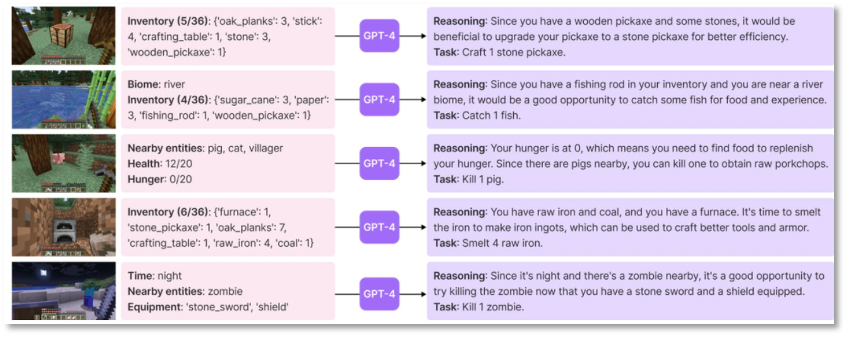 Voyager self-learning within Minecraft
The in-game Voyager learns from mistakes until it discovers correct methods, storing execution procedures for future use.
Voyager’s demonstrated abilities in Minecraft represent only NVIDIA’s initial exploration of AI Agents, proving it can learn, decide, and act like a human rather than run on predefined scripts. As NVIDIA envisions, Voyager could eventually be deployed in virtual environments, drone operations, and humanoid robotics.
DingTalk’s “AI Super Assistant” Enters Workflows
Since its launch in 2014, DingTalk rapidly entered enterprise management systems, becoming an unavoidable office tool for workers. As its features expanded, the interface grew increasingly bloated, leading to confusion—“many functions go unused, while needed ones are hard to find.”
Ten years later, with over 700 million users, DingTalk is embracing the AI era to boost productivity. On January 9, at the DingTalk 7.5 product launch event, AI Agents were the highlight.
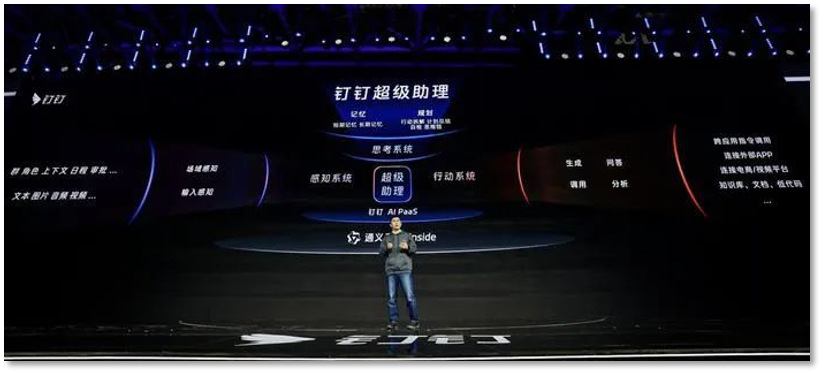 DingTalk launches its AI Super Assistant
As demonstrated, through a natural language chat interface, the AI assistant can handle over 30 tasks including system settings, scheduling, task management, work summaries, message digesting, leave approvals, content creation and editing, and smart image generation.
Notably, DingTalk’s AI assistant supports cross-system task execution. Once connected to third-party platforms via open APIs, it can integrate shopping, video, websites, and other external services. DingTalk plans to launch an AI Assistant Marketplace (AI Agent Store) in April this year, inviting developers to join the ecosystem.
SkyAgents: No-Code AI Agent Builder
Today’s market not only features scenario-specific AI Agents but also tools designed to build and deploy them.
On December 1 last year,昆仑万维 (Kunlun Tech) launched “SkyAgents,” a developer-focused tool for building AI Agents. On December 25, the SkyAgents Beta version officially opened for testing.
Built on Kunlun’s SkyChat large model, SkyAgents claims perception-to-decision and decision-to-execution autonomous learning and independent thinking capabilities. It enables no-code operation, allowing even non-developers to design their own large-model AI assistants.
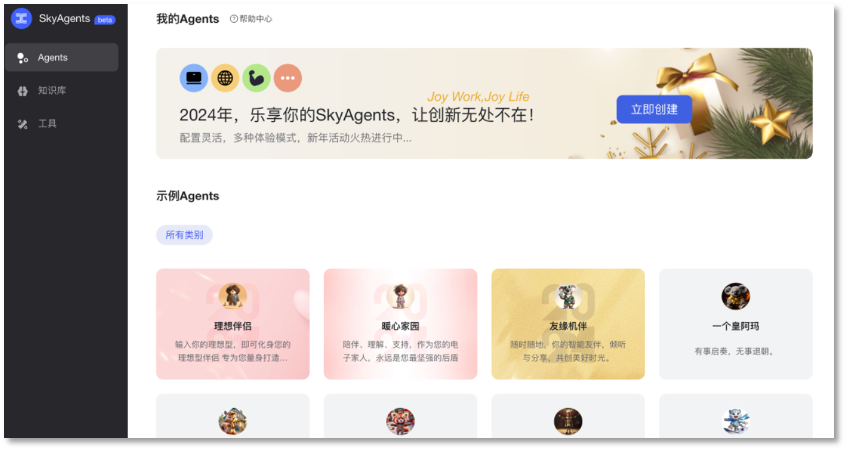 SkyAgent testing interface
On the SkyAgents platform, users can deploy personalized AI Agents within minutes using natural language and simple operations—no coding required. These agents can fulfill customized needs such as generating industry research reports, filling out forms, designing logos, creating fitness plans, or booking travel flights.
Conclusion
Current AI Agents are built upon AIGC capabilities, with text generation dominating. As large models advance, multimodal generation—voice, images, video—will increasingly emerge within AI Agents, enhancing how we interact with internet applications.
So, what exactly are AI Agents disrupting?
Bill Gates believes AI Agents will disrupt the software industry in the coming years. He describes this disruption as “a shockwave across the tech sector” and “the biggest transformation in computing since the shift from command lines to graphical interfaces.”
Join TechFlow official community to stay tuned
Telegram:https://t.me/TechFlowDaily
X (Twitter):https://x.com/TechFlowPost
X (Twitter) EN:https://x.com/BlockFlow_News