Exploring ERC-404: An Experimental Adventure in Token-NFT Duality
TechFlow Selected TechFlow Selected
Exploring ERC-404: An Experimental Adventure in Token-NFT Duality
An innovative token standard—how did it trigger a market frenzy with tokens surging over 100x in less than a week?
 Navigating Web3 tides with focused insights
Author: dt, DODO Research
Editor: Lisa
When it comes to the hottest trend on Twitter recently, nothing beats "ERC-404"—a new token standard developed by the Pandora team. Although it hasn't gone through the official Ethereum Foundation proposal process and remains an unofficial standard, ERC-404’s innovative “dual nature of tokens and NFTs” has captured widespread attention and triggered a wave of speculation. Not only did the team's own $PANDORA token surge over 100x within a week of launch, but it also sparked a rush among numerous projects to issue tokens based on the ERC-404 standard.
This week, Dr. DODO will walk you through what exactly the ERC-404 standard is all about.

Origin
To understand Pandora, we need to go back to early this month when a new project called Uniswap Emerald (EMERALD) emerged. To tackle NFT liquidity issues, Emerald introduced a modified token standard that directly integrates liquidity into Uniswap. When users buy 1 $EMERALD token (an ERC-20), they simultaneously receive one NFT—effectively establishing a 1:1 equivalence between each EMERALD token and its corresponding NFT. However, due to smart contract vulnerabilities, the project suffered attacks and had to redeploy its token contract multiple times; the team is still actively working on fixes. Pandora drew inspiration from Emerald, with its three founders refining the original concept into what is now known as the ERC-404 token standard. ERC-404 aims to bridge the long-standing gap between traditional ERC-20 and ERC-721 standards by creatively enabling coexistence and interaction between fungible tokens and NFTs through innovative coding techniques.
ERC-404
The core innovation behind this so-called "dual nature of tokens and NFTs" lies in its clever data encoding mechanism. ERC-404 enables fungible token balances and non-fungible token IDs to share the same underlying data structure while preserving their distinct identities—much like a magician who can identify specific cards within a deck without altering the total number of cards.
Another highlight of ERC-404 is its built-in mapping mechanism, which allows seamless conversion between fungible tokens and their associated NFTs. When you sell your tokens, the corresponding NFT is automatically burned; conversely, minting tokens creates a new NFT. This not only significantly enhances NFT liquidity but also unlocks endless possibilities for creative trading strategies. Users may even have the option to manually choose which NFTs to burn or retain.
Of course, as an experimental standard, ERC-404 currently has certain technical limitations—for example, it cannot precisely specify which NFT gets destroyed during redemption. However, such issues could potentially be mitigated through thoughtful tokenomics design, such as introducing rarity tiers.
Current Status
Pandora is the first token built on the ERC-404 standard, with a fixed supply of 10,000 tokens. Since its launch on February 2, its market cap has approached $100 million. On February 6, Pandora transitioned to a 2-of-4 multisig setup. As with any NFT project, rarity and fragmentation are key considerations. Pandora assigns varying degrees of rarity upon minting, with five distinct rarity levels creating potential arbitrage opportunities and boosting overall liquidity.
Beyond Pandora itself, numerous other projects have already launched tokens using the ERC-404 standard. Notably, OKX Web3 Wallet has created a dedicated category specifically for ERC-404 assets.
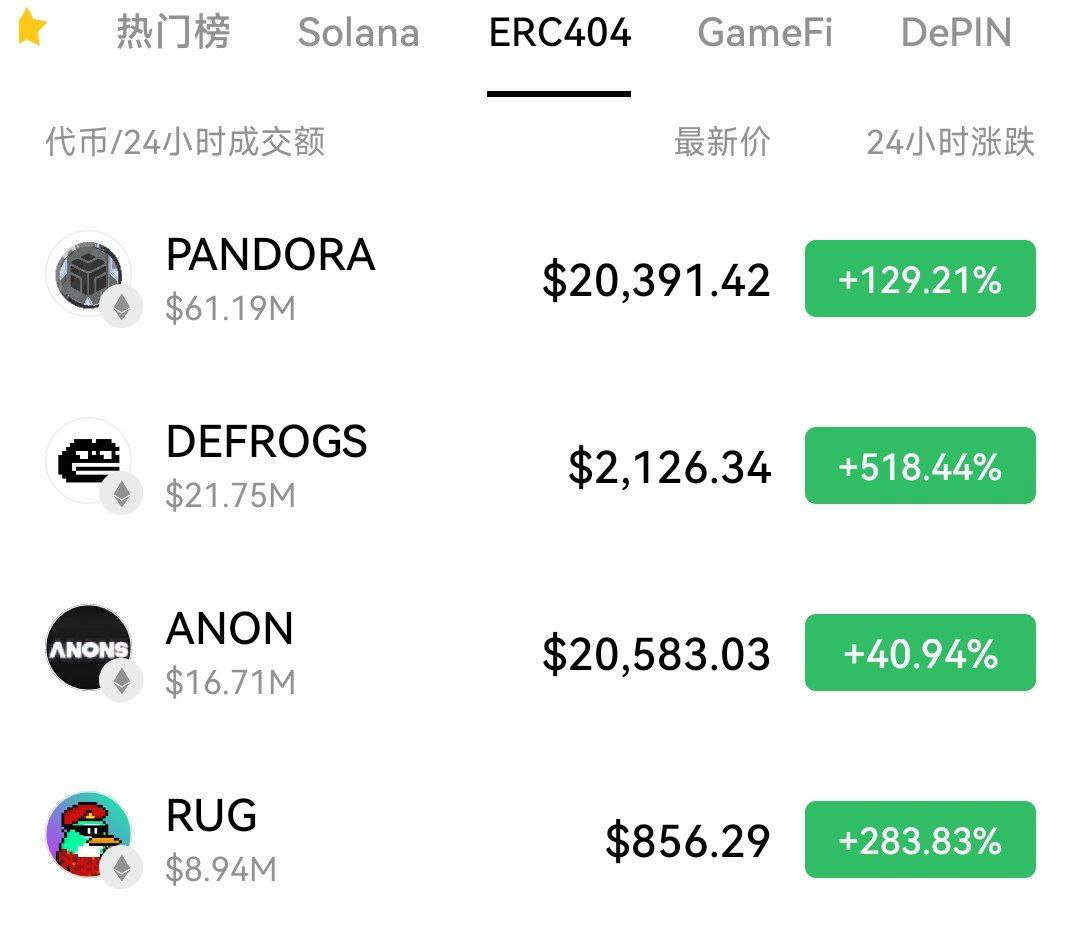
Source: OKX Web3 Wallet
Author's Perspective
In my view, ERC-404 represents a bold and pioneering experiment. Its emergence has made many existing NFT-Fi projects look less compelling. NFT liquidity has long been a major challenge, and ERC-404 directly addresses this by embedding the solution into a token standard, effectively bridging two previously incompatible worlds. It opens up exciting new possibilities in the digital asset space and could inspire many more groundbreaking innovations.
That said, as an unofficial standard, it also carries inherent security risks. We’ll have to wait and see how it evolves going forward.
Join TechFlow official community to stay tuned
Telegram:https://t.me/TechFlowDaily
X (Twitter):https://x.com/TechFlowPost
X (Twitter) EN:https://x.com/BlockFlow_News
 Dr.DODO