








Bixin Ventures: With the BTC ecosystem booming, why did we invest in DLC.Link?
TechFlow Selected TechFlow Selected
Bixin Ventures: With the BTC ecosystem booming, why did we invest in DLC.Link?
Bixin Ventures hopes that DLC.Link's seamless integration with DeFi will help address the challenges facing the Bitcoin ecosystem.
 Navigating Web3 tides with focused insights
Introduction
As early holders and staunch supporters of BTC, Bixin Ventures has always been committed to the BTC ecosystem. We believe BTC assets should play a greater role and generate higher yields within top-tier DeFi protocols across various blockchains. Therefore, efficient cross-chain bridges are essential, which is why we invested in DLC.link in its early stages last year.
With the rise of inscribed assets and the expansion of Bitcoin's data layer networks, Bitcoin-based applications are increasing. Given Bitcoin’s limited native smart contract capabilities, Bixin Ventures views DLC.Link as an innovative solution. After the FTX collapse, the market urgently needed secure, decentralized alternatives to Bitcoin. DLC.Link aligns with our vision—dedicated to building a secure, trustless ecosystem and expanding Bitcoin’s utility across diverse use cases.
DLC.Link Technology Deep Dive
How DLC Technology Leverages Schnorr Signatures from the Taproot Upgrade
Bitcoin introduced Schnorr signatures in the Taproot upgrade—a more secure alternative to ECDSA for generating and verifying cryptographic keys. Schnorr signatures exhibit linearity, enabling efficient aggregation of public keys and signatures, allowing multiple transactions to be verified in a single operation. Discreet Log Contracts (DLCs) fully leverage the Schnorr and PTLC technologies already implemented in Taproot. Since both are natively supported by the Bitcoin network, DLCs do not require Layer 2 solutions or sidechains. Instead, DLC technology is secured directly by Bitcoin’s entire network hash power, making it significantly safer and more reliable.
In a DLC-based lending scenario, Schnorr signatures are typically used to manage conditional outcomes. Each party generates a unique key, combining it with their long-term private keys to form a joint "public key," and pre-signs all potential outcome messages—such as repayment or liquidation. Then, a decentralized network of oracles confirms real-world outcomes via discreet log numbers, unlocking the pre-signed messages and triggering on-chain contract execution. This demonstrates the practical versatility, flexibility, and security of DLC technology.
How DLC Technology Ensures On-Chain Bitcoin Security Without Validators
Discreet Log Contracts (DLCs) eliminate the need for external validators by inheriting Bitcoin’s own security model, ensuring on-chain safety [2]. In the DLC.Link architecture, the Attestor network represents an innovative design. As an off-chain service, these attestation nodes actively monitor the blockchain through smart contracts and publicly announce DLC-related events in JSON format. After retrieving results from data sources (e.g., smart contracts on another blockchain), they verify and sign them. To enhance security, DLC.Link employs a 5-of-7 multi-signature scheme among attestation nodes, reducing collusion risks between oracles and counterparties. The DLC.Link management contract randomly selects trustless attesters from a whitelist. The design also allows third parties and organizations to operate attester nodes, further promoting decentralization. This decentralized oracle network eliminates single points of failure and efficiently supports DLC creation and signature requests. This comprehensive framework not only safeguards the integrity, security, and flexibility of Bitcoin transactions but also proves that DLC.Link is the ideal infrastructure for integrating BTC with decentralized finance (DeFi).
How FROST Signatures Enhance DLC Security
DLC.Link integrates FROST (Flexible Round-Optimized Schnorr Threshold Signatures) to improve security and streamline oracle management. FROST’s key re-sharing capability enables dynamic management of the attestation network, allowing rapid adjustments to participants without disrupting service integrity. During setup or changes to the attester set, the system collaboratively generates keys—producing both a shared group key and individual private keys for each attester. This flexible key generation mechanism ensures the oracle network can be securely modified later without service interruption.
When a blockchain event triggers the creation of a DLC contract, the coordinator among the attesters broadcasts a create-dlc command, generating a consensus-backed DLC announcement. Similarly, when closing a DLC, a blockchain event prompts the coordinator to initiate final attestation, where each attester’s signature ensures secure and verifiable contract closure. This advanced upgrade introduces dynamic adjustability to the oracle network, significantly reduces computational complexity, and maintains strict security standards.

Figure 1. DLC.Link Technical Workflow
DLC.Link Product Overview
dlcBTC
Launching in early 2024, dlcBTC stands at the forefront of decentralized finance (DeFi), offering custodian-free Bitcoin on the Ethereum network through Discreet Log Contracts (DLCs). With dlcBTC, users can "self-wrap" their deposits—their BTC remains under personal control, secured by attestation mechanisms. dlcBTC depositors never send BTC to DLC.Link or any third party.
In this groundbreaking process, users securely lock their Bitcoin into DLC.Link using a DLC, thereby minting an equivalent amount of dlcBTC. The DLC acts as a digital vault on the Bitcoin blockchain, establishing a pre-signed agreement between user and protocol. For enhanced security, key distribution uses a 2-of-2 multisignature UTXO mechanism: one key held by the user, the other intelligently distributed across a trusted network of attesting nodes.
Cross-chain bridges have gained a poor reputation due to numerous vulnerabilities. DLCs offer a unique solution by enabling cross-chain communication without the security risks inherent in traditional bridges. Unlike bridged assets such as wBTC, dlcBTC does not rely on intermediaries; instead, it leverages the full hashing power of the Bitcoin network for asset protection. dlcBTC v1, launching in Q1 2024, will feature whitelisted access, robust security measures, versatile trading pairs, and seamless integration with existing DeFi protocols—marking a significant advancement in decentralized finance.
We believe Ethereum is the most decentralized network after Bitcoin. Thus, through dlcBTC, we aim to bring native BTC into Ethereum’s DeFi ecosystem—without relying on smaller, unproven, and riskier L2s or alternative solutions. Minted dlcBTC tokens can be used as collateral on leading DeFi platforms like Curve and Aave, enabling users to actively participate in DeFi activities such as investing, lending, and hedging.
Broad Applications of DLC.Link in the Bitcoin Ecosystem
DLC.Link is a transformative force in the broader Bitcoin ecosystem, offering a wide range of applications through its Discreet Log Contracts (DLCs). This innovation holds particular significance for credit desks, prime brokers, digital asset custodians, exchanges, and OTC desks. This integration allows custodians to extend financial services to self-custody Bitcoin clients, supporting custody and conditional instant transfers of native Bitcoin, as well as lending services for miners and other self-hosted Bitcoin holders.
DLC.Link’s role in decentralized finance (DeFi) is equally broad and impactful. Its integration fosters the development of Bitcoin-backed loans and stablecoins, benefiting lending protocols. Additionally, DLC.Link can seamlessly extend to cross-chain protocols, enabling the transfer of native Bitcoin across different blockchains. With the current popularity of BRC-20 assets, DLC.Link can also support their inclusion in cross-chain bridging. Furthermore, it enables trading and lending of inscribed assets on NFT marketplaces (e.g., OpenSea) and other smart contract-based platforms, introducing new use cases to DeFi.
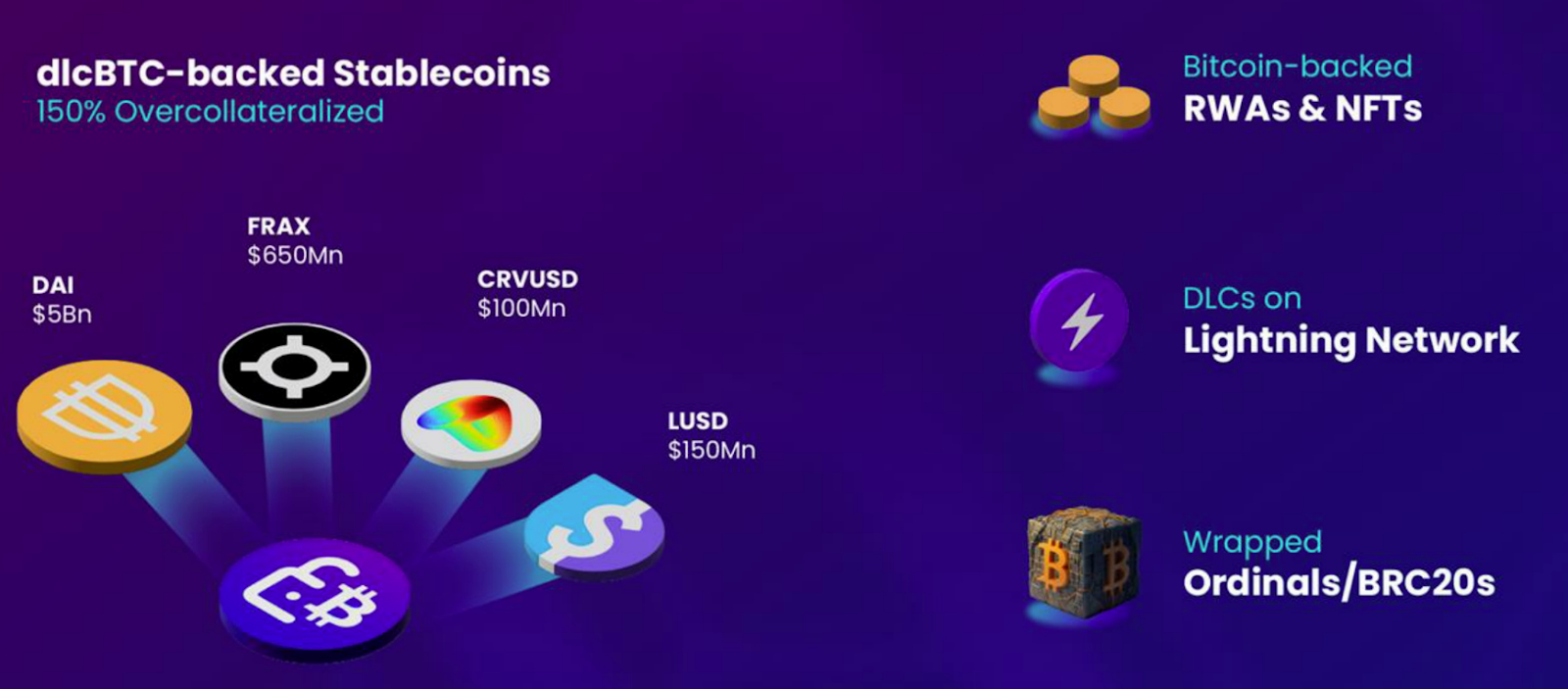
Figure 2. DLC.Link Broad Use Cases
Conclusion
Bixin Ventures strategically invested in DLC.Link during its early seed round, driven by the belief that its seamless integration with decentralized finance (DeFi) would help address key challenges facing the Bitcoin ecosystem. DLC technology overcomes Bitcoin’s limitations in smart contract functionality while better leveraging Bitcoin’s robust security, offering a safer alternative. Recent advancements such as Schnorr Signatures in the Taproot upgrade now enable DLC.Link to establish its oracle network, and the integration of FROST further enhances dynamic oracle management. The launch of dlcBTC also meets the growing demand for secure, decentralized, self-wrapped Bitcoin. Moreover, DLC.Link holds immense potential across various product layers—including self-custodial deposits in CeFi and cross-chain inscription assets in DeFi. Bixin Ventures’ strategic investment in DLC.Link reflects our commitment to shaping the future of decentralized finance. We recognize DLC.Link’s innovative contributions to the crypto space and foresee it playing a pivotal role in providing Bitcoin liquidity across the broader cryptocurrency ecosystem.
Join TechFlow official community to stay tuned
Telegram:https://t.me/TechFlowDaily
X (Twitter):https://x.com/TechFlowPost
X (Twitter) EN:https://x.com/BlockFlow_News
 Bixin Ventures









