
API3's new public chain targets overlooked OEV
TechFlow Selected TechFlow Selected
API3's new public chain targets overlooked OEV
API3's Layer2 specifically captures OEV value and feeds it back to DApps so they can benefit from the returns.
 Navigating Web3 tides with focused insights
Author: Riyue Xiaochu
1) API3 is an innovative first-party oracle that yesterday announced the launch of a zk layer2 for OEV. OEV is a subset of MEV, referring to oracle-related extractable value. When oracles deliver the latest prices to dApps, certain assets may present liquidation and arbitrage opportunities. API3's layer2 specifically captures this OEV value and redistributes it back to dApps so they can benefit from the revenue.
2) This is primarily due to API3 being a first-party oracle. In other words, API3’s oracle data does not require third-party aggregation or intermediaries, but is provided directly by the original data source. This is achieved through its core component, Airnode, which allows API providers to easily run their own oracle nodes and publish data sources (dAPIs) directly to any dApp interested in their service—without middlemen.
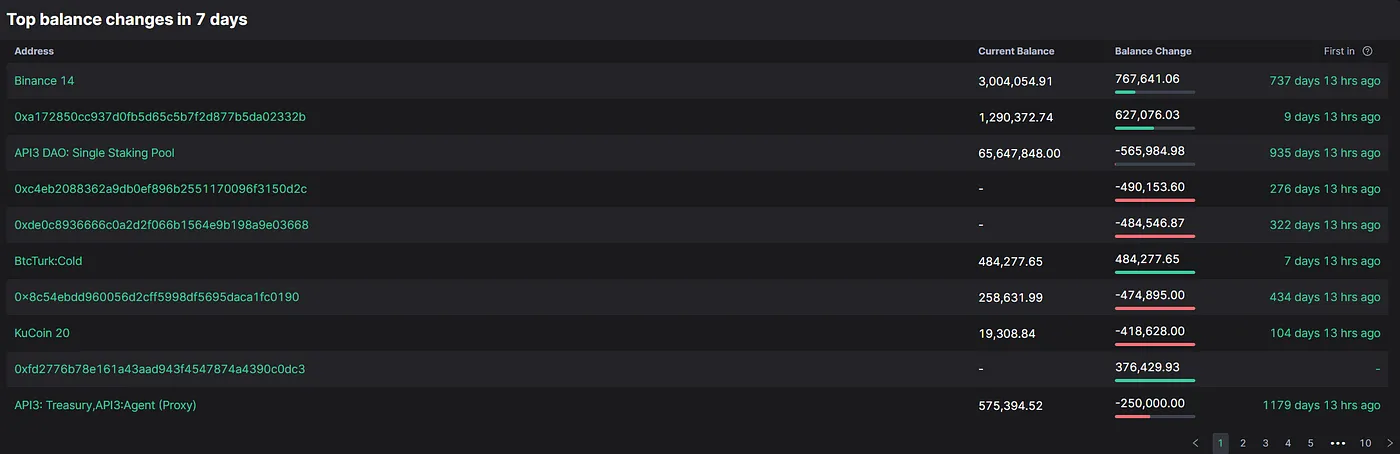
3) API3 has a circulating supply of 100 million tokens, with 65.54 million currently staked. Exchanges hold 13.86 million tokens. According to on-chain analysis, Binance's wallet saw the largest net inflow over the past seven days, receiving 760,000 tokens. The largest outflow came from the staking address, which released 560,000 tokens. However, compared to the total staked amount, this represents less than 1%. Therefore, despite the recent sharp price surge, there has been no significant selling pressure observed.
Note: API3 has recently surged around 100%; please make investment decisions based on your own risk tolerance.
1 Introduction to API3
API3 is an innovative project aiming to revolutionize the blockchain oracle space. Its core objective is to address limitations of existing third-party oracles by introducing first-party oracles. API3 achieves this via its Airnode technology, where oracle nodes are hosted within the API provider’s own infrastructure. This means oracle data doesn’t need to go through intermediary aggregators but is delivered directly by the first party. This approach aims to enhance privacy, cost efficiency, and source transparency in data transmission. More importantly, it eliminates the need for cross-chain bridges as intermediaries, thereby mitigating frequent hacker attacks.
Key Features and Highlights of the Project
-
First-party Oracles: API3 enables API providers to directly host oracle nodes via Airnode, significantly improving data transparency and trustworthiness.
-
Privacy Protection: Since API providers operate their own oracles, third parties cannot observe raw data processing, greatly enhancing privacy.
-
Cost Efficiency: By removing intermediaries, data provision costs are reduced and overall system efficiency improved.
-
Source Transparency: Data sources are verifiable on-chain, ensuring transparency and reliability.
2 Airnode
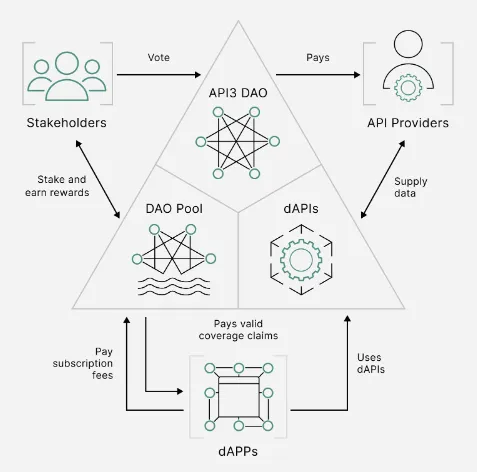
Airnode is the core component of the API3 project. It enables API providers to easily run their own oracle nodes and publish data sources (dAPIs) directly to any decentralized application (dApp) on blockchains interested in their services—without intermediaries. Airnode is designed for near-zero maintenance deployment. By simplifying the connection between APIs and blockchains, it allows smart contract developers to effortlessly access required data, enabling meaningful real-world use cases.
Airnode is designed as a lightweight wrapper for Web APIs, enabling them to communicate with smart contract platforms without overhead or token payment friction. Built on a “set and forget” principle, it requires no specialized operational knowledge and offers strong resistance to permanent downtime or operational interference. Constructed on a pay-per-use pricing model, node operators only pay based on usage, allowing API providers to potentially run oracles at no cost initially.
3 dAPI
dAPIs (Decentralized APIs) are key components of the API3 project—on-chain data sources provided by first-party oracles operated directly by API providers themselves. These data sources are continuously updated using signed data from first-party oracles, allowing dApp owners to read real-time values from any dAPI on-chain. A dAPI consists of one or more beacons and is sometimes referred to as a first-party data source because it originates from a first-party oracle. At its core, dAPIs connect smart contracts directly to first-party data sources, offering higher security, cost efficiency, and scalability.
dAPIs are maintained and supported directly by the data owners—i.e., the API providers—effectively eliminating reliance on third-party intermediaries found in other oracle solutions. They are efficient and flexible, built on a pay-per-use model that allows API providers to run oracles for free initially and begin paying only once they start generating revenue. dAPIs feature standardized, user-friendly interfaces designed to abstract away technical complexity.

4 OEV Network
Oracle Extractable Value (OEV) is a subset of MEV, referring to value extractable from oracle-related services. In DeFi applications, oracle-provided data is often used to determine asset prices, trigger liquidations, or perform other critical functions. When an oracle updates the data fed into a smart contract, these changes can affect the state of DeFi markets, creating arbitrage or liquidation opportunities. During such oracle updates, certain participants may attempt to exploit these opportunities to extract value from market participants like liquidity providers. According to Flashbots' statistics, MEV extraction generates hundreds of millions of dollars in annual revenue.
The OEV Network is a custom zk rollup network built using Polygon CDK, designed to capture OEV across all dApps using API3 data sources. The OEV Network acts as a specialized order flow auction platform, selling execution rights for specific data source updates on particular dApps to the highest bidder. The winner pays a fee when executing the data update, enabling decentralized applications to receive instant revenue on their native chains. This operates as an extension of our standard data delivery—meaning dApps using API3 data sources can simply enable the OEV Network and begin earning passively.
5 Token Economics
API3 has a total supply of 127 million tokens, with a circulating supply of 102 million and a circulating market cap of $300 million.
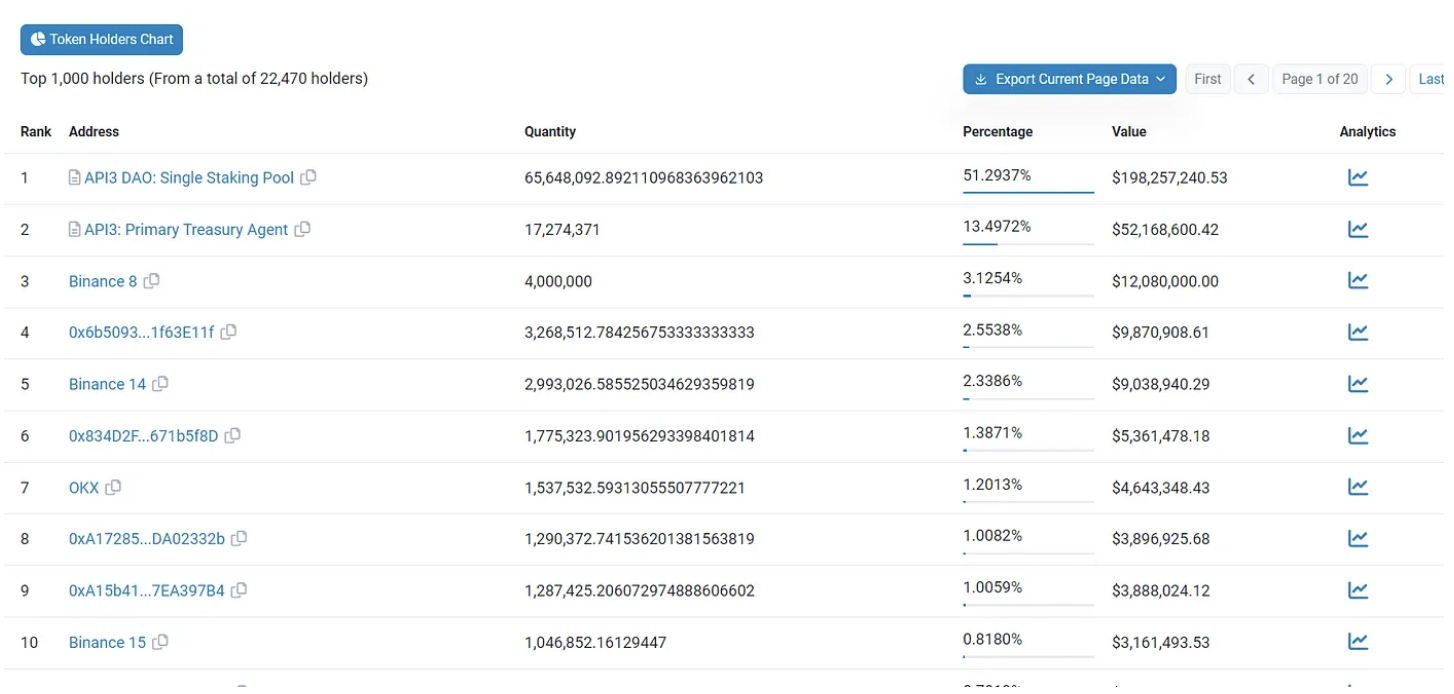
From on-chain data, the largest holder is the API3 staking pool:
-
Holding Address 1: API3 staking address
-
Holding Address 2: Treasury
-
Holding Address 3: Binance cold wallet
-
Holding Address 4: Transferred in December 2022, unmoved since
-
Holding Address 5: Binance wallet
-
Holding Address 6: Coinbase wallet
-
Holding Address 7: OK wallet
-
Holding Address 8: Coinbase wallet
-
Holding Address 9: Upbit wallet
-
Holding Address 10: Binance wallet
On-chain data shows that 65.54 million API3 tokens are staked, while approximately 13.86 million are held on exchanges. Combined, these account for 79 million tokens. Excluding these two categories, the freely circulating supply is relatively small.
Given the significant price volatility over the last two days, we reviewed address movements over the past seven days via Scope. The largest inflow was into Binance's deposit address, with a net inflow of 760,000 tokens. The second-largest inflow was into a Coinbase wallet, receiving 627,000 tokens. The largest outflow was from the staking address, which released 560,000 tokens.
Overall, while there have been inflows and outflows, the volumes remain relatively small. Specifically, the 560,000 tokens withdrawn from the staking wallet represent less than 1% of the total 65.54 million staked. Thus, despite the recent sharp rally, there has been no significant sell-off pressure observed.
Detailed information available at
https://www.scopescan.ai/token/0x0b38210ea11411557c13457d4da7dc6ea731b88a?network=eth&pp=ryxc
Join TechFlow official community to stay tuned
Telegram:https://t.me/TechFlowDaily
X (Twitter):https://x.com/TechFlowPost
X (Twitter) EN:https://x.com/BlockFlow_News
 @riyuexiaochu