6% Airdrop: Understand OKX Jumpstart Project Web3 Messaging Protocol Dmail in One Article
TechFlow Selected TechFlow Selected
6% Airdrop: Understand OKX Jumpstart Project Web3 Messaging Protocol Dmail in One Article
With decentralized governance approaching, Dmail is poised to continue leading the Web3 infrastructure construction race.
 Navigating Web3 tides with focused insights
On January 24, OKX Jumpstart announced the upcoming launch of a new project, Dmail, sparking widespread discussion on social media.
Last month, Dmail had already announced it would distribute its token in Q1 2024 and conduct an airdrop to community users. According to the latest information, the airdrop allocation will account for 6%.
As a popular Web3 communication protocol, Dmail has integrated 18 networks including Ethereum, BNB Chain, Polygon, and Starknet, offering cross-chain encrypted messaging, Web3 multi-chain infrastructure services, AI-powered email marketing, and notification features. It has secured investments from over 20 venture capital firms such as Hashkey Capital and Amino Capital.
To date, Dmail has registered 6 million on-chain accounts and more than 220 partners. According to DappRadar, Dmail consistently ranks first in daily active users among Social-category projects and is a leading dApp on networks like zkSync, Starknet, and DFINITY.
With decentralized governance approaching, Dmail is poised to continue leading the Web3 infrastructure race.
Redefining Web3 Communication
In recent years, despite rapid innovation in blockchain technology and growing vibrancy in the Web3 space, communication methods remain primitive—relying heavily on Web2 platforms such as Twitter, Telegram, and Discord—and lack secure, efficient, and decentralized alternatives.
Dmail addresses these gaps by providing a decentralized messaging system that effectively manages communications tied to wallet addresses and other decentralized identities, bridging the divide between traditional email systems and the Web3 environment.
Specifically, Dmail has built an AI-driven decentralized communication platform offering encrypted email services, unified notifications, and customized marketing solutions across multiple blockchains and decentralized applications (dApps), meeting the needs of users, developers, marketers, and influencers in the Web3 ecosystem.
Notably, to encourage broader adoption of Web3, Dmail has progressively integrated 18 major networks—including Ethereum, BNB Chain, Polygon, and Starknet—and launched a points rewards program. This allows users to upgrade their privileges, access advanced platform features, and earn credentials for future official airdrops. These points may also serve as foundational elements for Dmail’s future DAO development.
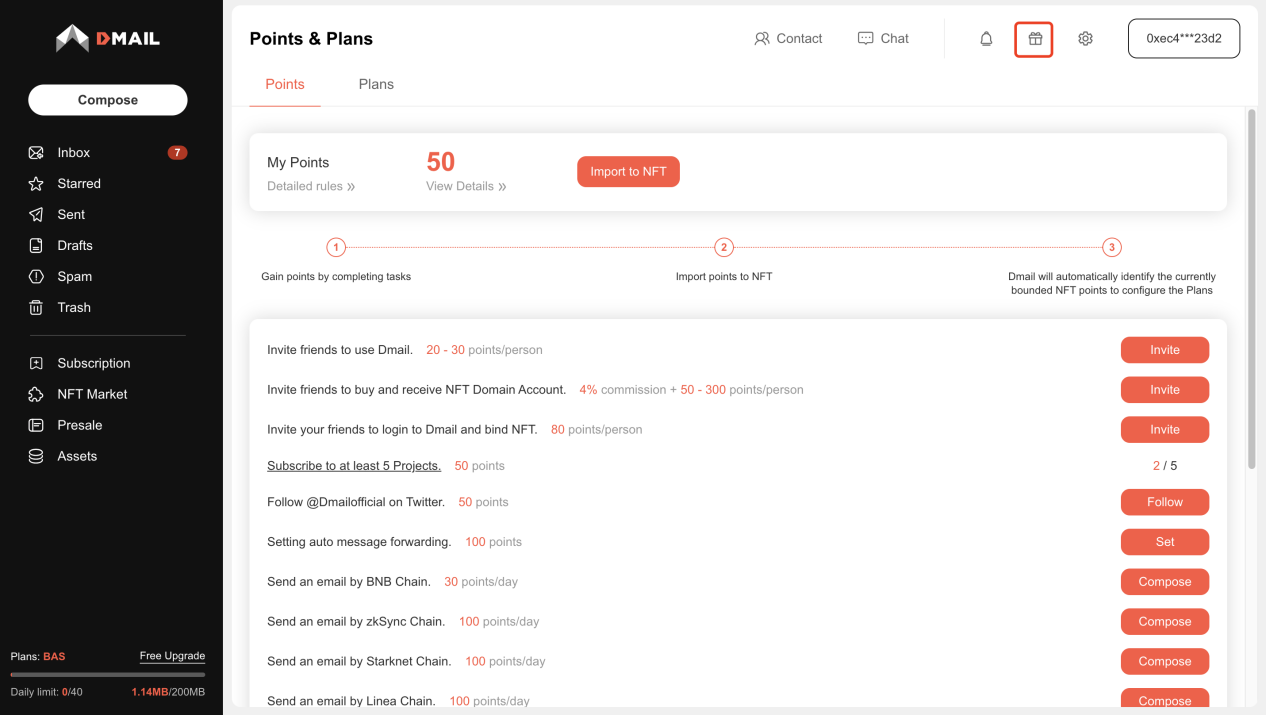
This model resembles the points program of NFT aggregation platform Blur, which grants points based on user activity, later redeemable for token airdrops or other benefits.
As widely known, Blur's points-based airdrop created massive wealth effects and triggered intense FOMO across the network. In comparison, Dmail’s points reward program spans a longer duration and covers a broader scope. Once the airdrop materializes, market enthusiasm could surpass even that of Blur.
In summary, Dmail builds decentralized communication infrastructure at the technical level, supporting nearly all mainstream blockchain networks. At the operational level, it leverages incentive programs to attract more users to experience Web3 communication services, helping open the gateway to the Web3 world.
A Leading Multi-Chain Application
In the Web3 space, moving toward decentralized governance is inevitable. However, many projects rush into token issuance shortly after launch, lacking sustained market interest, ultimately resulting in failure.
By contrast, Dmail has taken a more cautious approach to decentralized governance. Having operated stably for four years, it now boasts over 6 million on-chain registered users and has facilitated more than 100 million messages—solidifying its status as a leading multi-chain application. These metrics form a solid foundation for its transition to full decentralization.
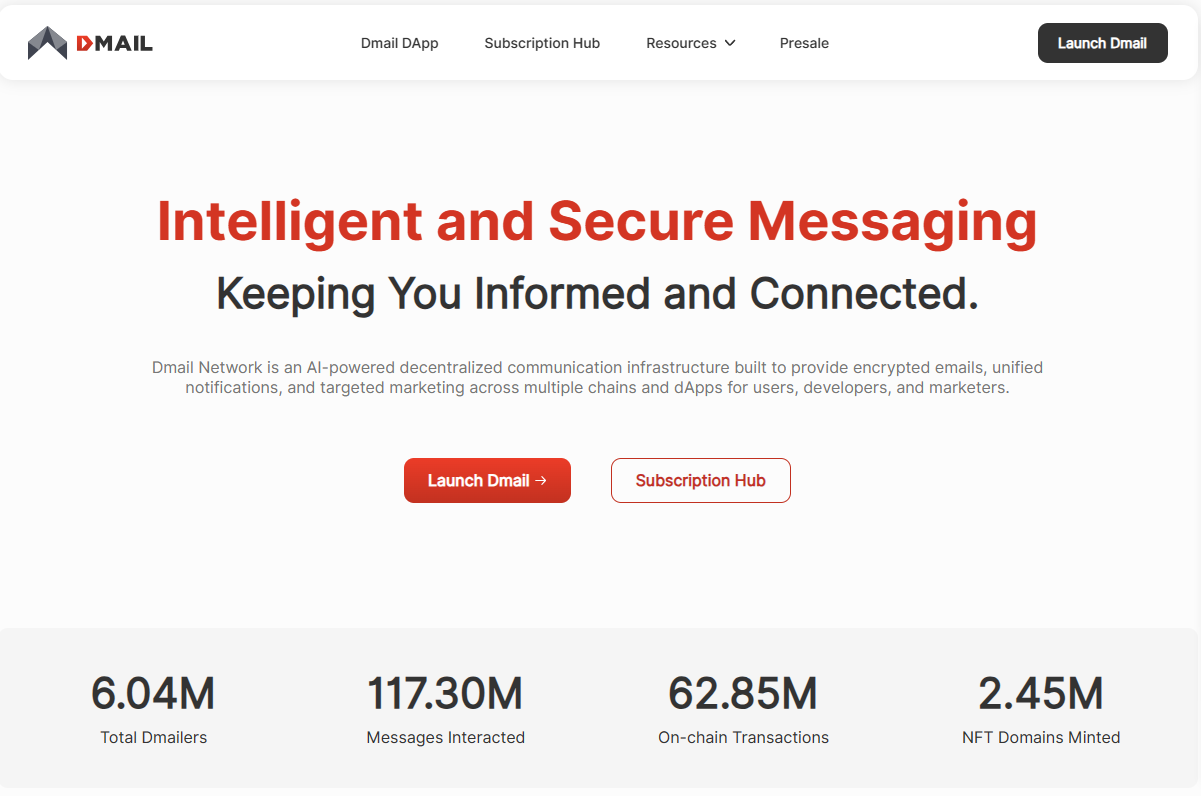
To fully understand Dmail’s achievements, we analyze its progress across three key dimensions:
① Supported Networks: 18
Dmail has integrated 18 networks including Ethereum, BNB Chain, Polygon, and Starknet, delivering cross-chain encrypted messaging protocols, Web3 multi-chain infrastructure services, AI-powered marketing, and notification tools.
According to DappRadar, Dmail consistently ranks #1 in daily active users among Social-category projects and is a top-tier dApp on networks such as zkSync, Starknet, and DFINITY.
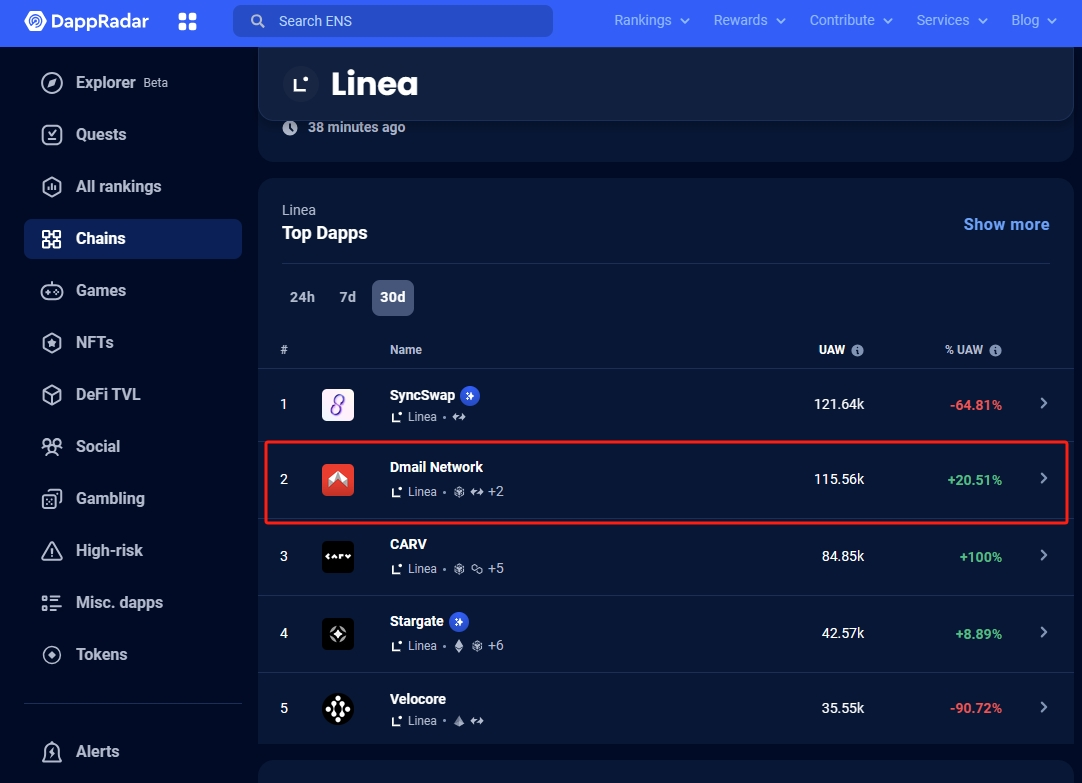
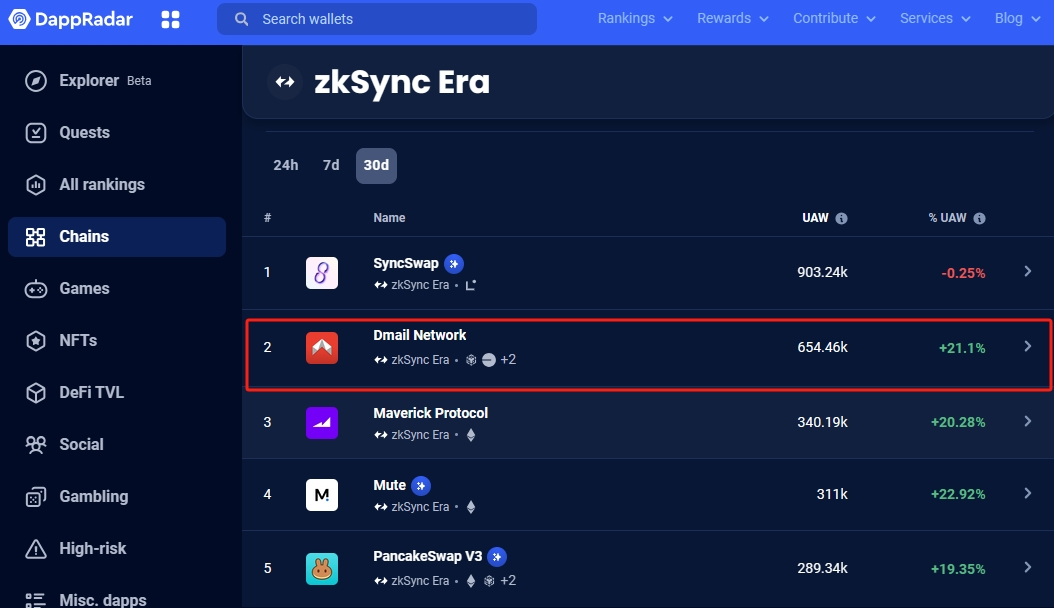
Today, competition among Web3 projects is fierce. Maintaining leadership on a single blockchain is challenging enough; Dmail’s ability to sustain its position across multiple chains highlights its exceptional strength.
② Enterprise Partnerships: 220+
Beyond integrating major public blockchains, Dmail has partnered with prominent projects such as ENS, WorldCoin, SpaceID, and Lens, spanning domains including decentralized identity (DID), distributed storage, and privacy computing. Its total number of partners exceeds 220.
On one hand, Dmail provides these partners with AI-driven email marketing and notification services; on the other, it delivers secure and convenient decentralized communication tools to their vast user bases, continuously feeding new users into its own ecosystem.
③ End-User Base: Over 6 Million
Official data shows that Dmail has over 6 million on-chain registered users, with nearly 2.5 million having minted Dmail domain names and collectively sending over 100 million messages.
Importantly, these users span nearly all major public chains and Layer 2 protocols, showing consistent growth and high engagement—forming a strong foundation for Dmail’s evolution into a super app.
Outlook on Decentralized Governance
On January 26, Dmail will officially launch on OKX Jumpstart, allowing users to stake BTC and OKB to receive DMAIL tokens, while community airdrops are set to roll out imminently.
With this, Dmail takes a crucial step toward decentralized governance. Going forward, the DMAIL token will serve as the value backbone and lubricant across all business lines, opening up limitless possibilities.
Based on Dmail’s current operational data, its listing on OKX may just be the beginning, with subsequent listings on other major exchanges highly likely:
① Dmail supports numerous major public chains and was a recipient of the first BNB Chain Grant, receiving additional support through grants from Polygon and Dfinity, giving it access to a large base of active, high-quality users;
② Dmail has attracted investment from over 20 VCs, including HashKey Capital, Amino Capital, Draper Dragon, Outliers Fund, Spark Digital Capital, KuCoin Labs, HG Ventures, Vespertine Capital, OIG VC, and BiXin Ventures—resources that could help unlock opportunities on larger platforms;
③ Dmail maintains frequent interactions with top-tier exchanges and has co-hosted multiple events. Further collaboration around token distribution cannot be ruled out.
As Dmail rolls out on major exchanges, community-held tokens may appreciate significantly. Of course, this represents only short-term upside—the long-term success hinges on how effectively the team continues to add utility to the token.
Given the team’s proven expertise in operations, Dmail is well-positioned to deliver further surprises with the added momentum of its token. Importantly, some of these surprises may come from external sources:
① Public Chains / Layer 2 Protocols
As a leading multi-chain application, Dmail’s token naturally becomes a flagship asset across multiple ecosystems. Any positive developments from these blockchains could directly boost the Dmail token.
This logic mirrors that of STG: as the flagship token of a Layer0 leader, STG sees price surges whenever positive news emerges from the Layer0 space.
Unlike STG, however, Dmail operates across multiple ecosystems. The bullish effects from different chains can compound—for instance, when zkSync, Starknet, Linea, and others announce token details, markets often speculate on leading assets within those ecosystems, putting Dmail front and center.
② Partner Projects
Among Dmail’s partners are notable projects yet to launch tokens, such as Lens, which carry high market anticipation and strong airdrop expectations.
As a service provider and collaborator, Dmail users may qualify for airdrops from these projects. This follows similar patterns seen in the Cosmos ecosystem, where ATOM stakers received airdrops from ecosystem projects, or modular blockchain projects distributing tokens to TIA stakers.
Beyond direct token airdrops, whitelist access and other exclusive rights from partner projects may also prioritize Dmail users. In essence, the Dmail governance token could become a "golden shovel," unlocking continuous value both within and beyond the Dmail ecosystem.
In conclusion, Dmail stands as a leading multi-chain application—one worthy of long-term attention and strategic positioning.
Join TechFlow official community to stay tuned
Telegram:https://t.me/TechFlowDaily
X (Twitter):https://x.com/TechFlowPost
X (Twitter) EN:https://x.com/BlockFlow_News