








Metis Breaks Into Top 5 Layer2 Projects, Unveiling the Secrets Behind Its Disruptive Decentralization Strategy
TechFlow Selected TechFlow Selected
Metis Breaks Into Top 5 Layer2 Projects, Unveiling the Secrets Behind Its Disruptive Decentralization Strategy
The $METIS token has broad utility, including network fees, node staking, and governance voting. It serves not only as a value asset but also contributes to the development of the network.
 Navigating Web3 tides with focused insights
TL;DR
-
Rumors about Metis's founding team being "Vitalik Buterin’s mother/friend," whether used as a marketing gimmick or based on truth, have proven overwhelmingly beneficial for Metis with no downside.
-
Metis has seen rapid growth in its ecosystem projects, covering all current market hotspots and attracting many well-known developers, demonstrating precise capture and application of market trends.
-
Recently, Metis launched multiple ecological incentive programs totaling billions of dollars to attract more high-quality projects to deploy on its network, continuously expanding its ecosystem footprint and showcasing proactive efforts toward ecological growth.
-
Unlike other Layer 2 solutions, Metis focuses primarily on decentralized sequencers as a key differentiator. By creating a sequencer pool and node staking mechanism, it ensures network security and decentralization, solving the centralization issues associated with single sequencers found in other Layer 2 networks.
-
$METIS token has broad utility, including network fees, node staking, and governance voting. It serves not only as a value asset but also actively contributes to the development of the network.
1. Project Summary
Metis is an Ethereum Layer 2 network that stands out among other Layer 2 solutions through innovative technologies such as a decentralized sequencer pool and Hybrid Rollup. It aims to maintain high throughput and fast transactions while ensuring decentralization and security.
2. Project Details
2.1 Team
The team currently consists of around 11–50 members, with an average tenure of 1.8 years. The total number of employees increased by 4% over the past six months.
Elena Sinelnikova (Co-Founder): Founder of Crypto Chicks, a blockchain nonprofit organization focused on blockchain education for women, providing learning and career opportunities in the blockchain space.
Kevin Liu (Co-Founder & Product Lead): Co-founder and CEO of ZKM (zkm.io), and Strategic Director at the MetisDAO Foundation, overseeing strategic planning and execution within the foundation. Kevin holds an MBA from the University of Chinese Academy of Sciences and is an active researcher in token economics, DAOs, and governance protocols.
Yuan Su (Co-Founder & CTO): Holds a bachelor’s degree in computer science and an MBA. He held various management positions at IBM Canada and CaseWare starting in 2003, bringing extensive software engineering and management experience. In 2022, Yuan founded Nuvo Technology Company.
2.2 Funding Status
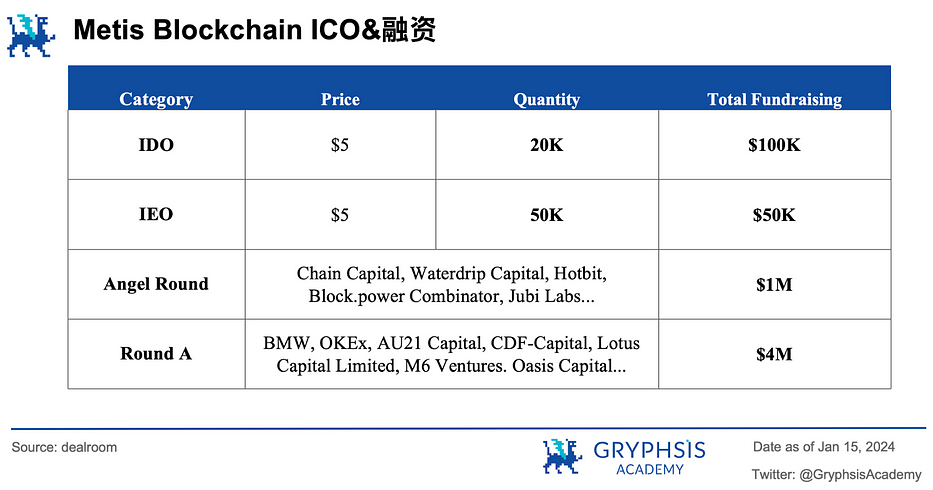
Metis has completed $1 million in angel and seed funding, followed by a $4 million Series A round. Investors include Block Dream Fund under OKEx, Genblock Capital, Cryptomeria Capital, and others.
Current institutional investors in Metis include Gate.io, DFG, AU21, HOT labs, CatcherVC, Parsiq, Chain Capital, Genblock Capital, and OK.
2.3 Recent Developments
2.3.1 Community Testing
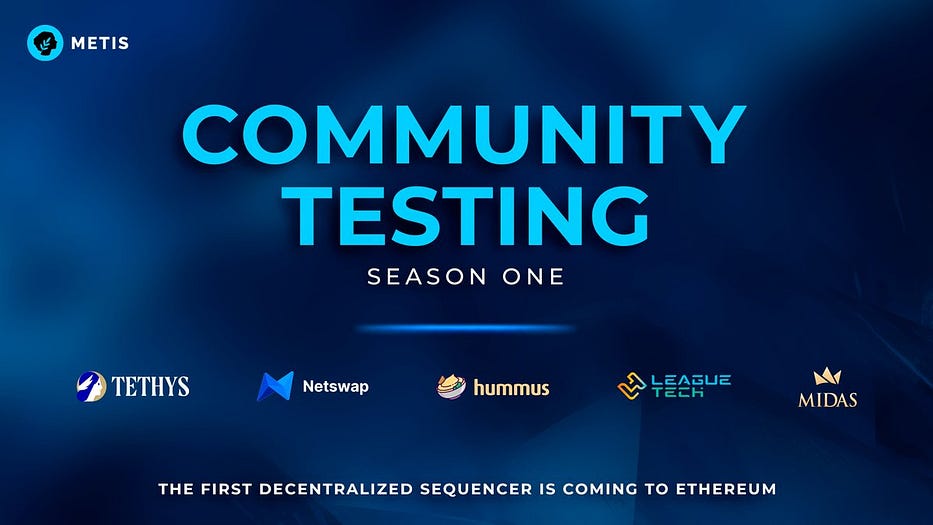
On January 16, Metis launched Season 1 Community Testing on the Sepolia testnet, allowing users to explore various dApps to test the POS Sequencer pool. Participants earn corresponding Testing Points as rewards.
Applications currently supporting Season 1 Community Testing include Hummus Exchange, League.Tech, Tethys Finance, Midas Games, and Netswap. Additional projects like Enki and League.Tech will join later. Each dApp has its own points pool, with different operations earning varying point ratios. Users can obtain testnet $METIS via faucets to participate at zero cost and accumulate points.
Key rules for points and rewards:
-
All participants earn points by completing tasks. Repeating the same action yields only 75% of the previous point amount.
-
If a user's balance exceeds their total accumulated points, the point value will be upgraded to match their balance.
-
Higher points lead to higher rewards, proportional to the participant's ranking.
Notably, Metis’ EDF program launched in December 2023 (totaling 4.6M $METIS) allocated $3M in tokens specifically for decentralizing the Sequencer. This community testing initiative not only offers rich incentives at zero cost but also lays the groundwork for future profit-sharing from Sequencer operations. As a Metis community member, active participation in ecosystem building provides returns unmatched by other Layer 2 networks today.
2.3.2 MetisEDF
On December 18, Metis officially launched the MetisEDF (Ecosystem Development Fund) program, allocating 4.6M $METIS (worth $550 million) to support various ecosystem initiatives—decentralized Sequencer implementation (as mentioned above), dApp grants, dApp Building mining incentives (detailed below), liquidity incentives, and other ecosystem development activities.
The dApp Building program, formally known as BMR (Builder Mining Rewards), will distribute 10,000 $METIS monthly to ecosystem projects, with 4,000 tokens tied to trading volume metrics.
There are no restrictions on eligible projects—DeFi, ReFi, DeSci, NFT, DAO, GameFi—all can receive incentives. Rewards are calculated based on each project’s share of total ecosystem transaction count, ensuring fair distribution.
2.3.3 MetisJourney
On December 6, Metis announced the #MetisJourney initiative, offering $5 million in incentives targeting DeFi projects to encourage deployment and attract more related dApps.
In summary, Metis' immediate focus includes: decentralized Sequencer community testing, DA layer migration to Ethereum, achieving full Sequencer decentralization, and prioritizing LSD project deployments.
These represent just the major developments from December 2023 to date. In just two months, Metis has rolled out incentive programs worth billions of dollars—from large-scale community-wide Sequencer decentralization testing to granular activity incentives for individual projects. Through financial backing, community engagement, and ecosystem resources, these actions have significantly boosted Metis’ influence and activity levels.
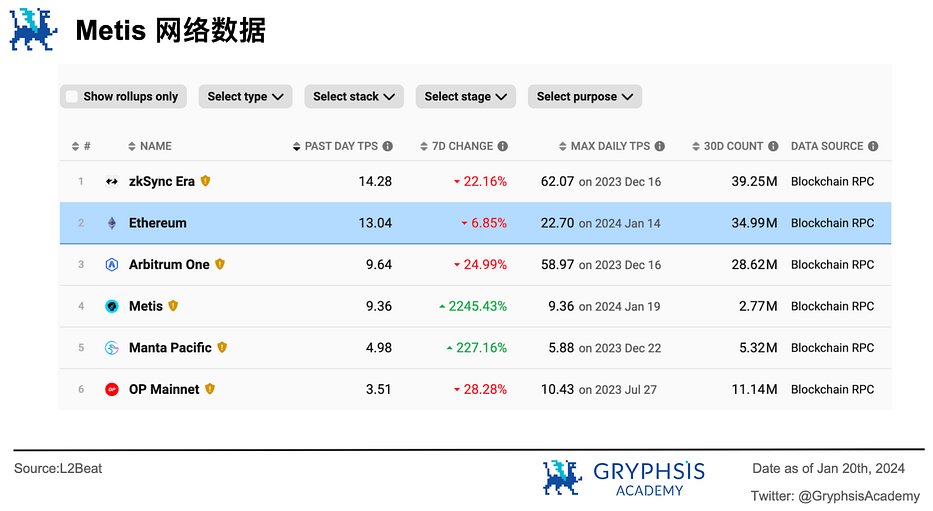
This momentum is clearly reflected in its ecosystem data: as of writing, Metis ranks among the top 5 Layer 2 networks in TVL and peak daily TPS. Its TVL grew 120% in one month, while its price surged 337.16%. Currently, Metis processes 9.36 transactions per second (TPS). Although this lags behind networks like zkSync Era and Arbitrum, Metis demonstrates faster iteration cycles (e.g., Optimism’s last peak data was from July last year), indicating strong performance and speed improvements.
These figures strongly demonstrate Metis’ robust growth trajectory and market recognition, highlighting its significant potential and value within the Layer 2 landscape.
3. Technical Framework
3.1 Hybrid Rollups
As early as March 2023, Metis introduced its Hybrid Rollup solution, combining OP-Rollup and ZK-Rollup technologies to leverage the strengths of both.
For example, OP-Rollup assumes all transactions are valid by default, enabling fast on-chain processing and improving network speed. ZK-Rollup excels in proving transaction validity and protecting user privacy. By integrating both, Metis DAO’s Hybrid Rollup achieves:
1) EVM Compatibility: Despite being a hybrid rollup, it remains compatible with EVM, allowing existing dApps to integrate easily.
2) Enhanced Security: By incorporating validity proofs, the rollup adds an extra security layer atop fraud proofs. Validity proofs ensure off-chain transaction accuracy and reduce centralization risks.
3) Lightning-fast Transaction Finality: Leveraging ZK-Rollup technology enables rapid final confirmation of transactions, reducing settlement time.
4) Optimized Capital Efficiency: The Hybrid Rollup minimizes gas consumption, enabling users to allocate resources more efficiently and improve capital utilization.
The Metis DAO Foundation launched ZKM, an open-source ZKP system provider based on MIPS technology. By developing zkMIPS—a functional component addressing the weaknesses of both OP-Rollup and ZK-Rollup—ZKM combines the advantages of both rollups to enable efficient Hybrid Rollup applications.
By splitting transactions between the two rollup types, ZKM can:
-
Quickly process simple transactions on OP-Rollup
-
Use ZK-Rollup for transactions requiring higher security
-
Avoid including excessive fraud proofs on the main chain, thereby reducing costs
This hybrid approach balances trade-offs between speed, security, and cost, delivering an optimal rollup solution adaptable to diverse transaction types and user needs.
3.2 Decentralized Sequencer
In Layer 2 rollup architectures, the Sequencer is responsible for collecting, ordering, and submitting user transactions. Due to this critical role, sequencers are prone to MEV-related gray income—gaining extra profits by reordering, front-running, or prioritizing high-gas transactions—leading to centralization. Additionally, reliance on a single sequencer creates a single point of failure; if attacked, the entire network could halt.
To address these issues, Metis implements a series of architectural and technical innovations to achieve sequencer decentralization. Below are foundational concepts for understanding this framework:
1. Tendermint Consensus Algorithm
In a given consensus round, validator A is selected as the proposer, collects a batch of transactions, and packages them into a new block. Other validators verify the block’s validity and vote. If final approval votes exceed 2/3, the block achieves finality.
2. Threshold Signature Scheme (TSS) and Multi-Party Computation (MPC)
Both are cryptographic techniques:
-
Threshold Signature Scheme: A special digital signature technique allowing a group of users to jointly control a private key. The key is split into shares distributed among participants. Only when a sufficient number of participants (meeting a predefined threshold) collaborate can a valid digital signature be generated. This enhances system security, as attackers must compromise multiple key shares simultaneously.
-
Multi-Party Computation (MPC): Enables multiple parties to jointly compute a function without revealing their private inputs. For instance, to calculate a class average without disclosing individual scores, each student inputs their score privately. The result reveals only the final average, preserving privacy while enabling collaborative computation.
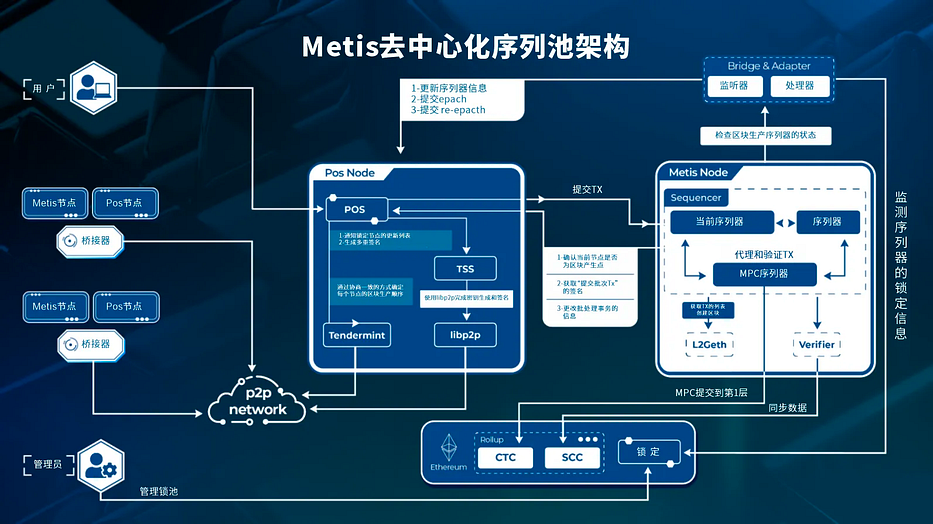
Metis transforms the traditional single-point Sequencer into a Sequencer Pool, introducing mechanisms like node staking and rotation to achieve decentralization (resisting MEV and eliminating single points of failure).
1) Sequencer Pool
Source: Metis Chinese Blog
For cost efficiency, most current Layer 2 networks operate centralized, single sequencers. However, this introduces a single point of failure—if attacked, the entire network may stall. Metis addresses this by establishing a Sequencer Node Pool, ensuring continued operation even if one sequencer goes offline.
Regarding MEV resistance: traditionally, only a centralized entity sees the mempool. Metis introduces multiple sequencers—any node that stakes can view the mempool and process transactions.
Thus, if a sequencer attempts malicious behavior, there's no guarantee it will be selected to propose blocks. Moreover, other sequencers monitor the mempool; any misconduct triggers slashing penalties. Furthermore, before transactions are submitted, they require Tendermint consensus—signatures from ⅔ of sequencers—to finalize, preventing manipulation.
By increasing the number of sequencer nodes through pooling, competition and transparency rise. Introducing consensus algorithms disperses power, eliminating single-point control risks and enhancing decentralization.
2) Node Staking
MEV is often considered “miners’ cake.” When Metis uses a sequencer pool to democratize profits, it undermines miners’ exclusive control, potentially threatening their interests. Could miners resist or strike, lowering network efficiency—especially harming DeFi transactions, causing user losses, driving users away, reducing usage, and pushing miners further into unprofitability, creating a vicious cycle?
Ultimately, decentralizing sequencers isn’t just a technical challenge—it’s a conflict of interest. The biggest obstacle isn’t technical feasibility but resistance from established beneficiaries.
How does Metis address miner incentives?
Metis introduces a node staking mechanism: nodes must stake $METIS tokens to participate. To become a sequencer node, at least 20,000 $METIS (approximately $2.4 million) must be staked. However, once involved in block production, sequencers earn both gas revenue from transaction processing and additional $METIS staking rewards. This not only compensates for lost MEV income but creates a positive feedback loop, increasing miner earnings. How?
First, MEV resistance benefits users. Users no longer need to overpay gas for faster execution or suffer frontrunning. Such protections are currently unavailable on most other Layer 2 networks. Protecting user interests attracts more users to the network. Increased transaction volume raises gas revenue for miners. Since Metis uses native $METIS as gas, every transaction increases demand for $METIS, stabilizing or lifting its price—thus increasing the value of staked tokens held by miners.
Additionally, validators are incentivized: those detecting malicious sequencers receive a portion of the slashed assets, encouraging vigilant monitoring.
By setting participation thresholds, Metis increases node sunk costs—malicious acts result in complete loss of staked tokens. Staking rewards boost participation enthusiasm, aligning network and miner interests. At the same time, staking reduces circulating supply, supporting token price while discouraging misconduct due to high asset exposure—effectively using tokens to secure the network.
3) Sequencer Rotation
After transaction processing, results must be broadcasted to other nodes for ledger synchronization (Proposer), which finalizes the transaction. To prevent Proposer failures during finalization, Metis introduces a rotation mechanism.
All Sequencer lists are stored in an MPC-controlled address. The specific sequencer selected from the pool is determined by a POS mechanism. Based on each node’s voting weight (linked to staked amount) and randomized hash selection, block producers are chosen more fairly. If a sequencer shuts down or stops serving, it gets rotated out, ensuring 24/7 network operation and preventing downtime.
Metis’ sequencer pool is tightly linked to staking amounts, binding node and network interests. This fully ensures censorship resistance and decentralization, returning network rewards to all contributors. Since DeFi dominates network value, Metis’ decentralized sequencer becomes a powerful attraction for DeFi products. Thus, DeFi components like farming, LSD, lending, and CDP will gradually build a vibrant, diverse Metis ecosystem.
3.3 MVM
Metis designed its own virtual execution environment, MVM, based on OP-Rollup. While EVM-compatible, it separates computation and storage modules. This allows any existing Ethereum dApp to seamlessly deploy on Metis while delivering better processing efficiency and lower gas fees.
Since MVM is built on OP-Rollup, it inherits the fraud proof workflow. When validators submit transaction results on-chain, a challenge period allows anyone to dispute invalid states. If accepted, erroneous state updates are reverted. The MVM_Verifier module performs this function.
By separating computation and storage—performing computation off-chain and storing state on-chain—MVM reduces on-chain costs and enables efficient concurrent processing.
4. Economic Model
4.1 Distribution Mechanism
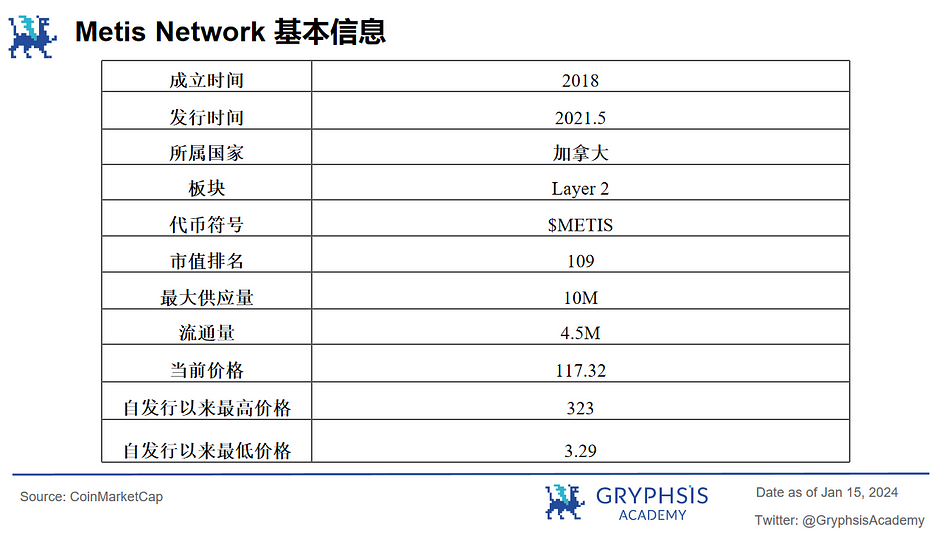
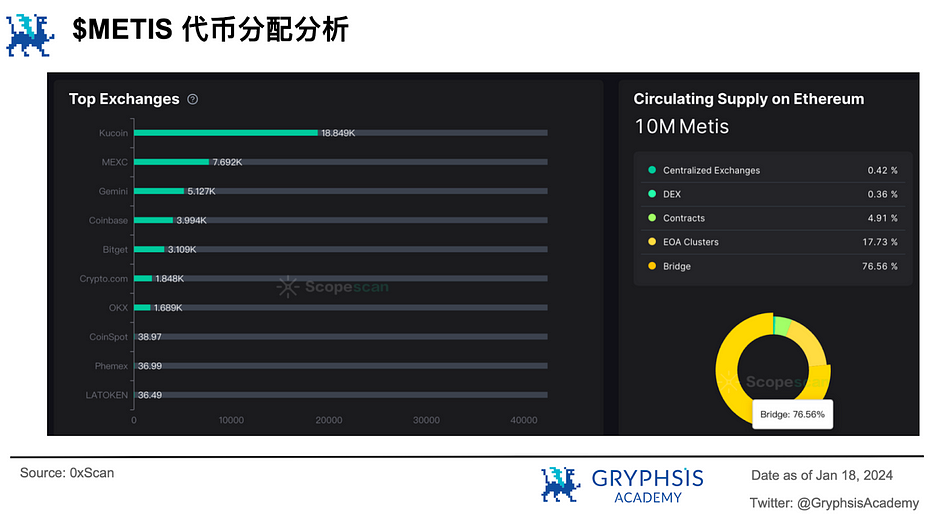
Metis’ native token is $METIS, with a maximum supply cap of 10 million, issued in May 2021. Allocations for advisors, founding team, and investors have already been fully unlocked. Remaining tokens will be distributed to support community development.
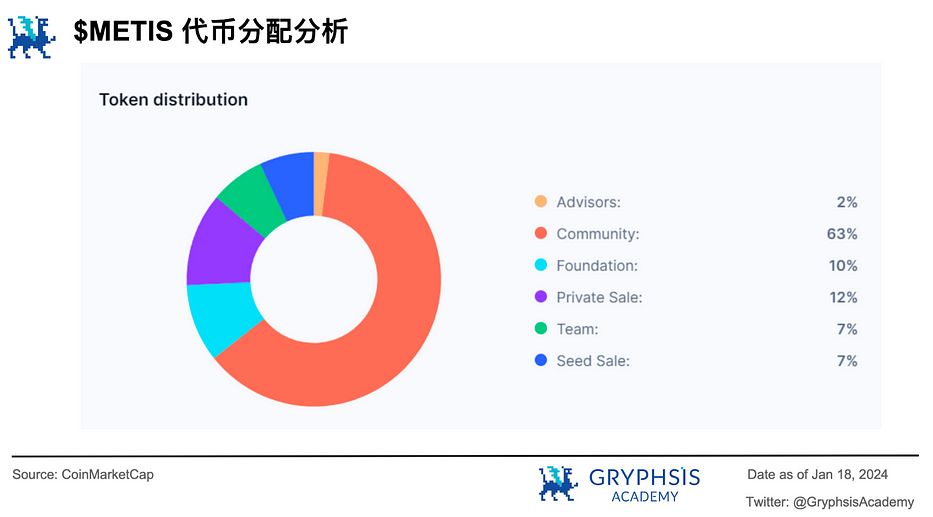
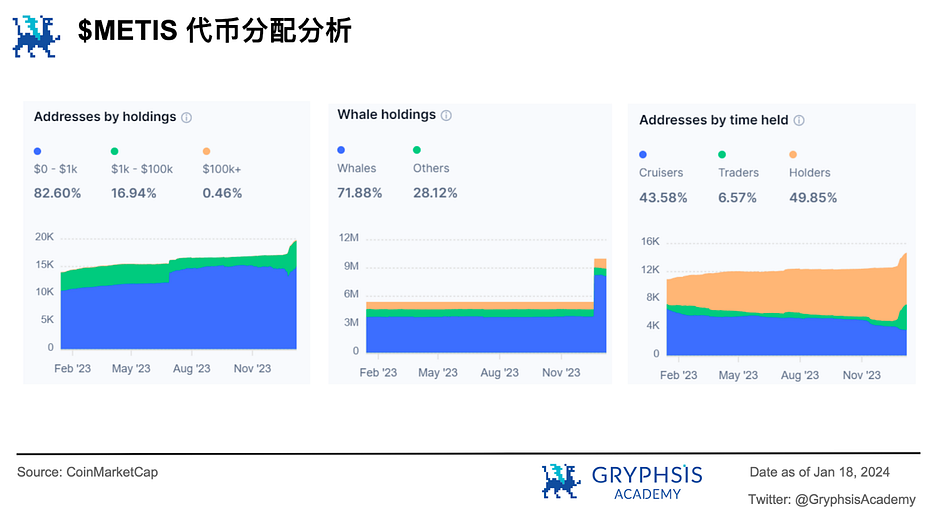
Currently, 4.5 million $METIS are in circulation. According to 0xscan analysis, nearly 76.53% of circulating supply is held in the Metis Bridge, 17.94% in EOA addresses. Holder count increased by 17.5% in the past month, with most holders bullish long-term—over half have held $METIS for more than a year. Around 80% of holders possess less than $1,000 worth of tokens, with only a small minority holding over $100,000, indicating relatively decentralized ownership.
Among CEXs supporting $METIS, KuCoin, MEXC, and Gemini offer the best liquidity.
4.2 Token Utility
$METIS is primarily used for:
1) Network Transaction Fees: Users pay $METIS as gas when interacting with Metis. 30% of transaction fees are returned to the protocol to support development.
2) POS Staking: Nodes must stake to participate; sequencer nodes earn both block rewards and staking rewards in $METIS.
3) Community Governance: $METIS holders gain voting rights in ecosystem proposals and network governance.
Unlike other Layer 2 tokens such as Optimism or Arbitrum, which are limited to governance, $METIS offers broader utility. This drives greater demand while staking controls circulating supply—both factors contributing to a 299.82% price increase in the past month (though active project development also plays a role).
Moreover, $METIS is not yet listed on major exchanges like Binance. Once Metis successfully completes decentralized sequencer testing and resolves core Layer 2 issues like single-point failures and malicious behavior, both $METIS and its ecosystem are poised for transformative growth.
5. Ecosystem Projects
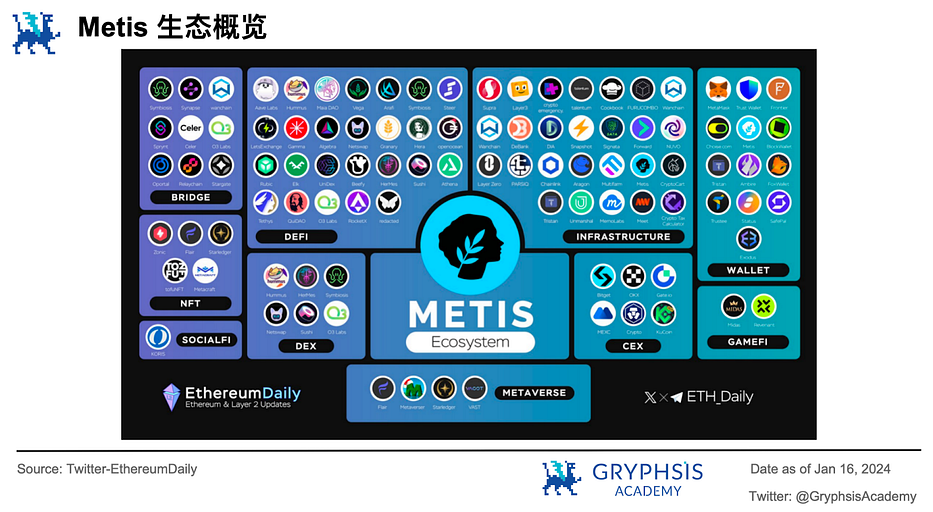
Metis currently hosts a diverse ecosystem spanning DeFi, infrastructure, wallets, GameFi, DEXs, SocialFi, NFTs, and bridges, with a concentration in DeFi and infrastructure. Notable developers such as Daniel (credited with bringing $1 billion in TVL to Fantom) have launched WAGMI, while promising testnet projects like League Tech, Hercules, and Enki are emerging. We’ll now highlight key projects.
1) WAGMI

WAGMI (formerly Popsicle Finance) officially deployed on Metis on January 10 and received a $2M grant from Metis.
Developed by renowned builder Daniele Sestagalli, who previously attracted billions in TVL to Avalanche and Fantom ecosystems, WAGMI’s presence on Metis significantly boosts market confidence in Metis across industry influence, technical expertise, and ecosystem resources.
As a comprehensive DeFi solution, WAGMI currently offers Swap, liquidity pools, and GMI features, with plans to add arbitrage bots and perpetual trading.
Once perpetual contracts are supported, permissionless creation of leveraged liquidity pools will be possible. Users will be able to trade native tokens from ecosystem projects like Revenant, Hummus, Netswap, Athena, and Tethys, greatly expanding trading options and boosting ecosystem liquidity and activity.
Additionally, on January 2, WAGMI announced a market-making partnership with DWF Labs, which purchased 26.6 million $WAGMI tokens. Both the project’s trajectory and its strategic positioning on Metis suggest WAGMI—and Daniele behind it—could have a profoundly positive impact on Metis.
2) Enki

ENKI is the first native LSD protocol on Metis, launching its testnet (opened January 19) based on Metis’ decentralized sequencer. ENKI plays a crucial role in the Metis node ecosystem, aiming to simplify the staking process for Metis sequencers to boost yields, enabling even small holders to participate.
Users can stake $METIS to earn rewards. The decentralized POS sequencer community test requires each sequencer to stake 20,000 $METIS. Smaller nodes can use the ENKI platform to pool community staking contributions and earn both testing and mining incentives.
Additionally, as Metis increasingly focuses on the LSD sector, the ENKI token will hold significant value within the Metis ecosystem.
Overall, ENKI lowers entry barriers, enabling broader participation in the Metis ecosystem and providing a more inclusive and efficient staking and yield platform.
3) League Tech

League Tech is a SocialFi platform on Metis, akin to a “Friend.tech” for Metis, featuring unique functions such as short-selling, dynamic reputation, badge systems, league creation and betting, and a three-tier access model.
It is actively preparing to participate in the community testing phase.
4) Hercules

Hercules is a DEX custom-built for Metis using CamelotDEX technology, offering diverse DeFi services:
I) Dynamic AMM: Supports dynamic asset liquidity based on Uniswap V2 model
II) Directional Swap Fee: Customizable fees based on trade direction (buy/sell)
III) NFT Liquidity Positions: Open positions to receive non-fungible collateral positions (spNFTs), enabling enhanced composability and higher capital efficiency
V) Custom Launchpad: A tailored platform offering multiple token launch strategies: fair launches, referrals, discounts, airdrops, whitelists, etc.
With rich financial offerings, Hercules aims to become Metis’ primary DEX by building a wide array of financial tools.
5) NUVO
NUVO is Metis’ first inscription project, featuring NIP-20 and NIP-721 protocols. It provides efficient DeFi solutions by addressing congestion and high fees, supporting inscription deployment, minting, and transfers.
Main features include:
1) NuMarket: A dynamic marketplace for asset flow between EVM and inscriptions, enhancing accessibility and market dynamics.
2) NuDex: A dedicated derivatives trading market enabling zero-cost trades (no $METIS gas required). Offers perpetual contracts, margin trading, spot trading, lending, and borrowing, delivering cutting-edge financial experiences.
As an inscription protocol, NUVO also supports asset liquidity and derivatives trading, providing robust liquidity solutions for inscriptions and similar assets.
Beyond these emerging protocols, several leading DeFi applications actively support Metis—including Aave, Stargate, and Sushi—bringing substantial users and liquidity. Their adoption validates Metis’ technical reliability and stability, significantly boosting its market credibility and influence.
Additionally, several native Metis projects deserve attention, such as NetSwap (first native DEX), Tethys Finance (financial services platform), and Hummus Protocol. Leveraging Metis’ technological strengths—especially in DeFi—they deliver strong user experiences and ecosystem support.
6. Conclusion
-
Since its inception, Metis has attracted widespread market attention due to rumors that its co-founder is "Vitalik Buterin’s mother/friend." Whether used as a marketing tactic or rooted in truth, this buzz has brought Metis significant favorable exposure.
-
Metis’ ecosystem is growing rapidly, covering all current market hotspots—such as NUVO (inscriptions), League Tech (SocialFi/Friend.tech), and Enki (LSD sector)—and attracting renowned developers like Daniele, who previously brought billions in TVL to Fantom. Metis clearly demonstrates precise identification and application of market trends. A thriving ecosystem and active developer base lay a solid foundation for its breakout potential.
-
Join TechFlow official community to stay tuned
Telegram:https://t.me/TechFlowDaily
X (Twitter):https://x.com/TechFlowPost
X (Twitter) EN:https://x.com/BlockFlow_News
Add to FavoritesShare to Social Media
 @gryphsisacademy












