
Bankless: Will Ethereum Spot ETFs Be Approved?
TechFlow Selected TechFlow Selected
Bankless: Will Ethereum Spot ETFs Be Approved?
The approval of a spot Ethereum ETF could be unexpected, meaning it has the potential to become the beginning of a bullish trend if approved.
 Navigating Web3 tides with focused insights
Written by: Jack Inabinet, Bankless
Translated by: Felix, PANews
After a decade of delays and rejections, the U.S. SEC last week finally approved spot Bitcoin ETFs for listing on U.S. stock exchanges—a move that thrilled the entire crypto industry.
Spot Bitcoin ETF products began trading on January 11. Although Bitcoin did not surge as much as some crypto enthusiasts had hoped, inflows into the ETFs met analyst expectations, reaching nearly $2.9 billion.
While the $1.2 billion in GBTC redemptions following BTC ETF approval and traders exiting bullish BTC ETF bets are currently suppressing Bitcoin's price, the long-term impact of ETF approval cannot be underestimated.
Now, every (or at least most) American’s traditional brokerage account can invest in crypto assets, unlocking access for an entirely new pool of capital. Even better, traditional financial giants launching Bitcoin ETFs now have a profit incentive to promote crypto assets (at least Bitcoin), as issuers seek to grow the assets under management of their products and generate higher fee income.
With spot BTC ETFs now live, traders are turning their attention to ETH and attempting to front-run the launch of a spot ETF, with a final approval decision deadline set for May 23.

Crypto markets are always bullish—shifting focus toward Ethereum has driven ETH/BTC up 25% this week, breaking a year-and-a-half-long downtrend since the Ethereum Merge.
While traders are beginning to seriously prepare for the arrival of a spot Ethereum ETF, not everyone is convinced.
Why Might a Spot Ethereum ETF Be Rejected?
Eric Balchunas, Senior ETF Analyst at Bloomberg, estimates only a 70% chance that a spot Ethereum ETF will be approved by May. The SEC must make approval decisions on multiple spot Ethereum ETF applications—including those from VanEck, Ark 21Shares, and Hashdex—by the end of May.
More pessimistically, JPMorgan strategist Nikolaos Panigirtzoglou believes the SEC would need to first classify ETH as a non-security before approving a spot Ethereum ETF—and he sees less than a 50% chance of that happening before May.
SEC Chair Gary Gensler was the decisive vote behind spot BTC ETF approval and has consistently maintained that Bitcoin is not a security under federal securities law—but he has refused to offer any clarification regarding ETH’s classification.
Some worry that Ethereum’s proof-of-stake design and its ability to generate yield automatically mean ETH would be classified as a security.
Can a Spot Ethereum ETF Be Approved?
There is considerable skepticism in the market about Ethereum ETF approval. But fortunately, skeptics may be wrong.
Many in crypto fear the SEC will classify ETH as a security and thus reject spot ETH ETFs, given the agency’s stance that the vast majority of crypto assets are investment contracts subject to federal securities laws. Nevertheless, ETH’s status as a non-security appears increasingly solidified.
The U.S. SEC has sued several crypto exchanges for listing assets it considers securities, including tokens from other Layer 1s such as SOL, NEAR, and ATOM. Notably, none of these enforcement actions have labeled ETH as a potential security.
JPMorgan strategist Panigirtzoglou argues the SEC must formally decide whether ETH is a security. However, the agency’s October vote to approve Ethereum futures ETFs already signaled a de facto recognition of Ethereum as a non-security.

While the SEC insists its approval of spot Bitcoin ETFs does not indicate willingness to approve ETFs for other crypto assets, that very approval has paved the way for a spot Ethereum ETF.
Chair Gensler’s rationale for approving the spot Bitcoin ETF stemmed from a U.S. appeals court ruling that Grayscale’s proposed spot BTC ETF was sufficiently similar to two previously approved BTC futures ETFs, warranting comparable regulatory treatment.
With Ethereum futures ETFs now approved—just like Bitcoin—the appellate court’s precedent could prevent the SEC from rejecting a spot ETH ETF on grounds of fraud or market manipulation, which was precisely the justification used to deny earlier BTC ETF applications.
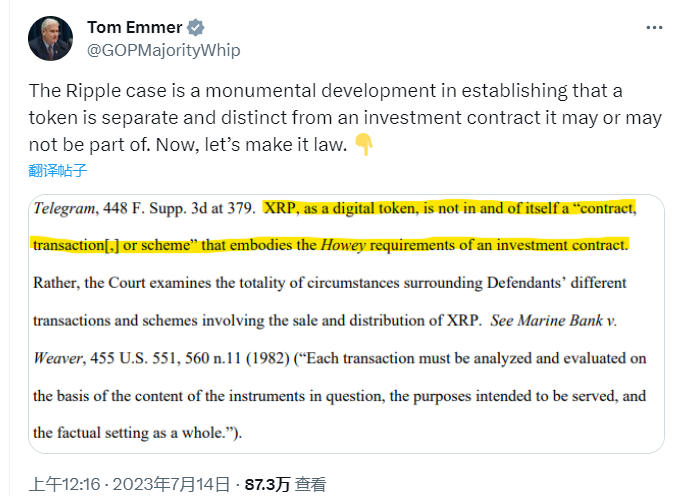
Furthermore, the legal precedent established in the SEC v. Ripple case found that digital tokens themselves do not satisfy the Howey Test and are only considered securities when sold as investment contracts. This alleviates market concerns over whether ETH’s staking yield constitutes an investment contract, making this earning mechanism irrelevant to spot ETF approval—since such transactions are distinct from ETH staking arrangements that might implicate securities laws.
Is a Spot Ethereum ETF Bullish?
Approval of a spot Ethereum ETF could bring bullish long-term effects, but it also risks becoming a “sell the news” event. Even Bitcoin saw its price drop 12% from its post-ETF-launch peak, despite inflows meeting analyst forecasts.
Last year’s launch of Ethereum futures ETFs saw disappointing demand—only $1.7 million in trading volume during the first few hours, compared to hundreds of millions in volume seen at launch for Bitcoin futures and spot products.
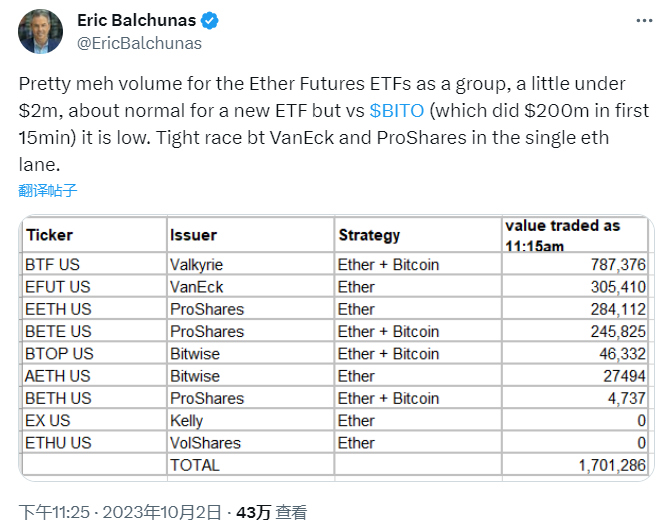
Although futures products are inherently less attractive than spot ones due to contango and backwardation effects (where next-month contract prices may be higher or lower than expiring ones), the near-total lack of demand from TradFi participants for ETH exposure suggests future spot product demand may also be weak.
Issuers will need to generate sufficient demand for spot Ethereum ETF products to succeed, but how to unlock that demand remains unclear. Perhaps TradFi will try creating demand by marketing ETH to mainstream users via CNBC.
While the scale of demand for a spot Ethereum product remains uncertain, market participants are clearly less confident about the likelihood of spot ETF approval compared to the Bitcoin case.
Approval of a spot Ethereum ETF could come as a surprise—unlike the Bitcoin ETF, where investors began positioning themselves months in advance and drove massive inflows well before approval. This means that if a spot Ethereum ETF launches, it could actually serve as a bullish starting point.
Join TechFlow official community to stay tuned
Telegram:https://t.me/TechFlowDaily
X (Twitter):https://x.com/TechFlowPost
X (Twitter) EN:https://x.com/BlockFlow_News
 Bankless