
Arbitrum Pilot Program Passes Vote, 45.815 Million ARB Kickstart New Incentive Era
TechFlow Selected TechFlow Selected
Arbitrum Pilot Program Passes Vote, 45.815 Million ARB Kickstart New Incentive Era
Arbitrum's previous short-term incentive program successfully boosted on-chain metrics across the board, and a new long-term incentive pilot program allocating 45.815 million ARB has just passed on Snapshot.
 Navigating Web3 tides with focused insights
Author: Jiang Haibo, PANews
On the morning of January 17, voting concluded on Snapshot for Arbitrum's Long-Term Incentives Pilot Program (hereinafter referred to as the pilot program). Among the voting options, the proposal to allocate 45.815 million ARB (45 million for incentives and 815,000 to subsidize participants involved in various tasks) received 57.49% of the votes. The option to allocate 25.815 million ARB received 39.23%, while the option to allocate 35.815 million ARB received only 0.81%.
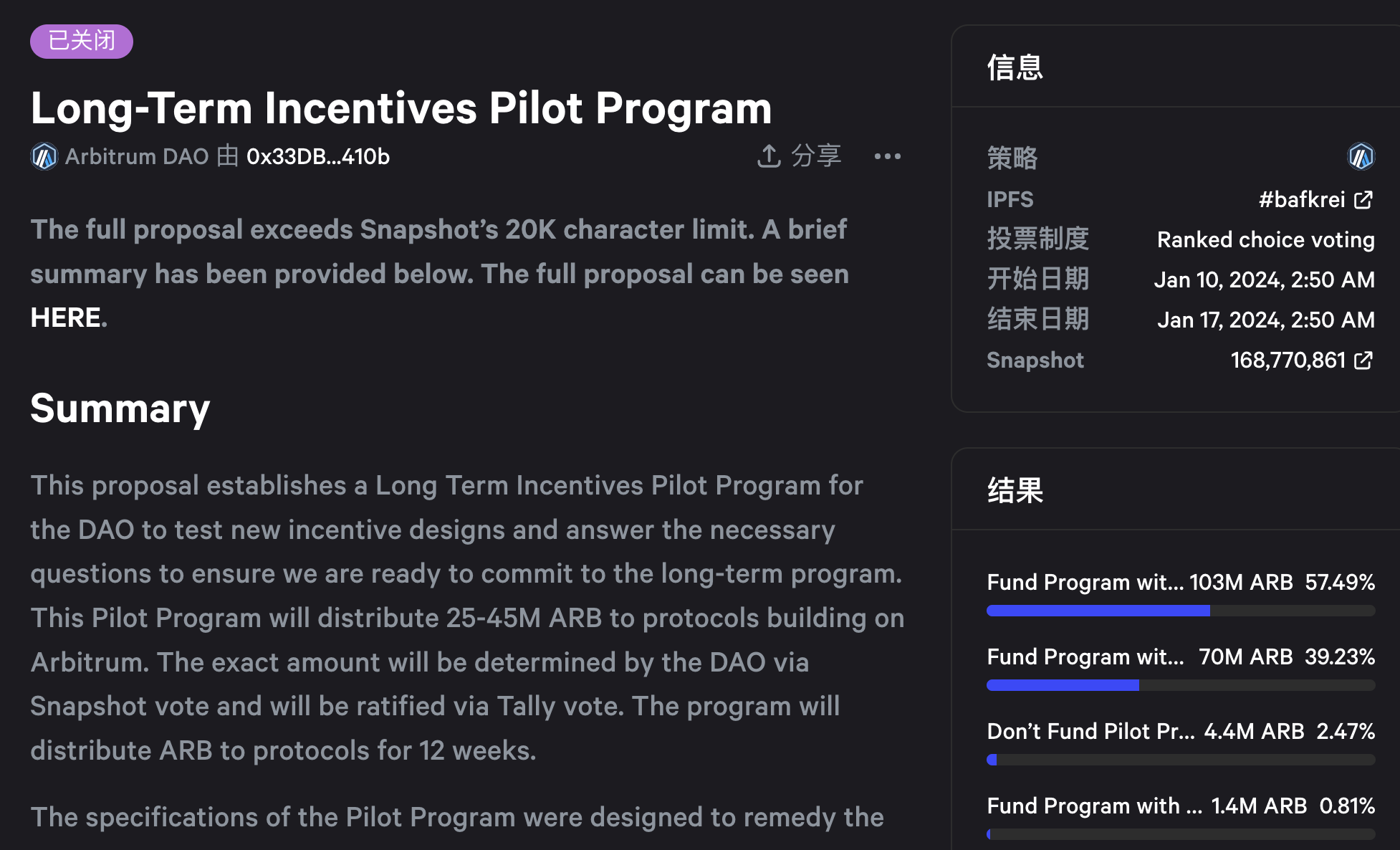
Ultimately, the proposal to distribute 45.815 million ARB won, while the option to allocate no funds at all received only 2.47%.
Short-Term Incentive Program Drives Comprehensive Growth
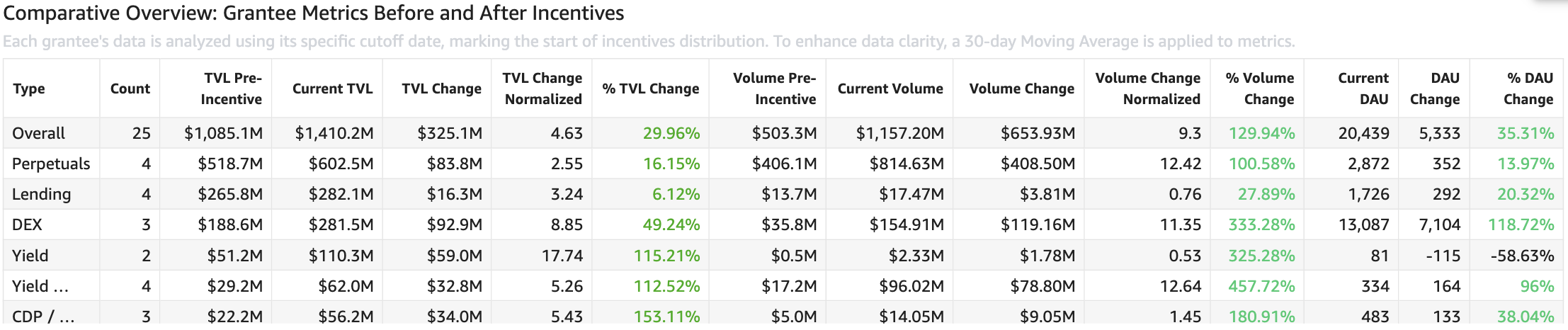
According to OpenBlock’s data, Arbitrum’s short-term incentive program (STIP), which has been running for several months, is considered a success, with protocols across categories achieving broad growth in daily active users (DAU), TVL, and trading volume. For example, DEXs saw DAU increase by 118.72%, TVL by 49.24%, and trading volume by 333.28%.
The STIP originally planned for two rounds, but its entire budget of 50 million ARB was exhausted in the first round. As Arbitrum hosts many new projects, some intending to apply in the second round missed their opportunity. Therefore, the current pilot program can serve as a replacement for the second round of STIP, allowing projects that did not receive STIP or Backfund incentives to now apply.
Additionally, the initial STIP had certain shortcomings, which the pilot program aims to improve upon. Lessons learned during implementation will also benefit future long-term incentive programs.
Improvements in the Pilot Program
The use of ARB incentives under the pilot program will be more flexible. Due to concerns such as limiting ARB sell-offs, STIP imposed strict restrictions on incentive mechanisms, causing most protocols to adopt conventional liquidity incentive models. The pilot program will offer greater flexibility, encouraging protocols to explore and experiment with diverse incentive schemes, thereby better serving the Arbitrum ecosystem.
The pilot program also introduces roles such as committees and application advisors. During STIP voting, each representative had to vote on hundreds of project applications—an impractical workload since representatives could not possibly be familiar with every project. This time, a five-member committee, approved by the DAO, will be established to conduct preliminary evaluations of applications, ensuring only worthy projects proceed to Snapshot voting.
To address the issue of insufficient feedback from STIP proposal responses, the pilot program introduces application advisors who will provide detailed feedback and guidance to each applicant, ensuring every applicant can refine their proposal based on feedback and submit a more compelling plan.
Five Stages of the Application Process
Protocols applying for the pilot program will go through five stages: reward application, feedback, screening, voting, and incentive distribution:
-
Application Period (2 weeks): Protocols submit their proposals using the pilot program application template, ensuring all applicants follow the same standards and objectives.
-
Feedback Period (2 weeks): Application advisors provide feedback and guidance for each proposal, allowing protocols to revise their submissions within two weeks based on received feedback.
-
Screening Period (1 week): The committee evaluates each protocol using predefined scoring criteria to determine which ones advance to the voting stage.
-
Voting Period (1 week): DAO members vote on each pre-screened proposal to decide whether funding should be allocated.
-
Incentive Period (12 weeks): Approved protocols will receive their allocated ARB every two weeks via Hedgey’s stream over a 12-week period.
During the upcoming Tally voting phase, the committee and application advisors will begin establishing specific evaluation criteria. Therefore, it is expected to take more than one and a half months before confirmation of exactly which protocols will receive incentives and how they will be distributed.
Additional Rewards for Participants
In the proposal, 45 million ARB are allocated for incentives, with any unspent portion returned. Additionally, 815,000 ARB are allocated to members participating in operational roles:
-
Committee members: 125,000 ARB total, 25,000 ARB each;
-
Application advisors: 105,000 ARB total, 35,000 ARB each;
-
Research bounties: 200,000 ARB total;
-
Data and analytics providers: 150,000 ARB;
-
Project manager: 100,000 ARB;
-
Members assisting in proposal creation: 15,000 ARB;
-
Retrospective community fund: 100,000 ARB;
-
Multi-sig signers: 20,000 ARB total, 2,500 ARB each.
Researchers may apply for research bounties, tasked with helping the DAO derive meaningful insights from the incentive program—such as which incentive designs were most effective, what an appropriate budget for a long-term incentive program might be, and which types of protocols received the most funding.
Regarding the retrospective community fund, Stablelab (an organization providing professional representation, governance framework design, and product development for DAOs) indicated in drafting the proposal that these funds will support community members who contributed during the pilot program. Active participation in the pilot program could yield additional rewards.
It should be noted that although the Snapshot vote has passed, an on-chain vote on Tally is still required to finalize fund allocation. PANews will continue to provide analysis once the distribution of the 45 million ARB is confirmed.
Join TechFlow official community to stay tuned
Telegram:https://t.me/TechFlowDaily
X (Twitter):https://x.com/TechFlowPost
X (Twitter) EN:https://x.com/BlockFlow_News
 PANews