From Dione Protocol to Rowan Energy: Can Representative Projects in the Refi Sector Alleviate the Environmental Crisis?
TechFlow Selected TechFlow Selected
From Dione Protocol to Rowan Energy: Can Representative Projects in the Refi Sector Alleviate the Environmental Crisis?
Can the Rei solution, based on Web3 and blockchain, address the persistent challenge of climate change?
 Navigating Web3 tides with focused insights
Author: 0xmonomi
The financial sector is undergoing an unprecedented transformation known as the Refi赛道 (Regenerative Finance). This emerging concept combines the principles of regenerative economics with decentralized finance (DeFi) technology, aiming to redefine the financial industry.
Inspired by John Fullerton, economist and philosopher behind the theory of regenerative economics, Refi emphasizes maximizing community value, resource regeneration, environmental protection, and long-term financial prosperity. Though initially unrelated to cryptocurrency, this philosophy has sparked a new way of thinking about finance.
In the Refi space, we see practical applications of these ideals. Leveraging decentralized financial technologies, it aims to broaden access to financial services while eliminating information asymmetry caused by intermediaries.
Although Refi (Regenerative Finance) lacks a formal authoritative definition, its evolution depends on community consensus, progressing in an open and self-evolving manner. In this article, we will explore key projects within the Refi ecosystem, revealing how they are shaping the future of financial innovation—a field full of potential that could bring entirely new possibilities to the world of finance.
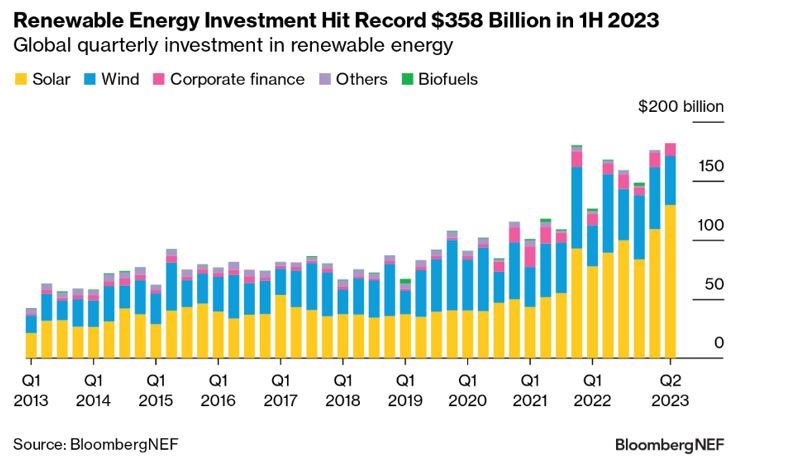
According to BloombergNEF data from August last year, global investment in new renewable energy capacity surged to $358 billion in the first half of 2023, a 22% increase from early 2022 and a six-month record high. At the same time, related capital markets have also experienced rapid growth. Venture capital and private equity commitments to renewable energy companies reached $10.4 billion, up 25% compared to the first half of 2022.
The Refi赛道 extends beyond blockchain and carbon offsetting. It is emerging as a response to climate and sustainability challenges. Currently, many Layer-1 and Layer-2 blockchains explicitly state their commitment to promoting and supporting low-carbon economies, offering incentive mechanisms for deploying ReFi projects. These include Cosmos, Internet Computer, Hedera, Topl, Polygon, Celo, Near, Algorand, among others. The primary use case for ReFi remains climate action—aiming to bring greater transparency to the global carbon offset market, which is already valued at $270 billion. For years, this market has faced credibility concerns from both supply and demand sides.
Regen Network, built on the Cosmos blockchain, focuses on helping enterprises purchase, trade, and retire carbon credits on-chain. Meanwhile, Klima DAO has created a tokenized carbon offset solution that, as of the end of January 2023, had transparently removed over 17 million tons of CO₂ from the atmosphere globally.
The ReFi赛道 is a dynamic and evolving field addressing climate change and sustainable development challenges while pushing financial innovation to new heights. Below are introductions to several promising projects currently gaining attention.
Dione Protocol: L1 based on Avalanche, PoS-based and EVM-compatible
Dione Protocol aims to lower entry barriers for the renewable energy industry, enabling consumers to build their own "green energy" businesses. Using blockchain technology, Dione creates a platform that incentivizes green energy usage and connects energy production and supply chains more efficiently and transparently to end users, utilities, investors, and regulators.
At its core, Dione features a PoS-based L1 blockchain compatible with the Ethereum Virtual Machine (EVM), built atop Avalanche, offering strong processing power and robust data privacy protection.
The project has developed Nebra, an energy trading marketplace that directly connects energy producers and consumers, enabling peer-to-peer energy transactions that save resources and costs. While transactions occur through Nebra, actual electricity delivery still happens via the traditional grid.
Interestingly, Dione’s blockchain validators utilize SpaceX's Starlink satellite network, combined with solar power, allowing operation even in remote areas—making it a truly “eco-friendly” and “decentralized” blockchain.
Although Dione’s native blockchain, named Odyssey, is currently in testnet phase and preparing for mainnet launch, the project has existed for two years with relatively slow progress toward mainnet deployment. Nonetheless, market anticipation remains high.
Dione’s native token, DIONE, has already been deployed on Ethereum and will migrate to the mainnet without tax implications. Recently, the DIONE token has seen price increases in secondary markets, with a relatively low market cap. With mainnet launch and growing environmental awareness, DIONE may attract increased market attention and speculative interest.
Dione Protocol represents an exciting project with the potential to reshape the energy industry by integrating renewable energy with blockchain technology, opening new pathways toward a more sustainable future.
Rowan Energy: Asset price tripled in a month, up over 20x year-to-date
Rowan Energy, a new energy company, is driving a green revolution in solar energy utilization. The company operates its own L1 blockchain, using blockchain technology to track residential rooftop solar power generation output, solving transparency issues in traditional energy markets.
Rowan Energy employs a consensus mechanism called Proof of Generation (PoG), where users participate in maintaining the blockchain by proving their solar energy output—an environmentally friendly and energy-efficient approach.
To achieve this, Rowan Energy offers SmartMiner, a hardware solution combining a smart meter with cryptocurrency mining capabilities. Users install it between their solar panels and the grid; this intelligent device not only measures electricity consumption but also generates crypto rewards. Rowan Energy pays $RWN tokens worth 10 pence for every 1 kWh of solar energy generated.
Additionally, Rowan Energy encourages long-term clean energy adoption by repurchasing a portion of $RWN tokens each time a user purchases a SmartMiner or conducts a transaction on the L1 blockchain, thereby supporting the token’s value.
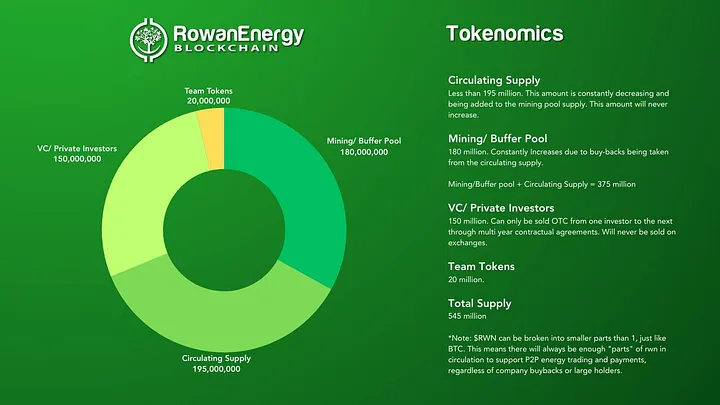
The total supply of RWN tokens is 545 million, with 150 million allocated to VCs and private rounds. Currently, 195 million RWN are in circulation, with the remaining 180 million reserved for DePIN mining rewards. On the market, RWN has risen 200% in the past month and nearly 20-fold over the past year, reaching a market cap of $33 million.
Rowan Energy’s innovative model empowers solar mining, aiming to accelerate renewable energy adoption and deliver dual environmental and economic benefits. This project represents a revolution in the energy sector, paving the way for a cleaner energy future.
SolareumChain: Proprietary PoG and PoH mechanisms allow eco-conscious participants to earn rewards
SolareumChain leverages blockchain technology to incentivize broader green energy adoption in response to the energy crisis. Its L1 blockchain uses two innovative consensus mechanisms: Proof of Generation (PoG) and Proof of Holding (PoH).
PoG, or Proof of Green Energy Generation, lies at the heart of SolareumChain. In Solareum, “miners” are rewarded not for consuming electricity, but for producing renewable energy—from solar farms, wind farms, tidal plants, geothermal systems, to individual rooftop solar panels. These producers not only generate clean energy but also enhance the security of the Solareum L1 network.
PoG technology ensures that generated renewable energy is verified as legitimate, preventing any single entity from gaining excessive control and delivering a truly decentralized solution. This method makes SolareumChain not only more environmentally friendly but also more secure.
PoH rewards holders of Solareum tokens (SRM) who meet certain criteria. This unique mechanism allows anyone to easily become a validator, contributing to network security and integrity. The more SRM one holds, the higher the yield earned, and participants gain opportunities to engage in energy generation, becoming integral members of the SolareumChain ecosystem. SRM is also used in Solareum’s public energy marketplace, ensuring publicly verifiable transactions and validation processes.
Currently, SolareumChain remains in testnet phase but has made notable progress. The testnet is actively processing transactions and undergoing further testing via integration with Tesla batteries. Solareum plans to soon announce a developer program, inviting developers to build decentralized applications (dApps) on the testnet in preparation for the public mainnet launch.
In terms of token performance, SRM has gained around 35% over the past month, with relatively stable prices over the past year and a market cap under $1.5 million. Despite limited documentation and sparse social media presence, SRM remains a high-risk, high-potential asset whose future development warrants close attention.
Arkreen Network: Web3-based carbon reduction infrastructure connecting energy supply and demand
Arkreen Network, abbreviated as $AKRE, is a Web3-based carbon reduction infrastructure focused on connecting and monetizing global renewable energy resources. The network brings together energy producers and consumers, enabling real-time exchange of electricity data and facilitating carbon-reduction applications.
Within Arkreen Network, energy suppliers—including owners of solar photovoltaic systems and households practicing energy conservation—can report their renewable electricity generation, storage, and consumption data and receive rewards. Demand-side participants can access this data to develop applications and services such as issuing renewable energy certificates and managing virtual power plants.
To achieve these goals, Arkreen Network integrates IoT, artificial intelligence, blockchain, and token economics to digitize energy facility parameters and create digital twin environments. The project’s vision is to encourage power generators to produce more renewable energy, reduce reliance on fossil fuels, and improve energy efficiency.
Arkreen supports multiple types of “miners” in AKRE token mining and has introduced the Smart Plug—a device that calculates appliance energy consumption and enables remote power control, allowing users to supply green electricity to appliances. Each Smart Plug also mints a corresponding NFT.
AKRE tokens are distributed as rewards to contributors, used to pay network transaction fees, and purchased for green energy data services. The total token supply is 10 billion, with 30% allocated to mining and the remainder distributed to team members, advisors, investors, and other ecosystem participants—all subject to vesting and linear release schedules. Although the token generation event (TGE) has not yet occurred, Arkreen Network is actively advancing the project. Unlike previous examples, Arkreen places stronger emphasis on energy-related data and credentialing. Further utility of the token will depend on official updates, warranting ongoing attention.
ReFi’s development may benefit ecological conservation—anticipating more Web3 innovations favorable to our planet
Reviewing the above projects and trends, we can draw several key insights:
First, these projects span multiple domains, covering L1 blockchains, DePIN, and even RWA (Real World Assets). This diversity highlights the breadth and potential of the regenerative finance (ReFi) space.
Second, these projects generally have relatively low market caps and remain under-recognized compared to established blockchain projects.
Third, participation often requires certain thresholds—such as owning solar panels, purchasing specific hardware, or engaging in the entire new energy supply chain.
However, these very barriers may explain why these projects remain relatively small in scale. The clean energy industry involves complex stakeholder relationships and policy constraints, making disruption of traditional energy structures difficult. While blockchain and IoT technologies offer improvements, comprehensive transformation still demands time and resources.
Precisely because of their complexity, these projects demonstrate greater social value. The challenges they face may be part of what gives them significance—making the ReFi space particularly worth watching.
In the midst of crypto market noise, whether there is enough patience to wait for these projects to mature remains to be seen. For investors seeking opportunities, low-market-cap projects may represent a potential avenue.
The mission of the ReFi Foundation is to redesign the monetary system to better align with planetary health. Traditional finance transforms natural resources into money while neglecting ecosystem protection and restoration—requiring fundamental change.
While current ReFi efforts primarily focus on carbon credit trading, we can optimistically anticipate that ReFi’s evolution will introduce more forms of nature-backed currencies, enabling verifiable blockchain-based transactions across broader fields such as green agriculture, water purification, and biodiversity conservation.
The development of green Web3 is crucial for environmental protection. Blockchain technology is a foundational pillar of Web3, whose core ethos includes building a more sustainable digital world. While Bitcoin mining has raised concerns about energy consumption, blockchain technology itself is actively seeking solutions—such as utilizing renewable energy and efficiently harnessing idle energy sources.
In summary, despite numerous challenges, these projects represent bold explorations and experiments within the ReFi domain. As we closely monitor the crypto market, we should also keep a watchful eye on these initiatives—they may provide critical insights and guidance for building a more sustainable and environmentally responsible digital future. We hope these projects overcome obstacles and make greater contributions to global renewable energy and environmental causes. That, too, is our shared responsibility and challenge.
Join TechFlow official community to stay tuned
Telegram:https://t.me/TechFlowDaily
X (Twitter):https://x.com/TechFlowPost
X (Twitter) EN:https://x.com/BlockFlow_News