








2024 Crypto Industry Outlook: Three Major Layer2 Narratives Unveiled
TechFlow Selected TechFlow Selected
2024 Crypto Industry Outlook: Three Major Layer2 Narratives Unveiled
ZK line is about to launch, creating a wealth effect in Layer2.
 Navigating Web3 tides with focused insights
By Asher Zhang, BitPush
Ethereum founder Vitalik Buterin once outlined the future Ethereum 2.0 upgrade roadmap in six concise phases: The Merge, The Surge, The Scourge, The Verge, The Purge, and The Splurge. Among these, the Dencun upgrade belongs to a key technical advancement within The Surge phase, with EIP-4844 being the most significant among several EIPs. In practice, EIP-4844 has the most direct impact on Layer2, making Layer2 very likely the most watched sector in the crypto industry in 2024. Recently, leading projects in the Layer2 space have begun gaining momentum. This article identifies three main narratives that will likely shape the future of Layer2.
Narrative One: Decentralization of Power – Layer2 Sequencers Begin to Go Decentralized
The purpose of Layer2 is to increase Ethereum's throughput and reduce transaction fees, largely achieved through sequencers. In Layer2 networks, sequencers bundle thousands of transactions into a single batch and submit them to Layer1 for final confirmation. During this process, sequencers charge fees, which currently constitute one of the primary revenue sources for Layer2 platforms.
Currently, Layer2 sequencers are centralized and mostly operated by project teams such as the OP Foundation and Arbitrum Foundation. From a security standpoint, a failure or attack on a centralized sequencer could pose serious risks to the entire Layer2 network. Therefore, decentralizing sequencers is crucial—and will likely give rise to an important new L2Fi (Layer2 Decentralized Finance) market.
According to official plans, OP Chain offers several sequencing options: self-sequencing, using Optimism Collective’s sequencer, or adopting a decentralized sequencer set service. Self-sequencing introduces a new revenue model where developers can earn fees and capture MEV from chains they deploy. Decentralized sequencers will serve multiple rollups simultaneously and use cryptoeconomic incentives to ensure operator accountability. Shared sequencers enable atomic and trust-minimized cross-rollup communication since nodes generate blocks across multiple chains. An early model of the Superchain sequencing mechanism involves auctions, where potential sequencers pay the network for sequencing rights and earn a share of fees and MEV. Sequencers may also be required to share a portion of their fee revenue with retroactive public goods funding (RPGF).
While OP Chain's sequencer plans have not yet been implemented, Metis is close to launching its decentralized sequencer, which is expected to accelerate sequencer development across other major Layer2 platforms.
Metis is a Layer2 built on Optimistic Rollup, launched on mainnet in 2021—one of the earliest rollup-based Layer2 networks—and upgraded in 2024 to a Hybrid Rollup combining Optimistic Rollup architecture with zero-knowledge (zk) proofs.
Metis’ decentralized Proof-of-Stake (PoS) sequencer is already running on the Holesky testnet, progressing through three stages: simulating real node behavior, increasing node count, and staking tests. Starting January 3, 2024, community testing was opened, allowing users to interact with new ecosystem dApps on the Holesky testnet and earn rewards over a one-month period. Each sequencer node requires a stake of 20,000 METIS tokens, but mining rewards are substantial—50% of the total METIS supply is allocated for node incentives. For users who lack sufficient capital to run a node, Metis recently launched Enki, a liquid staking dApp enabling community members to participate in staking and earn proportional returns.
Narrative Two: Complementary Strengths – Parallel EVM Gains Momentum
JD, former co-founder of Polygon, recently suggested on social media that he anticipates every Layer2 project in 2024 will rebrand itself under the label of "parallel EVM." Georgios, CTO at Paradigm, echoed this sentiment, calling 2024 the “year of parallel EVM,” and confirmed that Paradigm is internally exploring related technologies. Why is there such strong optimism around parallel EVM?
The EVM (Ethereum Virtual Machine) is Ethereum’s core engine, responsible for executing smart contracts and processing transactions. Its design executes transactions sequentially—a choice prioritizing security and minimizing potential complexities and vulnerabilities associated with parallel execution. However, under high load, this sequential model can lead to network congestion and delays. Parallel EVM is a concept designed to enhance the performance and efficiency of the existing EVM—akin to transforming a single-lane road into a multi-lane highway, allowing multiple vehicles to travel simultaneously.
Several projects have already begun exploring parallel EVM designs. In the Layer2 space, notable examples integrating non-EVM capabilities with EVM compatibility include Neon, Eclipse, and Lumio. Beyond Layer2, prominent Layer1 projects featuring parallel EVMs include Monad and Sei.
Narrative Three: ZK Rollups Launch Imminently – Wealth Creation Returns to Layer2
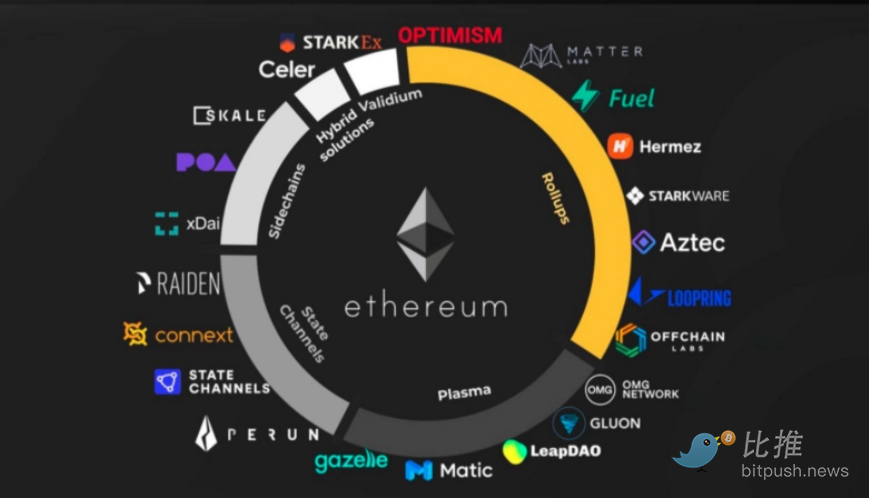
Compared to ZK Rollup solutions, Optimistic Rollups are easier to implement in the short term due to greater portability. However, ZK Rollups are fundamentally more favored by the market. According to L2Beat data, among 65 rollup projects, 26 adopt ZK-Rollup architectures, compared to only 21 using OP-Rollups. Within the ZK-Rollup category, Scroll and Taiko focus on maximizing EVM equivalence to improve compatibility with Ethereum mainnet; zkSync and Starknet aim for comprehensive scalability by boosting transaction speed and throughput to support increased user adoption; Aztec specializes in leveraging ZK technology to solve transaction privacy issues. With Ethereum’s upcoming Cancun upgrade, ZK-based projects are intensifying efforts—suggesting that a new wave of wealth creation driven by ZK Rollups is likely to unfold during the next bull market.
Due to higher technical complexity, ZK-based projects have developed relatively slowly. However, all signs indicate that several major projects are expected to launch during this bull cycle. For example, ZK leaders Starknet and zkSync are preparing token airdrops that are almost certain to trigger another round of wealth effects. Starknet plans to distribute STRK tokens to dApp developers to incentivize building; allocate STRK to ECMP (Early Community Member Program) contributors involved in content creation, meetups, and workshops; and dedicate 900 million STRK tokens for future user rebates.
Beyond traditional ZK narratives, ZKFair is conducting an innovative experiment in building a ZK L2 network that launches fairly, is fully community-driven, and governed by its users. Participants can contribute ideas for network development and receive generous rewards based on their contributions. This novel Layer2 narrative has the potential to rival even the recent inscriptions craze. ZKFair promotes the following community-centric Layer2 values: 100% fair token launch with a low initial valuation to ensure broad participation; returning gas fee revenues to all community contributors and users; encouraging creative projects to join, with anyone able to propose ideas and governance initiatives. Powered by ZK technology, ZKFair features several key innovations: using USDC as the gas token, offering users a stable and transparent fee structure; a ZK-Rollup built on Polygon CDK and Celestia DA; supporting atomic cross-rollup communication, enabling direct interaction with Ethereum L1 dApps; and operating a decentralized prover network for more reliable and robust zero-knowledge proof computation.
Conclusion
The EIP-4844 component of the Dencun upgrade will significantly reduce Layer2 transaction costs. As Layer2 performance improves, its competitiveness will sharply increase. Additionally, sequencers play a critical role in Layer2 infrastructure, and the emergence of decentralized sequencers is likely to spawn an entirely new staking sector. Although the Dencun upgrade will enhance Layer2 capabilities, a performance gap with Solana remains. However, the advent of parallel EVMs will further strengthen Layer2’s position. Furthermore, the arrival of ZK-based Layer2 solutions is poised to become a major focal point in the market.
Join TechFlow official community to stay tuned
Telegram:https://t.me/TechFlowDaily
X (Twitter):https://x.com/TechFlowPost
X (Twitter) EN:https://x.com/BlockFlow_News
 比推 BitpushNews







