A Guide to the Latest Bitcoin Asset Issuance Protocols
TechFlow Selected TechFlow Selected
A Guide to the Latest Bitcoin Asset Issuance Protocols
BTNS belongs to the category of meta-protocols, while Rune Alpha and CBRC-20 both belong to "layer-two protocols."
 Navigating Web3 tides with focused insights
Author: Jian Shu
1. Rune Alpha
The reason Rune Alpha has gained popularity is primarily due to the highly discussed concept of "Runes" recently. The previous post already introduced the concept and origin of "Runes"; here we will briefly go over it again.
The concept of "Runes" was initially proposed by Casey and regained attention due to BTC Core developer Luke’s opposition to "Inscriptions." A key distinction between "Runes" and "Inscriptions" like BRC-20 based on Ordinals is that "Runes" are stored in UTXOs, whereas "Inscriptions" based on Ordinals are JSON texts embedded within segregated witness data in Bitcoin scripts.
Although Rune Alpha calls itself a "Rune," according to its whitepaper, it is actually a new inscription protocol built on version 0.11.1 of the Ordinals protocol—different from the "Runes" proposed by Casey. Therefore, Rune Alpha isn't truly a "Rune" but merely leverages the popularity of the term for marketing purposes.
However, whether it's a genuine "Rune" or not doesn't really matter. In crypto, you can have a bad reputation, but you absolutely cannot lack visibility. The minting cost of $cook, the first token under this protocol, was around十几 U (a few tens of USDT), and its off-market price has now risen to 400U, though no official trading market has been launched yet.
2. CBRC-20
CBRC-20 is an efficient meta-protocol standard proposal for fungible tokens on Bitcoin via Ordinals. By leveraging the new metadata and metaprotocol fields introduced in ord version 0.10+, which allow arbitrary attributes to be stored directly within the Inscription envelope, CBRC-20 maintains the same functional logic as the BRC-20 meta-protocol while reducing inscription costs per unit and simplifying the indexing process.
Since CBRC-20 is an upgraded version of BRC-20, what specific optimizations does it offer?
Reduced Inscription Costs
Deploying, minting, or transferring any CBRC-20 token only requires engraving the number "0" onto the token. As a text file, this reduces inscription costs tenfold compared to other ordinal-based meta-protocol token standards.
Simplified Indexing
CBRC-20 provides a simple method to index the state of the CBRC-20 meta-protocol, as all relevant information can be directly retrieved from each inscription's envelope.
Flexibility with MIME Data
The CBRC-20 standard allows the use of any MIME data type to deploy, mint, or transfer CBRC-20 tokens. For example, issuing instructions for a token only requires inputting "0" as the content, reducing operational costs tenfold compared to other Ordinals meta-protocols.
Compatibility with Higher Versions of the Ordinals Protocol
Unlike BRC-20, which is limited to features available in Ordinals 0.9, CBRC-20 can leverage the latest functionalities introduced in Ordinals 0.10 and later versions.
Currently, the CBRC-20 team has not developed their own marketplace but instead used clever methods to list their tokens on existing markets.
One way is through RuneX, enabling direct listing on inscription SWAP platforms;
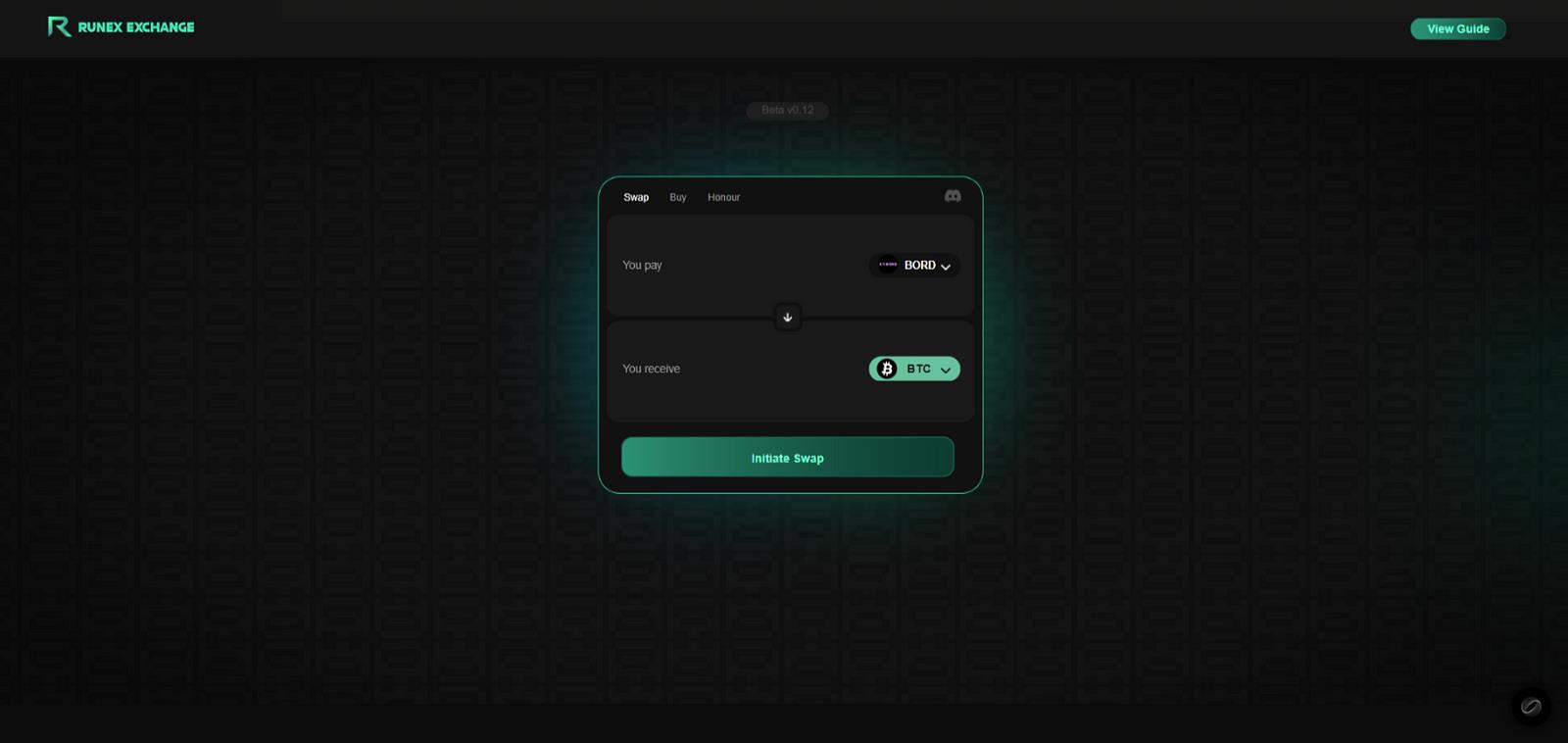
Another method involves using a Tampermonkey script to modify Unisat, forcibly listing CBRC-20 tokens. The transferred inscriptions generated during minting all belong to the cbrm collection. The founder created a browser extension that can read inscription data directly from Unisat, allowing users to identify specific inscriptions.
In addition to these two marketplaces, community members have independently developed trading platforms for CBRC-20 tokens. Some have even attached CBRC-20 tokens to BRC-20 tokens using a "Trojan horse"-like approach to get them listed on Unisat. However, this experimental method carries significant security risks and offers no guarantee for asset safety.
Recently, the founder initiated an OSMOSIS experiment and deployed the first meta-meta-protocol inscription, $SYMM. How should we understand "meta-protocol" and "cross-indexing"?
"Meta-protocol" is a term used in the Ordinals community to describe interactive protocols formalized through off-chain indexing of on-chain information (e.g., BRC-20, SNS, Bitmap, etc.).
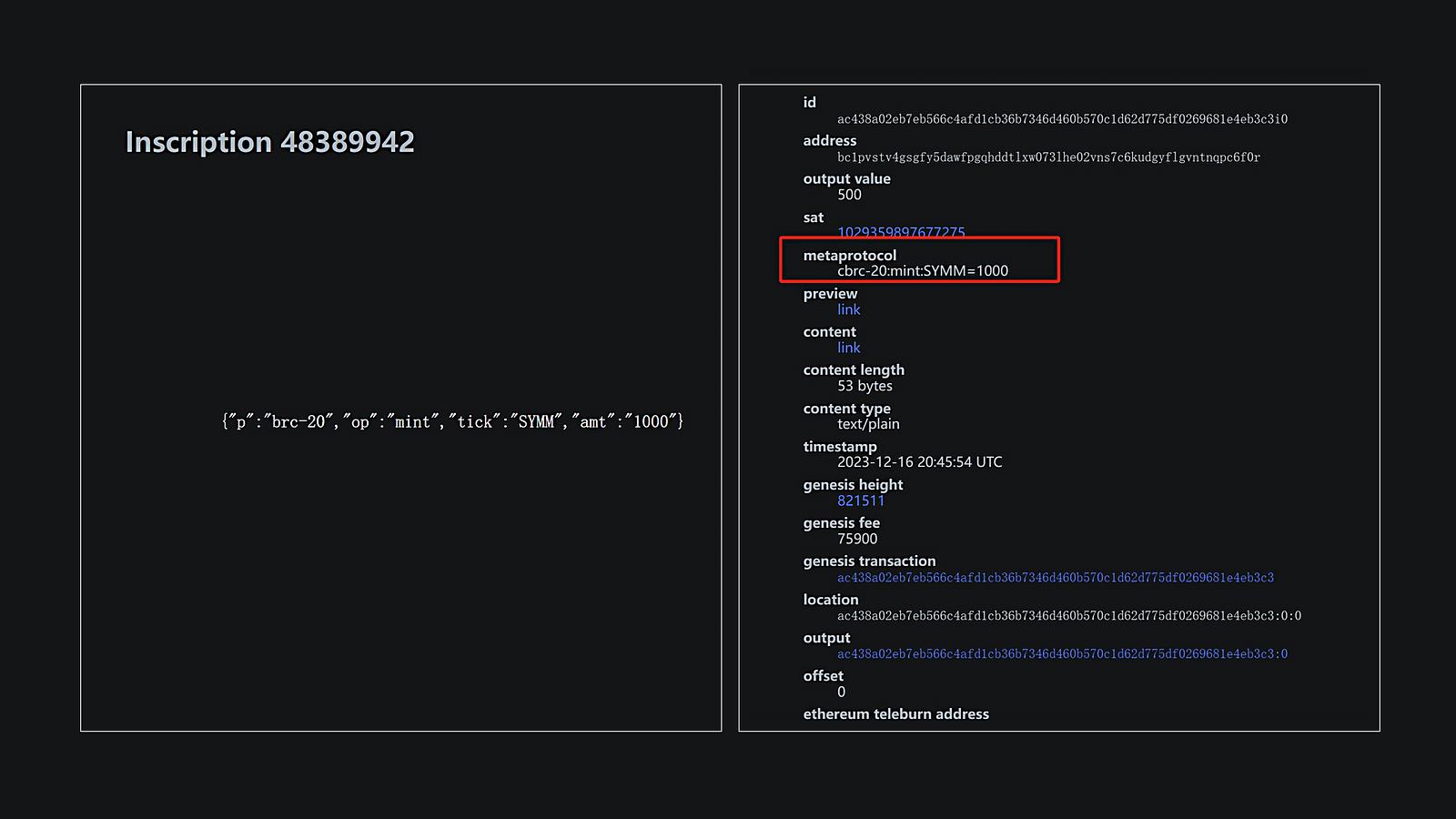
Due to the non-overlapping nature of the two BRC/CBRC meta-protocols, a single inscription can simultaneously complete deployment/minting/transfer operations across both protocols. If a holder possesses both, their $SYMM becomes "valid." The figure below shows a dual-protocol $SYMM inscription—the left side depicts the inscription.
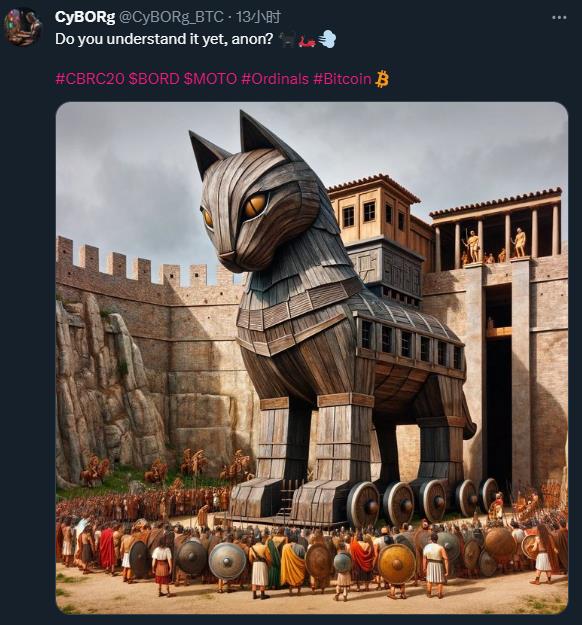
Overall, CBRC-20 functions like a "Trojan horse," utilizing its inscription method to embed multiple protocol inscriptions at once, thereby performing a kind of "vampire attack" on other protocols. Just like the Trojans frequently posted by the founder on Twitter, CBRC-20 achieves a form of "backdoor listing."
3. BTNS
Broadcast Token Naming System (BTNS) is an ecosystem constructed on the BTC mainchain by @jdogresorg, an early BTC holder and developer. Its core idea is to attach broadcast signals to every BTC transaction on-chain, using blockchain records as data sources and ledger indexing as a mechanism, making it possible for BTC to issue native on-chain assets—tokens and NFTs.
BTNS-420 is a token protocol standard built by @jdogresorg based on BTNS, integrating various ecosystem features such as asset issuance and transfer. The emergence of BTNS-420 makes the original BTNS vision feasible.
What distinguishes BTNS tokens from inscriptions and runes?
-
Firstly, BTNS ecosystem tokens do not alter or occupy BTC, aligning better with BTC's ecological direction. In contrast, inscriptions and runes rely on BTC itself for storage, leading to massive BTC usage and resource waste. Asset minting via broadcasting is more transparent and fair. Although indexing is built by @jdogresorg, all broadcast data are stored in BTC transaction blocks, fully transparent and publicly verifiable. The indexer mainly serves to limit and track total assets rather than enabling centralized control over who gets indexed.
-
BTNS carries no potential risks, as it is fully open-source, and all infrastructure developments extend from BTC’s inherent characteristics and functions without major controversies.
What value does BTNS bring?
-
BTNS transforms the previously impossible—issuing assets on the BTC mainchain—into reality, relying entirely on BTC's native features. It enables asset creation without consuming BTC supply. With further refinement, BTNS could potentially turn BTC into a fully playable, eco-friendly mainstream ecosystem chain (note: an ecosystem chain, not just a value coin).
-
The recent inscriptions and runes revolution has caused severe congestion on the BTC network. In my opinion, adopting BTNS to build ecosystems would allow frameworks and upgraded token protocols to support mechanisms like airdrops and fair indexing (via rules or specific instruction-based indexing), making asset acquisition more equitable—not determined by who acts first or pays higher gas fees—but through fairer methods such as address registration, block-range restrictions, or even low-gas transaction indexing.
According to the community, @jdogresorg is currently on vacation and has paused development work. Judging from his recent Twitter updates, this appears to be true. As a result, the planned marketplace remains undeveloped.
Summary
The above covers recent new Bitcoin protocols. Both Rune Alpha and CBRC-20 remain within the scope of inscriptions, representing asset issuance methods based on Ordinals. However, CBRC-20 demonstrates greater innovation by enabling simultaneous minting across multiple protocols. Conceptually, BTNS goes beyond both, belonging to the category of meta-protocols, while Rune Alpha and CBRC-20 fall under "layer-two protocols" (i.e., standards or protocols developed atop foundational ones like Ordinals). Moreover, BTNS uses a "broadcast" model to enable asset issuance on Bitcoin without occupying Bitcoin (no evaluation here regarding the pros and cons of such occupation).
Join TechFlow official community to stay tuned
Telegram:https://t.me/TechFlowDaily
X (Twitter):https://x.com/TechFlowPost
X (Twitter) EN:https://x.com/BlockFlow_News
 @jianshubiji