








With the upcoming Cancun upgrade, how is Metis making Layer2 truly "decentralized"?
TechFlow Selected TechFlow Selected
With the upcoming Cancun upgrade, how is Metis making Layer2 truly "decentralized"?
The L2 sector has shown trends toward decentralization and consolidation.
 Navigating Web3 tides with focused insights
Written by: TechFlow
Guess a riddle about a crypto project—"Meme among L2s, L2 among memes"—and you might instantly see the answer: Metis, the hot Ethereum Layer 2 project in the ecosystem today.
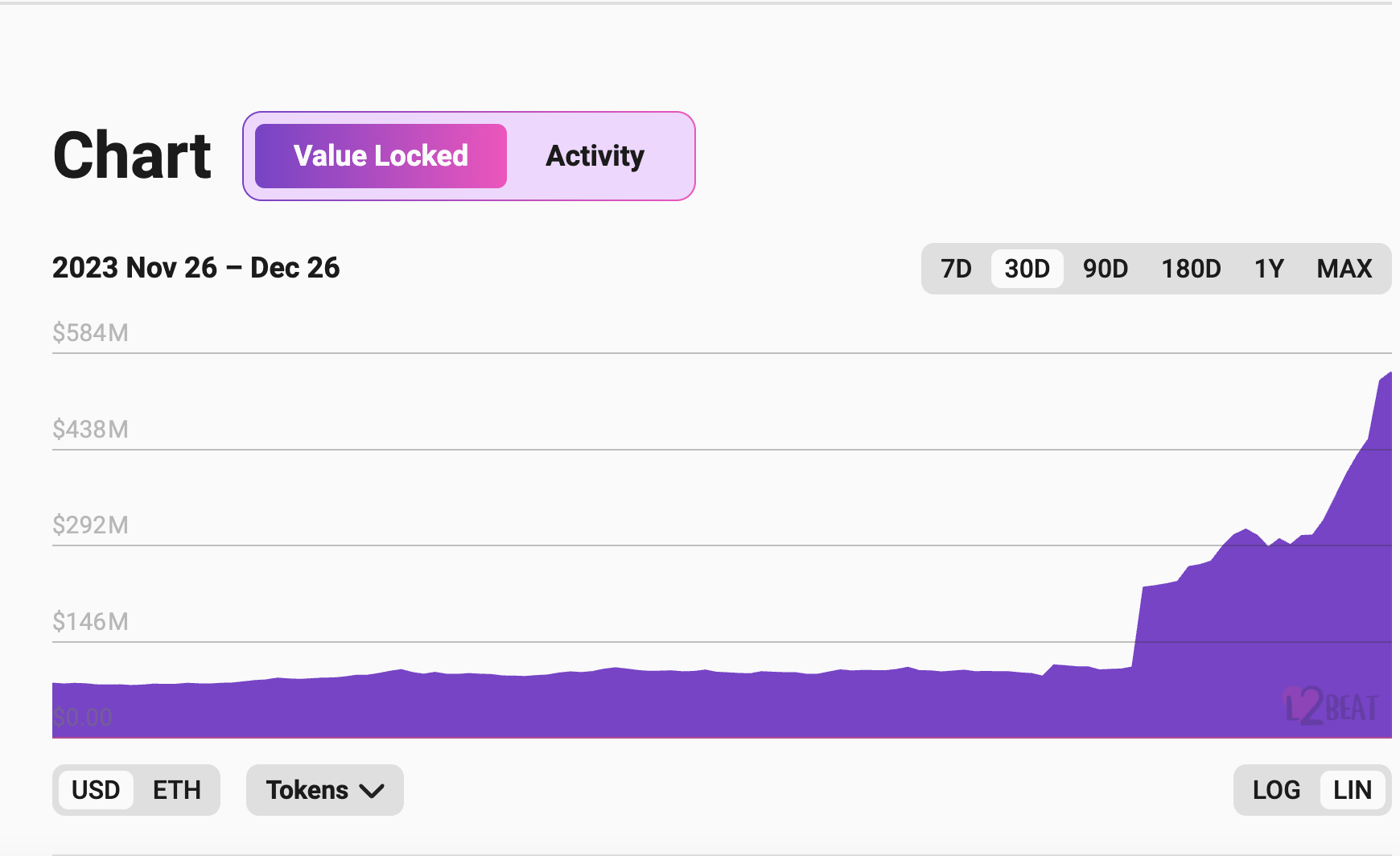
According to data from L2 Beat, this L2 project—backed by Vitalik Buterin’s mother Natalia Ameline and her close friend Elena Sinelnikova—now boasts a total value locked (TVL) exceeding $500 million, an increase of 416%, placing it firmly among the top four Ethereum Layer 2 platforms. Alongside soaring TVL, its token price has surged over 300% in just 30 days.
What is driving the spiral rise in Metis’ TVL and token price?
As Ethereum’s highly anticipated "Cancun Upgrade" draws closer in Q1 2024, Layer 2 projects are increasingly coming into investors’ crosshairs. Compared to large-cap L2s like Arbitrum and Optimism, which each have circulating market caps around $3 billion, Metis—with a market cap of only $300 million—is seen by investors as far more cost-effective. Moreover, Metis brings its own unique edge: a decentralized sequencer.
Most mainstream Ethereum Layer 2 solutions outsource smart contract computation to external servers, then submit results (via fraud proofs or zero-knowledge proofs) back to Ethereum for final settlement.
This server is known as the sequencer. It collects unordered user transactions off-chain, processes them into batches, compresses them, orders them, and then sends them to Ethereum. In essence, the sequencer is the soul of any L2.
Here’s a harsh reality: current leading L2s—including Arbitrum and Optimism—still operate with centralized sequencers. The reason is simple: running a single, centralized sequencer is convenient, user-friendly, and cheaper.
However, this contradicts the core ethos of decentralization that crypto champions. It also raises concerns about potential malicious behavior—such as transaction front-running, manipulation, and MEV extraction—by the sequencer operator.
Metis aims to break new ground in decentralized sequencing. It plans to test a decentralized Proof-of-Stake (PoS) sequencer on the Sepolia testnet, with community testing set to begin on January 3, 2024.
At a time when centralized sequencers have become entrenched, will Metis’ bold push toward decentralized sequencing accelerate innovation across the L2 space and spark a new wave of progress?
This article explores Metis’ technological innovations and ecosystem strategy as entry points to compare L2 projects across two key dimensions—technology and ecosystem—and examine future opportunities and challenges in the L2 landscape.
First Decentralized PoS Sequencer: Staking Incentives Fuel Internal Motivation
It's no exaggeration to say that the issue of sequencer centralization has reached a critical point in the L2 space.
On one hand, most existing L2s rely on centralized sequencers, and their commitment to decentralizing them remains ambiguous. Both the OP Foundation and Arbitrum Foundation run centralized sequencers themselves. While both have proposed decentralized sequencer solutions to appease community concerns, the low operational threshold and costs, along with lucrative revenue streams from running centralized sequencers, have led to painfully slow progress toward true decentralization.
On the other hand, advancing decentralized sequencing is now urgent. Centralized sequencers not only contradict blockchain’s foundational principle of decentralization but also pose serious risks. A failure or attack on the sequencer could bring down the entire L2 network. Since the sequencer controls transaction ordering, content, and structure, it could act maliciously to maximize arbitrage profits, capture MEV value, or even censor user transactions entirely.
Human nature gravitates toward profit—a fact unlikely to change. Therefore, designing a decentralized sequencer must account not only for market dynamics but also for human incentives. Building systems that harness self-interest is essential for ensuring long-term, stable operation.
Metis’ solution—introducing a staking-based decentralized PoS sequencer—is precisely such a design: robust at the technical layer and reinforced by incentive mechanisms.
In Metis’ architecture, there is first an Admin role—the rule-maker responsible for setting key parameters in the decentralized system, including qualifying and adding sequencers to the sequencer pool and determining block reward emission rates.
Sequencers in the pool are responsible for determining transaction order, content, and structure. When multiple sequencers exist, at least 2/3 must sign off before a batch can be submitted to the L1 Rollup contract.
To prevent malicious behavior, validators perform spot-checks on blocks—for example, verifying whether transaction sequences were altered or if invalid transactions were inserted.
This process can be loosely compared to a school setting: a principal (admin) selects qualified teachers (sequencers) to form exam questions. These questions are finalized only after approval from at least two-thirds of the teachers. Meanwhile, inspectors randomly audit these teachers to ensure no misconduct, such as leaking exam content.
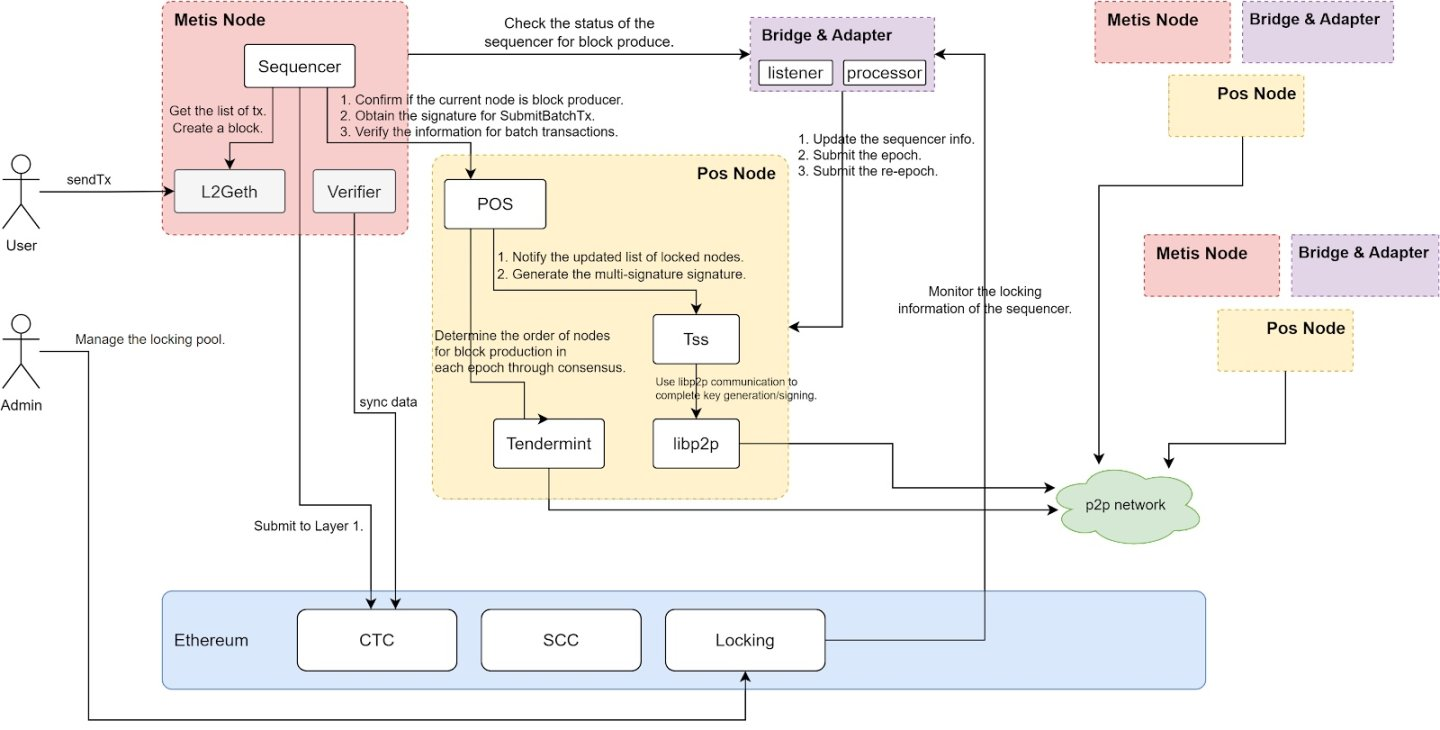
Metis Decentralized PoS Sequencer Operation Diagram
This multi-party sequencer model achieves true decentralization, reflecting Metis’ deep understanding of market needs and timely responsiveness. But another crucial question arises:
Decentralization stems from broad participation and consensus. So what motivates people to join?
Metis answers with staking-based incentive mechanisms.
First, prospective sequencer operators must stake at least 20,000 METIS tokens to enter the sequencer pool. Once active, they earn substantial block rewards. This 20,000 METIS threshold serves multiple positive purposes:
-
Network stability: It ensures sequencers have the capability to participate meaningfully in network operations and acts as a deterrent—if a sequencer behaves maliciously, its staked assets will be slashed.
-
Ecosystem growth: At a time when L2 native tokens often lack utility beyond governance, staking increases METIS' real-world use cases. It also reduces circulating supply, creating a virtuous cycle that benefits overall ecosystem health.
For validators, checking blocks earns direct token rewards. Additionally, if they detect malicious activity, they receive a portion of the slashed assets from offending sequencers—further incentivizing vigilant monitoring.
To broaden participation, Metis’ ecosystem will likely spawn staking dApps that allow ordinary users without enough capital to join. These users can delegate their tokens to trusted sequencer operators and share in the rewards. In turn, operators seeking greater backing will need to share part of their earnings with supporters.
This creates a stable, widely participatory, transparent, and mutually beneficial framework for decentralized sequencer operations.
Beyond incentives, Metis’ implementation of staking invites deeper reflection on the practicality of L2 native tokens. For years, L2 tokens have largely been confined to governance roles, prompting skepticism about their necessity. How to expand their utility remains a major challenge. By integrating staking into its decentralized PoS sequencer mechanism, Metis not only provides strong incentives but embeds token utility directly into consensus and network security.
Currently, this design remains theoretical—but it won’t stay that way for long. On December 27, 2023, Metis began testing its decentralized PoS sequencer on the Sepolia testnet, with full community testing launching on January 3, 2024. Users can earn points via test dApps and Learn-to-Earn programs, unlock NFTs based on achievement tiers, and ultimately qualify for community test airdrops.
Metis encourages broad community involvement to rigorously test network resilience, identify vulnerabilities, and refine the decentralized PoS sequencer solution.
Hybrid Rollups: Bridging the Gap Between OP and ZK, Achieving the Best of Both Worlds
Of course, Metis’ competitive edge isn’t limited to its decentralized PoS sequencer. Its Hybrid Rollups approach is equally groundbreaking.
Looking back at the past two years in the L2 space: Optimistic Rollups (OP) have flourished thanks to open-source tech stacks, sparking numerous derivative projects and community excitement through airdrop campaigns. ZK Rollups, meanwhile, offer stronger mathematical guarantees and higher security, with projects like zkSync and Starkware rivaling Optimism and Arbitrum. Most new entrants derive from either OP or ZK architectures, inevitably leading to technical homogenization and exposing weaknesses inherent to each approach:
-
Optimistic Rollups offer full EVM compatibility, faster off-chain processing, and lower costs. However, since they assume transaction validity by default, they carry security risks. The dispute period required for fraud proofs also leads to longer finality times.
-
ZK Rollups use zero-knowledge proofs for verification, offering higher security and instant finality without a challenge window. However, achieving EVM compatibility is difficult, and generating proofs demands significant computational resources off-chain.
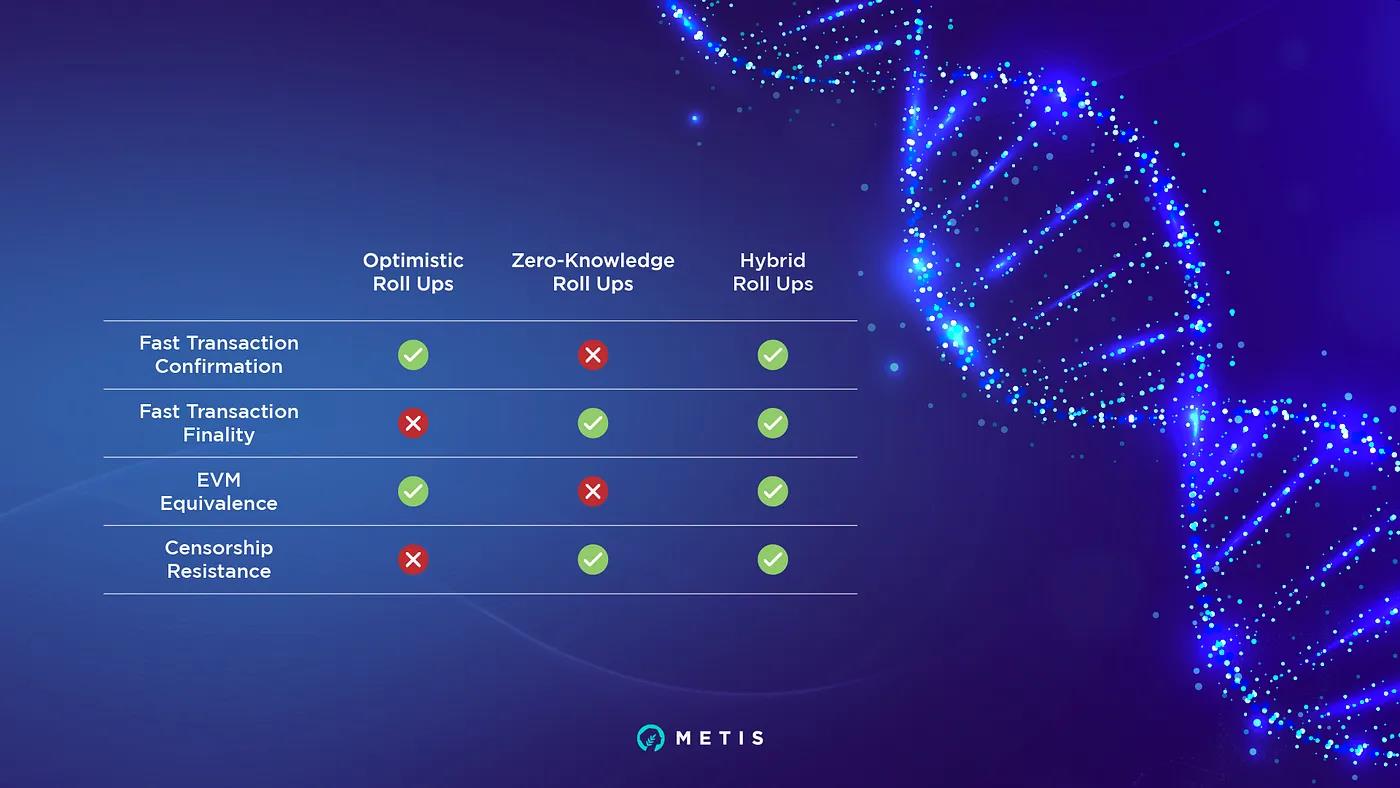
Image source: Metis Medium
After prolonged trade-offs between security and efficiency, these once-competing camps are now exploring convergence. Hybrid Rollups—blending strengths from both sides—are emerging as a promising trend, with many teams pursuing hybrid models. For instance, in July, Frax Finance launched Fraxchain, a Layer 2 network exemplifying Hybrid Rollups. Similarly, Mina Protocol applied its MIPS zkVM-based zero-knowledge proof technology to OP Stack fraud proofs.
This inclusive direction resonated with Metis. As early as March 2023, Metis highlighted Hybrid Rollups in its publicly released roadmap.
Metis retains the Optimistic Rollup architecture while introducing Zero-Knowledge Fraud Proofs (ZKFP). Unlike traditional fraud proofs requiring full re-execution of transactions, ZKFP submits a single ZK proof to verify the rollup. Verifying one ZK proof is easier, cheaper, and far more efficient.
In operation: after the sequencer generates a block, the Proposer submits transactions and state. Then, the Prover reads data from L1 to generate the block and MIPS program. After proof generation, the Prover submits it to L1. If no proof is submitted or conditions aren't met, validators initiate a fraud challenge, potentially slashing the sequencer’s stake.
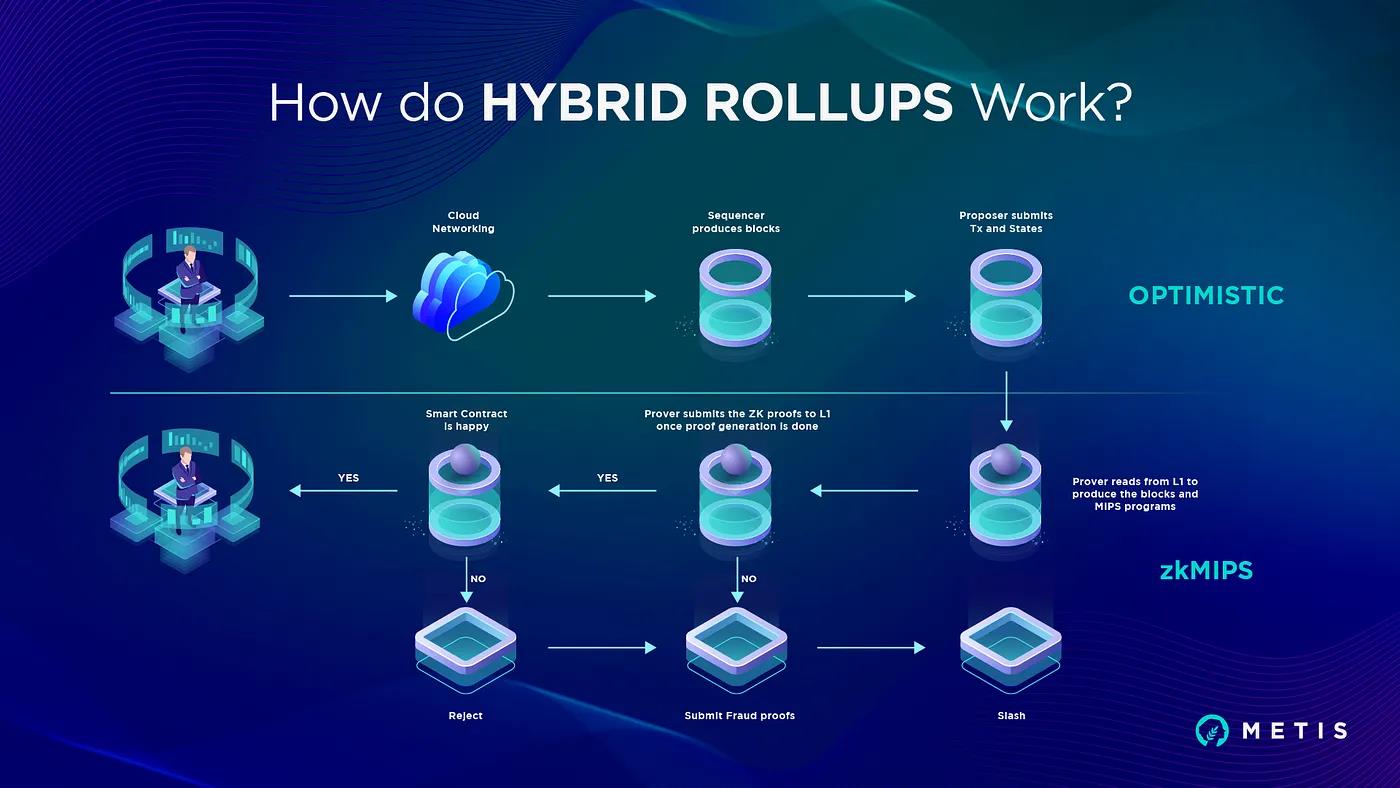
Metis Hybrid Rollups Operation Diagram
In terms of implementation, Metis integrates the MIPS instruction set into its Hybrid Rollups design.
Because the EVM instruction set evolves over time—adding new commands and deprecating old ones—it poses challenges for developers aiming to build standardized tooling. To address this, Metis optimized the MIPS architecture to create zkMIPS—a ZK-proof-optimized instruction set. Compared to conventional approaches, zkMIPS supports recursive proofs, enabling aggregation of multiple proofs into a single, manageable unit—making verification more efficient and cost-effective.
In July, Metis announced the incubation of ZKM, a zkMIPS-based project. ZKM leverages the MIPS instruction set to deliver zero-knowledge proof (ZKP) security at the CPU level for all virtual machines and applications, supporting multiple blockchain smart contract engines. Its plug-and-play design allows developers to apply ZKP without code changes, lowering adoption barriers. Backed by Ethereum’s decentralized security infrastructure, ZKM can verify transactions across both blockchain and non-blockchain systems.
Still, Metis recognizes the importance of EVM compatibility: supporting EVM attracts experienced Ethereum developers and grants access to a vast ecosystem of tools, tutorials, and infrastructure. To balance innovation and compatibility, Metis introduced the Metis Virtual Machine (MVM)—nearly identical to EVM but with key improvements like separating computation and storage. This design opens Metis to the broader EVM universe while reducing gas fees and withdrawal wait times.
Thus, Metis preserves OP’s advantages—EVM equivalence and developer-friendliness—while enhancing ZK-like benefits: finality improves from 7 days to ~4 hours, significantly boosting security. For developers, Hybrid Rollups mean lower barriers and greater flexibility; for users, they mean safer, faster experiences.
Compared to 2021, L2 technology has matured considerably—thanks to innovators pushing boundaries. As one such pioneer, Metis’ vision for decentralized sequencers and Hybrid Rollups reflects its commitment to staying at the forefront of L2 innovation. Equally, in ecosystem development, Metis continues to lead by prioritizing user and developer needs.
User-Centric Design: Multi-Dimensional Economic Incentives Drive Ecosystem Growth
Building a Layer 2 is like constructing a shopping mall. Solving technical challenges lays the structural foundation—ensuring the mall can thrive. But users drive commerce. Just as a mall's success depends on attracting tenants and customers, an L2’s vitality hinges on two factors:
-
Attracting more developers to build and innovate within the ecosystem;
-
Drawing in more users to participate and explore the ecosystem long-term.
L2 projects have already developed successful strategies in this battle for attention: Optimism’s multi-round airdrops created massive buzz, followed by its OP Stack-powered Superchain vision; Arbitrum attracted top-tier DeFi protocols like Uniswap, Aave, Curve, and 1inch, bringing huge user inflows; BASE, backed by Coinbase, went viral with FriendTech; Blast, launched by Blur’s founder, achieved over $600 million TVL in nine days using RWA-native yield mechanics…
Having深耕 the L2 space for years, Metis understands standard ecosystem-growth tactics. While following core strategies, it focuses on low barriers and high returns to expand its ecosystem footprint across users and developers.
For users:
Lowering entry barriers is paramount. That’s why every L2 prioritizes wallet integration, and Metis is no exception. Major wallets like MetaMask, Trust Wallet, imToken, TokenPocket, and OKX Web3 Wallet already support Metis, allowing seamless interaction with dApps without additional learning curves.
Reducing participation costs builds strong user goodwill. Thanks to its Hybrid Rollups design, Metis offers fast and secure transactions. Combined with its decentralized storage solution MemoLabs, transaction fees are dozens of times lower than those on Optimism or Arbitrum—ETH transfers cost less than $0.01. Even though fees may rise slightly when Metis transitions its data availability (DA) layer to Ethereum mainnet, they’ll remain low while further improving security.
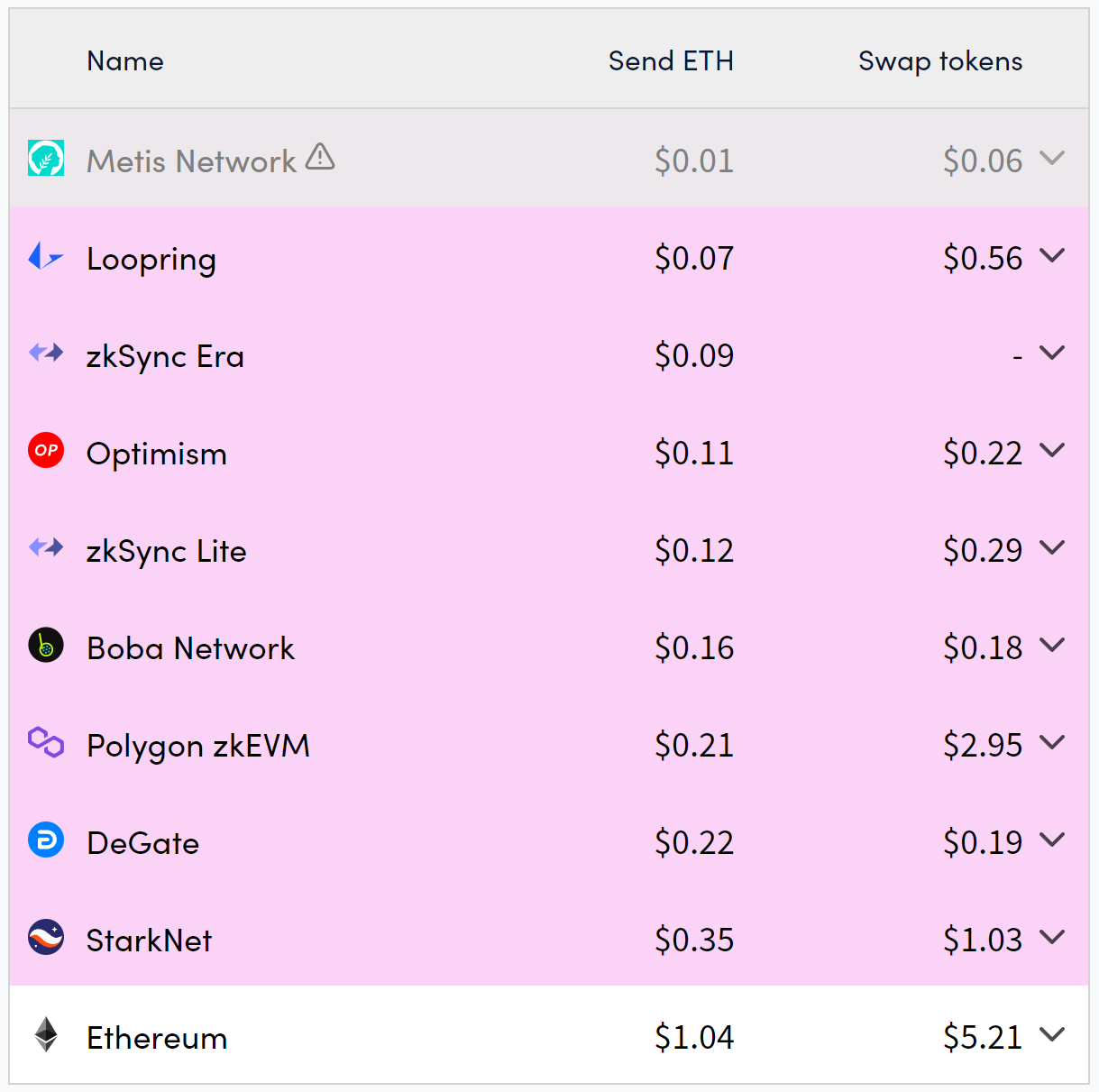
Image source: l2fees.info
Diverse participation options keep users engaged long-term. According to Layer2 Station, Metis hosts over 100 dApps spanning DeFi, wallets, and NFTs, including well-known names like Aave, SushiSwap, and Stargate. These early partnerships brought significant traffic and added depth to the user experience.
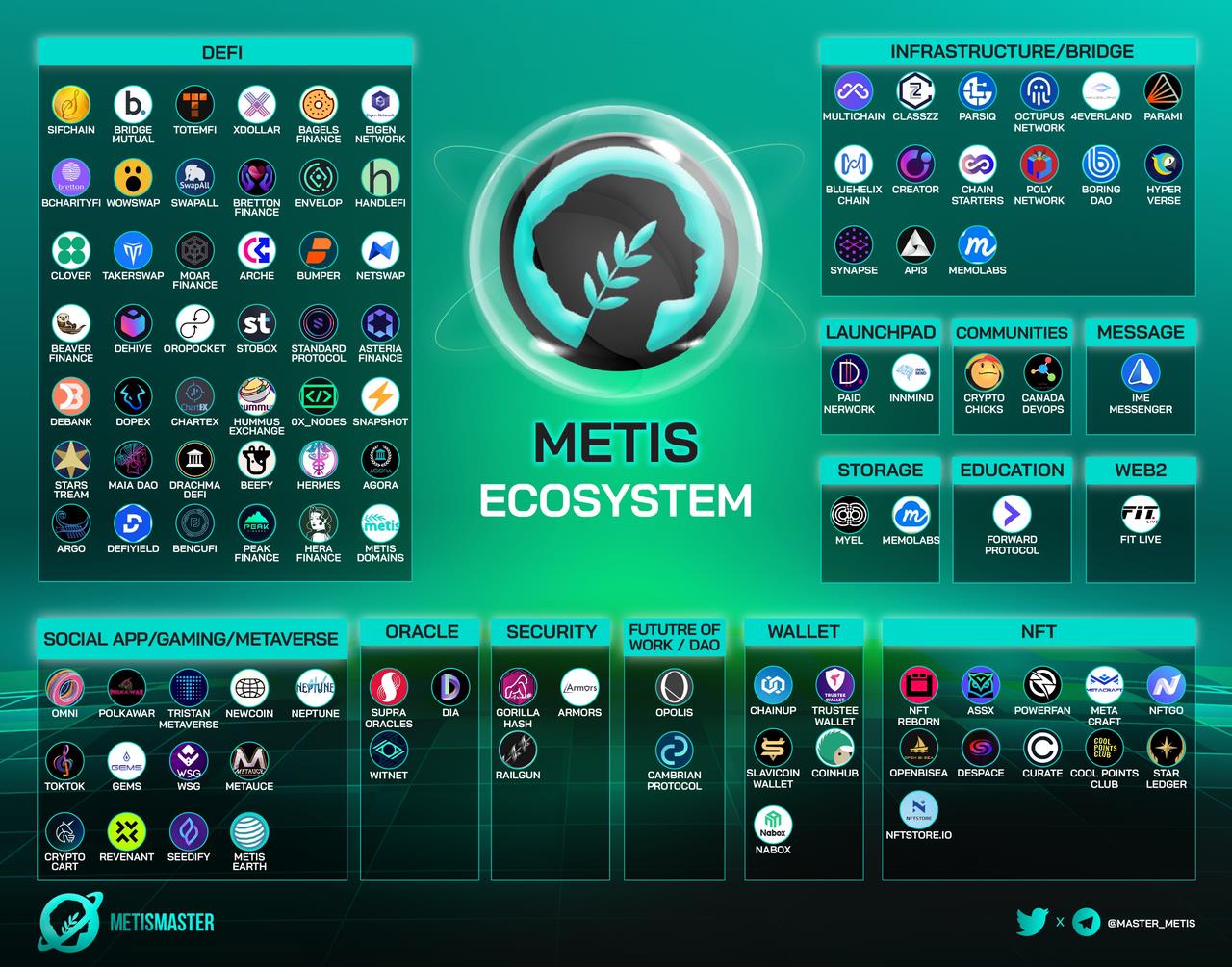
Image source: Twitter @Layer2_Station
Interestingly, since “Metis” comes from the Greek goddess of wisdom, many projects in its ecosystem are named after Greek goddesses: Maia, a DeFi yield booster, takes its name from the goddess of birth (Greek: Μαῖα); Hera Finance, a DEX aggregator, references Hera, queen of the gods (Greek: Ἥρα). This naming theme has become a memorable trait for the community.
Going forward, Metis will continue expanding into DeFi, GameFi, SocialFi, and NFTs, enriching the ecosystem and enhancing user experience.
Appealing to users’ profit motive is key to capturing attention. Airdrops have long been a favorite topic in L2 communities. Metis conducted major airdrops upon launch in 2021, and will soon reward active participants in its upcoming decentralized PoS sequencer community test (starting January 2, 2024).
Beyond airdrops, Metis ties rewards to ongoing participation through its Metis Advocates Program. Community members who align with Metis’ vision and possess content creation or social media influence can contribute and earn rewards.
In September, Metis announced a $5 million DeFi incentive program called “Metis Journey,” targeting active DeFi users. Specifically, 100,000 METIS tokens were allocated to incentivize liquidity pools on Aave within Metis, covering ETH, METIS, USDC, USDT, and DAI. Such initiatives aim to boost user yields and attract deeper engagement.
Additionally, as mentioned earlier, regular users will soon be able to stake their tokens with sequencer operators and share in block production rewards.
For developers:
Low technical barriers save developers time and effort. By maintaining Optimistic Rollup architecture, Metis ensures EVM equivalence, enabling smooth migration for Ethereum developers.
Comprehensive technical support helps avoid pitfalls. Like mature projects, Metis offers detailed documentation, tutorials, and developer tools on its official site, plus an active developer community where technical staff respond promptly to queries.
Moreover, Metis doesn’t skimp on financial support: its long-running bug bounty program for smart contracts offers up to $100,000 in rewards. It also regularly hosts hackathons to discover promising projects and developers, providing funding, technical guidance, and marketing assistance.
This week, Metis announced a $100 million ecosystem development fund, allocating 4.6 million METIS tokens to support sequencer mining, retroactive funding, new project deployments, and other initiatives. The fund will prioritize projects in DeFi, RWA, SocialFi, NFTs, cross-chain tech, smart contract development, blockchain security, decentralized identity, privacy solutions, and gaming—accelerating ecosystem growth.
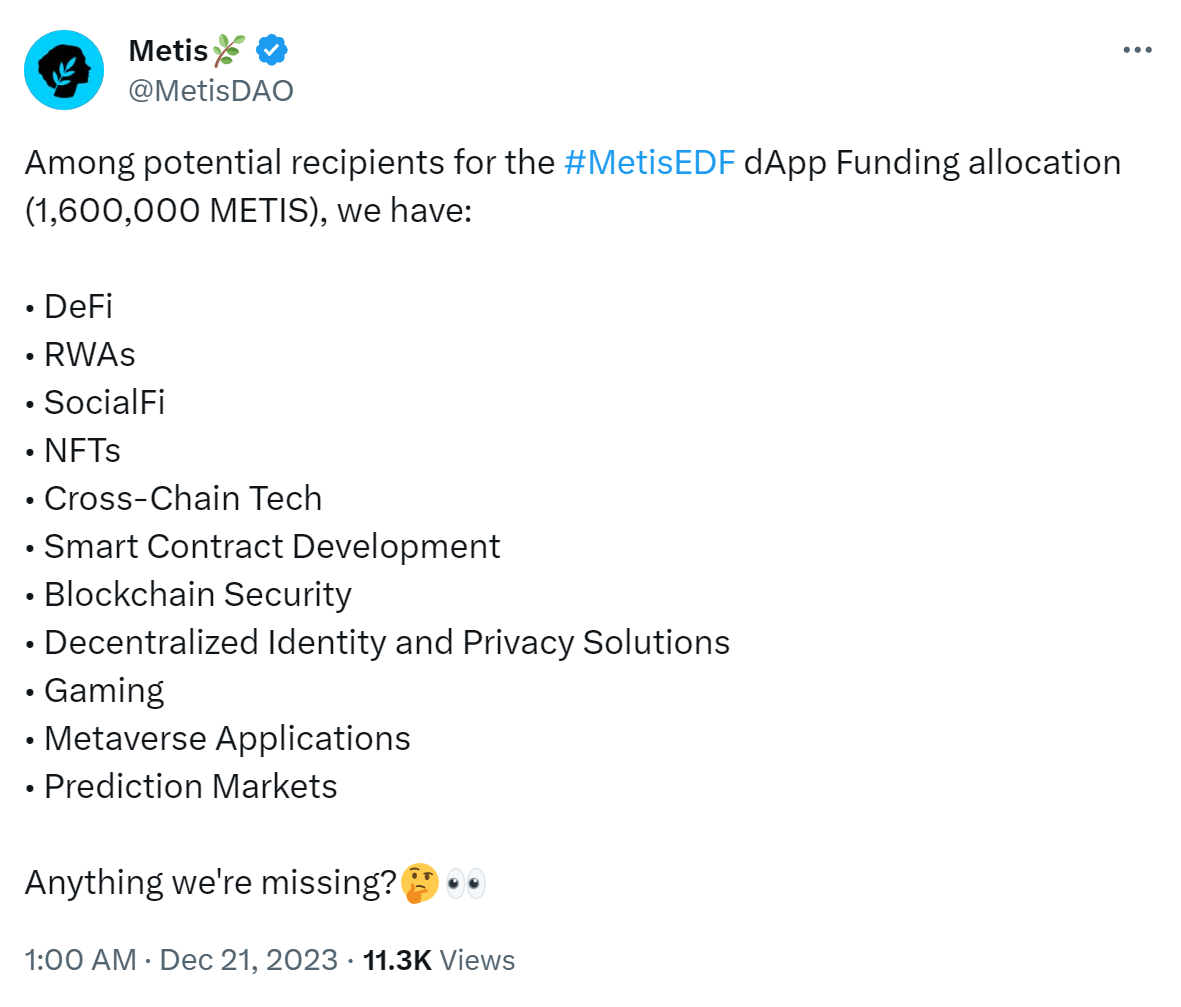
Image source: Twitter @MetisDAO
Looking Ahead to 2024: Reaching Key Milestones
Earlier this year, Metis outlined its roadmap, highlighting Hybrid Rollup upgrades as a priority. The team confirmed that ZKM will launch in Q1 2024.
Another major milestone is the upcoming decentralized PoS sequencer community test.
The first phase runs for two weeks (January 3–17, 2024), encouraging users to interact with Metis dApps deployed on the Sepolia testnet:
-
Hummus Exchange
-
Netswap
-
Tethys Finance
-
Native liquid staking protocol for METIS tokens
-
And more…
As the first project to implement a decentralized sequencer, Metis’ community test has generated significant curiosity and anticipation. Additional gameplay guides and reward details will be shared across Metis’ social channels. With various rewards tied to airdrop eligibility, interested users should stay tuned.
In 2024, Metis’ Q1 focus will center on launching the decentralized PoS sequencer. In Q2, it will accelerate work toward deploying Hybrid Rollups on testnet. By Q3, Metis’ dual-layer governance model—Common + Eco Node—will go live.
Overall, Metis’ ecosystem momentum is building rapidly. Just days ago, its TVL was around $240 million, wallet addresses ~470k, and daily active addresses ~2,000. This week, TVL jumped to $355 million—reflecting the positive impact of approaching milestones and fueling community expectations for explosive growth:
On one hand, investor and team allocations of METIS tokens have fully vested, and on-chain tracking shows institutions have largely exited. Compared to other L2s still holding large amounts of unvested institutional tokens, Metis stands out as a compelling investment opportunity in the eyes of many KOLs.
On the other hand, with the decentralized PoS sequencer launch, staking incentives will drive both sequencers (staking 20,000 METIS for block rewards) and users (sharing staking rewards) to participate actively, increasing token utility. At that point, Metis may enter a rapid growth phase.
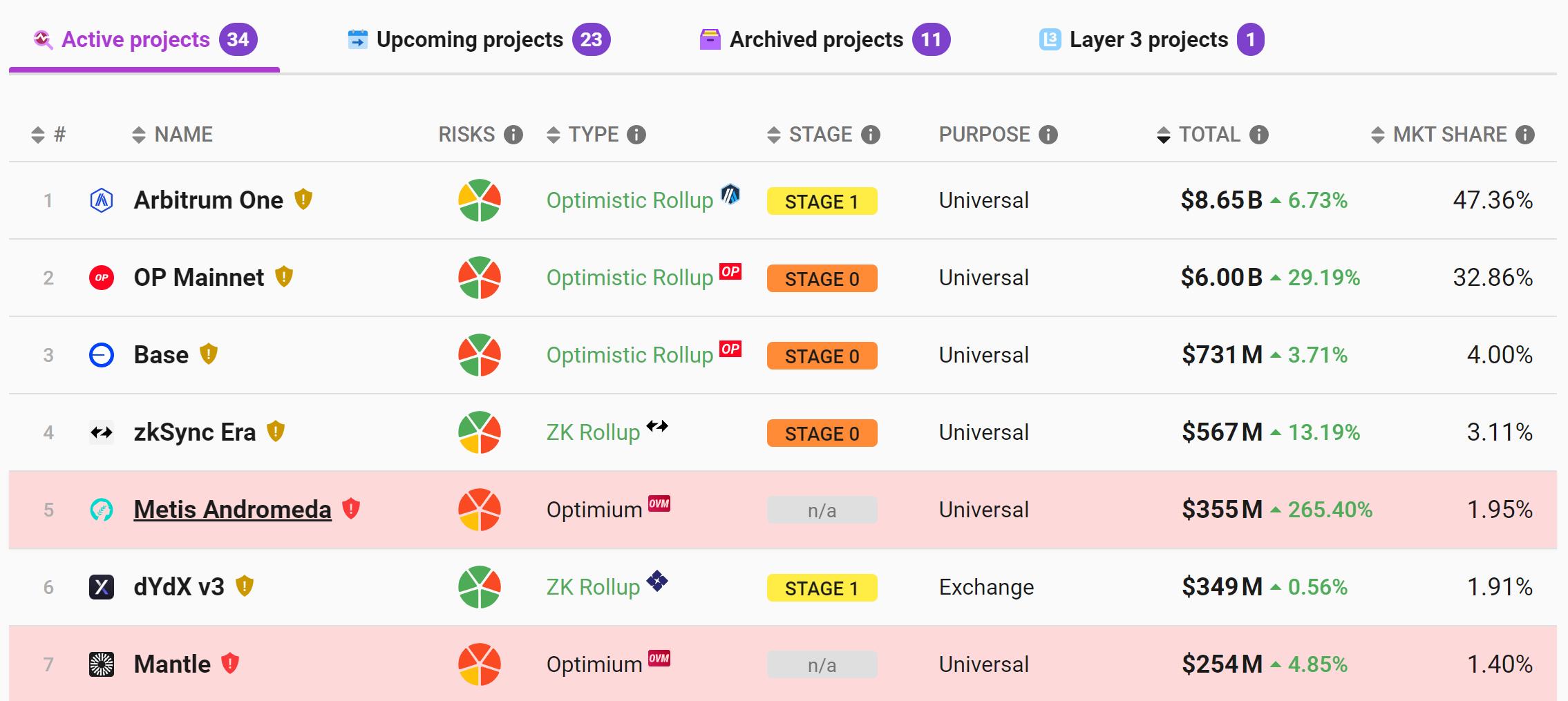
Image source: l2beat.com
In 2024, Metis will hit multiple milestones. As ecosystem development accelerates, it may seize the opportunity to challenge the current top-tier L2s—Arbitrum, Optimism, zkSync, and Starkware—and claim a spot among the elite.
Conclusion
From rising calls for decentralized sequencers and growing interest in Hybrid Rollups, it’s clear the L2 space is trending toward decentralization and convergence.
Go with the flow, and progress multiplies. In today’s competitive L2 landscape, making wise, trend-aligned choices—embracing inclusivity and continuous innovation—can propel projects forward and break through industry bottlenecks.
Extending the meaning of “Metis”—from the Greek Μῆτις, goddess of wisdom—the project’s name reflects both its aspirational identity and perhaps a subtle nod to its strategic intelligence in navigating the L2 landscape:
Breaking free early from the OP vs. ZK rivalry, Metis identified Hybrid Rollups with sharp market insight and steadfastly pursued decentralization—using both technical innovation and incentive design to ensure the stable operation of its decentralized PoS sequencer.
This wisdom extends to ecosystem building. As the saying goes, bear markets are for building. Today, Metis’ ecosystem—from infrastructure to diverse dApps—is maturing steadily. Now, at the dawn of a bull market, Metis is poised for breakthroughs, ready to welcome surging user and capital inflows.
Of course, the L2 war is just beginning. As the next bull market unfolds, we look forward to seeing how Metis performs—and how the broader L2 space continues to innovate.
Join TechFlow official community to stay tuned
Telegram:https://t.me/TechFlowDaily
X (Twitter):https://x.com/TechFlowPost
X (Twitter) EN:https://x.com/BlockFlow_News
 深潮TechFlow


