The "Ethereum killers" are back—here's a breakdown of the Solana community's shilling rhetoric
TechFlow Selected TechFlow Selected
The "Ethereum killers" are back—here's a breakdown of the Solana community's shilling rhetoric
Looking back at Solana's development this year, its vision of becoming the "Nasdaq of blockchain" is steadily moving forward, and once again Solana has reclaimed the familiar title of "Ethereum killer."
 Navigating Web3 tides with focused insights
Author: Kaori
The Solana ecosystem continues to heat up, with meme coins, tokens, and NFTs all driving momentum—making the crypto market wonder if this once-and-future "Ethereum killer" is making a comeback?
Yesterday, SILLY, a meme coin project on Solana, surged 211% over 24 hours. Other Solana-based meme coins like COQ and WIF also climbed high on trading charts with impressive gains. Meanwhile, Solana’s native token SOL briefly broke above $84 earlier today, rising 11% in 24 hours.
Before this, the spotlight was first captured by Bonk—one of the meme coins that once rescued Solana during its darkest days. As Bonk's price rose, Saga, the Web3 phone launched by Solana Labs, gained massive premium value in the secondary market, since each Saga device qualifies for an airdrop of up to 30 million BONK tokens. A few days ago, Kyle Samani, co-founder of Multicoin Capital, stated on social media that he expects Solana Saga phone owners to receive significant airdrops within the next 12 months—adding more fuel to Solana’s ongoing meme season.
On December 16, DEX trading volume on the Solana network reached approximately $1.475 billion, surpassing Ethereum (around $1.164 billion). Over the past week, Solana’s total trading volume hit $6.429 billion—an increase of 52.75%. Less than a week later, Solana’s DEX daily trading volume exceeded Ethereum’s for the second time in history, topping $1.2 billion in a single day.
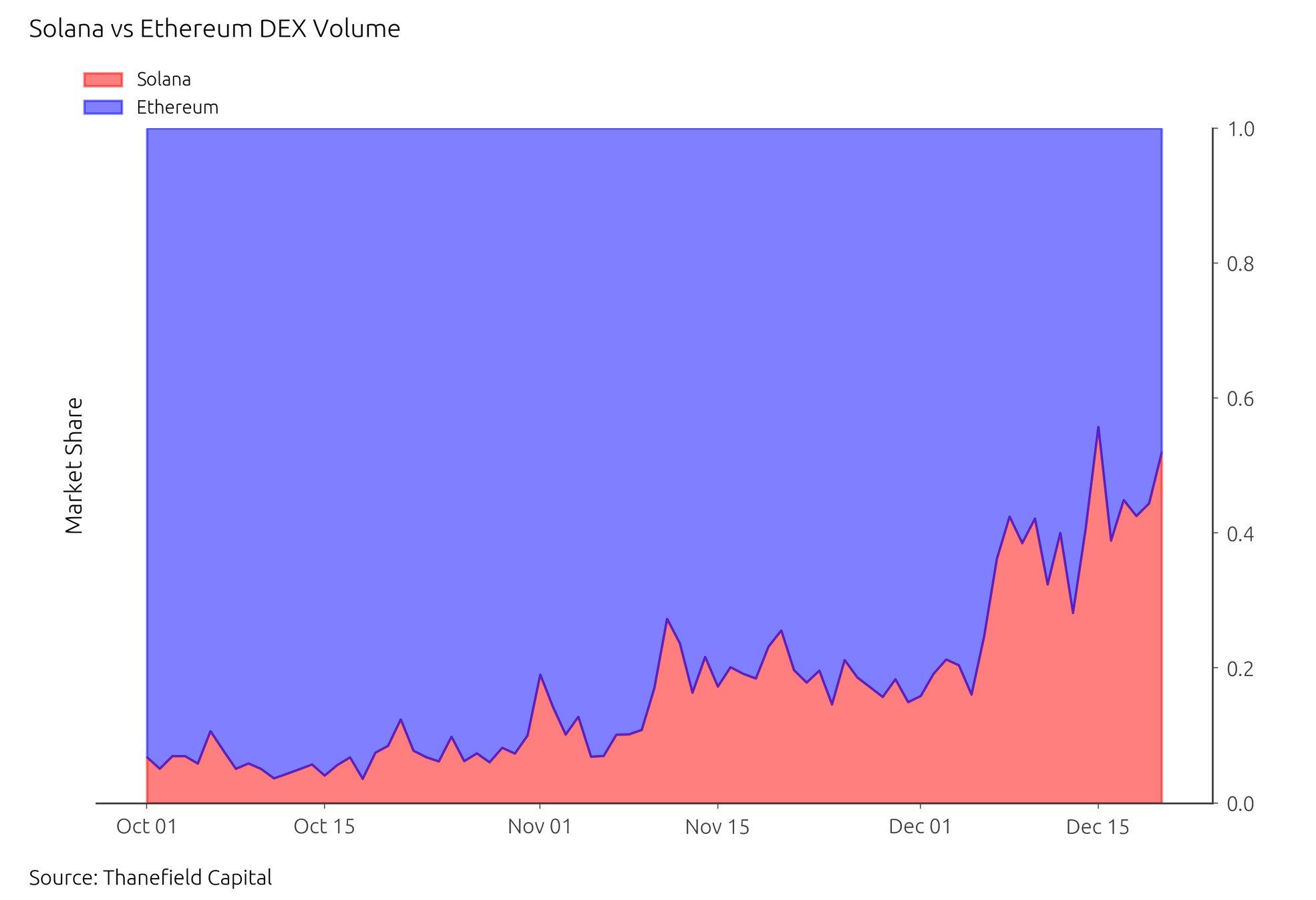
Analysts believe that thanks to low fees, faster transactions, and an improved user experience—combined with recent wealth effects within its ecosystem—the trend of Solana gaining market share may continue, potentially positioning it as a new center of crypto activity. This aligns perfectly with Solana co-founder Anatoly’s grand vision: to fully rebuild the New York Stock Exchange or Nasdaq on-chain.
“The Nasdaq of Blockchain”
Solana's origins trace back to 2017, during the rise of cryptocurrencies—a period that created legendary fortunes but also caused severe congestion across blockchain networks. Anatoly, an engineer who previously worked at Qualcomm for several years, realized that blockchains and communication networks face similar challenges and might share common solutions. One of Solana’s core ambitions has always been to capture market share from traditional finance.
To tackle the blockchain trilemma, Solana uses Proof of History to verify the timing of transactions—sacrificing some degree of decentralization in favor of speed. The result? “Fast, low-cost, frictionless user interactions” became Solana’s hallmark. Solana’s theoretical peak TPS reaches 710,000, far exceeding Visa’s 17,000.
In July 2020, Solana reached a major turning point when FTX announced it would build its DEX Serum on Solana—marking the beginning of SBF’s collaboration with Solana. SBF’s need for a public chain capable of supporting high-frequency trading aligned perfectly with Solana’s mission to become the “Nasdaq of blockchain.”
Following this partnership, SBF not only publicly supported Solana multiple times but also participated in several funding rounds for the network and invested in numerous Solana-based applications. Backed by FTX, Solana quickly established itself in the crypto world. Star VCs such as Multicoin Capital, a16z, and Polychain Capital joined in, reaping substantial returns—earning Solana the nickname “VC Chain.”
However, with the arrival of a bear market cycle and the collapse of the FTX empire, Solana faced its biggest survival crisis since inception. Yet as market activity rebounds and trading volumes surge, Solana’s strengths are being recognized once again.
On October 31, the Solana Foundation announced at Breakpoint, Solana’s annual community summit, that Firedancer—the second validator client for Solana developed by Jump Crypto—had officially launched on testnet, with mainnet rollout expected in the first half of 2024.
Firedancer enhances node client diversity and improves the stability of the Solana blockchain, making the network more resilient and resistant to attacks. Written in C/C++, compared to the original client, it offers better compatibility, higher memory efficiency, and reduced costs for running Solana nodes.
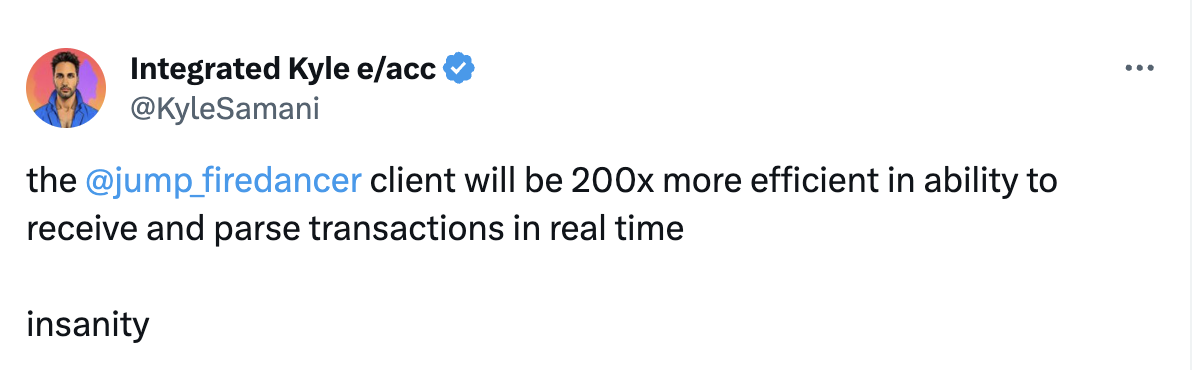
Today, Multicoin Capital co-founder Kyle Samani noted on X that Firedancer will improve real-time transaction ingestion and processing efficiency by 200x—further reassuring the market.
Currently, Solana achieves a TPS of 2,373 with average transaction fees of just $0.00025—significantly outperforming Ethereum’s 14.8 TPS and $1.66 gas fee. During the recent wave of token-related trading frenzy, Solana’s transaction fees have remained largely stable, while those on Bitcoin, Ethereum, Avalanche, and other blockchains skyrocketed, becoming prohibitively expensive.
"The Ethereum Killer"
High transaction throughput remains one of the core demands in cryptocurrency—which is why Ethereum has undergone multiple major upgrades. Looking back at Solana’s progress this year, its vision of becoming the “Nasdaq of blockchain” is steadily advancing, and the familiar title of “Ethereum killer” is once again being attached to Solana.
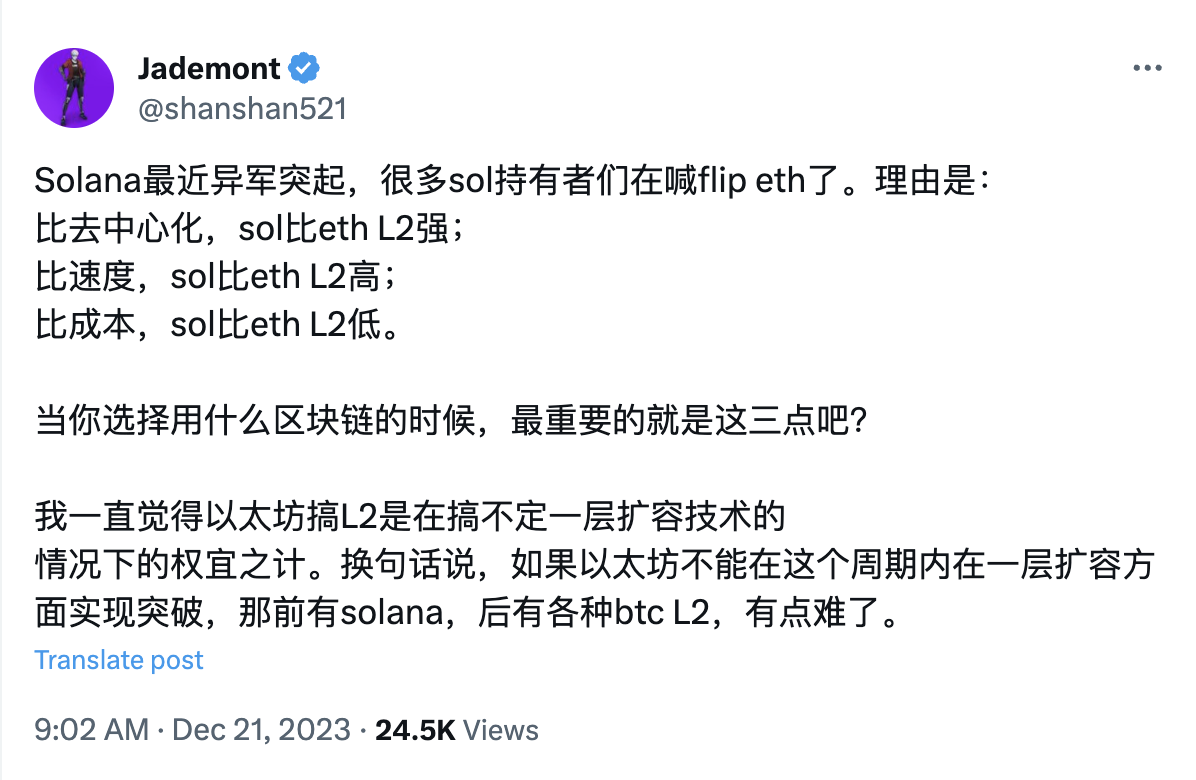
Jademont, founding partner at Waterdrip Capital, recently wrote on X that Solana’s sudden rise has led holders to chant “Solana Flip ETH.” He believes, “Ethereum’s push for L2s is merely a stopgap solution due to failure in scaling Layer 1. In other words, if Ethereum doesn’t achieve a breakthrough in Layer 1 scalability within this cycle, it’ll be tough—with Solana ahead and various BTC L2s emerging behind.”
Messari wrote in its recently published report *CRYPTO THESES 2024*: “When I think about Ethereum versus Solana, I see Visa vs Mastercard—not Google vs Bing in terms of dominance.”
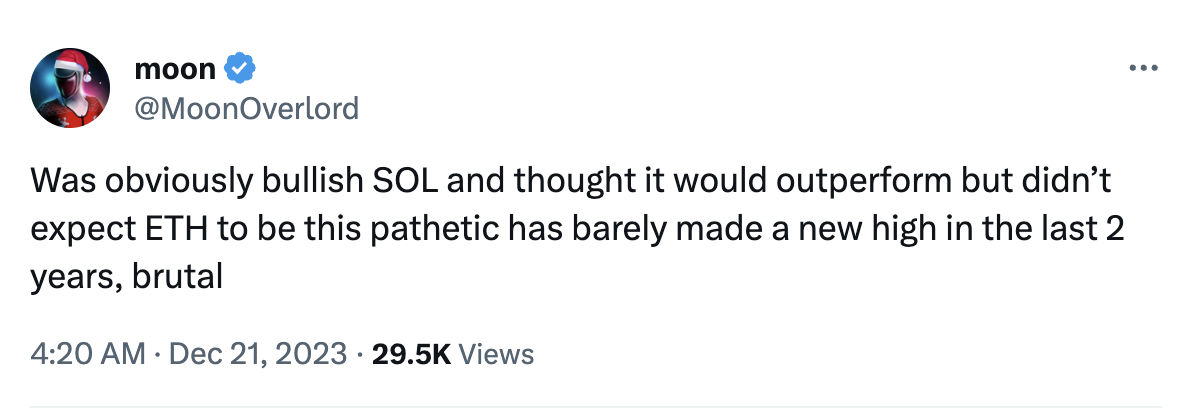
Crypto trader @MoonOverlord wrote on X: “Clearly bullish on SOL, expecting it to outperform the market—but didn’t expect ETH to be this weak, barely reaching new highs over the past two years. Brutal.” According to CoinGecko data, SOL has risen 587.4% over the past year, while ETH has gained only 81.7%.
On October 28, asset management firm VanEck released a report applying its standardized valuation framework to Solana, projecting a base-case target of $335 per SOL by 2030. Despite its huge potential, VanEck believes Solana still has a lower probability than Ethereum of hosting most global crypto transactions by then. However, if Solana can escape Ethereum’s narrative shadow and achieve similar dominance, VanEck’s bull-case scenario estimates Solana’s network revenue could reach $51.8 billion by 2030, with a SOL price target of $3,211.
Solana’s performance speaks for itself. Its promised 2024 Firedancer upgrade is expected to boost network capacity another tenfold, enabling throughput nearly 1,000 times greater than Ethereum 2.0. Still, Ethereum is set to roll out its Cancun upgrade in 2024—making the evolving landscape of next year’s crypto market even more exciting to watch.
Join TechFlow official community to stay tuned
Telegram:https://t.me/TechFlowDaily
X (Twitter):https://x.com/TechFlowPost
X (Twitter) EN:https://x.com/BlockFlow_News
 BlockBeats