









EigenLayer has once again increased its TVL cap—how to interact ahead of the closing window?
TechFlow Selected TechFlow Selected
EigenLayer has once again increased its TVL cap—how to interact ahead of the closing window?
In just a few hours, the market has deposited over 200,000 ETH, drawing ever closer to the hard cap.
 Navigating Web3 tides with focused insights
Author: Azuma
In the early hours of December 19, Ethereum restaking protocol EigenLayer reopened its liquid restaking deposit window and increased the total cap (think TVL limit) for major ETH liquid staking tokens (LSTs) from 100,000 to 500,000 ETH.
Earlier this year, EigenLayer completed a $50 million Series A funding round led by Blockchain Capital, with participation from Coinbase Ventures, Polychain Capital, Zonff Partners, Bixin Ventures, Hack VC, Electric Capital, IOSG Ventures, and others.
Previously, it had also raised a $14.5 million seed round led by Polychain Capital and Ethereal Ventures.
Thanks to its innovative restaking mechanism that expands Ethereum’s trust layer, along with recent breakthrough progress in its data availability solution EigenDA currently under test, market expectations around EigenLayer’s valuation and potential token airdrop are extremely high.
Odaily Planet Daily Note: For an introduction to EigenLayer's mechanism, refer to "EigenLayer: Expanding Ethereum’s Trust Layer via Restaking."
From June through August this year, shortly after launching Phase 1 on mainnet, EigenLayer raised LST restaking limits three times. Each time, the hard cap was quickly reached within hours—clear evidence of intense market enthusiasm for the project.
This time, although EigenLayer increased restaking capacity by a full 400,000 ETH, within just a few hours—from early morning until publication—over 200,000 LSTs had already been deposited (real-time restaked amount at 380,390 ETH; subtracting the original 100,000 ETH and native restaking of 74,144 ETH). The cap is rapidly approaching again.

So how can users participate in EigenLayer restaking? Currently, there are two ways to interact with EigenLayer: liquid restaking and native restaking. The key difference is that the latter is more suitable for users who run their own validator nodes.
Below, we’ll walk through the operational details of both methods, focusing especially on liquid restaking—the option better suited for average users.
Liquid Restaking
Early this morning, alongside the increase in overall LST deposit cap, EigenLayer added support for six new LSTs: osETH (StakeWise), swETH (Swell Network), OETH (Origin Protocol), EthX (Stader Labs), WBETH (Binance), and AnkrETH (Ankr).
Combined with the initially supported stETH (Lido), rETH (Rocket Pool), and cbETH (Coinbase), EigenLayer now supports a total of nine LSTs.
Taking stETH—the most commonly used LST (available directly on OKX at a price nearly equivalent to ETH)—as an example, clicking the stETH tab on the Dapp website will redirect you to the corresponding restaking page. Next, enter the amount of stETH you wish to restake, click “Next,” then complete authorization (set maximum spending allowance), followed by confirming two transactions. Upon seeing “Deposit Successful,” your restaking is complete.
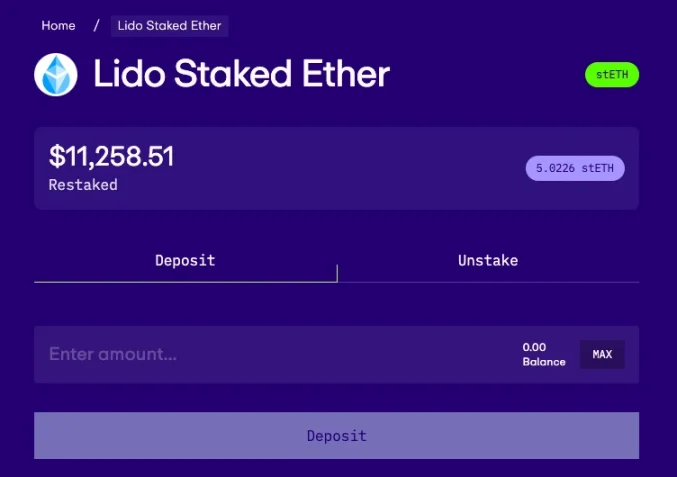
Note that in addition to the 500,000 ETH overall cap, EigenLayer has also set an individual cap of 200,000 ETH per LST this time—meaning no single LST can exceed 200,000 ETH in deposits. Currently, stETH deposits have already surpassed 170,000 ETH. Once the 200,000 ETH threshold is hit, users must choose another LST for restaking.
Back on the homepage, users can track reward accruals from their restaked stETH and monitor their Restaked Points in real time—these points certainly spark speculation.
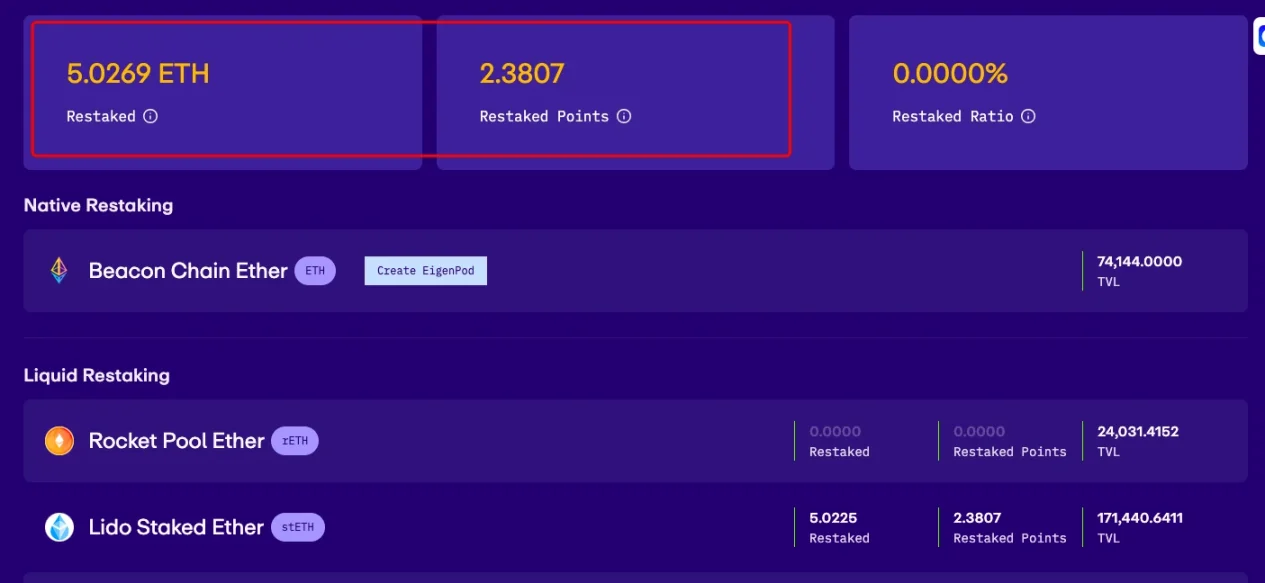
After completing restaking, users may also unstake their assets later by selecting “Unstake” on the relevant token’s restaking page. One important note about unstaking: withdrawing funds from EigenLayer requires a 7-day security period, meaning assets cannot be withdrawn until at least seven days after initiating the process.
Native Restaking
Unlike liquid restaking, native restaking requires users to operate their own validator nodes, making it technically and financially more demanding (still requiring 32 ETH; while liquid restaking may eventually relax restrictions, this remains a fixed requirement for Ethereum mainnet staking and likely won’t change).
EigenLayer does not impose a hard cap for native restaking. However, clearly most users lack the technical expertise to manage complex node operations, so as of writing, only 74,144 ETH have been deposited—equivalent to 2,317 addresses participating.

For users already running validator nodes and wishing to proceed with native restaking, the official documentation provides step-by-step guidance on assigning validator withdrawal credentials to an EigenPods address. The deposit process consists of four steps.
First, visit the Dapp website and connect your wallet.
Next, click “Create EigenPod” to set up an EigenPod. After successful creation, click “Pod Details” to obtain the specific EigenPod address.
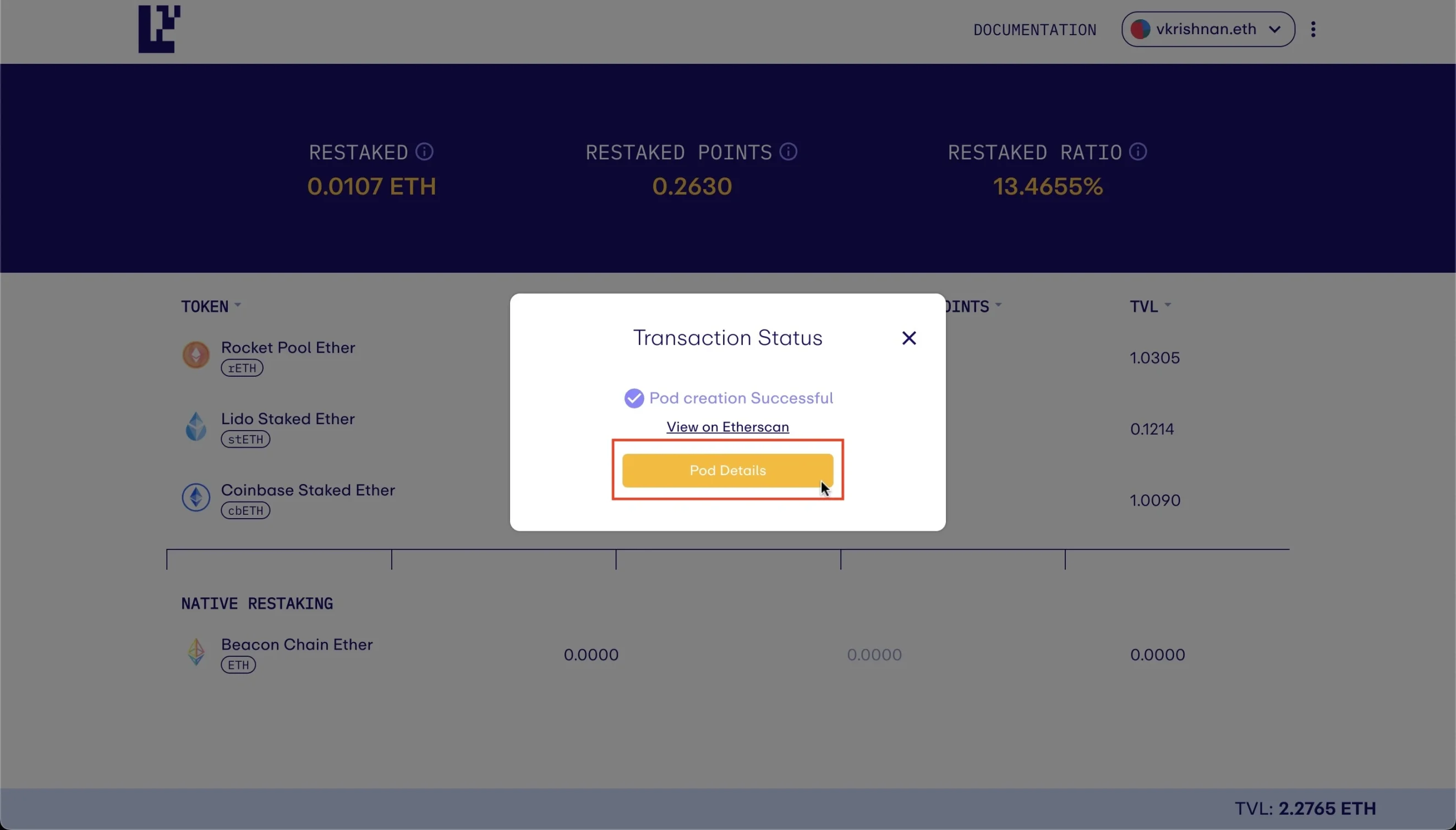
Then, configure the withdrawal credentials on the Beacon Chain (this requires having an active Ethereum validator node) to point to the EigenPod address.
Finally, return to the homepage to monitor changes in your restaking rewards in real time.
Phase One Is Just the Beginning
According to earlier disclosures by EigenLayer, the project rollout will occur in three phases designed to attract diverse participants into the ecosystem.
In Phase One, “Stakers” (the actions described above), users experiment with restaking via EigenLayer. In Phase Two, “Operators,” node operators will accept delegations from stakers. By Phase Three, “Services,” active validation services will go live.
Last month, EigenLayer announced the launch of its Phase Two testnet and unveiled its data availability solution EigenDA, allowing rollups to directly use EigenDA as a data availability layer.
Earlier this month, EigenDA revealed it is conducting joint launch tests with several partners including AltLayer, Caldera, Celo, Layer N, Mantle, Movement, Polymer Labs, and Versatus. Just days ago, it further announced support for OP Stack.
Join TechFlow official community to stay tuned
Telegram:https://t.me/TechFlowDaily
X (Twitter):https://x.com/TechFlowPost
X (Twitter) EN:https://x.com/BlockFlow_News
 Odaily







