High-Yield Tools in Volatile Markets: A 3-Dimensional Analysis of OKX Futures Martingale Strategies
TechFlow Selected TechFlow Selected
High-Yield Tools in Volatile Markets: A 3-Dimensional Analysis of OKX Futures Martingale Strategies
This article will provide an in-depth analysis of the strategy across three key dimensions: underlying logic and characteristics, applicable scenarios and differentiation from similar products, and usage tutorial with parameter explanations—aiming to help readers truly understand and master the authentic Martingale strategy.
 Navigating Web3 tides with focused insights
From one angle a ridge, from another a peak; near or far, high or low, each view unique.
——Song Dynasty · Su Shi, "Inscription on the West Forest Wall"
Interestingly, financial markets bear striking similarities to quantum mechanics.
Whether it's price movements or electron behavior, neither follows a definite trajectory nor maintains a stable state. Instead, both are described probabilistically. From this logic, we derive three fundamental market views and methodologies: First, market movements cannot be predicted. Second, profits arise precisely from market volatility—the transitions between falling, ranging, and rising patterns—where the trading principle is continuously buying low and selling high. Third, there is no such thing as a long-term "holy grail" of trading with 100% win rate; that would violate objective laws. However, by employing multi-dimensional analysis including trading strategies, risk control, data analytics, and project research, traders can improve their win rates. These foundational understandings are essential for users to grasp the market.
Yet, the emergence of the Martingale strategy—often touted as a “guaranteed win,” “market holy grail,” or “100% win rate” approach—seems to challenge these established market principles. As a systematic counter-trend investment strategy, the Martingale strategy has long been polarizing in reputation, vividly illustrating the dual nature of financial instruments: returns and risks. It is most popular—and controversial—in forex trading.
What exactly is the Martingale strategy, and how should it be used correctly? This article takes OKX’s leading futures contract Martingale strategy product in the current crypto industry as an example, offering an in-depth analysis across three dimensions: core logic and key features, applicable scenarios and differentiation from similar products, and practical guidance with parameter explanations. The goal is to help readers truly understand and learn how to use the authentic Martingale strategy.
Core Logic and Key Features
From a probability and statistics perspective, each dice roll is an independent event. That means the outcome of the first 99 rolls does not affect the 100th roll—each time, the chance of rolling high or low remains exactly 50%. This reflects the independence of each trade. However, many people mistakenly believe that as the number of trades increases, so does their winning probability. This is incorrect.
The logic of Martingale originated in 18th-century gambling towns in France. Starting with the first bet, if you lose, you double your stake. Since each trade has a 50% win/loss probability, as long as you keep betting, eventually you will recover all previous losses and gain a profit equal to your initial stake. For example, starting with a $1 bet, if you succeed on the fourth attempt, you’ll recover the losses from the first three bets and earn $1 in profit.
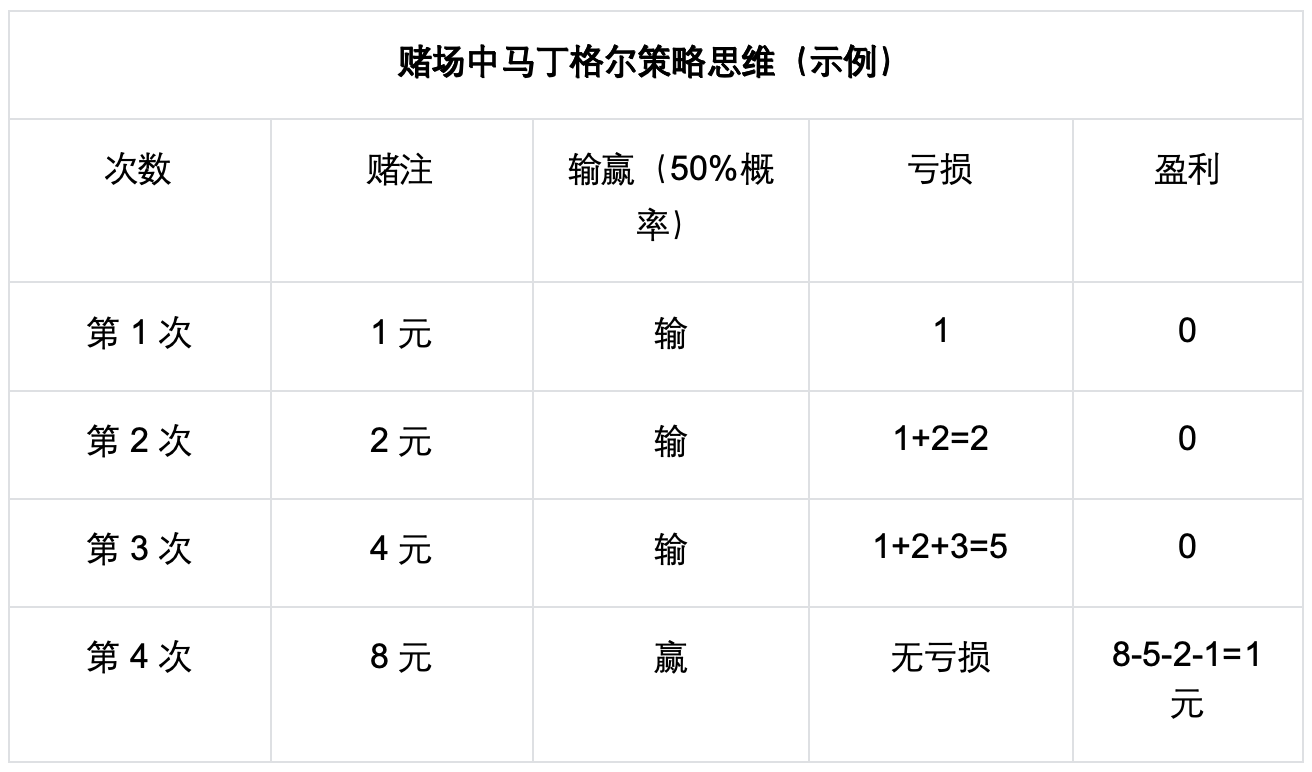
With infinite bets, regardless of how many times you lose in between, you will eventually recover all losses plus profit. But this only works under the assumption of infinite capital. Without infinite funds, continuously doubling down will ultimately lead to total loss.
The casino version of Martingale is overly idealistic, but its concept of doubling stakes after losses profoundly inspired participants in finance, giving rise to the Dollar Cost Averaging (DCA) Martingale strategy. Simply put, in a two-sided market, a user opens a position; when facing adverse price movements, they continue adding to their position to lower the average cost, until the market rebounds and reaches the take-profit target. The essence is increasing the probability of successful buy-low-sell-high outcomes.
To meet diverse user needs, OKX has inherited and innovatively optimized the traditional Martingale strategy, launching both spot and futures versions. This provides users with a systematic counter-trend investment strategy—continuously averaging down entry costs through repeated buying—so that when the market reverses, closing all positions results in profit. Compared to the spot version, OKX’s futures Martingale strategy offers more flexibility with two-way trading and leverage options, enhancing capital efficiency.
Using OKX’s Martingale strategy, users don’t need to predict market direction, choose precise entry timing, or conduct fundamental analysis. They simply set parameters to manage positions—an easier and less stressful approach. It boasts a high win rate: profits are realized during upward moves, while downward trends within the preset range reduce holding costs, enabling profitable exits once prices rebound. Compared to making a single investment decision in fast-moving markets, this method makes achieving “buy low, sell high” easier and reduces losses caused by incorrect predictions.
However, it's important to note that the Martingale strategy also has clear drawbacks: if profits are taken during an uptrend, some allocated capital may remain unused, leading to low capital utilization. In a sustained downtrend without recovery, significant drawdowns or even liquidation risks can occur.
Applicable Scenarios and Differentiation from Similar Products
Based on the above characteristics, the suitable application scenarios for the Martingale strategy are clear: ranging markets or bottom-fishing during consolidation phases.
OKX’s spot Martingale strategy focuses on staged position building and cost reduction. It is well-suited for medium-to-long-term ranging markets. Even if temporary paper losses occur, profits can still be locked in upon rebound. This strategy is particularly user-friendly for those uncertain about entry timing or fearful of missing out, allowing accumulation at lower levels and selling at higher ones. However, caution is required during strong one-sided downtrends, which could result in losses.
Compared to the spot version, OKX’s futures Martingale strategy is more flexible. Building on staged entries and cost averaging, it supports two-way trading and adjustable leverage, improving capital efficiency. It applies to most market conditions except extreme one-sided trends, especially mid-to-long-term consolidations.
For instance, suppose a user buys an asset at price A, but the price starts moving against them. Using OKX’s Martingale strategy, they can gradually add to their position in batches, lowering their average cost to B. Once the price rebounds to D, the system automatically sells all holdings for profit. Although D is below A, due to the reduced average cost, the user still profits from this swing.
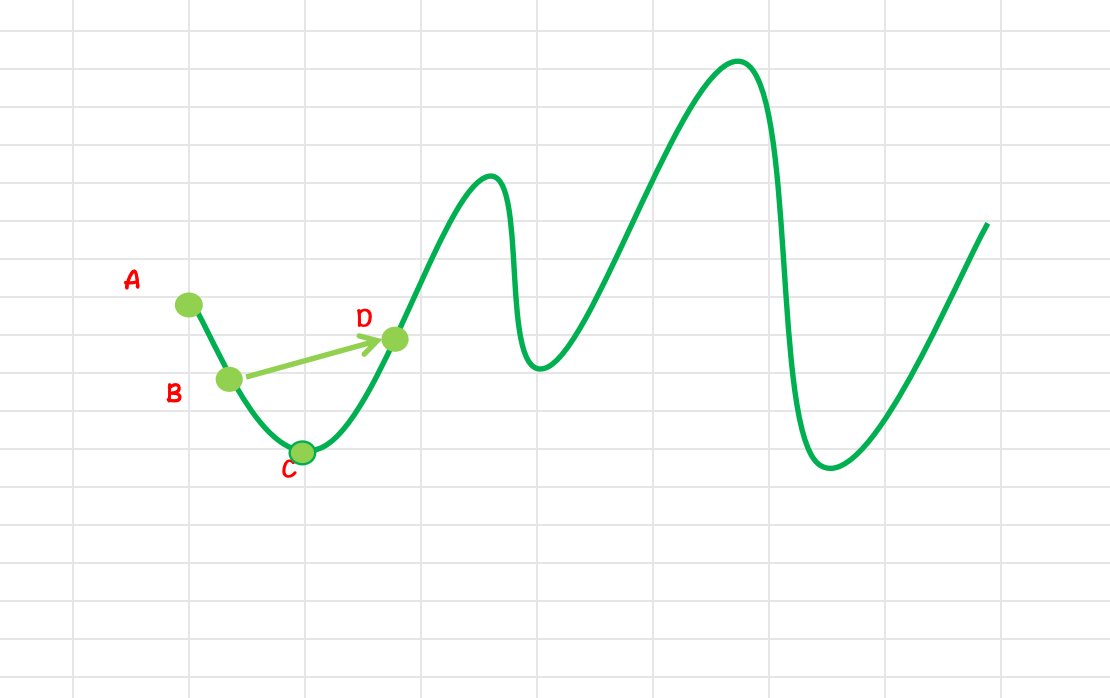
Illustrative diagram
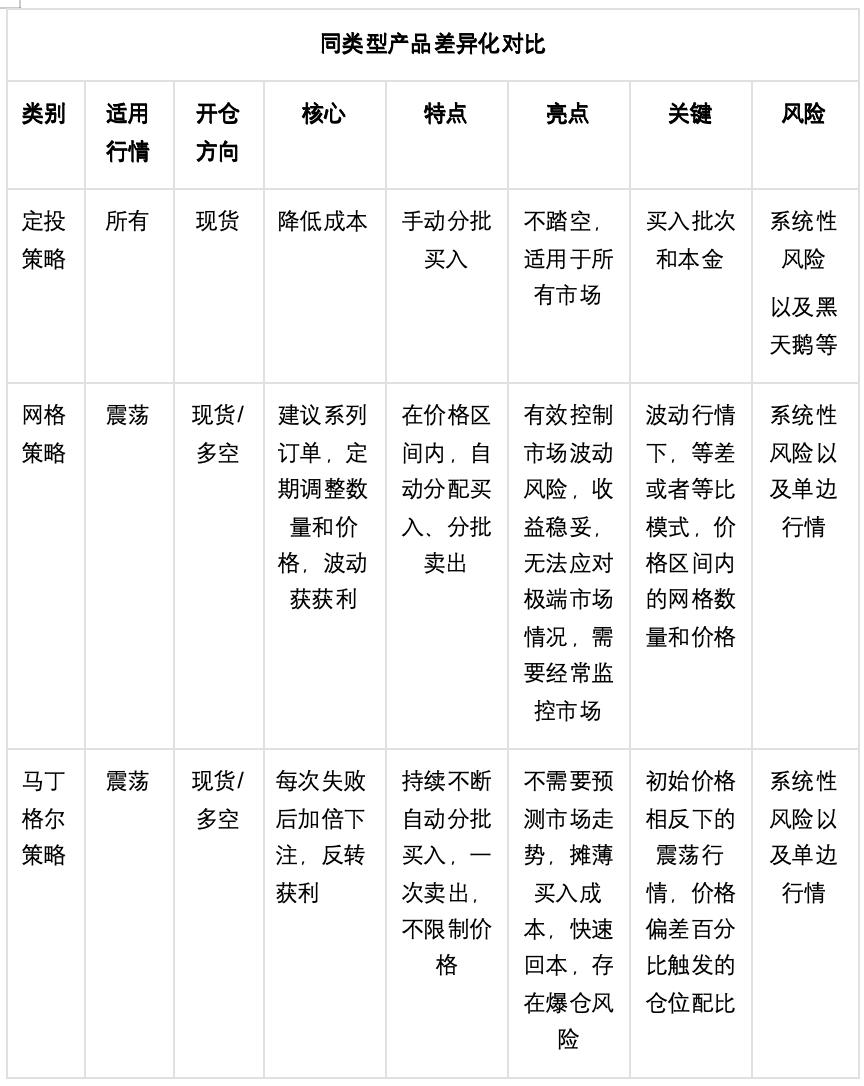
Compared to passive dollar-cost averaging via manual periodic investments, the Martingale strategy offers greater flexibility and more dynamic cost control. Compared to grid trading, Martingale doesn’t require predicting market direction and allows faster recovery of costs, though it carries liquidation risk. Grid strategies better manage market risk with steady returns but require constant monitoring and struggle in extreme market conditions.
OKX Futures Martingale Strategy: Tutorial and Parameter Guide
Currently, OKX’s futures Martingale strategy is among the most feature-rich and versatile tools in the industry’s strategy trading landscape. Fearless of market swings, it helps users achieve optimal average holding costs and enables effective buy-low-sell-high execution. With customizable trigger conditions across various timeframes, flexible risk management tools, and advanced settings like maximum re-entry count, re-entry price gaps, and stake multiplication factors, users can tailor the strategy to their preferences. They can also choose triggers such as immediate activation or technical indicators like RSI to easily capture favorable opportunities.
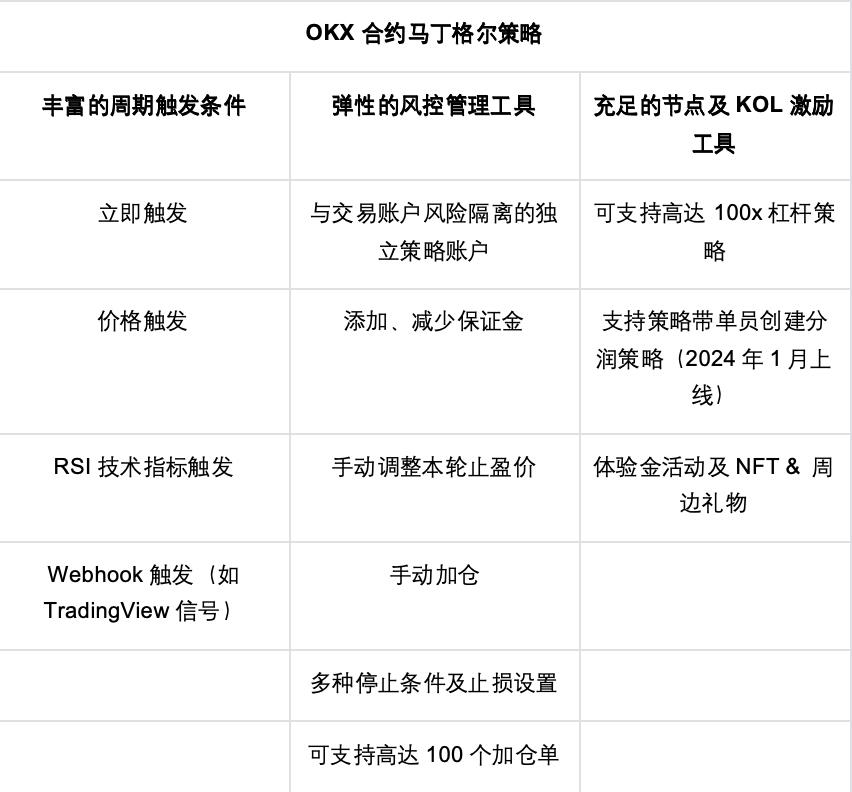
Therefore, how to scientifically configure the parameters of OKX’s futures Martingale strategy—balancing high returns with low risk—is a critical consideration for every user. The same tool can yield vastly different outcomes depending on how it’s used.
For example, setting too narrow a range may cause your available funds (“ammunition”) to be exhausted quickly, limiting profit potential. Conversely, too wide a range may leave capital underutilized, capping gains. Additionally, since the Martingale strategy relies on incremental position building, it faces liquidation risk during persistent one-sided trends without reversal. Hence, manually setting risk controls like stop-loss targets is crucial. However, by combining market analysis and technical indicators to determine optimal entry points, and using the futures Martingale to accumulate positions at lower levels and reduce average costs, users can maximize profitability.
After gaining preliminary understanding of OKX’s futures Martingale strategy, users can begin testing it. First, access the “Strategies” section via the OKX app or official website, select the “Cost Averaging” module, then choose “Futures Martingale.” Next, pick the cryptocurrency and direction for which to activate the strategy. Currently, OKX supports Futures Martingale for all USDT-margined perpetual contracts.
OKX’s futures Martingale strategy offers two creation modes: manual and smart setup. Manual mode suits experienced traders, while beginners are advised to use the smart mode. Smart mode recommends parameters based on the user’s risk tolerance, investment amount, and entry rhythm. These recommendations are calculated using historical market data, asset volatility, and OKX’s proprietary algorithms, ensuring reliability. Moreover, smart mode categorizes recommendations into conservative, balanced, and aggressive profiles according to the user’s financial status and risk capacity.
Next, here’s a plain-language explanation of the main parameters in OKX’s futures Martingale strategy — manual mode. Since the core idea is cost averaging, parameters define how many times to re-enter, how much to add each time, and when to exit.
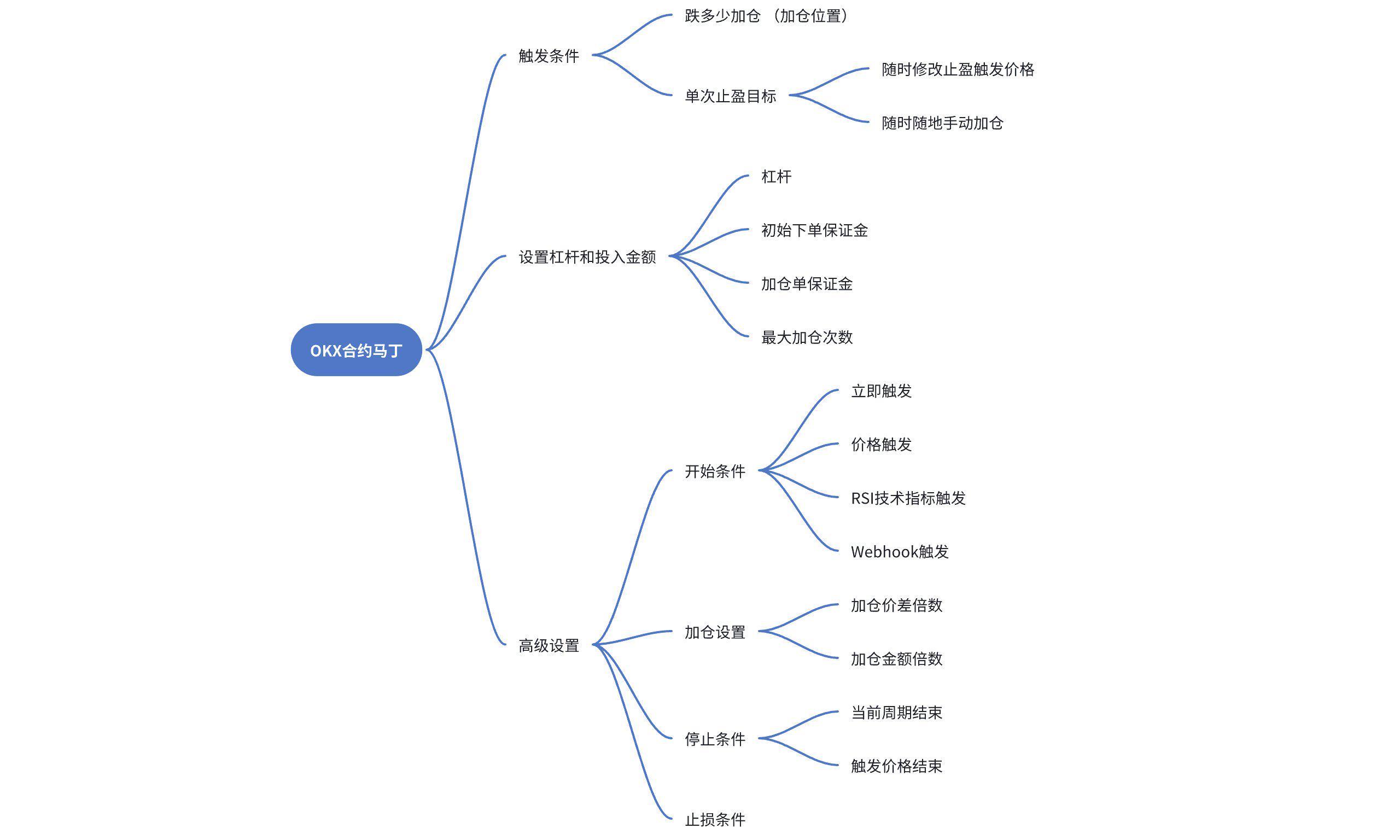
Trigger condition parameters include “price drop threshold for re-entry” and “single take-profit target.” The “price drop threshold” is crucial—it determines the spacing between re-entries, i.e., the cost increment. For example, if the gap is large but market movement is small, only part of the allocated funds may deploy, reducing capital efficiency. Furthermore, compared to other industry offerings, OKX’s futures Martingale has two unique advantages: one, users can manually adjust the take-profit price anytime to secure profits; two, users can manually add positions at any time to boost gains.
Leverage and investment amount settings include leverage ratio, initial margin, re-entry margin, and maximum number of re-entries. Leverage is straightforward. Initial margin refers to the opening position size, re-entry margin specifies how much to add per step, and maximum re-entry count sets how many times to add.
These two sets of parameters allow configuration of re-entry levels and amounts. Additionally, advanced settings enable fine-tuning of start conditions, re-entry rules, stop conditions, and stop-loss parameters for more precise control.
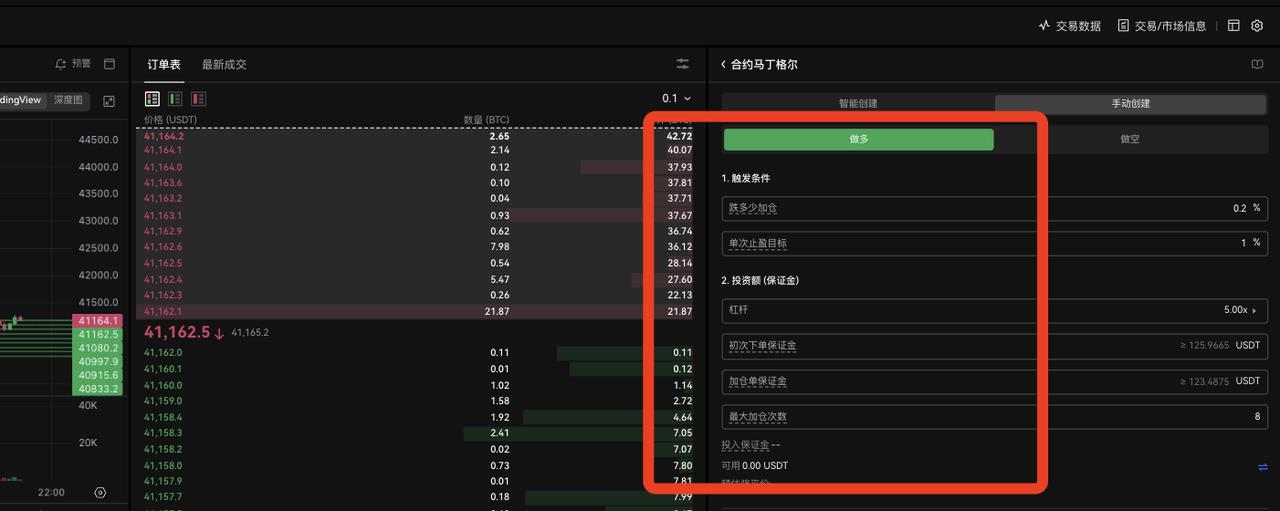
Start conditions are simple—they define when the strategy begins. Options include immediate start, price-triggered, RSI indicator-triggered, or Webhook-triggered (e.g., TradingView signals).
Re-entry settings include “re-entry price gap multiplier” and “re-entry amount multiplier.” The latter defines how much larger each subsequent stake is compared to the previous one, while the former adjusts the spacing between re-entry prices—effectively controlling where and how much to add.
Stop conditions determine when the strategy ends. If left unconfigured, it continues indefinitely. Users can choose to halt after the current cycle or upon reaching a specific trigger price.
Stop-loss conditions are straightforward: when losses exceed expectations, users can manually execute a market or limit order to cut losses.
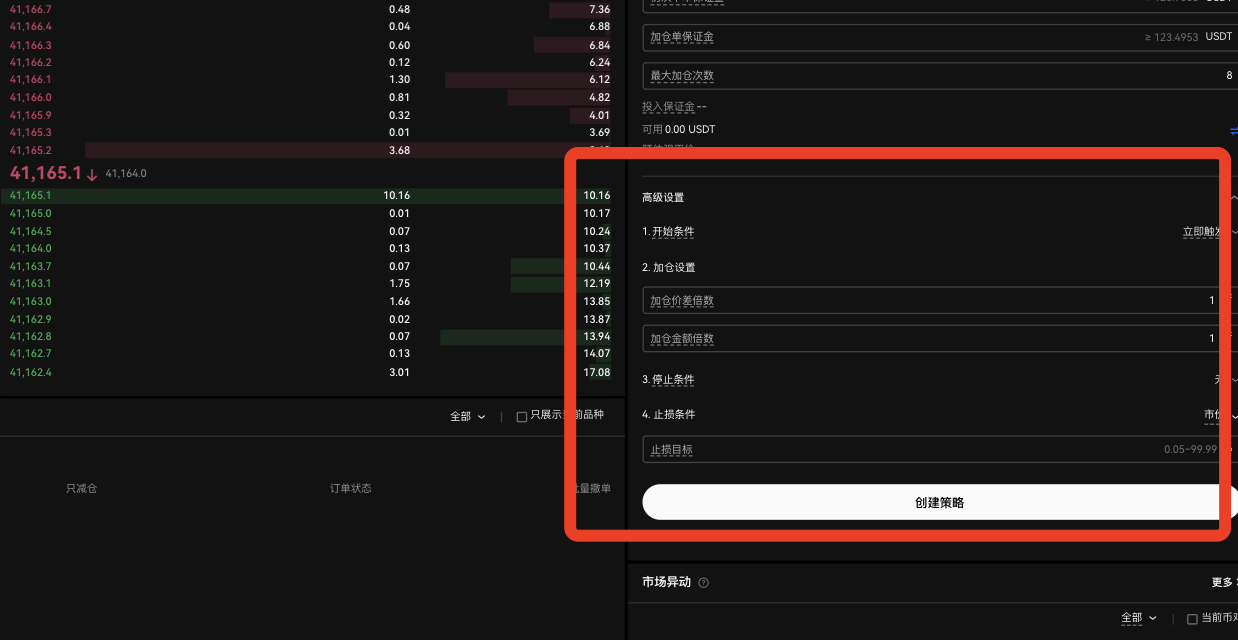
Once all settings are confirmed, click “Create Strategy.” Alternatively, users can adopt pre-built strategies from OKX or follow top-performing Martingale traders in the Strategy Square. Note that once created, the allocated funds are isolated from the main trading account and dedicated solely to the futures Martingale strategy. Users must therefore monitor the impact of this fund allocation on their overall portfolio risk. Additionally, during periods of high market volatility or sustained adverse price movement, existing positions may face floating losses or even forced liquidation. Therefore, it is advisable to set appropriate stop-loss levels based on market analysis to ensure timely risk mitigation.
Conclusion
As a globally leading cryptocurrency exchange and Web3 technology company, OKX has launched 14 advanced trading strategies—including futures Martingale—to meet the growing and diverse demands of global crypto users, maintaining a clear industry lead. Committed to continuous innovation, OKX keeps upgrading sophisticated and differentiated investment tools, promptly responding to user needs and relentlessly shaping the future of financial instruments.
However, no trading strategy guarantees 100% success. Strategy execution may be affected by market conditions, execution delays, or technical issues. Successful algorithmic trading typically requires deep market understanding, robust technical infrastructure, and effective risk management. The high success rate of the Martingale strategy depends heavily on specific market conditions and accurate judgment. Before using any trading tool, users must fully understand its mechanics.
Cryptocurrency markets bring both opportunities and risks through their volatility. Investors should proceed cautiously, ensuring their chosen strategies align with their risk tolerance. Amid the noise and complexity of trading environments, it’s vital to filter distractions, identify and properly use tools, and always maintain respect for the market—because every individual perspective is inherently limited. As Song Dynasty poet Su Shi wrote in “Inscription on the West Forest Wall”: From one angle a ridge, from another a peak; near or far, high or low, each view unique.
Join TechFlow official community to stay tuned
Telegram:https://t.me/TechFlowDaily
X (Twitter):https://x.com/TechFlowPost
X (Twitter) EN:https://x.com/BlockFlow_News
 OKX
OKX