Decrypting Hyperspace: The New L1 That a16z's Founder Is Watching, Redefining the Future of Supercomputing
TechFlow Selected TechFlow Selected
Decrypting Hyperspace: The New L1 That a16z's Founder Is Watching, Redefining the Future of Supercomputing
All zombie blockchains are fast and cheap. But our goal is to design the cheapest and fastest system under high concurrency.
 Navigating Web3 tides with focused insights
Author: Hyperspace
Translated by: TechFlow
Editor's Note: This is a new Layer 1 blockchain that has not yet received widespread attention, but has already caught the eye of many industry insiders. Among its early supporters was Marc Andreessen, co-founder of a16z. The following article is the project team’s initial self-presentation, explaining why they chose to build a new blockchain in 2023 and outlining their long-term vision.
I am a time traveler from 2025. This is a moment when everyone in the world knows who Satoshi Nakamoto is, and blockchains are used daily by hundreds of millions of people. These two statements are deeply connected—our present reality stems directly from the story you're about to read.
On January 24, 2023, a group collectively known as Gutenberg announced the launch of Hyperspace—a new kind of supercomputer powered entirely by a browser-native blockchain. In hindsight, it would become one of the most important products in computing history since the Macintosh launched on January 24, 1984. When you read this sentence in 2023, that sounds absurd—but not now. Our world is vastly different from yours—it was created through sheer willpower by a group of people who were never supposed to do this.
Why Build a New Blockchain in 2023?

To understand just how outrageous the invention of Hyperspace seemed, consider this: by early 2023, there were already dozens of well-funded blockchains. At the time, the community believed everything worth inventing had already been invented—a consequence of misunderstanding blockchain’s real utility. The problem was that blockchains were being built as extensions of research projects, with friction ignored, while most others were unfortunately drawn into extracting whatever value they could from these systems.
We learned from Satoshi how to build blockchains—but not why he built them.
In our world, Satoshi’s message has been lost. It was a message about simplicity, equal opportunity for all at the starting line, and shared cryptographic economic benefits across the entire network. It was a message of sacrifice for the greater good—choosing an ordinary life, not seeking fame for your invention, and deliberately mining less than you could have—again, choosing the network’s interest over personal gain. Recall that in 2009, a college student could download the Bitcoin client and earn 50 BTC simply by being a full participant in the network. Those bitcoins were nearly worthless then—but if the network took off, it offered equal opportunity to everyone.
The Global Blockchain Era
By 2022, blockchains had fully entered the franchise era—like local entrepreneurs opening McDonald’s franchises. It became an investment: deep financial and technical resources required to become a full validator. Block production was actively shifting toward centralized entities through deliberate design choices, such as Ethereum, where a single corporate entity once accounted for over 80% of production. There were only thousands of full validators, mostly located in specific data centers in AWS Virginia and Germany. Many other projects merely pretended to be blockchains, actually being only slightly more decentralized than traditional enterprise databases. A liquidity staking derivative entity with around 100 members theoretically held governance control over many major proof-of-stake (PoS) blockchains at the time. Transactions could be censored simply by appearing on some obscure bureaucrat’s list in a particular country, leading to significantly worse user experiences. After 2022, the world also began associating cryptocurrency with greed rather than utility.
Ordinary people, aside from speculators, were excluded from the blockchain world.
While almost everyone globally lacked access to full network rewards (considering only 6% of U.S. households could afford to run an Ethereum full validator in 2022), developers were forced to learn complex programming languages and figure out how to connect all components within the existing blockchain ecosystem. This limited active blockchain developers to around 1,000 worldwide—even though more than 100 million software developers existed. Users made fewer sacrifices due to excessive friction. We failed to build sufficiently practical systems and applications for people in Manila, Casablanca, or even Phoenix, Arizona. This led to fundamental inequality—those with sufficient technical and financial resources became the primary beneficiaries of the powerful new blockchain world. That wasn’t fair.
People saw the smart contract revolution of the 2010s—but didn’t live it.
Ethereum was the most remarkable tech project of the 2010s, sparking a wave of creativity. Yet, even by 2022, building something like Uber on Ethereum remained just talk. Why didn’t this happen? Why were proprietary database providers still being used even within the blockchain community despite high commission fees? Why hadn’t blockchain disruption reached the real world at scale? Why hadn’t any other blockchain delivered tangible, everyday utility for ordinary people? Why did blockchain remain tied to bull-and-bear market sentiment while GDP did not?
There was an urgent need for a fresh start—rethinking everything from scratch. An inexperienced, passionate amateur team might ask seemingly absurd questions like:
-
What would a blockchain even more decentralized than Ethereum look like?
-
How can we enable broader participation from ordinary people, rekindling the participatory spirit seen in early Bitcoin and BitTorrent?
-
Can we deliver a fully browser-native blockchain experience for validators, users, and developers?
-
When people can simply use their browsers, why pay computational fees to "franchise owners" on other blockchain systems?
-
What kind of blockchain system design could allow tens of millions of people—from Manila to Mumbai—to use it simultaneously?
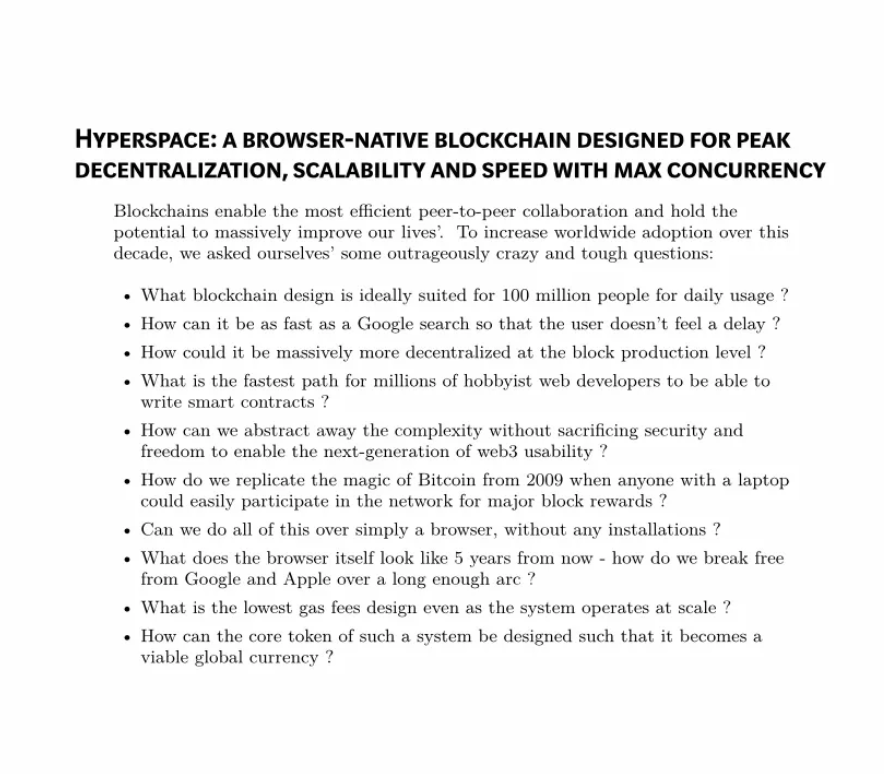
The opening page of Hyperspace’s initial whitepaper draft: it introduces detailed P2P browser engineering innovations, a ZK-Proof and WebAssembly-based runtime called Nanochain, and Interstellar—a highly decentralized parallel execution and block production architecture—all leveraging Groot, a large-scale decentralized state subprotocol. The paper lays out the mathematical and engineering foundations for security, operation, scalability, and speed. It further explains how we dramatically simplify end-to-end experiences for users, developers, and validators.
All zombie blockchains are fast and cheap. But our goal is to design the cheapest and fastest system under high concurrency.
Designing Hyperspace: Our Thinking
When Hyperspace announced its development, the blockchain landscape looked like this:
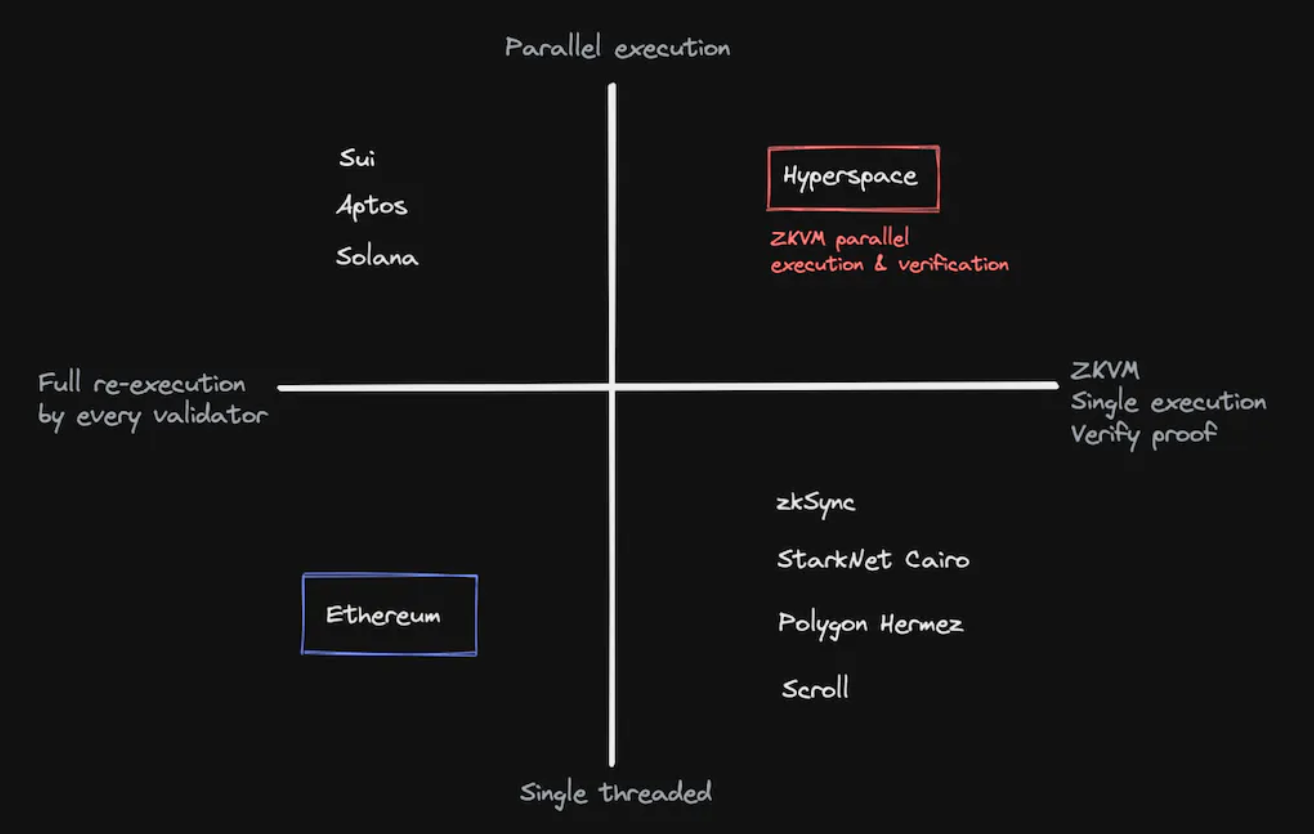
This blockchain serves as the “microchip” of a completely new browser-based P2P supercomputer, later constructed over several years. At the time of announcement, it was the fastest L1 and most advanced design ever revealed. This combined rapid learning and iteration observed across the industry with fundamentally new innovations, resulting in a cross-network parallel-execution zkVM design (surpassing the powerful server-centric designs common in other blockchains), capable of parallel validation. Key breakthrough technologies introduced by Hyperspace included:
-
Browser P2P Network: Enhance browsers to run blockchain protocols without requiring users to download anything
The Gutenberg team’s solution for browser networking was among the most groundbreaking of its generation, ushering in a new era of inherently peer-to-peer web infrastructure.
As part of the first set of engineering challenges, the team developed a network library enabling comprehensive peer-to-peer connections between existing browsers—discovering nodes and forming stable data-exchange links. Running a full blockchain node no longer required downloading and installing software on a computer. This enabled future blockchains and decentralized services to operate entirely within browsers, unlocking a world of decentralized web applications. Imagine frontends running entirely on this P2P network, eliminating reliance on Big Tech cloud services. This provides better privacy, lower latency in certain cases, reduced costs, and ultimately creates a permanently running, highly available, permissionless network.
PS: If you loved Nostr in late 2022, you’ll love the Hyperspace network protocol in 2023—it offers similar benefits but now with full P2P capability.
-
Web zkVM: Building a fast, secure runtime inside browsers using ZK + WebAssembly that generates execution proofs

Hyperspace uses the new web zkVM inside users’ own browsers to execute smart contracts and capture execution traces as STARK proofs. These STARKs (“actions”) are bundled into a single SNARK transaction and propagated across the network. This design enables massive parallel execution. Knowing exactly which states are affected plays a crucial role in parallel verification. Overall, this achieves 10ms–50ms pre-L1 finality—offering experiences faster than so-called Web2 systems—and unlocks new multi-user use cases for Web3.
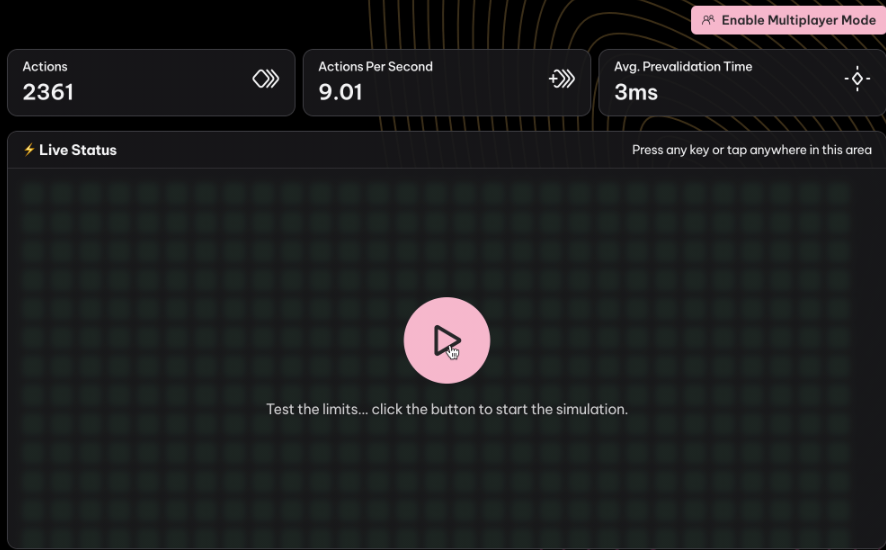
Here is a live demo link of the Hyperspace web zkVM—click here to try it!
This website embeds a zero-knowledge runtime. To see how fast it is, try our stress simulation. Press play, then during the next ten seconds, press keys, click the mouse, or tap the screen as much as possible to send actions. Each action triggers the runtime to execute a piece of WebAssembly (WASM) code simulating state retrieval/modification, then generates its execution proof (turning the square green). All these proofs are merged into one, forming a transaction on the Hyperspace system.
If this feels fast enough, imagine this as the foundation for social, gaming, financial, and marketplace applications.
3. Parallel Validation: A multi-lane highway approach to modular construction and validation, highly practical for global use
-
Narwhal-inspired DAG and enhanced HotStuff
A decentralized group of nodes using DAG and weighted algorithms efficiently bundles transactions into blocks, then sends them to designated validator shards.
-
Conflict-free sharded consensus
These shards can also receive transactions directly, further build blocks, and achieve distributed consensus—enabling parallel validation of multiple micro-blocks without conflict.
-
Breakthrough design for sharded state
Hyperspace was designed from day one with a sharded state strategy, preventing the state bloat issues that plagued all monolithic L1s. Ethereum’s own tech lead once called this a “death spiral,” as state grew by 1GB per day. Hyperspace aimed to solve this from the outset.
-
Optimization for cross-program calls
Overall, the system was designed for worst-case scenarios: maximum cross-program calls. This required reimagining the entire validation and execution layer, removing execution bottlenecks in validators entirely, enabling true platform scalability through parallel validation.
-
Inherently horizontal scaling design
The system allows continuous addition of validator shards as it grows, because it doesn’t require individual block-producing nodes to have high system requirements. This has always been central to the Gutenberg team’s philosophy: enabling ordinary people to participate fully in the network using just a simple laptop and browser.
-
Hyperspace integrates identity, oracles, restaking, and more directly into the base protocol, delivering superior UX and DX
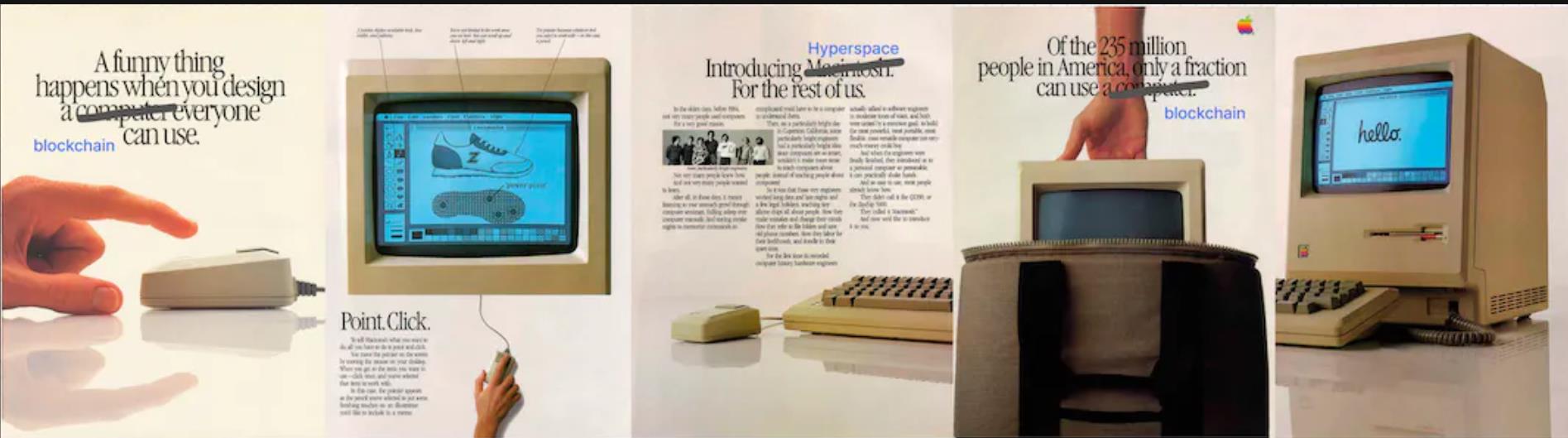
There’s a common thread between Apple’s product philosophy and Vitalik’s suggestion on how to build new blockchains: integrated experience.
-
Hyperspace incorporates oracles into the core protocol. Existing validators can join using browser-based client software to begin providing oracle services. By leveraging a restaking mechanism built into the base protocol, it enhances security and expands service scope—including cross-chain primitives, automation, time management, and Web2 data. This architecture also greatly simplifies direct integration of dApps built on Ethereum, Solana, Polkadot, and Near with Hyperspace. From a developer’s perspective, this sanctified oracle offers low-level primitives that drastically simplify interaction with off-chain data compared to existing oracle solutions.
-
Hyperspace provides an integrated identity and smart wallet subprotocol, introducing a new way to manage independent identities within the Hyperspace ecosystem. Known as session sub-wallets, they are cryptographically derived from a user’s main wallet, abstracted into multiple identities for specific apps. Inspired by traditional Web UX, this gives users full control over authorized applications and spending limits. Overall, this zero-install approach simplifies onboarding for beginners while offering practical security options for advanced users. The subprotocol also standardizes token/NFT formats, making integration easier for smart contract developers and enhancing composability. This unlocks new design spaces for seamless, confirmation-free transactions ideal for multi-user scenarios.
-
Built for developers. “The fastest code is the code you never have to write.” – Steve Jobs, 1997 keynote
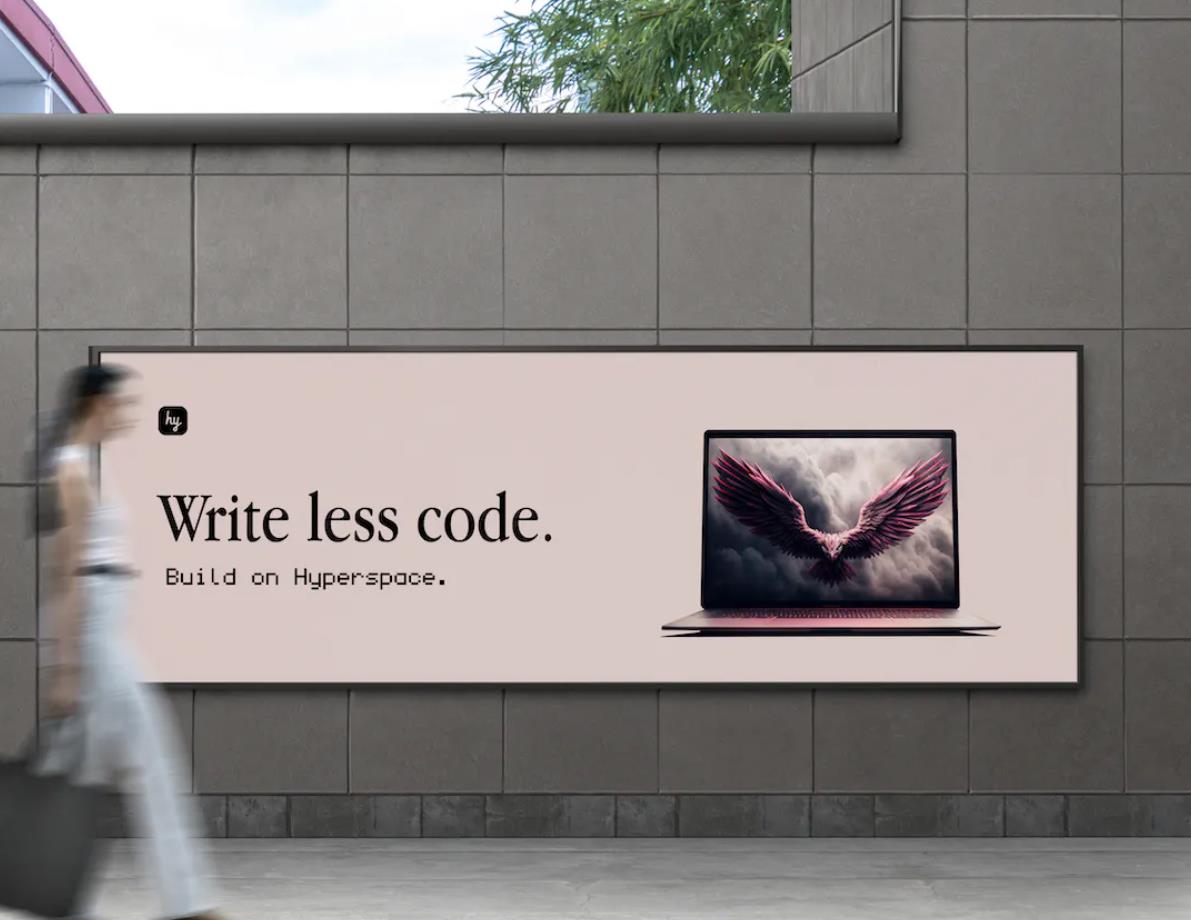
Hyperspace adopts TypeScript as the primary language for smart contract development, combined with a software development kit (SDK), allowing millions of amateur web developers to quickly adapt to smart contracts. The protocol also sanctifies multiple subprotocols and decentralized services, offering developers an integrated experience that simplifies building complex applications.
Smart contract wallet design enables context-based access, beneficial for developers by providing user safeguards, building trust, and encouraging greater usage. Overall, Hyperspace aims to deliver the fastest blockchain experience—achieving pre-L1 finality speeds comparable to Google Search in the same region.
-
Just as Uber disrupted taxi medallion businesses, Hyperspace disrupts full-node validator operations—democratizing it

Hyperspace’s crypto-economics are driven by core principles including:
-
Even a college student using a laptop should be able to earn substantial rewards simply by using a browser and fully participating in this new network.
-
Deflationary model: deflation increases the base token’s value via restaking, boosting network security.
-
Maintaining independence from governance mechanisms imposed by external liquid staking derivatives. If all other PoS blockchains face censorship for any reason, Hyperspace should remain viable.
-
Maximizing decentralization of block production among ordinary individuals, not corporate entities that may censor or degrade permissionless user experiences.
What People Experienced: The Supercomputer Era
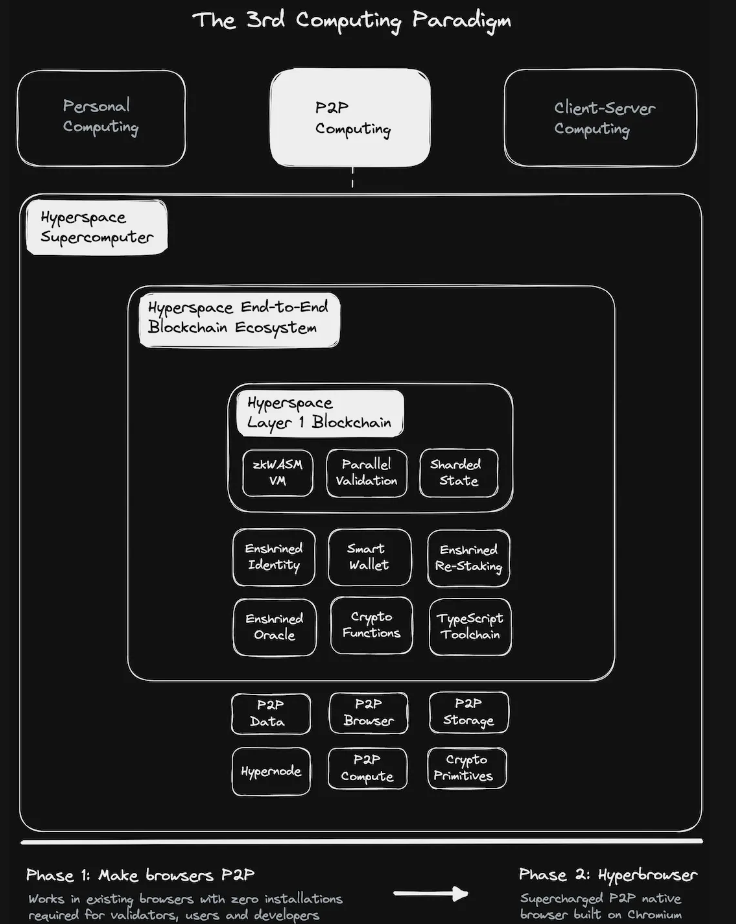
The concept of a “supercomputer” once referred to a group of extremely powerful computers connected together within the same building. Hyperspace applied this idea at a scale involving hundreds of millions of people using nothing more than a browser on their laptops—entirely without installation. This fully P2P “computer” was built upon three inevitable trends of the 2020s:
-
Laptops and personal computing devices became exceptionally powerful and cheaper simultaneously, making data center computation obsolete.
-
Bandwidth became faster and cheaper, and improved browser-based P2P networks unlocked new capabilities.
-
The era of zero-knowledge proofs and WebAssembly enabled near-native-speed execution inside browsers—without any installation.
-
Hyperspace is how ordinary people experience the efficient network power formed by browser nodes connecting directly, capable of performing functions traditionally handled by proprietary APIs and cloud providers. Our era’s “Shopify, Uber, Airbnb, even ChatGPT” increasingly and inevitably run on this P2P network maintained by regular internet users—not subject to any single company and its rules. Software functionality has been massively commoditized—this is the age of smart contracts.
The world we imagined is one where everything relates to crypto.
With Hyperspace, you no longer need to pay high fees to third-party closed databases just to execute business logic. Code is open, active, accessible. You can transact efficiently with others directly using your own computer. You can easily plug into millions of smart contracts or quickly compose your own. Your data isn’t locked in; you own and control it. You can also choose to participate in the network by contributing computing resources, improving network health and earning rewards. Think BitTorrent.
This is a browser-driven, peer-to-peer computing world—no downloads needed. The Hyperspace blockchain operates like a microchip—running invisibly—while users experience the collective power of the entire network.
We’re improving the fundamental web experience.
Endgame: Fully Native, P2P Browser
“The network is the platform”—Marc Andreessen
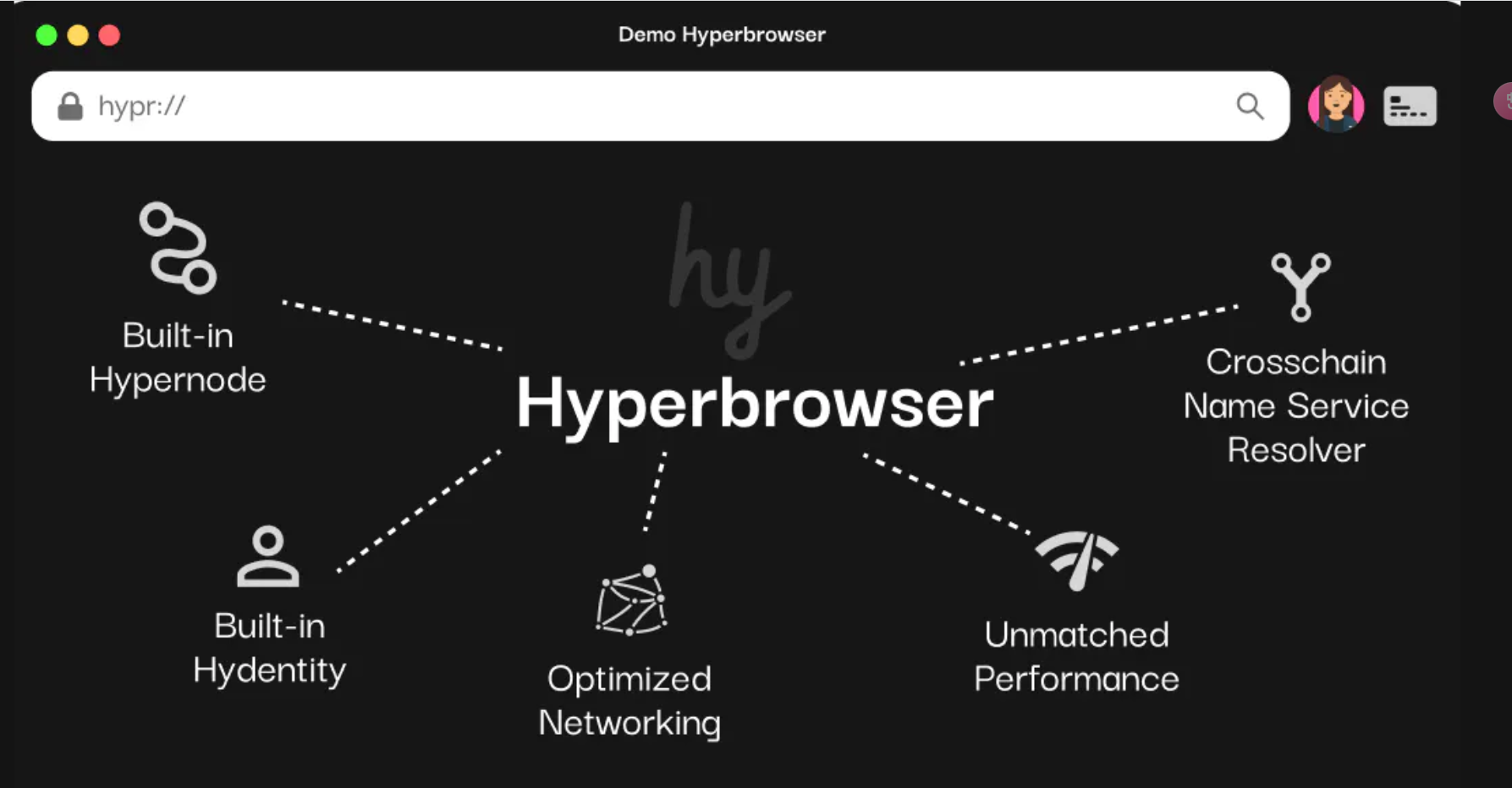
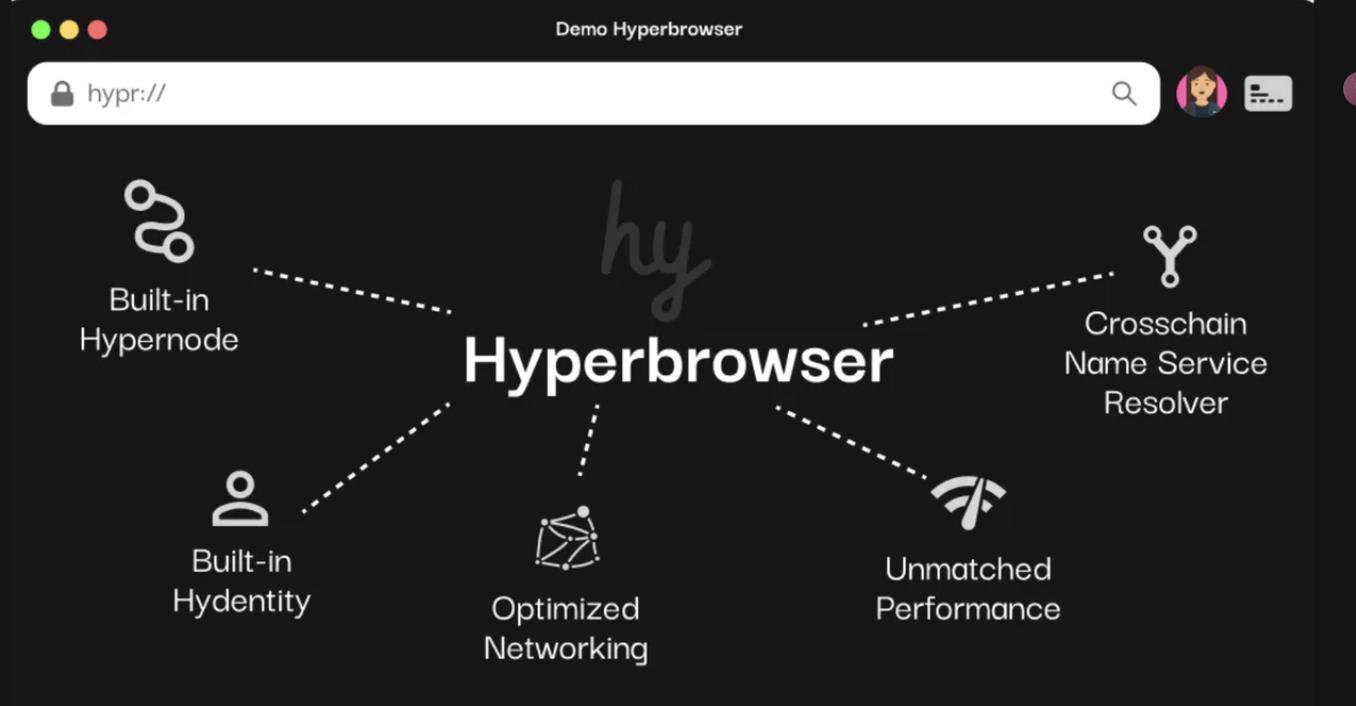
Despite mainstream browser vendors continuously making underlying hardware and software incredibly powerful, they haven’t fully aligned with the peer-to-peer computing paradigm. This prompted the Gutenberg team to develop multiple browser-network-related innovations involving trade-offs. Ultimately, to deliver the highest-quality, most native-like Web3 experience to users, the ultimate goal evolved into building Hyperbrowser.
Built on Chromium, this dedicated browser brings zk-proof runtimes close to native performance and allows home node operators to earn more by directly granting GPU and storage access. This browser surpasses the limitations of the Chromium network stack, becoming a truly native P2P browser. Authentication via a hardened identity layer becomes far more convenient for end users. Imagine typing someone’s identity address directly into your browser and being able to view their profile, send tokens, NFTs, etc.
Since the runtime is also browser-native, decentralized web applications load significantly faster. This is achieved by informing servers of dApp storage locations and indicating that the requester is using Hyperbrowser. The server then sends a smaller app containing only smart contracts, CSS, HTML, and JavaScript—excluding extra runtime components. This saves bandwidth by drastically reducing app size and delivers faster experiences while enhancing decentralization. A world of tens of millions of smart contracts as native web objects fundamentally benefits consumers.
Overall, Hyperspace intends to redefine the standard for web browsers in the 2020s. Client-server browsers of the 2010s were great—but now it’s time to roll out powerful P2P software across devices.

Build with AI, Deploy on Hyperspace

A brief overview of how the software world works today:
It’s 2025. Software creation is done by generations of AI products following ChatGPT and similar models, while software deployment and usage occur on accelerated P2P “supercomputers” like Hyperspace. Your AI agent tailors end-to-end personalized software experiences based on your history and basic prompts, using Hyperspace as the deployment layer.
Here’s an example of a user renting out spare rooms:
Instead of visiting websites, clicking buttons, manually setting prices, paying expensive and arbitrary commissions, and locking in your data—you simply express intent. Your AI agent, already aware of your schedule and preferences, finds the best among millions of trusted, cost-effective auction smart contracts on Hyperspace, bundling them into a fully functional software experience using your data—all running entirely on a fully P2P network stitched together from thousands of browser-based nodes incentivized by Hyperspace’s crypto-economic model.
And these millions of smart contracts weren’t built by 2020s-era blockchain rocket scientists—they were created by AI models using simple prompts from regular internet users or by thousands of TypeScript developers. Now, with just one sentence, you can rent your room at optimal price, paying almost no commission, because smart contracts automatically compete to serve you! We’ve shifted from advertisers automatically competing in Google search results to smart contracts on Hyperspace automatically competing to deliver optimal software utility.
Software has become as commoditized as electricity. Other use cases include:
-
P2P Discord and messaging apps.
-
P2P Netflix, YouTube, and file-sharing systems.
-
P2P Notion and note-taking systems.
-
P2P metaverse, further enabled by WebGPU and WebXR. In MMORPGs, everyone moves across connected 3D world maps.
-
P2P gaming: one player hosts, others join directly.
-
P2P AI: each user collaboratively trains models using only local data.
Now, the idea of a single company owning your data feels like a distant memory. We have powerful laptops seamlessly connecting to each other via fast, affordable bandwidth now available—using the Hyperspace supercomputer. This is our new world, and excitingly, we’re still in the early stages of understanding the full potential of such a network.
Join TechFlow official community to stay tuned
Telegram:https://t.me/TechFlowDaily
X (Twitter):https://x.com/TechFlowPost
X (Twitter) EN:https://x.com/BlockFlow_News
 @HyperspaceAI