








Bitcoin Core Developers to Kill Inscriptions? Not That Easy
TechFlow Selected TechFlow Selected
Bitcoin Core Developers to Kill Inscriptions? Not That Easy
Who decides the development path of Bitcoin amid complex interests from multiple parties?
 Navigating Web3 tides with focused insights
By Nan Zhi, Odaily Planet Daily
Do Bitcoin Core Developers Want to Eliminate Inscriptions?
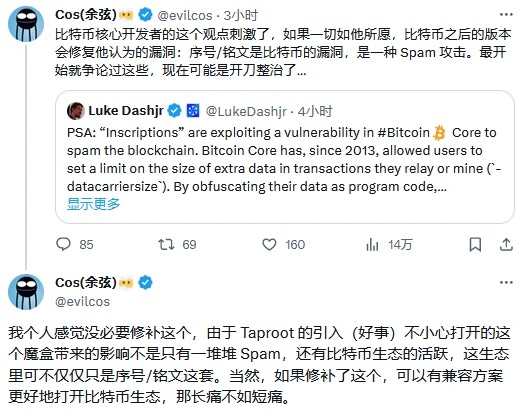
This morning at 9 a.m., Bitcoin Core developer Luke Dashjr posted on X stating: "Inscriptions are exploiting a vulnerability in the Bitcoin Core client to spam the blockchain. Since 2013, Bitcoin Core has allowed users to set a limit (‘-datacarriersize’) on the size of extra data relayed or mined in transactions. By obfuscating their data as program code, inscriptions bypass this limit. This vulnerability was recently fixed in Bitcoin Knots v25.1. Due to severe disruptions in my workflow last year (v24 was completely skipped), the fix took longer than usual. The vulnerability remains in the upcoming v26 release of Bitcoin Core. I can only hope it will be finally resolved before next year's v27."
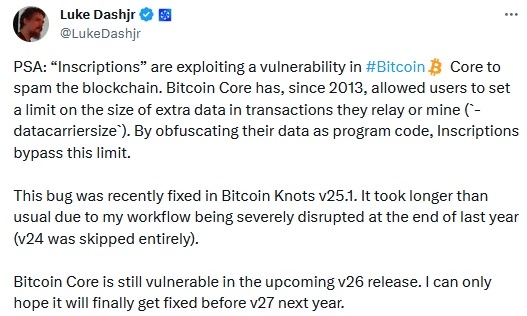
Clearly, from Luke’s perspective, the recently hyped inscriptions are essentially a bug. Regarding Luke’s statements and views, several key points deserve attention:
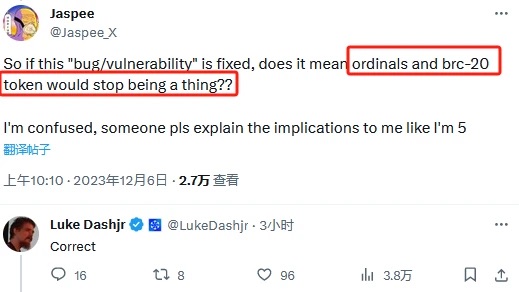
What will happen to Ordinals after the fix?
Luke: Ordinals and BRC-20 will cease to exist. This will be achieved by setting the data carrier size limit to zero.
What is ‘-datacarriersize’?
In Bitcoin transactions, OP_RETURN is a script opcode that allows attaching data to a transaction. ‘-datacarriersize’ sets an upper limit on the payload size of the OP_RETURN opcode. By default, Bitcoin Core nodes limit data carriers to 80 bytes. Using ‘-datacarriersize’, this limit can be changed to allow larger payloads. In Luke Dashjr’s view, this is a BUG that needs fixing.
Is there a specific date for Bitcoin Core v27?
No specific date has been announced yet, so even if such changes are decided upon, they won't happen in the near term.
What impact does this have on regular Bitcoin holders?
Which other protocols will be affected?
According to Bitcoin ecosystem developer @wooooer, after studying Luke's code in knots, some critical details were found. Luke introduced two main parameter limits in knots targeting what he considers fraudulent Bitcoin transactions:
-
The datacarriersize parameter primarily restricts data carried via OP_RETURN, i.e., data written into the output part of UTXOs. If this restriction is enabled, affected protocols would include Colored Coins, OmniLayer, Runes, etc.
-
The maxscriptsize parameter restricts inscription protocols based on TaprootScript, where data is inscribed into the witness field of UTXOs. If this restriction takes effect, affected protocols will include Ordinals, BRC-20, etc.
Wooooer further stated that if Luke's proposals are ultimately implemented, the default values of these two parameters could leave only Taproot Assets and RGB—protocols with the smallest on-chain footprint—in the Bitcoin ecosystem.
Community Opinion: Opposition Is Futile; Support for a Diverse Ecosystem
Bitcoin Is Not Developer-Driven
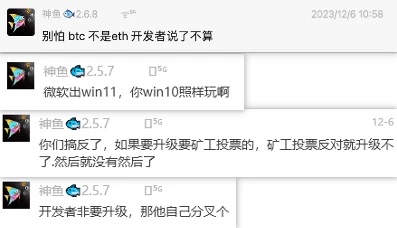
Shen Yu: Bitcoin isn’t Ethereum—developers don’t get to decide. Upgrades require miner voting; without consensus, upgrades won’t go through unless there’s a fork. (Note: F2Pool ranks third in Bitcoin hashrate, behind Foundry USA and AntPool.)
In response to a user comment saying, “But most miners will choose to include inscription transactions because it’s more economically beneficial,” Luke countered: “Bitcoin operates under the assumption that most miners are honest and non-malicious. Your ideology of chasing short-term profits is just another ideology—and a poor one at that.” He believes miners should reject inscription transactions due to their malicious nature.
Tripartite博弈, But Forks Have Never Truly Overtaken Bitcoin
Chen Mo, founder of BV DAO: Bitcoin Core developers see inscriptions as a bug; fixing it in the next version means BRC-20 would disappear. Those benefiting from inscriptions argue developers don’t have final say, and if necessary, miners could fork. Ultimately, everyone’s stance depends on their interests. In Bitcoin’s world, miners, developers, and capital form a balance of power—it's hard to say who truly holds authority. Historically, Bitcoin has seen many forks supported by miners, yet BTC has always remained singular. Miners are indeed major beneficiaries of the inscription economy, so they likely want inscriptions to continue. But whether capital is truly willing to back inscriptions is another matter. On the flip side, can the inscription community actually build a thriving ecosystem on a Bitcoin fork?
Taproot Has Revitalized the Bitcoin Ecosystem
Yu Xian of SlowMist: Personally, I don’t think this needs patching. The unintended consequences of introducing Taproot—a positive development—aren’t just piles of spam; they’ve also brought vitality to the Bitcoin ecosystem. This ecosystem isn’t limited to just ordinals/inscriptions.
Overall, the dominant community sentiment remains optimistic about the Bitcoin ecosystem, believing that inscriptions (Ordinals) have opened new developmental pathways and will continue evolving through the combined interests of multiple stakeholders.
Summary
In fact, since the birth of Ordinals, FUD has never ceased. Adam Back, inventor of PoW, advocated attacks against Ordinals as early as February; Luke declared in May that Ordinals were worthless; and JA N3 CEO Samson Mow claimed that the latest hype around Bitcoin Ordinals and BRC-20 tokens is unsustainable and will vanish within months.
The evolution of the Bitcoin ecosystem cannot be dictated by any single voice—it requires ongoing contention among multiple parties. Yet history moves in spirals. These waves of FUD have never stopped Ordinals’ progress; instead, they’ve fueled further growth, diversified into multiple protocols, expanded across chains, and ensured that springtime for the Bitcoin ecosystem continues.
Join TechFlow official community to stay tuned
Telegram:https://t.me/TechFlowDaily
X (Twitter):https://x.com/TechFlowPost
X (Twitter) EN:https://x.com/BlockFlow_News
 Odaily







