Bitget AMA Transcript: What’s Next After BRC? Bull Market Outlook for the RWA Ecosystem
TechFlow Selected TechFlow Selected
Bitget AMA Transcript: What’s Next After BRC? Bull Market Outlook for the RWA Ecosystem
Two key points are important when bringing real-world assets onto the blockchain: one is compliance, and the other is that the underlying assets must be of high quality.
 Navigating Web3 tides with focused insights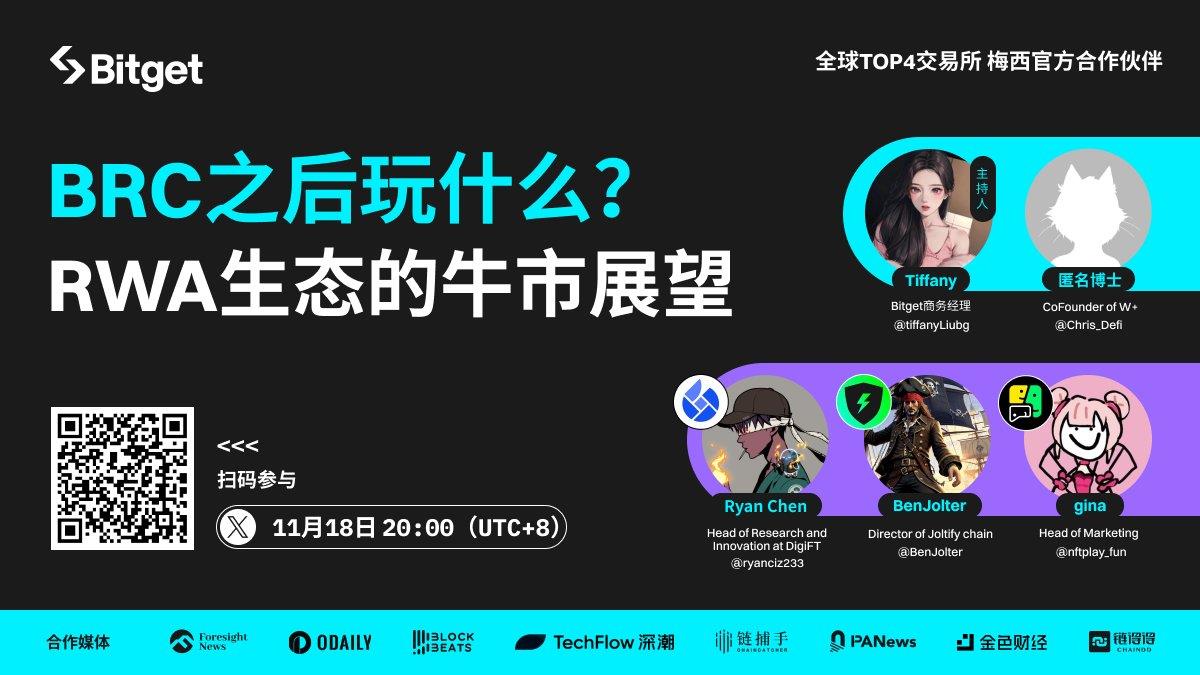
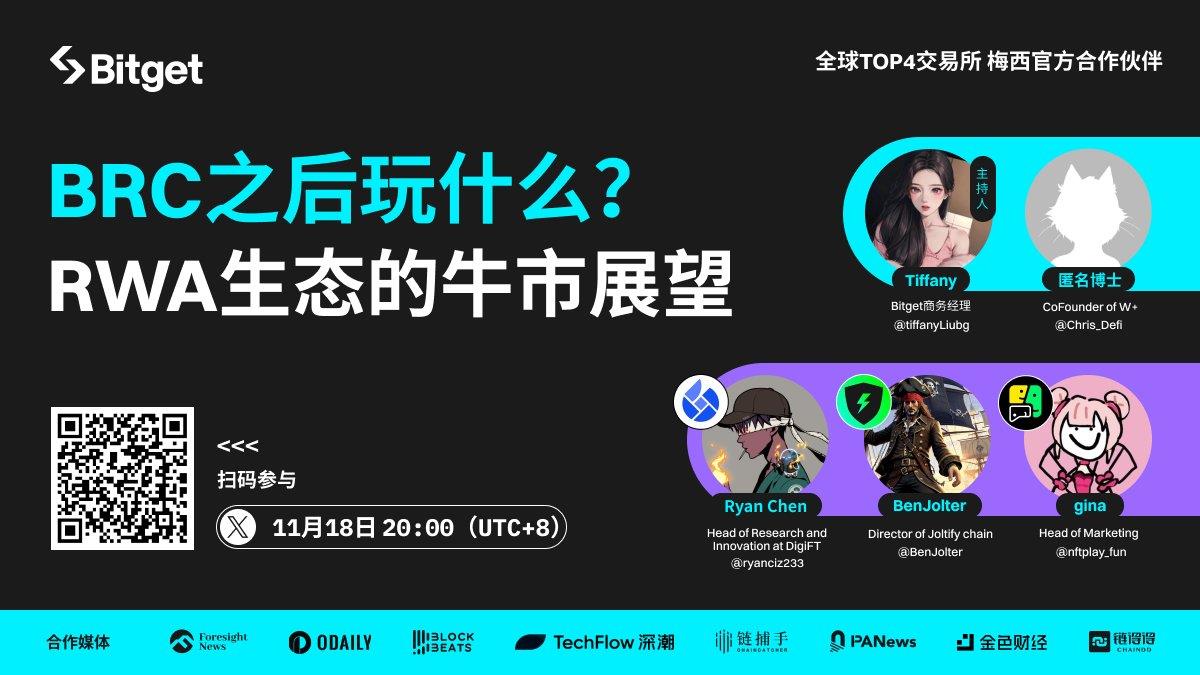
Recently, Bitget hosted an X Space in its Chinese community on the topic "What's Next After BRC? A Bull Market Outlook for the RWA Ecosystem," exploring the potential of the RWA sector as the next hotspot in the crypto industry. Guests included: Anonymous Doctor (Co-Founder of W), Ryan Chen (Head of Research and Innovation at DigiFT), BenJolter (Director of Joltify Chain), and NFT Play_Gina (Head of Marketing).
Below is a transcript of the community discussion:
Host:
The first question is: When did you first become aware of the RWA sector? Do you believe RWA can be the optimal solution for connecting real-world assets with crypto assets?
Gina:
I officially started engaging with RWA around June this year. But actually, RWA isn't really a new concept or something entirely novel. In my view, it represents a return to the original intent of blockchain technology—blockchain was created precisely to solve this very problem. Now that people are paying attention to this direction, it's a positive trend and a sign of healthy industry development.
Ryan:
From my understanding, RWA refers to assets issued in token form but backed by underlying real-world assets. Or, the rights or business associated with these tokens originate from the real world. Any asset of this type can be classified as RWA. By this definition, the earliest form of RWA was the stablecoin backed by real assets, which we are all familiar with.
Ben:
RWA is crucial for the future development of blockchain. If blockchain remains limited to niche assets like gaming or NFTs, it will be difficult to scale. Only by bringing real-life assets onto the blockchain can blockchain truly grow large. However, two things are critical when introducing real-world assets to blockchain: one is compliance, and the other is ensuring the underlying assets are high-quality.
Host:
The second question: After BRC-20 went viral, many felt the bull market had returned. In the next bull cycle, what role do you think RWA will play—could it lead the market’s growth?
Gina:
BRC-20 has recently gained massive popularity, giving everyone a renewed sense of hope. As for RWA, I don’t believe it will single-handedly drive the entire bull market. Instead, I think it can expand the Web3 market and attract more traditional institutions and everyday users into the Web3 space. Therefore, I believe in the next phase, RWA could bring significant traffic and value to the broader blockchain and Web3 ecosystem.
Ryan:
From my perspective, RWA is more like a channel—a way to move traditional high-quality assets onto the chain through complex financial supply chains and tools. A bull market requires smooth channels allowing capital to flow in and out easily, so RWA could serve as foundational infrastructure enabling the next bull run.
Ben:
I believe RWA is not just the main narrative for the next bull market, but also a bridge that will bring blockchain into mainstream finance. It won’t merely trigger a bull market—it could usher in a perpetual bull market. That’s our belief, and we hold strong conviction in this vision.
Host:
The third question: In the RWA sector, what factors do you think are essential for a project to break through and gain mainstream traction?
Gina:
Currently, everyone in the RWA space is still experimenting and figuring out the best approaches. In my opinion, RWA products should focus on solving pain points and inefficiencies in traditional finance. If a product successfully addresses these two areas, it’s highly likely to gain user acceptance.
Ryan:
For RWA to go mainstream, it must effectively address compliance and licensing issues. For example, in major financial hubs like Singapore, Hong Kong, or the U.S., many operations cannot function without proper licenses. So I believe compliance and licensing will definitely be key priorities.
Ben:
Indeed, I completely agree—compliance is the primary prerequisite. Additionally, how can we deliver high-quality assets to people worldwide, especially in developing countries where individuals have capital but lack access to such优质 assets? An efficient and affordable channel would be extremely valuable for them—that’s one of blockchain’s key advantages.
Host:
The fourth question: The digitization process of RWA faces several challenges. What urgent issues need to be addressed right now, and how can builders solve them?
Gina:
In my opinion, the most critical issue for RWA is achieving real-time mapping between on-chain assets and physical assets. Then there's the matter of RWA asset yields—specifically, operational cash flows—and how tokenized traditional financial assets can integrate with blockchain technology to create innovative new use cases.
Ryan:
What we urgently need to solve is the issue of token asset ownership verification. Especially when integrating with DeFi applications, how exactly should ownership rights over the underlying assets be established and enforced? So token ownership verification could be a major challenge.
Ben:
Currently, the biggest challenge in the RWA space remains compliance. We must respect laws and regulations. Only by fully honoring compliance can we truly scale this sector—that’s my view.
Host:
The fifth question: Some users are highly optimistic about the RWA sector. Can you give some advice to newcomers? For instance, what aspects of this sector can they currently explore and experience?
Gina:
New users can try investing in lower-threshold tokenized assets, including cross-border products or art pieces. On the risk side, they should check whether the issuer has any history of default, understand their insurance underwriting due diligence processes, and assess standard management risks.
Ryan:
Currently, the two largest segments in RWA are stablecoins and fixed-income products. Fixed-income yields aren’t particularly attractive—mainly centered around U.S. Treasuries—and due to compliance restrictions, most fixed-income products are currently available only to institutional users. New users might consider RWA-related protocols such as MakerDAO’s Spark Protocol.
Ben:
RWA essentially brings tangible financial assets and resources onto the blockchain, leveraging blockchain’s efficiency and speed to reduce capital costs. So I suggest people study how real-world finance operates—identify which financial instruments offer the best returns, highest safety, and strongest performance—and then look for similar assets on-chain. That’s a solid approach.
In addition to the lively discussions among the panelists, enthusiastic audience members also joined in. Below are some questions raised by users:
Audience Member 1: What role can ordinary investors play in RWA, and how can they benefit from the returns RWA offers?
Ben:
There are essentially two ways to share in RWA’s success. First, identify strong on-chain opportunities—for example, U.S. Treasuries, real estate funds, or high-performing companies. Second, find a strong RWA project that ties profits and dividends directly to its token holders. This way, you benefit both from the project’s success and the token’s performance.
Join TechFlow official community to stay tuned
Telegram:https://t.me/TechFlowDaily
X (Twitter):https://x.com/TechFlowPost
X (Twitter) EN:https://x.com/BlockFlow_News