








The ATOR Crash: From Partners to Rivals, the Turbulent Relationship with Tor
TechFlow Selected TechFlow Selected
The ATOR Crash: From Partners to Rivals, the Turbulent Relationship with Tor
The crypto community never lets down the builders who build for cryptocurrency, and Ator stands at one end of the crypto spectrum.
 Navigating Web3 tides with focused insights
Written by TechFlow
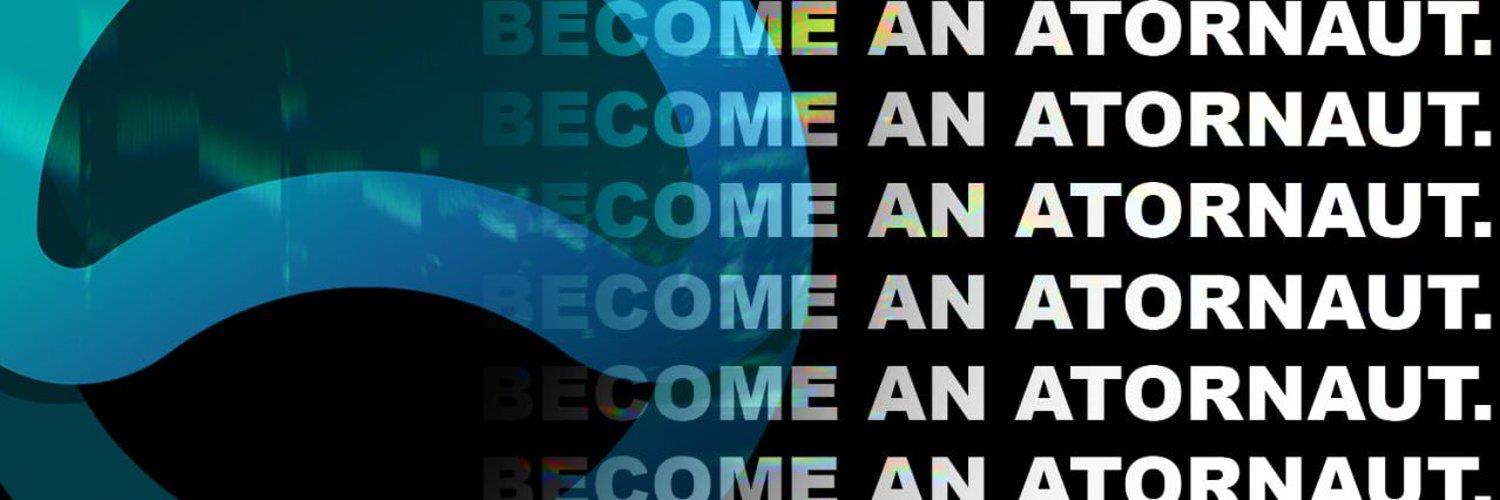
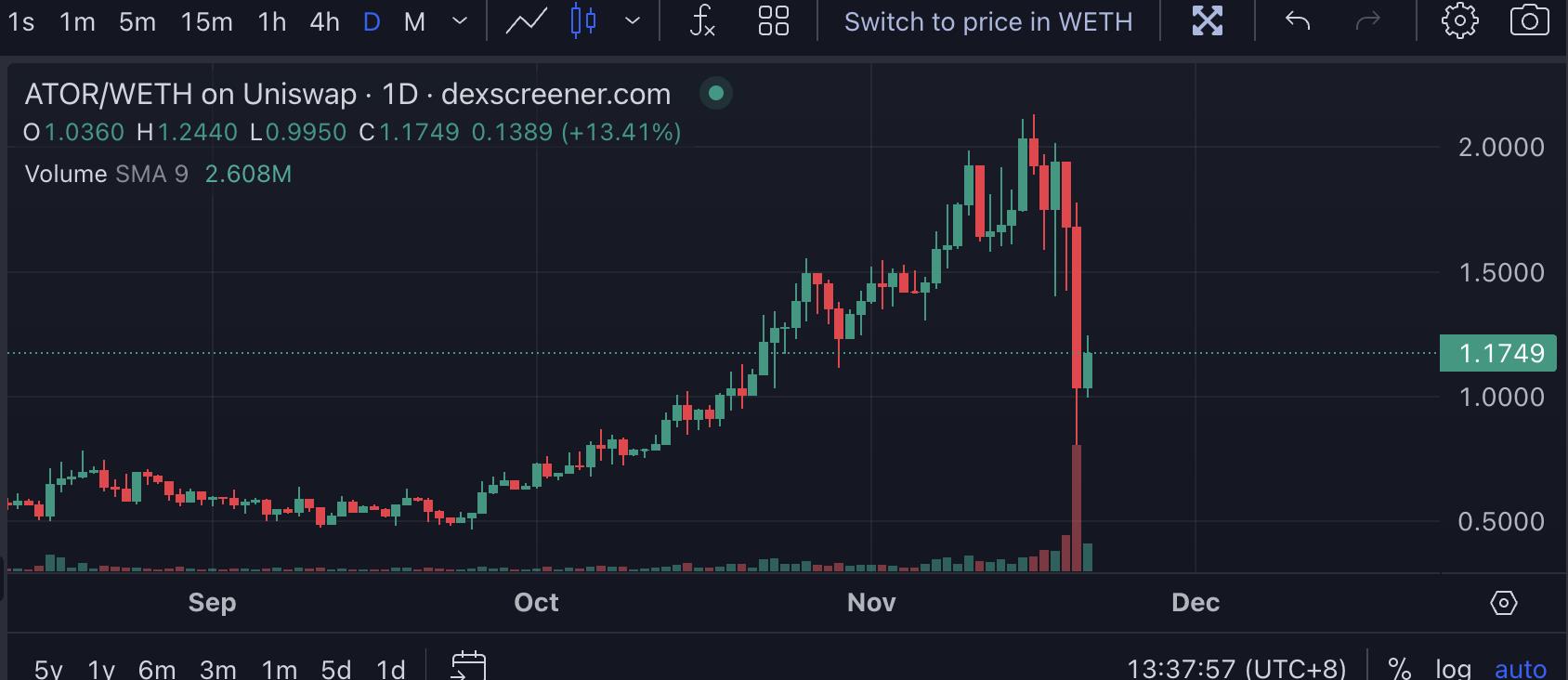
If you were to name the hottest on-chain projects this year, ATOR Protocol would undoubtedly be on the list. From $0.02094 in March to a new high of $2.13, its price surged over a hundredfold.
But now, its glory seems to have faded. Recently, $Ator suffered a major setback—its price plummeted 60% within four days, nearly cutting latecomers' investments in half.
What exactly is ATOR Protocol? And what lies behind its dramatic price swings? Let’s dive in.
ATOR Protocol ($Ator): Overview and Timeline
ATOR Protocol incentivizes operators who provide relay nodes for privacy networks, enhancing both service performance and privacy protection for these networks.
The privacy network referred to here is primarily the Tor Project, also known as the onion routing network. The Tor network can be simply understood as a browser enabling anonymous internet communication by hiding users’ IP addresses and preventing tracking by intermediate or destination routers.
One major drawback of the Tor network is its limited number of nodes. With insufficient relays to meet user demand, network stability suffers. This is where ATOR Protocol steps in—its relay node incentives help alleviate this critical shortage.
At first glance, it seemed like a win-win: Tor provided ATOR with a reason to exist, while ATOR boosted Tor’s node count. But this symbiotic relationship abruptly ended on November 20.
On November 20, the Tor Project published a blog post stating that third-party protocols not endorsed or approved by Tor, which use cryptocurrency incentives, have attracted operators associated with high-risk, profit-driven schemes. These relay nodes pose risks to the Tor network. Furthermore, such crypto-based incentives could attract malicious actors, endangering users and undermining the volunteer-driven ethos that sustains the Tor community.
As a result, Tor removed nearly one thousand relay nodes—an action that directly impacted ATOR Protocol’s operations and sparked backlash from ATOR whales. Many token holders may themselves have been node operators, whose earnings were now severely affected.
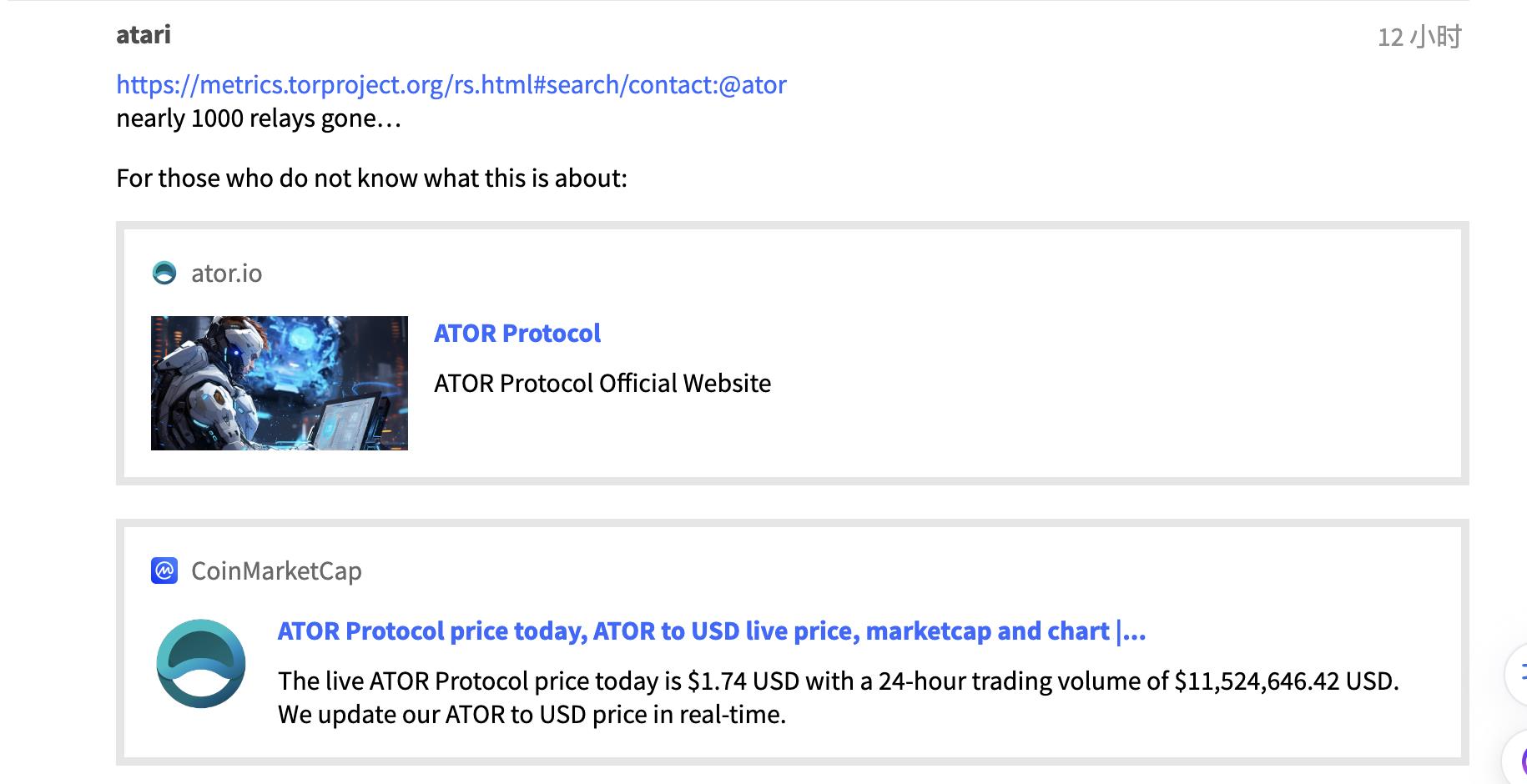
Amid this turmoil, users began spreading FUD (fear, uncertainty, doubt) within the ATOR community. On November 20 alone, the Ator token price nearly halved.
Going Independent: Becoming a Competitor to Tor
Ator didn’t stay silent. Nearly seven hours after Tor’s blog post, Ator issued its own "counter-statement":

Ator announced its future plans—to break free from Tor Project’s constraints and position itself as a competitor by building its own decentralized peer-to-peer routing network. This new network aims to offer services such as private messaging, streaming, file transfer, and a decentralized marketplace secured by the $ATOR token.
Ator pointed out that Tor took 20 years to build 6,500 relays, whereas Ator, since its fair launch just eight months ago, has already established over 2,000 testnet relays. At this pace, even operating independently, Ator is confident it can surpass Tor’s relay count within months.
Technologically, they claim to have matured significantly. Over recent months, continuous R&D improvements have led to the development of a novel cross-chain, scalable protocol and industry-standard hardware. They’ve also doubled the size of their engineering team to accelerate iteration on this innovative protocol.
Ator further criticized Tor for doing nothing to incentivize relay operators while heavily relying on government grants. A privacy-first network depending on state funding raises serious questions about whether its values align with its stated mission—a perspective that resonated deeply within the crypto community. This sentiment turned short-term bearishness into long-term bullish momentum, restoring community confidence.
The crypto community never abandons builders advancing the cause of decentralization. Ator stands firmly on the side of cryptocurrency ideals.
This shift in narrative is reflected in market performance. The statement restored HODLing confidence in the community. Rather than harming the project, this crisis brought greater attention and made clear that Ator is no longer subordinate to Tor—it has accelerated the realization of its roadmap.
Currently, $Ator is showing signs of recovery, rebounding nearly 50% from its recent lows.
Looking ahead to 2024, ATOR plans to release new hardware tailored for its network operations and launch the ATOR mainnet. A series of strategic initiatives are underway to secure its independent growth.
Perhaps, as ATOR said on social media, “The future is decentralized—and no one can stop this movement.” The same applies to internet privacy. If excluded by the Tor network, why not forge your own path and start a new movement?
Only time will tell how the market responds.

Join TechFlow official community to stay tuned
Telegram:https://t.me/TechFlowDaily
X (Twitter):https://x.com/TechFlowPost
X (Twitter) EN:https://x.com/BlockFlow_News
 深潮TechFlow


