Analyzing Zephyr: Where Privacy Meets Overcollateralization – What's New About This Novel Stablecoin Protocol?
TechFlow Selected TechFlow Selected
Analyzing Zephyr: Where Privacy Meets Overcollateralization – What's New About This Novel Stablecoin Protocol?
At the core of the Zephyr protocol is an over-collateralized, cryptocurrency-backed stablecoin mechanism, a concept refined through the innovative Djed protocol.
 Navigating Web3 tides with focused insights
Written by: TechFlow
Recently, the stablecoin sector has seen new developments.
The privacy-focused stablecoin protocol Zephyr is rapidly rising, with its token ZEPH increasing 5x in market cap to $30 million within a month. Why has it managed to stand out in the highly competitive stablecoin market?
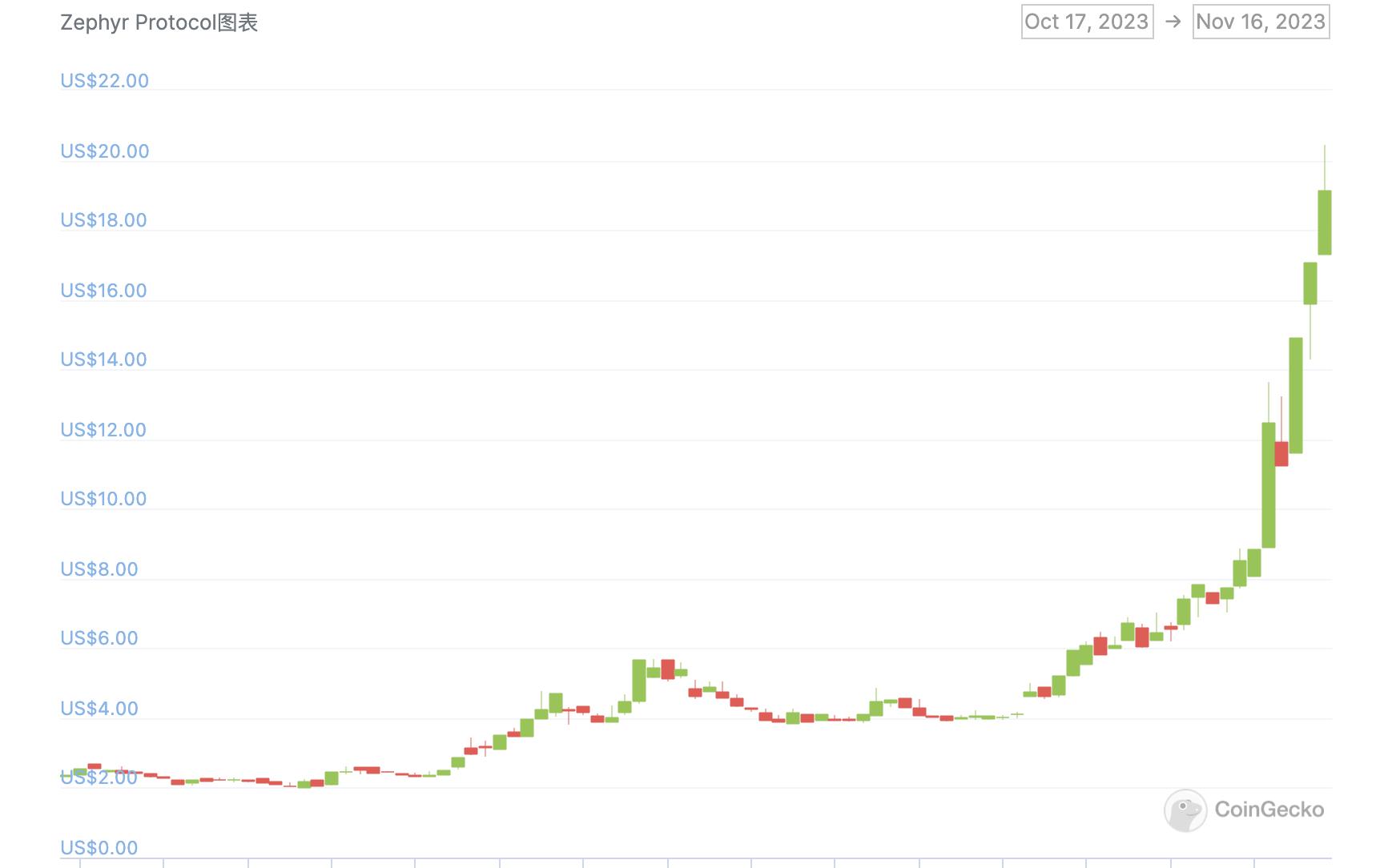
First, Zephyr is built on Monero, even using the same wallet infrastructure.
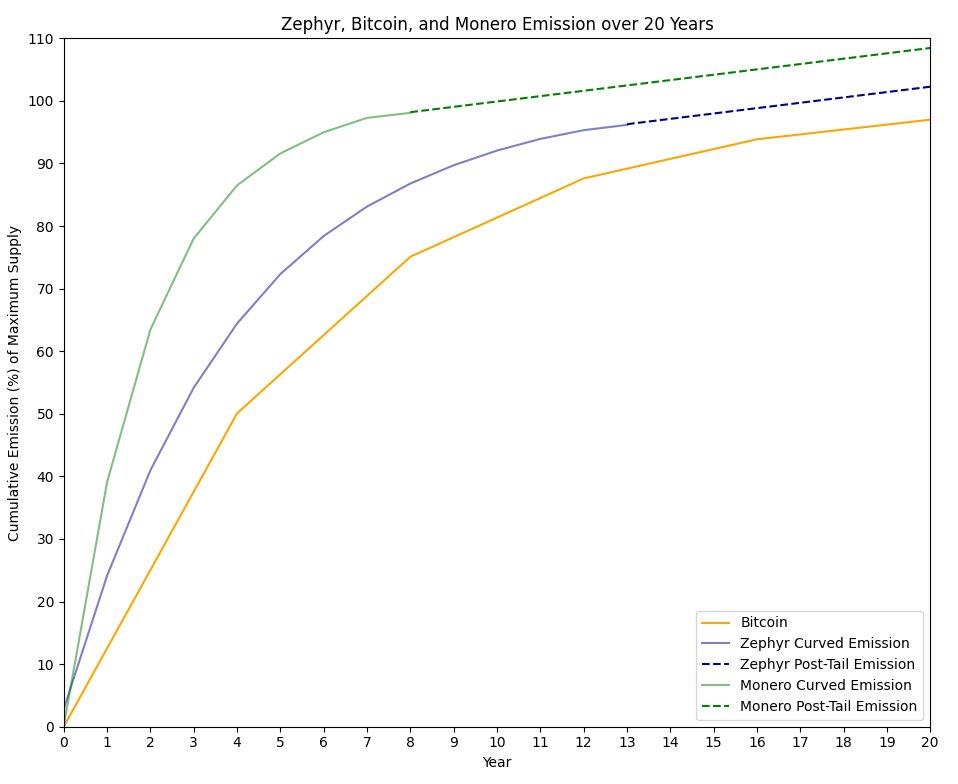
ZEPH is the base currency of the protocol, with a total supply of 18.4 million and a current circulating supply of 1.35 million. The Zephyr protocol operates on the RandomX proof-of-work (PoW) algorithm, designed to optimize general-purpose CPUs and support decentralized and equitable mining. However, Zephyr’s block time is set at 120 seconds, slightly slower than Monero’s emission curve. This design choice aims to reward early adopters, limit dilution, slow initial emissions, and mitigate any inflationary impact on the ZEPH price—thereby enhancing the stability of the algorithmic stablecoin system. The chart below compares emissions with Bitcoin and Monero:
At its core, the Zephyr protocol is an over-collateralized, cryptocurrency-backed stablecoin mechanism—an approach refined through the innovative Djed protocol.
What is DJED? Inspired by AgeUSD and developed by prominent organizations Emurgo, IOHK, and the Ergo Foundation, Djed is a stablecoin protocol with a proven stabilization mechanism.
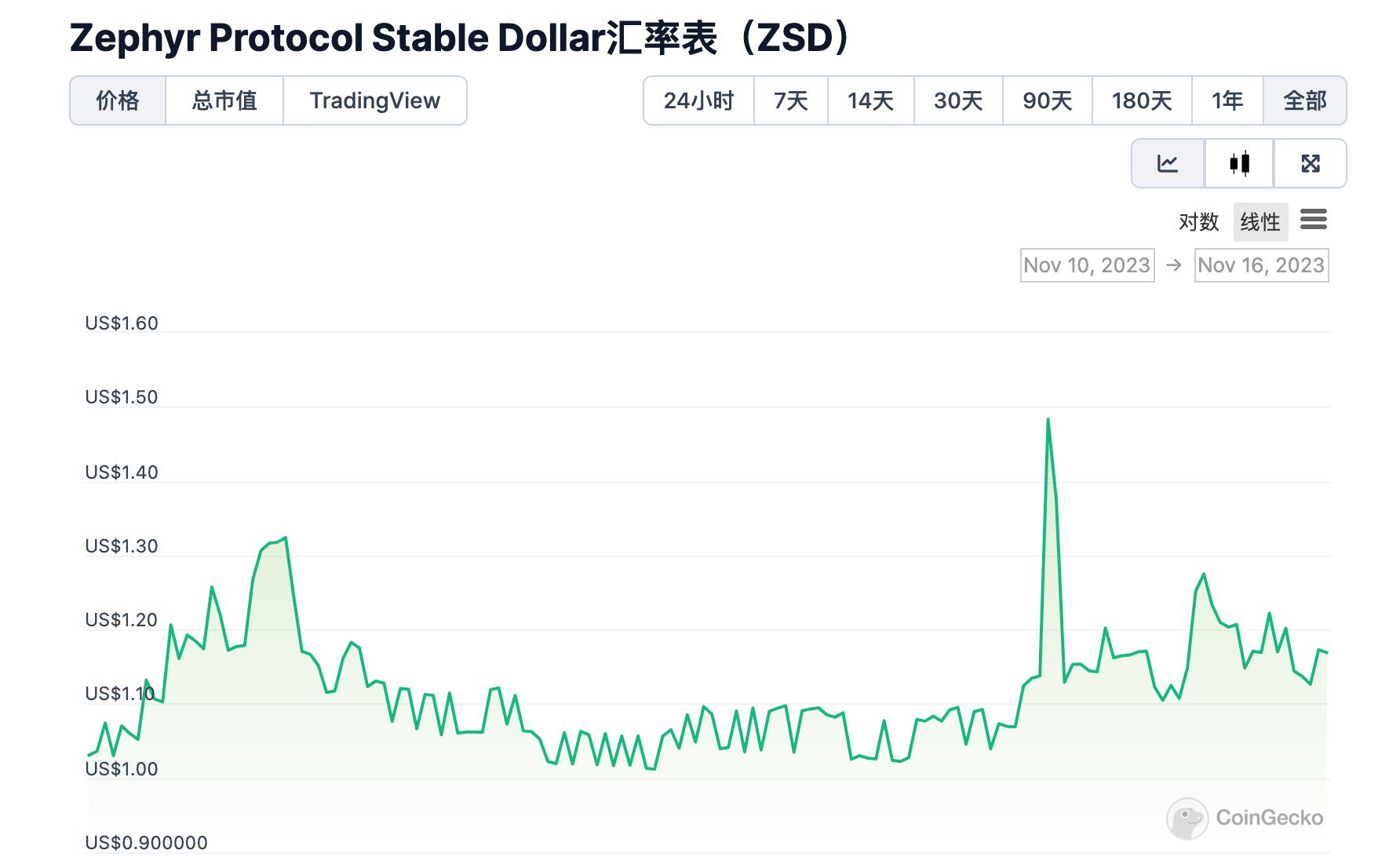
Its principle can be summarized as an autonomous bank that buys and sells stablecoins within a price range tied to a target value. This stabilization mechanism has been tested in the market, and currently, the zephUSD backed by this system rarely experiences de-pegging.
How ZEPHYR Avoids the "Death Spiral"
Although Luna’s collapse was some time ago, the "death spiral" remains an unavoidable topic for stablecoins. So how does ZEPHYR avoid such a fate?
A "death spiral" typically refers to a situation where an algorithmic stablecoin protocol is forced to mint excessive amounts of its base token to maintain the stablecoin’s peg, causing the base token’s value to plummet in a downward spiral.
The Zephyr protocol ensures no additional ZEPH tokens are created spontaneously because zephUSD is backed by ZEPH held in over-collateralized reserves—and crucially, the core mechanism does not rely on algorithms. The supply of ZEPH grows only through scheduled emissions. This approach safeguards network stability and value, as a constant emission rate eliminates the risk of sudden inflation shocks that could destabilize the system.
In other algorithmic stablecoin protocols, spontaneous and unlimited minting of the base token is often used to maintain stability, potentially triggering a death spiral. Fundamentally, Zephyr does not follow this model.
Zephyr Protocol v1.0.0
On October 1, 2023, Zephyr Protocol executed a critical hard fork, introducing two new assets on the Zephyr blockchain: Zephyr Stable Dollar ($ZSD) and Zephyr Reserve Share ($ZRS).
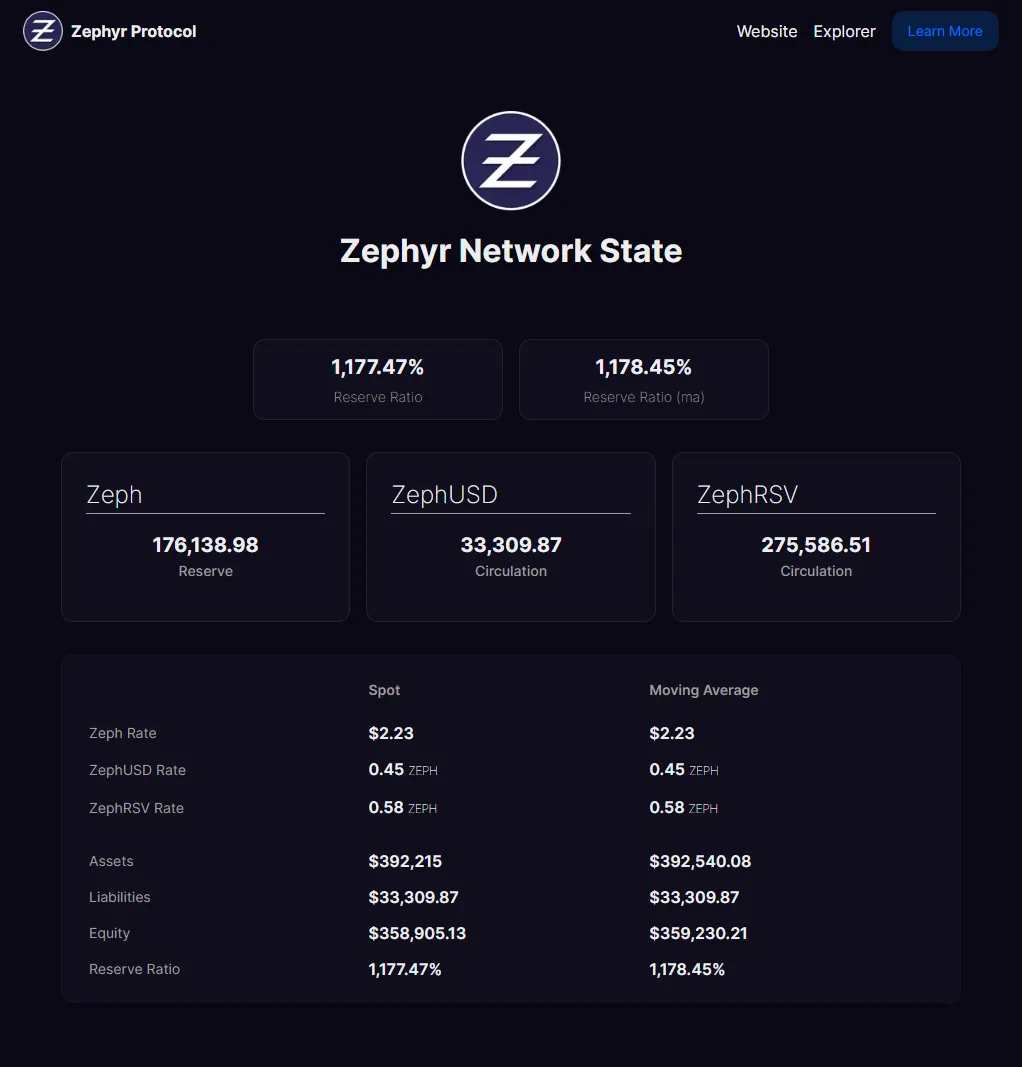
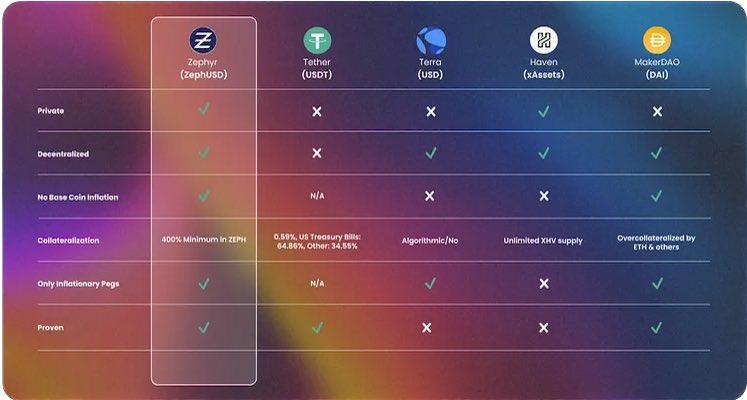
$ZSD is a privacy-preserving stablecoin, fully over-collateralized and supported by ZEPH.

Key advantages of $ZSD compared to other stablecoins:
-
Privacy: Amounts, recipients, and destination addresses are hidden in $ZSD transactions.
-
Decentralization: Other stablecoins (e.g., USDT) are operated by centralized entities, conflicting with DeFi’s ethos of decentralization.
-
No Base Token Inflation: Algorithmic stablecoins must mint base tokens to maintain their peg, leading to inflation. $ZSD is not algorithmically pegged but crypto-backed.
-
Over-Collateralization: More than 400% ZEPH must be held in reserve when minting $ZSD. In contrast, USDT is backed by less than 1% in U.S. Treasuries.
-
Proven Mechanism: Inspired by the battle-tested Djed protocol, which has been implemented for years via SigmaUSD (Ergo) and Djed (Cardano).
-
Low Transaction Fees: Transferring $ZSD costs less than one cent.
Holders of Zephyr Reserve Shares ($ZRS) receive a portion of block rewards in every block, serving as a premium for supporting the Zephyr Stable Dollar ($ZSD). Reserve providers effectively bet on Zephyr’s value and adoption.

Incentives for reserve providers:
-
Leveraged Position: As the Zephyr price rises, the value of ZEPH in the reserve increases, meaning more equity becomes available.
-
Conversion Fees: As adoption grows and protocol usage increases, more fees are generated, boosting reserve assets.
-
Block Rewards: 20% of block rewards go directly into the reserve, strengthening it and providing another path for $ZRS appreciation.
-
Spot and MA Divergence: Due to dual pricing of Zephyr assets, users transact using the less favorable rate between spot and moving average prices. This mechanism prevents manipulation and also benefits the reserve.
This incentive structure is referred to as “pseudo-staking rewards” for $ZRS on the Zephyr protocol.
Example of Asset Collaboration within the Zephyr Ecosystem
Let’s explore two user scenarios to understand the mechanics and functionality of the Zephyr protocol. For simplicity, we exclude fees and other auxiliary protocol features in these examples:
Scenario 1: When the Base Currency (ZEPH) Price Rises
Suppose Alice is a user holding 100 ZEPH who seeks value stability.
Bob, on the other hand, holds 200 ZEPH and seeks capital appreciation, betting on the future value of ZEPH.
Bob becomes a reserve provider, depositing his 200 ZEPH into the Zephyr protocol and minting reserve tokens ($ZRS). As long as the reserve exceeds the minimum collateral ratio, these tokens can be redeemed for underlying ZEPH at any time.
Alice deposits her 100 ZEPH into the protocol and mints $100 worth of stablecoin ($ZSD).
Now, the total reserve equals 300 ZEPH. Four weeks pass, and the ZEPH price increases by 10%.
Excited by the recent price surge, Alice decides to close her position. She redeems $100 of stablecoin and withdraws ZEPH worth $100. At a ZEPH price of $1.10, she receives 90.90 ZEPH, leaving 209.1 ZEPH in the protocol reserve for future use.
Bob wants to lock in profits and redeems his reserve tokens, receiving the remaining 209.1 ZEPH. Thus, Bob earns 9.1 ZEPH by being a reserve provider, while Alice maintains value stability through stablecoin minting.
Scenario 2: When the Base Currency Price Falls
Now, consider a scenario where the ZEPH price drops. Assume Alice and Bob start with the same amount of stablecoins/reserve tokens as in the previous example. Four weeks later, the ZEPH price falls by 10%.
Alice decides to redeem her stablecoin for ZEPH worth $100. At a ZEPH price of $0.90, she receives 111.12 ZEPH, leaving 188.88 ZEPH in the protocol reserve.
Next, Bob decides to close his reserve token position and redeems the remaining reserve, receiving 188.88 ZEPH. In this case, Bob incurs a loss of 11.12 ZEPH by providing reserves to the protocol, while Alice preserves dollar-denominated value stability through the stablecoin ($ZSD).
From the above examples, it's clear that ZEPH, ZSD, and ZRS work together in a stable flywheel:
-
ZEPH – A base token with limited supply
-
ZSD – The stablecoin
-
ZRS – Earns block rewards and a share of fees paid by minters and redeemers
However, privacy coins always face regulatory risks. Many governments are skeptical of privacy coins, which may limit their appeal to mainstream crypto users—a challenge currently facing ZEPHYR. The solution Zephyr has proposed is integration with decentralized exchanges (DEXs), but whether this approach will prove effective remains to be seen.
Join TechFlow official community to stay tuned
Telegram:https://t.me/TechFlowDaily
X (Twitter):https://x.com/TechFlowPost
X (Twitter) EN:https://x.com/BlockFlow_News
 深潮TechFlow