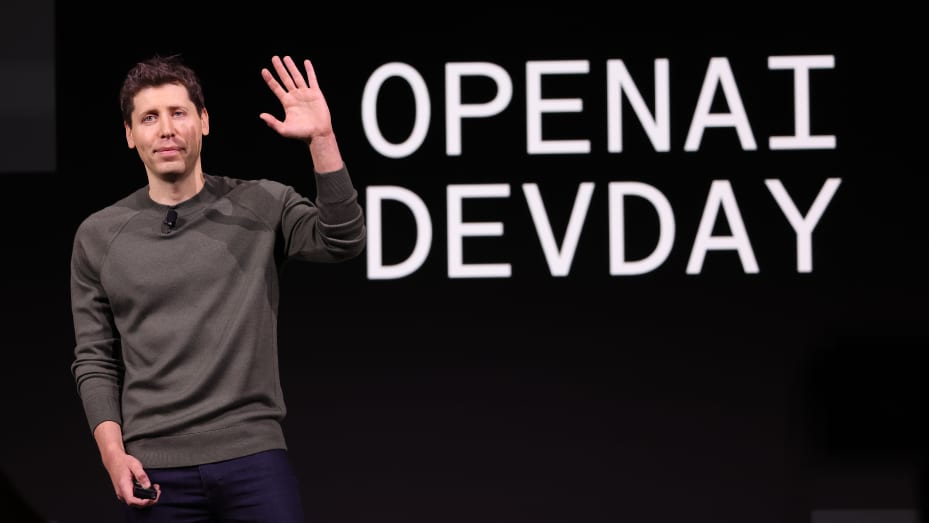
OpenAI's First Developer Conference: Seizing the Ecosystem, Everyone Can Build Their Own GPT
TechFlow Selected TechFlow Selected
OpenAI's First Developer Conference: Seizing the Ecosystem, Everyone Can Build Their Own GPT
Give developers tools, then change the world.
 Navigating Web3 tides with focused insights
The first-ever AI Spring Festival, OpenAI DevDay, was held in San Francisco. With the release of a series of new products and features, OpenAI has begun to showcase its ecosystem strategy in the era of large models.
At the start of the launch event, Altman shared some data about OpenAI's platform and products: weekly usage has reached 100 million people, developer count has hit 2 million, and 92% of Fortune 500 companies are using OpenAI products.
Price Reduction Cheaper and Faster GPT-4 Turbo
OpenAI launched the new GPT-4 Turbo, which is more capable than the current GPT-4.
-
Knowledge extends up to April 2023 on internet content.
-
128K context window, capable of handling text equivalent to over 300 pages.
-
Price reduction: cheaper than previous GPT-4, input pricing at one-third the cost of GPT-4, output pricing at half.
-
Enhanced function calling supports multiple functions called simultaneously, with higher accuracy and a new JSON output mode.
-
GPT-4 Turbo now supports image inputs during chat, the same technology currently used by BeMyEyes. Developers can access this feature via API; the gpt-4-vision-preview pricing depends on image size. For example, passing a 1080×1080 pixel image to GPT-4 Turbo costs $0.00765.
-
Fine-tuning is now open, allowing developers to modify every step of the training process, with trained models being exclusive to their organization.
-
Faster output speed—doubled tokens per minute.

Assistants API / Assistant API
OpenAI released a new agent-like application. Developers can use the Assistants API to execute specific instructions, read from additional knowledge bases, and complete tasks by calling models and tools. It comes equipped with tools such as code interpreter, retrieval, and function calling.
-
The Assistant API features persistent and infinitely long threads, enabling developers to offload thread state management to OpenAI and overcome context window limitations.
-
Code Interpreter: writes and runs Python code within a sandboxed execution environment, generates graphs and charts, and handles files with various data formats. Allows assistants to iteratively run code to solve complex coding and mathematical problems.
-
Retrieval: enhances assistants with knowledge beyond the model, such as proprietary domain data, product information, or user-provided documents. Users no longer need to compute and store document embeddings or implement chunking and search algorithms.
-
Function Calling: enables assistants to invoke defined functions and incorporate responses into their messages.
16K Context GPT-3.5 Turbo
OpenAI also upgraded GPT-3.5 Turbo, expanding its context window to 16K.
-
Input pricing reduced to one-third of the previous GPT-3.5 16K model, output pricing matching the former GPT-3.5 16K, with fine-tuning prices also lowered accordingly.
-
Supports improved instruction following, JSON mode, and parallel function calling.
DALL·E 3 and TTS APIs Now Open for Developer Integration
Companies like Snap and Coca-Cola are already using DALL·E 3’s API to generate images for customers. The API includes built-in moderation capabilities to help protect developers from misuse.
Developers can easily use the TTS API to convert text into human-like speech. The TTS model offers six preset voices across two genders.
Open-Sourcing Whisper v3 and Consistency Decoder
Whisper is a leading speech-to-text software. This time, OpenAI open-sourced version v3 and will soon release the Whisper v3 API. The Consistency Decoder serves as an alternative to Stable Diffusion’s VAE, improving all images compatible with Stable Diffusion 1.0+ VAE, with significant enhancements in text rendering, facial details, and straight lines.
Ecosystem Strategy Customizable GPTs and the GPT Store for Everyone
The most exciting announcement was the launch of GPTs: anyone can now create customized versions of ChatGPT for daily life, work, or home use. Users can share their created GPTs publicly or limit them to personal or internal company use.
No coding is required—users simply provide natural language instructions along with any additional knowledge base text to quickly build a GPT capable of web search, image creation, or data analysis.
More importantly, OpenAI will launch the GPT Store later, similar to the App Store, where verified user-created GPTs will be listed and searchable. The store will highlight top-performing GPTs in categories like productivity, education, and entertainment, and creators will earn revenue shares based on usage.
Like plugins, user-created GPTs support integration with external data and internet connectivity. Users can connect their GPTs to databases, email, shopping assistants, and more. With Zapier, user-built GPTs can easily enable calendar subscriptions, syncing, and SMS functionalities.
ChatGPT enterprise users can build GPTs exclusively for internal use.
A true OpenAI developer ecosystem seems within reach.

Empowering Developers Then Changing the World
At the end of the keynote address at the developer conference, Sam Altman shared his final thoughts with developers:
"In closing, I'd like to take a moment to thank the teams who made all of this possible. OpenAI has an incredibly high density of talent, but even so, making this a reality requires immense hard work and collaboration. I truly believe I have the best colleagues in the world, and I feel profoundly honored to work alongside them.
We do all of this because we believe AI will be a technological and societal revolution. It will transform the world on many levels. We’re thrilled to be doing this work, delivering value to you, so that you in turn can create even greater value for all of us.
Earlier, we said that if you give people tools, they can change the world. We believe AI will empower individuals and institutions with unprecedented capabilities, elevating humanity to scales we’ve never seen before.
We’ll be able to do more, create more, and have more. As intelligence becomes ubiquitous, each of us will possess on-demand superpowers."
Join TechFlow official community to stay tuned
Telegram:https://t.me/TechFlowDaily
X (Twitter):https://x.com/TechFlowPost
X (Twitter) EN:https://x.com/BlockFlow_News