








Schrödinger's Word: Dialogue is creation, going on-chain is manifestation
TechFlow Selected TechFlow Selected
Schrödinger's Word: Dialogue is creation, going on-chain is manifestation
Since coexistence is a fundamental way of human existence, helping those around us as much as possible, especially assisting them in liberating their minds, is the prerequisite for our own happiness.
 Navigating Web3 tides with focused insights
Author: Feng Guangneng
Signed author of Wai Bo San Guan, founder of Xiao Guang's Cultivation World
The narrative of "exploitation" as an ideology possesses certain explanatory power over reality. Yet stories that seem factually accurate may not necessarily open up the future. To speak is to create; creation entails risk. If we hope for a better life, what we truly need is to cherish every opportunity for dialogue. Academic texts exhibit the clearest intentionality—essential not only for liberating thought but potentially unlocking countless "firsts." To inspire enthusiasm for sharing ideas, taking action, and earning lasting recognition, we might even try putting achievements on the blockchain.
Words shape the transmission of memory and the formation of collective memory. Through words, people establish connections across time and space. For instance, we can connect with Heidegger through the language of "The Question Concerning Technology," and simultaneously connect with everyone else who has read it. Beyond connection, words allow us to speak freely or deliberate together. Gathering around a fireplace to read once represented an ideal life. Likewise, deliberating together, acting together, and building relationships through shared action embody an ancient tradition of being. Yet under industrialization-driven globalization, both reading as an ideal life and deliberation as a tradition of being have gradually edged toward oblivion. The inability to speak freely or deliberate collectively constitutes industrial civilization’s gravest crisis.
"Exploitation" Narrative as Ideology
Every grand narrative contains ideology. According to Adorno, ideology refers to a "necessary social illusion"—a form of social consciousness widely believed to be true, yet actually false, yet still necessary.
Three aspects deserve attention here: First, ideology is not ordinary social consciousness, but rather a necessary belief held by most people despite being fundamentally false. Second, our critique of ideology always occurs within ideological frameworks; ideologies cannot be escaped. Our task is not to construct a correct ideology, but merely to reduce its distortions—thereby achieving social reform. Third, ideology resembles the rules of a chessboard. As players, each move we make affects the game’s state, but does not alter the rules themselves—unless we begin reflecting upon and discussing those rules. The goal isn’t to overturn the board, but to make the game more engaging.
Ideologies are diverse, sedimented within various grand narratives—an inevitable fate. Many young people today reject all grand narratives, yet this very rejection stems from another grand narrative: “All grand narratives are deceptive.”
Among prevailing grand narratives today, the one most in need of reflection is the narrative of "exploitation," originating in Adam Smith’s *The Wealth of Nations* and Marx’s *Capital*. Based on analysis of his era’s international landscape, Smith discovered a simple law: the more people engaged in organized productive labor, the wealthier a nation becomes; otherwise, it grows poorer. This is because non-productive labor (performed by priests, doctors, writers, lawyers, actors, singers, dancers), however noble, vanishes as soon as it occurs. A table, once made, can be traded years later; a speech leaves no lasting product. Thus, Smith established a new value system based on durability—one that exalts productive labor and emphasizes the importance of free markets, private enterprise, and division of labor for prosperity through diligence and thrift. Within this framework, capital size reflects capitalist virtue.
Marx inherited Smith’s distinction between productive and non-productive labor, but was shocked to discover that diligence does not guarantee prosperity. Capitalists typically pay wages below workers’ actual due—the growth of capital depends on exploitation. Thus, capital size no longer reflects virtue, but original sin.
The danger of the "exploitation" narrative as ideology lies in its presupposition of opposition between "exploiters" and "the exploited." The more realistic it feels, the firmer this assumption becomes, obscuring other possible relationships. Ultimately, while revealing injustice, it renders reality even more tragic.
We cannot use peasant mentality to understand economic issues under globalization. In traditional villages, landlords were typical rentiers—overthrowing them and redistributing land seemed sufficient to resolve inequality. But this rarely works. First, peasant thinking is conservative, incapable of institutional innovation. Overthrow old landlords, and if distribution systems remain unchanged, new ones will rise. Second, peasant thinking disconnects from rapidly evolving technological environments. Landlords were visible then; today, capital flows are invisible, leaving ordinary people unaware of passive redistribution. Still, critical spirit remains indispensable—though now directed not at individuals, but outdated ideas, prompting awareness, self-reflection, and vigilance among their holders.
We must critique backward ideas. Everyone lives historically, shaped by their own historicity—first manifesting as sedimented beliefs, since actions follow from beliefs. Deep within each person’s intentional world lie numerous ideas: some good, inspiring divine qualities—e.g., “make others comfortable,” “respect others,” “suspend preconceptions,” “exercise benefits body and mind,” “do things step by step,” “attend to others’ needs,” “build meaningful connections,” “protect environment and conserve energy,” “focus on details,” “seek meaning in lived experience”; some evil, unleashing demonic tendencies—e.g., “the world’s rule is a few exploiting the many,” “only by exploiting others can you gain advantage,” “this society is exploitative—either exploit or be exploited,” “reality is harsh, ideals are meaningless”; others neutral, belonging to private domains.
Our age long ago surpassed production limits—people could explore life’s possibilities, enrich existence, bring dignity even to the lowest strata. But due to these evil ideas, discussions about new orders become extremely difficult. Crucial common-sense notions for public discourse get obscured—rarely mentioned when discussing matters—such as “the world could be one of mutual care, understanding, and inspiration,” “historical trends depend on individual choices,” “liberating thought itself is the highest cause,” “earning money isn’t the end—we seek a better world,” “under industrial civilization, many public-interest projects simply can’t profit,” “a good society enables everyone to live happily”… Some individuals, having benefited from such evil ideas, dismiss these common-sense notions as nonsense.
Yet criticism is immensely difficult. People tend to display their divinity, voicing good beliefs while avoiding mention of evil ones—secretly clinging to them, remaining unmoved even when challenged, thinking concealment suffices. As a result, their minds remain bound, unable to envision broader worlds. As the technological era accelerates, game rules must evolve to adapt, enabling gradual improvement for all. Since co-existence defines human being, helping others—especially freeing their minds—is the prerequisite for our own happiness. In ancient Rome, slave owners constantly kept slaves for entertainment, eventually becoming culturally assimilated by them. At Britain’s Royal Society, individuals pursued distinct goals, competed vigorously, inspired one another—and produced generations of immortal scientists.
Due to the difficulty of critique, evil ideas sometimes feel deeply entrenched, dissolving public life entirely. Those holding such views, lacking self-reflection, cannot sincerely discuss public affairs. Instead, they obstruct such discussions while feeling morally superior—creating absurdity. Meanwhile, these ideas appear self-evident in narrow contexts, spreading rapidly and turning society into a cutthroat arena. Even local government officials with limited reading and narrow horizons may fall under their spell, failing to see proper governance paths—hindering regional development and worsening local order.
Under new global conditions, the harm of "exploitation" narratives lies in initiating a signifier-avoiding game of dodgeball—encouraging concealment rather than reflection of evil ideas. Undeniably, the suffering of the lower strata is evident. Improving their living standards would ease middle-class fears of downward mobility, alleviate societal involution, and free up energy and time for exploring life’s meaning. It is reasonable for the exploited to voice demands—but they receive no substantive response, only stories. Whether labeled “exploiters,” “capitalists,” “entrepreneurs,” or “politicians,” these terms point not to accountable individuals, but abstract collectives.
In modern industrial civilization, nearly everyone may play some role as a “rentier class” within their domain, forming layered rent-seeking and mutual distrust.
In the long run, both rentiers and the underclass are destined to be forgotten by history—death equalizes all.
An Age Without Public Life
The crux lies in how the "exploitation" framework presumes the existence of a “rentier class” within consciousness.
In practice, following Smith’s distinction, anyone not engaged in productive labor already participates somewhat in rentier status—some extracting more, others less. Rentiers and the underclass aren’t opposed—they often overlap significantly. A construction foreman, for example, may belong to the underclass while also appropriating subordinates’ profits, and simultaneously being exploited by superiors.
Once the concept of a rentier class takes root in popular consciousness, and the "exploitation" narrative becomes core belief among the underclass, the exploited cease focusing on systemic reform or embracing complexity. Instead, they strive to join the rentier class, thereby expanding personal freedom. Yet each social tier accommodates limited numbers. When demand exceeds supply and no one expands the pie, vicious, involutionary competition becomes unavoidable. Moreover, human civilization advances through the realization of shared possible worlds. If only a few envision better futures while most remain trapped in exploitation narratives, no matter how beautiful those visions, consensus remains unattainable. Reality persists in the “exploiter–exploited” structure—generating endless infighting, waste, idle motion, depletion—leaving everyone unhappy.
In modern society, human conditions grow increasingly absurd. With ongoing industrial revolution, material output long ago exceeded needs—addressing necessity has never been easier. Yet civilizational waste and idleness have also intensified unprecedentedly. The outcome? Even rentiers suffer like laborers: workers struggle within systems, then desperately seek stimulation post-work—e.g., scrolling short videos to relieve stress. Rentiers who climbed from poverty gain so-called “freedom,” yet seldom become speakers or actors. They don’t engage public affairs, instead skillfully playing dodgeball games, disbelieving in love, maintaining frugal lifestyles, and diligently teaching descendants what they believe are rentier-class survival strategies.
Superficially, everyone “strives” for a better life. But methods involve scheming, pretense, mutual draining, calculation, layered extraction—resulting in self-imprisonment by thought, blindness to new possibilities, inability to authentically pursue ideals. This is a fundamental predicament. Exploitative techniques (e.g., telling ghost stories, carrot-and-stick tactics, using debt as motivation…) are cyclical. The more one practices them, the more skilled and dependent they become—even taking pride in their managerial prowess. Meanwhile, the exploited learn these same skills. These micro-mechanisms permeate society like capillaries, gradually making most people both exploiters and exploited.
Tragically, self-limitation brings limitation upon others. My constraints on you bind me in return. Without mental liberation, society suffers excessive mutual restraint.
Post-wealth rentiers seemingly buy anything—but the public sphere of civilization has nearly collapsed. Technological environments grow ever more systematic. Industrial civilization develops at accelerating, unsustainable speeds. Modern millionaires make gossip headlines, but cannot enjoy public life, lack joy in discussing civic matters, cannot redirect eras or act as messiahs to save the world. Glory and immortality belong to distant pasts.
Conversely, intellectuals daring to speak, attempting to discuss public affairs and improve society, often lack wealth and face labels like “public intellectual,” “stinking ninth category,” or “why do you care about national affairs?” Under such conditions, any intellectual spared abuse or humiliation is likely unqualified.
Clearly, within the "exploitation" grand narrative, rentiers tell ghost stories while playing dodgeball; intellectuals endure constant insults; the exploited struggle merely to climb ranks and join the rentier class. This creates a vicious cycle: despite surplus production, no one finds happiness. The underclass suffers indignity; rentiers secretly indulge, earn no glory; fame-seeking intellectuals face endless scorn, pouring effort into Sisyphean labor. Any narrative of possible worlds gets dismissed as irrelevant fantasy, not a vision awaiting realization. During civic deliberations, consensus forms not through rational discussion, but on the basis of “we’re all ‘rule-makers,’” granting trust and security. Conversely, however concrete, feasible, or inspiring your vision, without offering a profitable liquidity mechanism, it’s often futile. Because “beauty” has become equivalent to “wealth.”
The "exploitation" narrative is highly exclusionary, destroying basic interpersonal trust. In conversation, everyone worries whether they’re being deceived. Once the underclass accepts this narrative, all wealthy people and intellectuals appear potential exploiters. They may suddenly turn hostile toward anyone living well, making alternative narratives inaccessible, blinding them to new possibilities. Compared to painful memories cutting deep into soul and flesh, the faint light of unattainable美好生活 seems blindingly bright.
Undoubtedly, memories of "exploitation" have settled into the marrow of many modern individuals—a pain like a parasitic limb, unmentionable yet unforgettable. Thus, the "exploitation" grand narrative operates ideologically at unconscious levels, dominating behavior—making it hard for moderns to negotiate public affairs, engage in dialogue, or initiate new orders amid surplus production. In this sense, launching new civilizations and welcoming new orders requires effort from every modern person: letting history ferment into wine, planting flowers on cliffs.
This effort begins mentally, linguistically—facing unclaimed debts and debt-driven dynamics embedded in intentional life, embracing existential possibilities offered by modern technology, learning to accept, and to forget.
Speech and Creation
For Heidegger, language is the house of Being. Harari claims humans are storytelling animals, forming imagined communities through stories. Both express the same truth: speaking is always creation. We create possible worlds through speech; humanity’s journey forward consists in realizing shared possible worlds.
As creative acts, speech lacks truth/falsity distinctions—only differences between emptiness and fulfillment. If someone says, “I’ll read 100 books,” failure doesn’t make it false—it remains empty, possibly fulfilled later. Even saying, “I’ll read 100 books within a year,” then failing after twelve months—even reading zero—doesn’t render it false, just hollow: unfulfilled, losing possibility of fulfillment. Still, the expressed intention—“I will read 100 books within a year”—was real; the determination was genuine. That intention might inspire others. A year later, peers noticing the failure lose trust, yet they were already inspired to read. If the speaker’s original aim was precisely to ignite others’ reading desire, prepared for broken trust, they remain authentic.
A story’s actuality lies in its perpetual openness as an unfilled possible world. Marx’s described communist society (note: “communism” is a flawed translation; *communism* should be rendered “commonism”—centering public life. “Communal ownership” presupposes “production-centric” or “production-supreme” thinking. In an era of surplus, people no longer need to produce collectively; production is merely one among many public tasks) envisions individuals, freed by abundance, pursuing free and comprehensive development based on personal worldview. Such ideals are neither true nor false—merely insufficiently filled. We continually enrich them through speech and action, manifesting excellence.
Within the "exploitation" narrative, we find event structures precede our judgment of correspondence, governing behavioral choices—yet often go unnoticed. Many believe this narrative fits reality, trapping them within its structure—offering only two roles: exploited or exploiter—forever preventing transcendence. Simultaneously, this narrative aligns so closely with modern experience, feels so believable, it becomes entrenched ideology. Most modern behaviors thus follow this ideology, reinforcing it, making social innovation increasingly difficult. Compared to systematically reflecting on the entire era, playing dodgeball or climbing one step higher initially seems easier, more grounded. But as more join these games or involution, ceasing civic negotiation, civilizational crises accumulate—no one ultimately escapes hardship.
Thus, we observe the quantum effect of words: as creation, speech may open better worlds—or reinforce old flaws.
To highlight this effect, consider adapting “Schrödinger’s cat” into “Schrödinger’s word.” Inside a box with radium and cyanide, the cat exists in superposition—alive and dead—until observed. Similarly, any story we attempt to tell holds unpredictable potential: will this possible world guide reality toward improvement or deterioration?
Of course,叠加 possibilities within stories are richer, as each listener responds from unique perspectives and circumstances. Good stories perpetually extend themselves. This means storytellers must remain humble, assume responsibility for speech, and continuously reflect on narrative structures. Speak well, we become gods illuminating the world; speak poorly, demons misleading hearts—god or demon, only revealed after speaking. This is the dual nature of the speaker.
Flowers and Bayonets
Recently living as a digital nomad, I’ve initiated many reading groups, gradually meeting new friends who enjoy conversation. Chatting with Xiao Guo, he shared a beloved artwork—*Flowers and Bayonets*, also known as *The Girl with the Flowers in Washington*. It captures 17-year-old American Jane Rose offering flowers to soldiers’ bayonets during an anti-war protest in Washington on October 21, 1967—a historic moment. A simple image, yet profoundly, indelibly震撼ing.
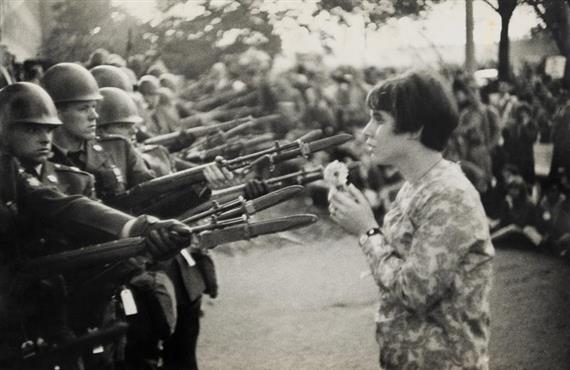
Image source: Wikipedia
In our information-rich age, people recognize war often serves to divert social contradictions. Yet in modern civilization, war’s costs and uncertainties have greatly increased. Facing widening wealth gaps and problems like financial bubbles, rigid social structures, populism—each person carries deep inner burdens. Condemning Keynesianism, denouncing listed companies fleeing with funds—we feel lost, homeless. Despite industrial overcapacity, society brims with oppositions. People guard against each other, unable to negotiate public affairs.
According to Mumford, dialogue represents the highest form of urban life. We first inhabit possible worlds brought forth by dialogue, playing roles within them—e.g., a cry of “Rape!” conjures a story of beauty and beast. “Real identities” are simply our roles in worlds most tightly coupled with technological environments—these are the lowest, incapable of further realization. Conversely, “ideal identities”—wandering poets, shamans, God, Buddha, Bodhisattva, immortals, true persons, lovers—are more exalted, opening entirely new possible worlds capable of illuminating our “reality.”
Negotiating public affairs means freely articulating possible worlds from present conditions. Yet in repressive atmospheres, leisure-time individuals don’t automatically assume the duty of contemplating possible worlds or actively negotiating public matters—they don’t know where to begin, deepening existing repression.
Still, if we desire better lives, we must cherish every dialogue opportunity—during conversations, strive to articulate our deepest insights, share life-integrated wisdom, offer “flowers” to every listener. Conversely, if still dominated by "exploitation" narratives, chasing answers to inherently unanswerable questions, we remain eternally迷茫—for opening the future means realizing possible worlds. Hence, the more “realistic” a story sounds, the less capable it is of opening the future.
Everyone lives in history, none escaping historicity in speech. The "exploitation" narrative has long settled deep within consciousness. Likely, we believe ourselves sincere speakers, yet unconsciously reinforce decaying orders. Living in industrial civilization, we obsess over operability, efficiency, measurability, evaluability, dialogic conclusions—hallmarks of Habermas’ instrumental rationality. Since instrumental rationality aligns perfectly with industrial-era work logic, we easily immerse in it, forgetting communicative rationality. Even valuing cooperation, negotiation, inclusion, final proposals often follow instrumental-rational models. Without recognizing profound intentionality behind every utterance, we underestimate the difficulty of liberating thought, overestimate the quality of our speech.
I enjoy initiating reading groups because I believe books are the most beautiful flowers—textual intentionality is clearest, currently the best resource to pierce through "exploitation" narratives. Each book embodies authors’ efforts, especially academic works—e.g., Oxford Very Short Introductions, SDX New Knowledge Library, Hanqing Hall Series, Phoenix Series, Famous Scholars’ Fifteen Lectures, Science Canon Series, Translated World Academic Classics…
Undoubtedly, to most readers, these books seem too specialized, uninteresting, even daunting. Yet for liberating thought, cultivating reason, enriching intentionality, reading them is the most direct and effective path. Conversely, lacking courage to read them, we struggle to transcend沉重 histories—authors’ efforts left exposed and betrayed.
Putting Achievements on the Chain
Previously, Brother Hao proposed “putting promises on the chain,” leveraging blockchain’s decentralization and immutability to build trust mechanisms, hoping to awaken long-termism. This idea greatly inspired me. Perhaps “putting achievements on the chain” could ignite passion for reading academic books.
Clearly, immersing in academic books, grasping authors’ thoughts, expressing insights in public spheres, continuously creating beautiful words and noble deeds—is itself glorious, fully displaying personal wisdom and charisma.
For those unaccustomed to academic reading, learning to read itself becomes an interesting journey—filled with countless “firsts”: first reconstructing an argument’s structure, first suspending preconceptions, first carefully reading footnotes and endnotes, first mastering paragraph-theme relationships, first entering an author’s intellectual world, first sensing the realm of Being, first engaging in deep dialogue with a distant or even deceased author, first debating with friends, first discussing public affairs through complex lenses, first grasping the relationship between enduring speech and immortality, first feeling compelled to write a book, first developing intense curiosity about certain issues, first experiencing intellectual freedom, first developing predecessors’ ideas upon inheritance…
Carefully reading well-written academic books may spark intellectual resonance—finding belonging, a sense of home, adopting fresh worldviews. Shared reading experiences are beautiful—enabling intellectual dialogue, deep consensus among participants. Of course, we shouldn’t communicate merely to “seek consensus,” since the act of reading together is purpose enough. Gathering around reliable texts, opening topics, freely exchanging ideas, fully expressing uniqueness, highlighting differences, discovering deeper unity through discussing differences—this itself is an ideal life.
Additionally, reviewing, discussing, and recording events from reading sessions allows us to extract highlights—documented in writing or via blockchain—as immutable public memory in community development. This links offline communities with online digital polises.
This immutability itself carries sacredness—signifying immortal reputation, unless the entire community is forgotten. As long as newcomers are drawn, as long as members maintain it, predecessors’ outstanding deeds continue illuminating successors, inspiring emulation and pursuit.
Join TechFlow official community to stay tuned
Telegram:https://t.me/TechFlowDaily
X (Twitter):https://x.com/TechFlowPost
X (Twitter) EN:https://x.com/BlockFlow_News










