Understanding Namada: A Modular Privacy Solution for the Multi-Chain Ecosystem
TechFlow Selected TechFlow Selected
Understanding Namada: A Modular Privacy Solution for the Multi-Chain Ecosystem
Namada's trustless bidirectional Ethereum bridge serves as concrete evidence of its adaptability, enabling the extension of Namada's modular privacy to tokens and dApps beyond its base ecosystem.
 Navigating Web3 tides with focused insights
Author: Namada
Translation: TechFlow
Historically, the architecture of decentralized systems has forced users to commit to specific cryptocurrencies, chains, or dApps in order to access privacy features.
While functional, this siloed structure inherently limits the scalability and extensibility of privacy solutions. Namada disrupts this status quo by introducing the concept of "modular privacy"—a bold reconfiguration designed to expand the applicability of privacy functionalities across decentralized systems.
Namada Architecture Overview
The Namada protocol operates as a Layer 1 solution composed of multiple components, but the foundation enabling modular privacy lies in two key features: the Unified Shielding Set (USS) and Shielded Actions (SA). These elements are far more than incremental upgrades—they represent a fundamental rethinking of how privacy is implemented across chains and throughout the broader crypto landscape.
Namada’s Unified Shielding Set (USS)
Traditionally, in the privacy domain, shielding sets are asset-specific—Zcash’s Sapling architecture, for example, supports only ZEC. The larger the shielding set for an individual asset, the stronger the privacy guarantees for each user. However, fragmenting privacy into single-asset pools reduces effectiveness for low-volume assets like NFTs, where limited inputs and outputs weaken anonymity.
Namada overcomes these limitations through its Multi-Asset Shielding Pool (MASP), an evolution of Zcash’s Sapling technology. This forms the USS—a unified, asset-agnostic shielding set capable of accommodating a wide range of assets. As a result, users can privatize assets from non-private chains such as Cosmos Hub, Osmosis, Stargaze, or Noble.
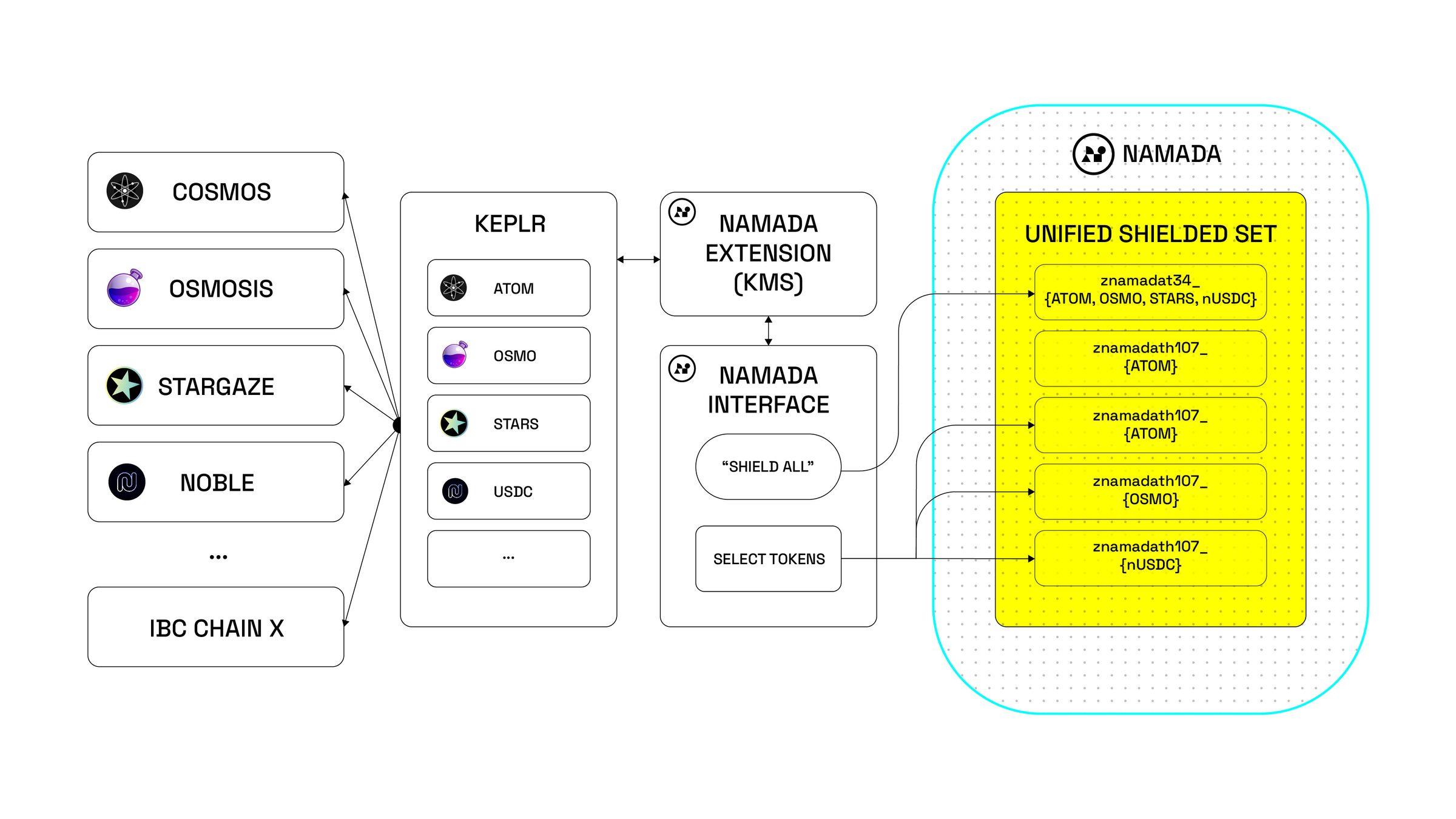
To optimize user experience—especially for those interacting via Cosmos and IBC—Namada has developed browser extensions and web interfaces. These platforms are fully compatible with Keplr key management while incorporating Namada-specific functionality.
Thus, the USS provides Zcash-like privacy for all IBC tokens. Moreover, unlike traditional privacy models where tokens are typically locked, the USS allows tokens to flow and transfer within the shielding set.
To incentivize contributions to the shielding set—and thereby enhance user privacy—the USS includes a Shielding Set Reward mechanism, a unique feature of the MASP/CC circuit. Namada governance determines which tokens qualify for shielding set rewards and the target quantities.
Shielded Actions
The second cornerstone of Namada’s modular privacy is Shielded Actions (SA). This feature empowers users not only to execute transactions but also to perform complex, orchestrated operations across multiple blockchains, app-chains, and dApps—all while maintaining a privacy layer through the USS. Its purpose is to enable users to do much more than what Namada natively offers, all through a single privacy-preserving interface.
SA is meticulously designed, introducing a new level of automation within the user interface. It enables users to execute multiple interactions in parallel, significantly reducing complexity for end users. This design aligns closely with innovations around Interchain Accounts (ICS-27) in the IBC and Cosmos ecosystems.
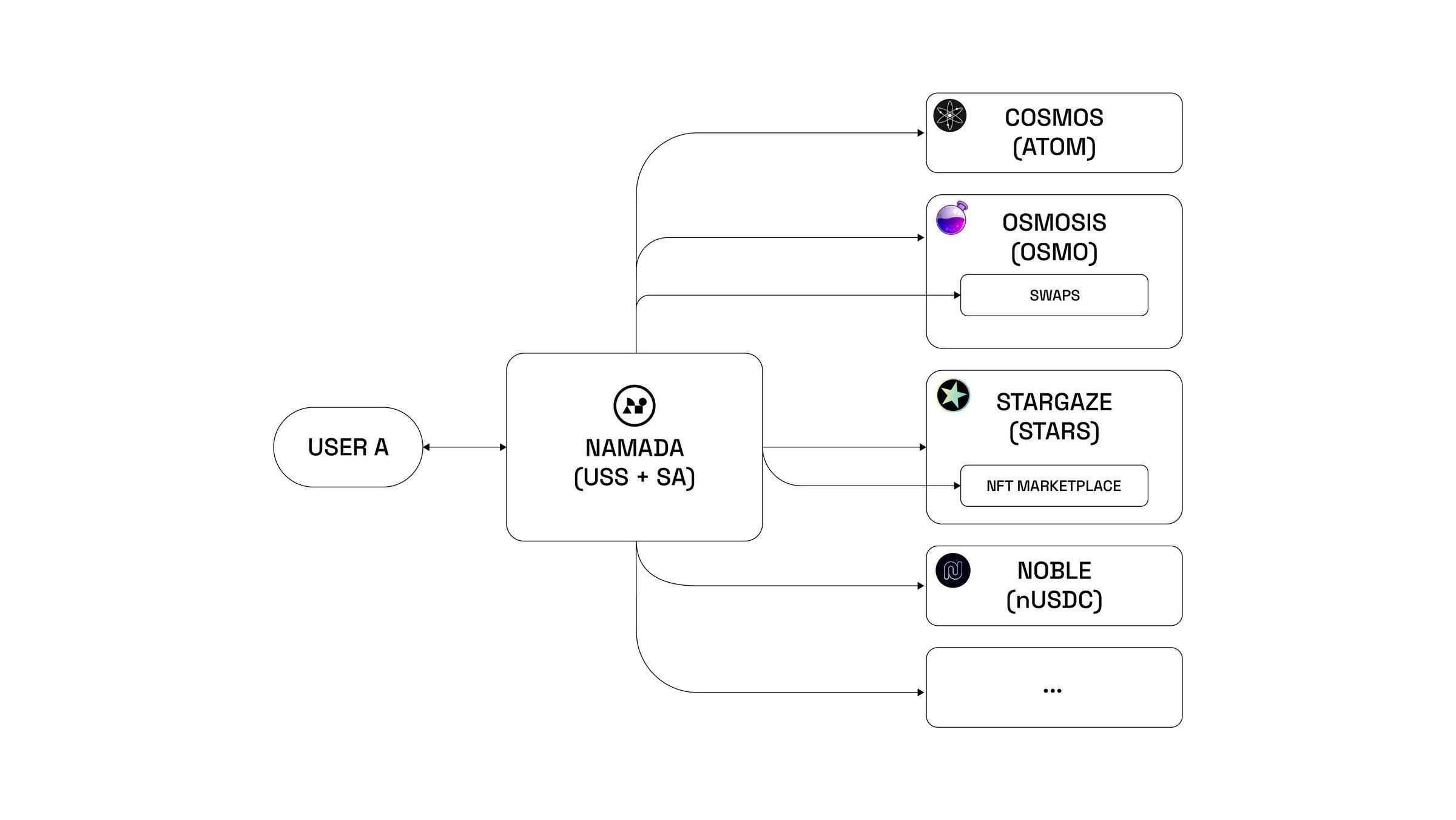
Every shielded action begins within the Unified Shielding Set. This ensures that user identities remain hidden, making it extremely difficult for external observers to trace the origin of a shielded action. All they can see is that an action originated from the Namada USS. The rule is simple: the larger the USS, the stronger the privacy mechanism.
To interact with applications on other chains, users do not sign simple transfers; instead, they sign a sequence of instructions originating from Namada. This unlocks a range of use cases, such as:
-
Shielded staking on Cosmos: A user unshields ATOM, transfers it to the Cosmos Hub, and then stakes it.
-
Shielded swaps on Osmosis: SA allows a user to unshield OSMO tokens, transfer them to Osmosis, swap them for ATOM, move the newly acquired ATOM to the Cosmos Hub, and finally return them to Namada for re-shielding—all completed in seconds.
-
Publishing shielded data on Celestia: A user can unshield TIA tokens, transfer both TIA and specific data to Celestia, publish the data, and cover fees—all under privacy protection.
-
And more.
Although SA leverages IBC for more than just token transfers, it is important to note that any interaction over IBC remains transparent (it reveals transaction graphs). To maximize privacy between Cosmos and IBC, it is best to keep assets shielded within the USS at all times unless needed for an operation, and to avoid using easily correlatable amounts over IBC.
SA is pivotal to modular privacy because it allows users to continue privately interacting with the tokens, applications, and chains they already use—without requiring any changes from the chains or applications themselves.
Conclusion
Ultimately, Namada’s modular privacy is not confined to the Cosmos and cross-chain ecosystem. The protocol’s architecture is extensible and ready to seamlessly integrate into diverse blockchain environments.
The implementation of Namada’s trustless two-way Ethereum bridge serves as concrete evidence of its adaptability, enabling the extension of Namada’s modular privacy to other tokens and dApps beyond its native ecosystem.
As blockchain technology matures, the demand for robust, scalable, and private interactions grows ever more urgent. Namada does not merely adapt to this future—it is helping to shape it.
Join TechFlow official community to stay tuned
Telegram:https://t.me/TechFlowDaily
X (Twitter):https://x.com/TechFlowPost
X (Twitter) EN:https://x.com/BlockFlow_News
 @namada