Understanding Intent-Centric Architecture: A Result-Oriented Approach Focused on "Intent"
TechFlow Selected TechFlow Selected
Understanding Intent-Centric Architecture: A Result-Oriented Approach Focused on "Intent"
Intent still carries significant risks and challenges during its execution, as it relies on intermediaries or specific executors, leading to risks of centralized control and monopolization, thereby affecting the trustworthiness of the entire middleware.
 Navigating Web3 tides with focused insights
Author: @YBBCapital Researcher @Ac_Core_
Preface
The cumbersome user experience of Web3 has become one of the reasons hindering the widespread adoption of blockchain. Recently, when prominent Web3 venture capital firm Paradigm introduced its top 10 potential trends in the crypto space—placing "Intent-Centric protocols and infrastructure" at the top—this concept instantly attracted significant industry attention.This is a design philosophy that centers around users' needs, treating intent as the core element.
For example, "I want to order a ¥30 hamburger delivery" represents an “intent.” To fulfill this intent, the user only needs to enter their name, phone number, delivery address, and place the order on a food delivery platform—without needing to understand how the ¥30 payment is distributed among merchants or how the platform assigns riders and completes delivery. This architecture greatly simplifies the user experience threshold, allowing each user to simply express their intent while delegating intermediate processes to various protocols and waiting for the final outcome.
Note: This article does not promote any project and is suitable for general readership. Content is for analytical reference only.
Intent-Centric Design Principles
Background:
In the Web3 world, transactions are the most fundamental function—whether it’s DeFi, GameFi, NFTs, or any other sector—all rely on basic transaction capabilities. However, the reality is that blockchain's decentralized nature means different chains operate as isolated islands. We need bridges between these islands to complete asset exchanges. While centralized exchanges offer convenient asset trading experiences, users still need to individually authorize wallets to access numerous DApps. To lower the usability barrier of decentralized applications, the concept of Intent-Centric architecture emerged.
Although the prototype of “intent” did not originate recently, this conceptual wave was sparked by Paradigm, so we will use their definition as a reference: “An intent is a set of signed declarative constraints that allows users to outsource transaction creation to third parties without relinquishing full control over the transaction counterparties.” In practice, signatures are driven by users’ self-directed intentions, but can transferring assets to third-party intermediaries truly reduce user friction? The following sections will discuss what is required to realize the vision of Intent-Centric systems.
What Is an Intent?
Intent-Centric can be understood as “centered on intent.” In its June 1, 2023 article titled *Intent-Based Architectures and Their Risks*, Paradigm explained the concept of intents. In a typical user transaction flow, transaction signatures allow validators to verify and execute along a specific computational path, with gas fees incentivizing validators to perform computations. However, an intent does not specify a particular computational path—any path that satisfies certain constraints and achieves the desired end result is acceptable. In practice, by signing and sharing an intent, users allow recipients to choose the execution path on their behalf (see diagram below). To distinguish from traditional transactions, we define intent as an information signature—it enables state transitions from a given initial state through multiple possible paths to reach the final desired state [1].
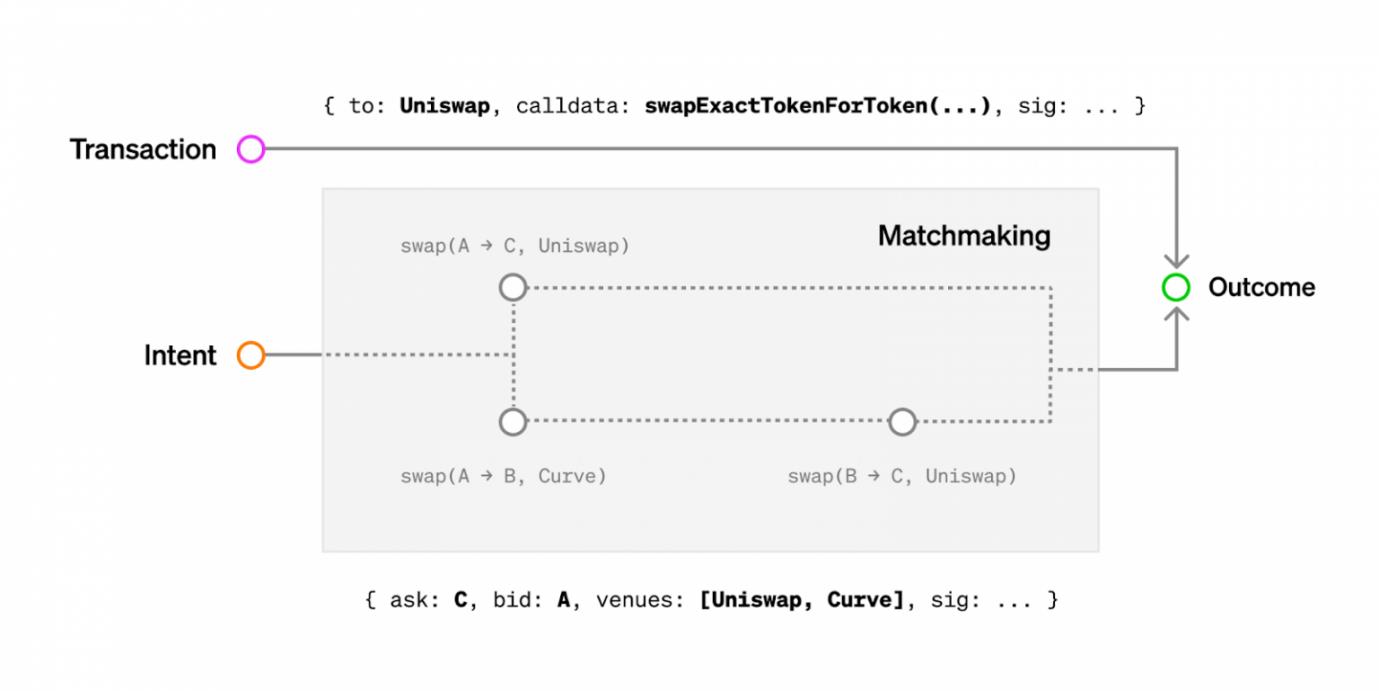
Image source: Intent-Based Architectures and Their Risks – Paradigm
As shown above, submitting a transaction requires specifying a clear execution path—for instance, swapping tokens on Uniswap. But when submitting an intent, the execution path is determined by matching results. For users, they only need to state their intent—the rest is handled by Intent-Centric protocols/applications: matching execution paths. In brief, a Solver is responsible for identifying execution paths that satisfy the intent, after which users wait for final execution and results.
In short: Transaction = I specify exactly how to execute; Intent = I only care about the outcome, not the process.
Different intent preferences can be matched in complex ways, requiring two key components: “finding counterparties” and “solver computation.”
Bob, the Intent Solver
Image source: ETH Global
Bob the Solver (translated as Bob Solver, hereinafter referred to generically as “solver” unless specifically referring to Bob Solver) is an intent-based transaction infrastructure primarily designed to simplify operations, lower user entry barriers, and integrate seamlessly into wallets and decentralized applications. At its core, it creates and executes outsourced transactions for users, consisting of two main interconnected parts:
-
Transaction-solving solver: Composed of an AI chatbot + intent classification + transaction optimization, responsible for determining the optimal execution path for user intents and sending them to AA wallets. The solver also includes machine learning (ML) models for classifying user intents;
-
“Abstract Account Wallet” for transaction execution: An AA wallet system based on EIP-4337 standard, composed of Bundler and Paymaster, integrated with the solver to streamline transaction flows.
Intent Layer and Solvers
Can we build a standalone intent layer where solvers compete to solve intents? Theoretically feasible, but practically very challenging. Here we must highlight Anoma and SUAVE (details below), which aim to solve the critical MEV problem. To achieve the vision of Intent-Centric systems—outsourcing transaction processing to third parties—what characteristics are necessary to securely transfer assets?
-
Trustworthiness
To maintain trustworthiness and decentralization, assuming only a simple “intent network” exists may not be sufficient—it cannot guarantee commitments between users and solvers regarding intents. After users declare their intent, the solver calculates specific costs for various execution paths, constrained by user-defined parameters. Users need assurance that all execution paths are trustworthy;
-
Privacy
Solvers provide users with optimal execution paths. Due to their complexity, they risk being exploited by hackers seeking to steal assets or obtain user data. Additionally, in most cases, users’ on-chain activity information is exposed to observers. To ensure data security, at least some critical information must be encrypted or hidden—but achieving private computation of verifiable data on blockchains is extremely difficult;
-
Intent Expression
Intent is an abstract concept. Expressing intent on a blockchain resembles asking questions to an AI—how should one phrase it so the system understands the intended meaning? If vague or ambiguous intents are expressed, could solvers incur higher gas costs when selecting execution paths? An efficient and accurate parser is key to realizing intent;
-
Consistency Between Intents and MEV
Take SUAVE—an independent blockchain addressing real-world EVM issues—as an example. When handling Ethereum intents, cross-chain settlement is required—similar to the success of previous MEV decentralization solutions like MEV-Geth and MEV-Boost—which satisfy cross-chain MEV demands through fairer, more transparent transaction processing mechanisms;
-
Censorship Resistance
From Paradigm’s explanation, we see a core issue: AI-powered parsers should not be singular entities. A single parser suffering attacks or downtime could bring down the entire system. Also, concerns about refusal or incorrect execution exist—issues potentially addressable by Anoma discussed later;
-
Solver Competition
Different users have different intents, and solvers may include multiple transaction types such as swaps, cross-chain transfers, staking, etc. Single solvers won’t compete since fees are only collected upon on-chain settlement. Can solvers specializing in different transaction categories be fairly redistributed or optimized via algorithmic improvements to maintain competitive dynamics, enabling every valid address to qualify as a solver and participate in the mempool, thereby improving execution quality?
-
Intent Mempool
Paradigm proposed three new mempool (Mempool) solutions:
a. Permissionless Intentpools: Open design allowing anyone to submit intents and granting executors permissionless access;
b. Permissioned Intentpools: Require permission to submit and execute intents, allowing users to delegate execution to trusted third parties;
c. Hybrid Solutions: Combine features of both pools to balance openness and control.
Elements Required for Implementing Intent
Account Abstraction (AA)
Brief recap: Ethereum has two account types: EOA (Externally Owned Accounts) and CA (Contract Accounts). The difference lies in EOAs initiating transactions, while CAs cannot initiate transactions but can host Solidity code. Most accounts we currently use are EOAs. There are also multi-signature smart contract wallets like Gnosis Safe (SCW). Since contract accounts cannot initiate transactions, EOAs are needed to trigger SCWs—allowing EOAs to solely handle signing while smart contracts execute arbitrary logic, enhancing asset security and enabling countless new application scenarios.
Implementing the intent layer requires account abstraction (reasons explained in the SUAVE section below). EIP-4337 consists of six components: UserOperation, Bundler, EntryPoint, Wallet Factory, Paymaster, and Signature Aggregator. The simplified workflow is as follows:
-
Initiate UserOperation to execute transaction content;
-
Send operation to P2P “UserOperation Mempool,” where Bundlers bundle signatures, gas fees, and other transaction details before submitting to chain (multiple scenarios exist, not elaborated here);
-
Bundler sends bundled content to EntryPoint for processing, optionally using Signature Aggregator to verify legitimacy;
-
EntryPoint pre-sends transactions to wallet contract or Paymaster;
-
Paymaster can support various business logics depending on project needs—briefly mentioned here without expansion [2].
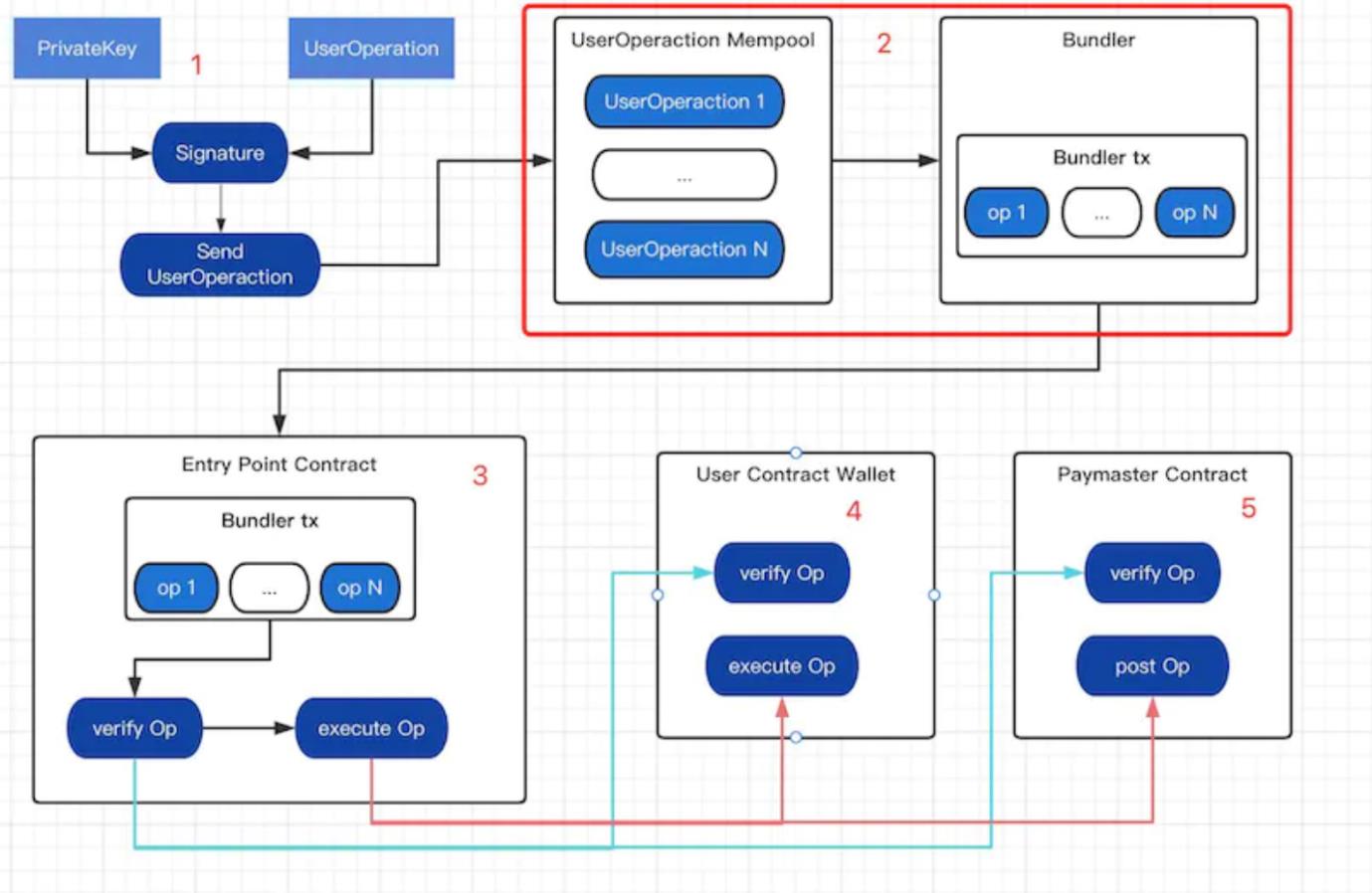
Image source: ReadON Investment Research Group
Smart contract wallets are undoubtedly major players in account abstraction. Current leading competitors include multi-sig wallet Gnosis Safe and Candide, a smart contract wallet focused on full EIP-4337 compatibility. From the diagram analysis, it’s evident that account abstraction uses Bundler + Paymaster to achieve “developer-friendly narrow-sense” intents, whereas Paradigm leverages Solver + AI to deliver “mass-user-friendly broad-sense” intents. Placing “abstraction” and “intent” within the same conceptual framework makes perfect sense—they both embody a magical blend of chaos and order.
Programmability of Intent
According to Researcher@tmel0211, programmability of intent can be summarized as: if intent isn’t programmable, programs can’t execute, automation becomes impossible, and intelligence cannot exist. How do we understand this? Intent reflects human thought and inherently carries emotional abstraction, while the recipient consists of cold lines of code and algorithms. For example, my intent is to make money—how can code and algorithms help me find an execution path? Intent-Centric is not a completely new concept but builds upon existing simplified intent designs. Below is a compilation of known Intent-Centric projects and concepts.
Known representative projects:
-
UniswapX: off-chain extension solution for intent;
-
CowSwap: off-chain extension solution for intent;
-
1inch: Fusion order matching off-chain + multi-DEX aggregator;
-
Solv Protocol: New ERC3525 standard enabling complex financial intents;
-
Unibot: Centralized server backend preset parameters, rules for automated intent;
-
OpenSea: Off-chain signing + on-chain contract combination;
Known representative concepts:
-
ERC3525 Standard: Proposed by Solv Protocol, aims to provide a semi-fungible asset standard capable of structurally describing digital assets for diverse application scenarios;
-
Abstract Account (Account Abstraction): Provides standardized account management interfaces abstracting underlying complexities of different account types, supporting features like gasless transactions and social recovery;
-
MPC Wallet: Uses private key sharding technology, splitting the private key into multiple pieces stored across separate nodes. During transactions, these nodes jointly compute signatures via secure multi-party computation protocols without reconstructing the full private key.
Overall, whether representing projects or concepts, all employ increasingly complex instructions to deliver simpler user experiences. These can be categorized into four types:
-
Centralized Intent:
Based on centralized resource matching platforms, e.g., Unibot trading bots on CEXs, Friend.tech, etc.;
-
Structured Intent:
Based on combinations of smart contracts or proxy contracts, on-chain + off-chain preprocessing, new ERC standards, and preconfigured parameters compatible with EVM execution;
-
Distributed Intent:
Based on novel blockchain architectures featuring decentralized Solver + Executor models, creating new markets for executing complex user intents;
-
Intelligent Intent:
Based on AIGC as input/output carrier, leveraging AI trained across the DeFi domain to program and execute complex user intents.
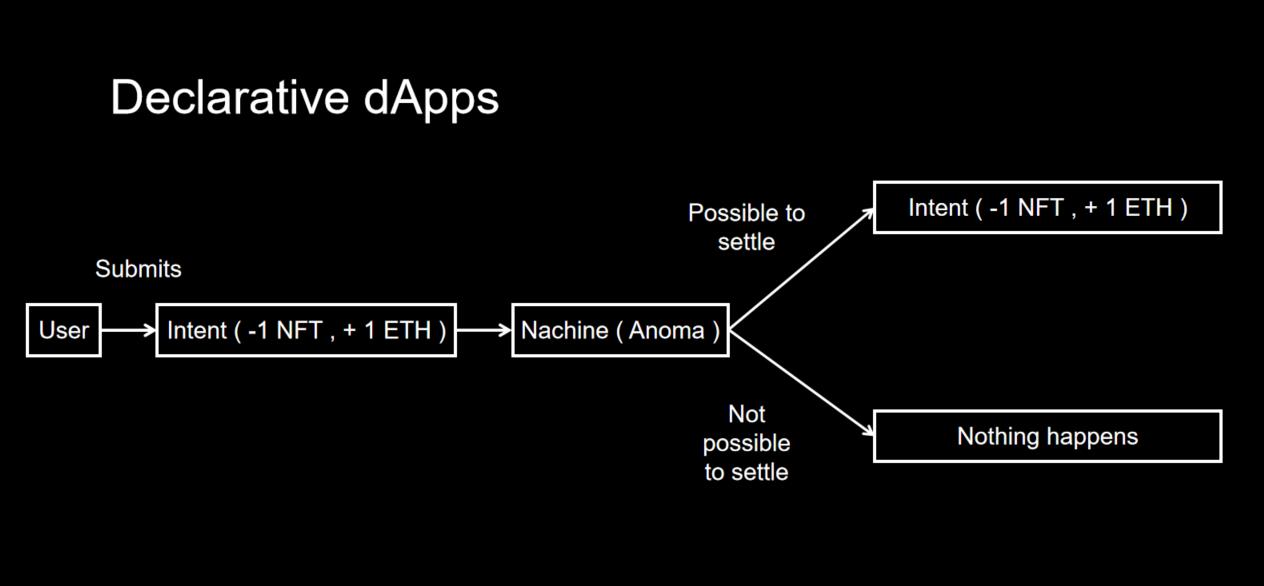
Image source: Researcher@tmel0211
MEV
Maximal Extractable Value (MEV) refers to additional profits miners gain by adding, removing, or reordering transactions—enabling arbitrage on DEXs, front-running, back-running, liquidations, sniping bots, time-bandit attacks, sandwich attacks, etc.—which harms regular DeFi users. More specifically, Ethereum transactions are ordered by gas price—high gas prioritized, low gas delayed. Transactions first enter the Mempool [3], awaiting inclusion in blocks. Validators extract transactions from the mempool and add them to the next block. Because the mempool is public, searchers can pay validators to arrange transactions in specific orders, extracting value from users—hence the term MEV miner profit. Since Intent-Centric architectures involve outsourcing transactions to third parties, MEV generated during transaction processing remains a critical concern.
The most direct impact of MEV: harming the overall network while competition increases market efficiency.
-
Unequal capital distribution (large holders owning more ETH stakes) may lead to validator centralization (larger staking pools earning higher MEV revenue), reducing overall network security. Although mitigation measures have had some effect, the centralization risks stemming from block-building rights remain unresolved;
-
To increase chances of transaction inclusion, competing MEV searchers bid high gas prices for priority, congesting the public mempool due to high-fee searcher transactions. Yet, DEX arbitrage and lending liquidations help DeFi markets reach equilibrium faster, maintaining stability.
MEV is an unavoidable and crucial topic the industry has explored for years. Ongoing efforts seek to mitigate its negative impacts. This article will elaborate further in the next chapter, “General Solutions for Implementing Intent.” According to EigenPhi data as of September 15, 2023, on-chain MEV profitability still offers substantial gains—post-merge Ethereum nodes using Flashbots alone have earned over 200,000 ETH. This represents a massive pie of value distribution.
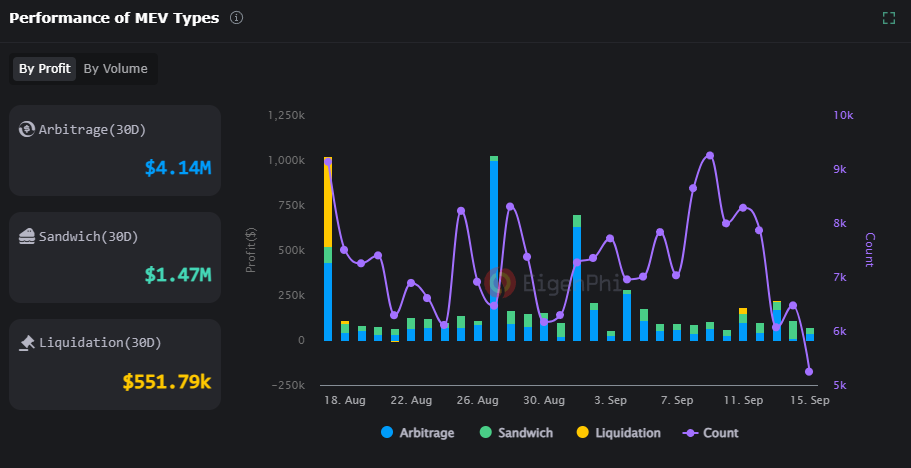
Image source: EigenPhi | MEV Data
Cross-chain, Sequencers, and Oracles
Intent-Centric is a vast system architecture. As per Paradigm’s explanation, Intent-Centric encompasses the entire blockchain domain—massive asset transfers between various Layer1s and Layer2s must be streamlined via intent handling. Today’s industry evolution has brought us into a multi-chain era, where each chain is an island connected by bridges. Thus, cross-chain connectivity and sequencers are essential bridging components for fulfilling intents.
Given the thriving Ethereum Layer2 ecosystem, today’s mainstream “Big Four”—Arbitrum, Optimism, zkSync, Starkware—are showcasing their own Layer3 narratives, OPstack and ZKstack respectively. A common challenge facing current Layer2s is the centralized sequencer issue. Though actively seeking solutions, there lies a huge revenue opportunity here. Taking OPstack as an example, its profit model can be simply viewed as “renting storefronts”: Layer2 profit = Layer2 gas revenue + MEV revenue - Layer1 gas cost. Achieving intent objectives necessitates unavoidable tolls between Layer2 and Layer1.
Turning to cross-chain bridges, the prosperity of Layer2s initially highlighted the attractive profits of sequencers, but cross-chain revenues are equally significant. Cross-chain bridges are indispensable for connecting isolated chain islands. As foundational infrastructure, beyond meeting normal users’ cross-chain demands during bear markets, speculative “airdrop farmers” generate real cross-chain demand driven by anticipated token drops. Thriving DApp applications will gradually erode profits from convenient centralized exchanges. However, a notable concern is bridge security. According to hacked.slowmist official data, from June 29, 2021, to September 16, 2023, the cross-chain bridge ecosystem suffered 38 public security incidents, cumulatively losing up to $2 billion. Overall, gas fees involved in implementing intents are inevitable. However, this article temporarily refrains from discussing sequencer and bridge security—though they warrant close attention.
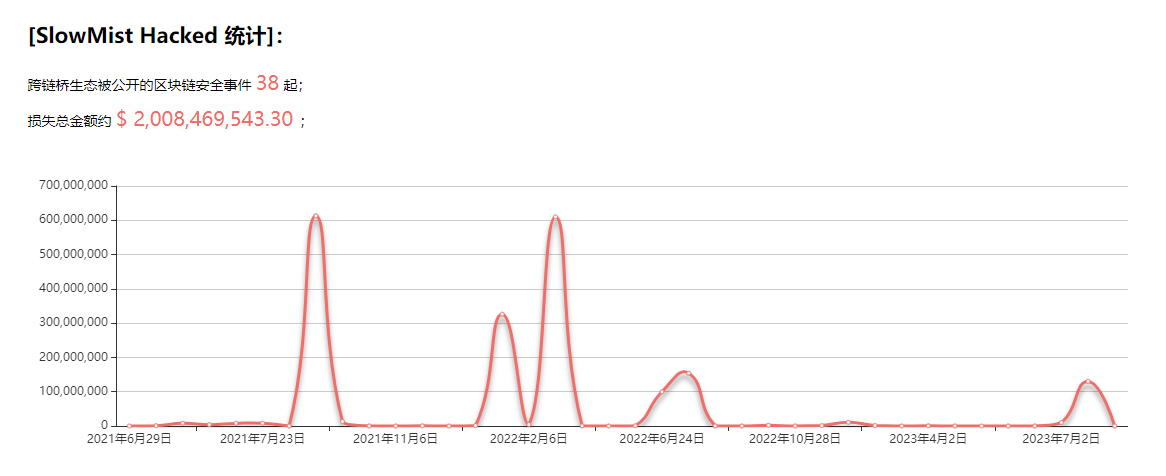
Image source: hacked.slowmist
Regarding oracles, from a macro perspective, blockchain’s strong financial attributes make it a deterministic system environment. Despite years of RWA narratives, blockchain cannot access real-world off-chain data—only on-chain data—because virtual machines (VMs) prevent smart contracts from making network calls. Hence, smart contract executions must yield consistent results, rendering blockchain data closed to the outside world.
Zooming into micro perspectives, oracles are vital in the DeFi world. Although protocol security usually inherits from the underlying smart contract network, normal operations still depend on oracles. If a protocol’s oracle is attacked or compromised, the entire protocol becomes manipulable. Modern DeFi prefers defining itself as “primitives,” encouraging teams to build products or composite protocols atop them. However, iterative development introduces upgraded operational logic for emerging DeFi composites to support larger ecosystems, bringing external dependencies and unforeseeable correlated risks.
After years of growth, the DeFi sector has cumulatively lost billions in thefts. For instance, in March this year, Euler Finance suffered a hack resulting in losses exceeding $200 million. It allowed users to post collateral and borrow funds. The vulnerability lay in a specific function lacking proper safety checks, enabling users to violate core market invariants (e.g., Uniswap’s invariant: tokenBalanceX * tokenBalanceY == k). Similarly, derivative protocols relying on oracles for pricing, lacking internal price discovery mechanisms, are vulnerable to lagging or stale prices—severely limiting scalability and user experience. This explains how trader Avraham Eisenberg successfully attacked Mango Markets, draining $116 million from the cryptocurrency exchange.
In summary, the dark forest laws of blockchain abound with unknown risks. Realizing the vision of Intent-Centric architecture still requires a long journey ahead.
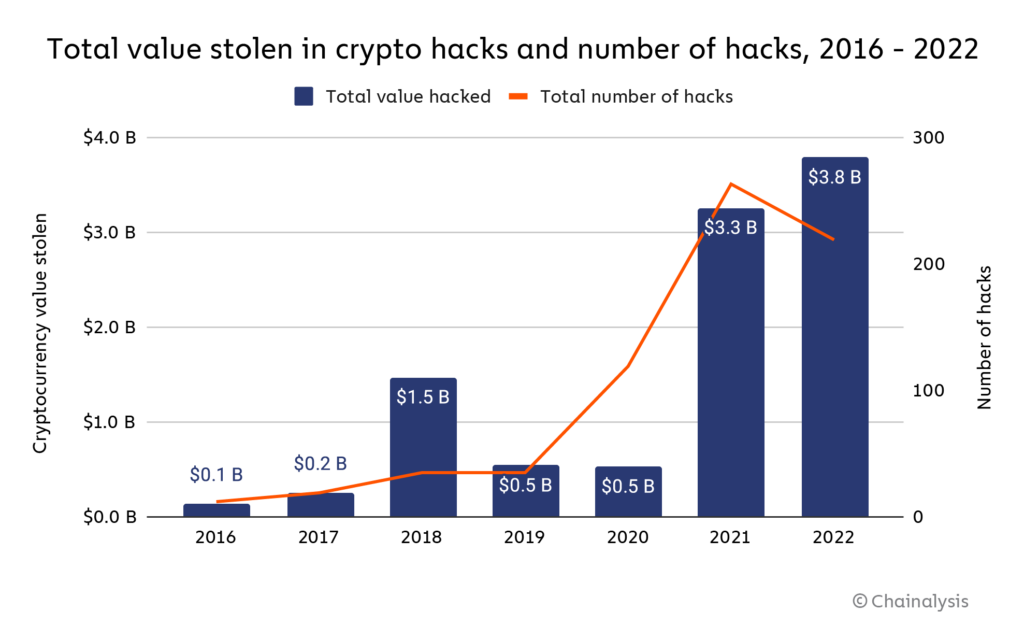
Image source: Chainalysis
Aggregators and Gas
Aggregators directly aim to save users the trouble of finding optimal transaction routes and yield strategies. They come in many forms: trade aggregators, information aggregators, yield aggregators, liquidity aggregators, asset management aggregators. Intent-Centric architecture inherently involves some degree of centralization. Various aggregators might assist parsers in efficiently identifying execution paths during intent resolution, providing a form of “reference answer.”
Gas is an indispensable toll fee for executing transactions. Optimizing gas fees remains a perennial industry discussion. Currently, optimizations mainly focus on product-side enhancements, account abstraction wallets, and DeFi protocols. Could future integration of aggregators, account abstraction, and DeFi protocols create entirely new product paradigms for superior gas optimization? We shall see.
Wallet Authorization
First step in DApp interaction: wallet authorization. Let’s revisit transactions themselves. The goal of Intent-Centric architecture is to simplify transactions and lower user thresholds. Yet, each intent involves numerous authorization signatures. Safely and conveniently resolving authorization issues is another consideration—perhaps account abstraction and dappOS V2 discussed below offer promising solutions.
General Solutions for Implementing Intent
Anoma
Image source: Anoma Official
Overview:
According to a May 31, 2023 CoinDesk report, Anoma Foundation has successfully raised $25 million from 14 investors including CMCC Global and Electric Capital. The project introduced its intent architecture in an August 2022 whitepaper: the Intent Gossip Layer (gossip here translated as “propagation,” sometimes interpreted as “gossip”) propagates intents, discovers counterparties, and matches execution paths. Its design serves as a default validation path—where all gossip messages are signed by originating nodes, forming a traceable signature chain back to initiators. This feature is particularly important for censorship resistance and defense against DoS attacks (Denial-of-Service attacks, methods disrupting legitimate users’ access to target networks or websites). Therefore, Anoma is indispensable in realizing Intent-Centric systems.
Initially developed on Tendermint using Byzantine Fault Tolerance (BFT) consensus, Anoma later transitioned to Heliax’s PoS (Proof-of-Stake) consensus mechanism called “Typhon,” enabling consensus partitioning across independent chains. The team has successively developed Taiga (a private state transition framework integrating the Intent Gossip Layer and matching layer), Typhon (consensus mechanism for atomic cross-chain transactions), MASP (Multi-Asset Shielded Pool), Vamp-IR (arithmetic circuit language), Juvix (smart contract programming language), advancing experimentation in cryptography and distributed systems.
Continuing from the earlier “Programmability of Intent” section, achieving the Intent-Centric architectural vision requires indispensable capabilities: programmable algorithm structures and counterparty discovery. These must be built upon highly interactive, multi-application foundations. Hence, we introduce Anoma—a full-stack decentralized application unified architecture—to collectively establish paradigms for building decentralized applications.
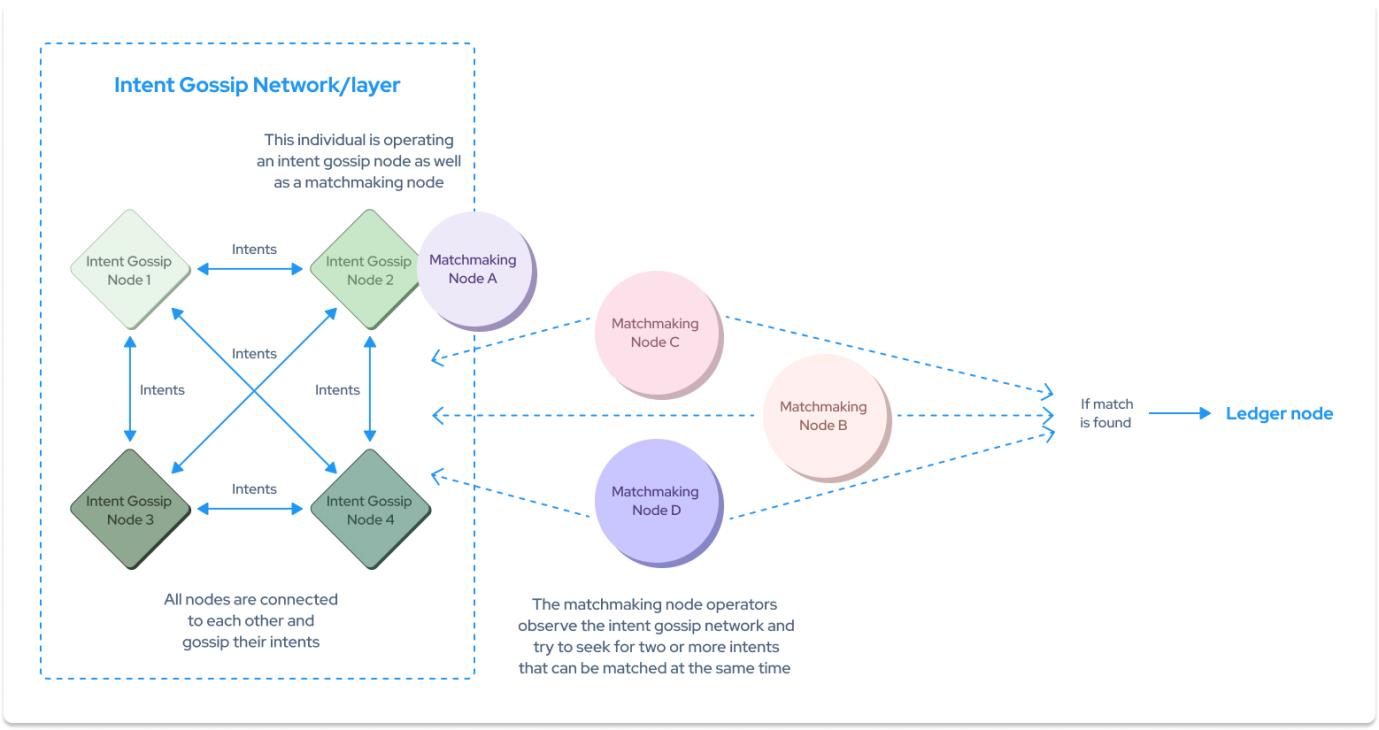
Image source: Anoma
Architectural Design and Innovations:
-
Private Payments
To protect user privacy and prevent data tracing, sender, receiver, amount, and asset denominations are all encrypted, using zero-knowledge proofs (zk-SNARKs) to ensure fund transfers. Its unique advantage lies in allowing all assets to share a single shielded pool (MASP), providing composable asset protection and increasing user anonymity sets—rather than shielding each asset separately. With more participants, more assets, and more frequent transfers, asset transfer data becomes significantly more obscured;
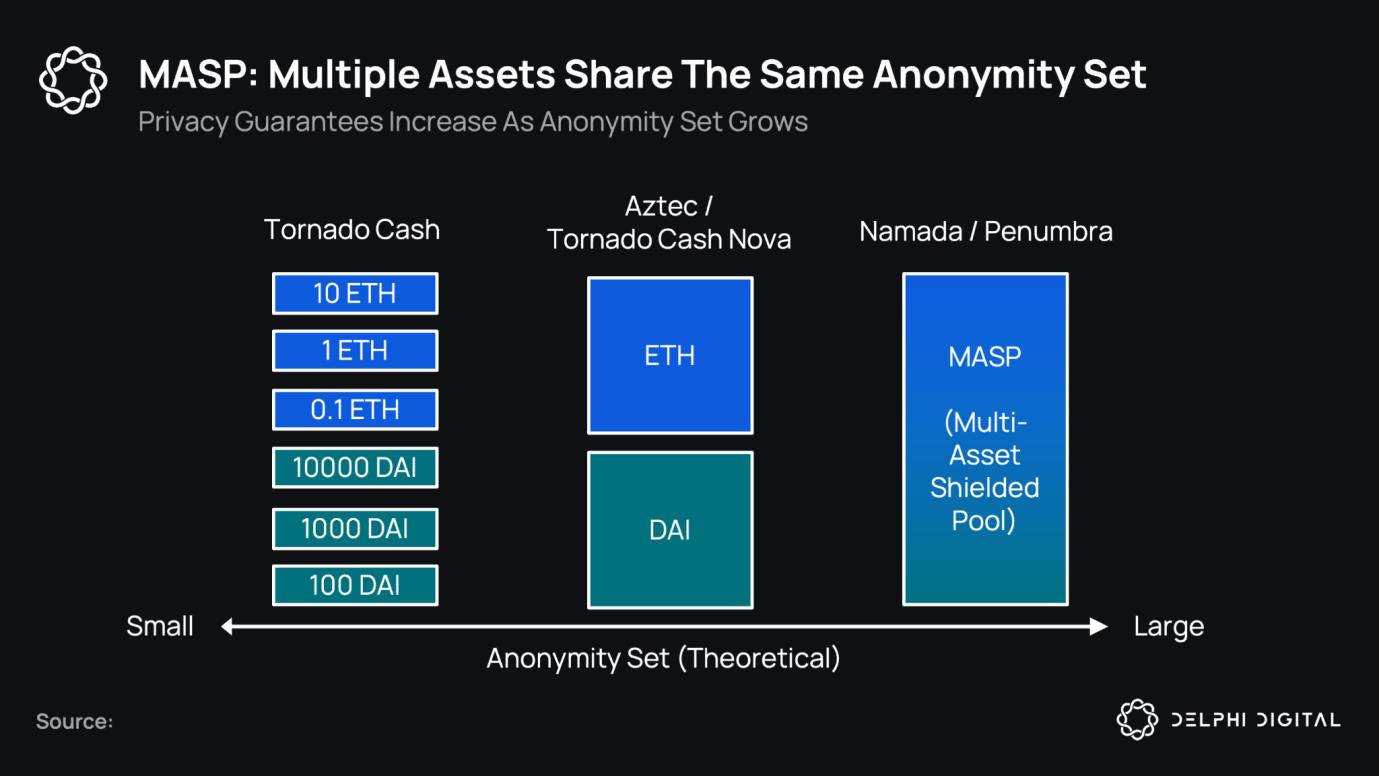
Image source: Delphi Digital - Delphi Creative
-
Barter Trading
The project repeatedly emphasizes its “barter” exchange plan, inspired by ancient barter trade. Simply put, it’s goods-for-goods exchange without a medium, no cash involved. Participants require double coincidence: both parties must want what the other possesses, and transfer conditions must be mutually agreeable. This helps users propagate node operators’ intent operations and run matching nodes checking intent compatibility—creating and pairing relevant transactions, then sending corresponding execution ledgers. Anoma implements a digital barter scheme facilitating trades of goods, services, or digitally represented value;
-
Intent Matching System
In Ethereum’s EVM, transactions don’t mandate future states but authorize specific execution paths. Anoma includes a matching system allowing users to broadcast transaction intents via gossip. Simply put, Anoma comprises two main components: a distributed ledger and an intent matching system—they complement each other and can operate independently. By running nodes with Intent Gossip, Token Swap Solvers, and RPC servers requesting new intents, transactions are submitted from matched intents to the distributed ledger, helping users automatically discover counterparties;
-
Multi-chain Support
Anoma uses Cosmos ecosystem’s Inter-Blockchain Communication (IBC) protocol for inter-chain communication, leveraging relayers to transmit data between different blockchains—aiming to become a multi-chain privacy layer. Currently, relayers are typically operated by node operators, but anyone capable can run them and earn fees in return;
-
Fractal Scaling Solution
Anoma uses a fractal solution to tackle blockchain scalability issues, allowing users to create local instances to meet varying transaction demands. Fractals mean dividing Anoma into different application chains handling distinct tasks—each Anoma app chain highly customizable for scale and user growth (similar to scaling via IBC protocol support). Future security enhancements will come from IV Interchain Security, IV Mesh Security, and IV Interchain Alliance projects.
SUAVE
Overview:
On July 25, 2023, news reported that Ethereum infrastructure service Flashbots secured $60 million in Series B funding at a $1 billion valuation to develop the SUAVE platform. SUAVE (Single Unified Auction for Value Expression) separates the mempool and block-building functions from existing blockchains, forming an independent blockchain network (ordering layer), offering highly specialized plug-and-play alternatives [4], aiming to resolve MEV-related challenges through infrastructure.
Although SUAVE is a new blockchain, it is not a general-purpose smart contract platform competing with Ethereum or any participating chain. If Anoma is building a blockchain centered on intent, SUAVE constructs intent-centered infrastructure.
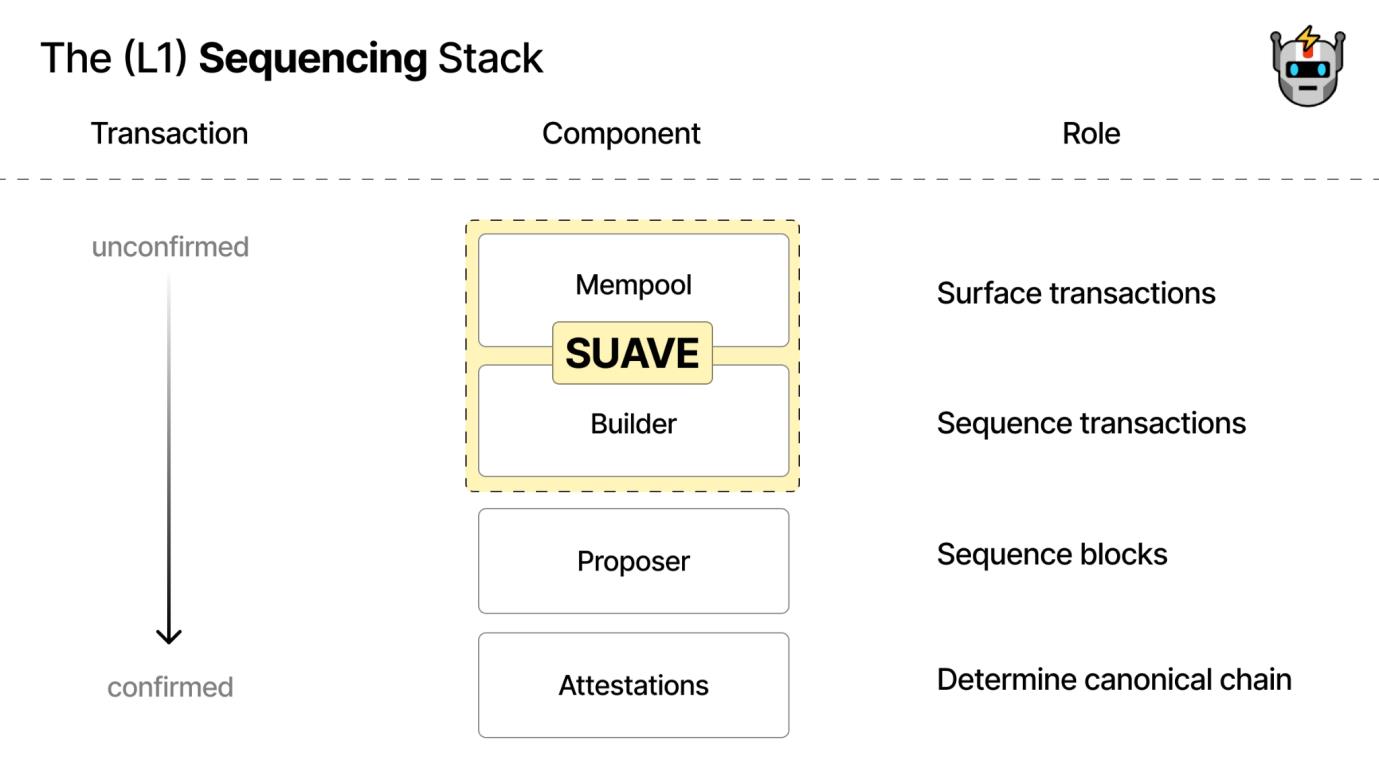
Image source: SUAVE in the blockchain stack
Three Goals of SUAVE:
-
Illuminate the Dark Forest:Expose unfair events in today’s opaque MEV ecosystem, quantify their impact, and break down information silos among participants;
-
Democratize Mining:Achieve integration between miners and searchers in an open manner, maximize competition among stakeholders, freely open to all miners, preventing MEV centralization and monopolization;
-
Value Distribution:Return MEV to those who created it—the Ethereum users.
According to SUAVE’s intent solution, handling external transactions (e.g., from Ethereum) requires cross-chain settlement. It can attempt to resolve various risks within EVM—similar to the past successes of MEV-Geth and MEV-Boost in decentralizing MEV. However, it should be noted that during intent fulfillment, users deposit funds into SUAVE, and during the unlocking process, SUAVE’s smart contracts require asset verification involving oracles. Thus, to some extent, SUAVE also faces all current cross-chain bridge risks.
From SCW & AA to SUAVE & Intent-Centric:
Recalling the earlier “Account Abstraction (AA)” section, consider the primary benefits of account abstraction: key recovery, gasless payments, multi-signature authorizations, batch transfers in a single transaction, fee caps, etc. Overall, account abstraction perfectly combines advantages of regular accounts (EOA) and smart contract accounts (CA).
SUAVE’s vision is to become a shared ordering layer across various chains (including cross-chain transactions and MEV). Therefore, when user intents involve cross-chain asset transfers, combining strengths of account abstraction (AA) and multi-signature smart contract wallets like Gnosis Safe (SCW), together with SUAVE’s EVM solutions, may represent a theoretically optimal approach today.
CoWSwap

Image source: CoW Protocol
Overview:
If choosing the project closest to Intent-Centric architecture, CoWSwap would certainly rank high. Unlike other protocols, users only need to send a signed order, delegating transaction execution to a network of solvers who complete trades off-chain (no need to specify execution paths). Off-chain signed orders are executed after solver matching (similar to Bob Solver mentioned earlier but different). Due to solvers’ “batch bundling” privilege, gas fees are borne by solvers—users pay nothing if transactions fail.
CoWSwap Hooks:
Does Hooks remind us of Uniswap V4? But their actual functionalities differ significantly. CoW Hooks link transactions, bridging, staking, deposits, etc., executing before/after order executionand executing transaction sequences as a single transaction.
Join TechFlow official community to stay tuned
Telegram:https://t.me/TechFlowDaily
X (Twitter):https://x.com/TechFlowPost
X (Twitter) EN:https://x.com/BlockFlow_News
 @YBBCapital