








What is "e/acc," the new thing Silicon Valley elites are all chasing?
TechFlow Selected TechFlow Selected
What is "e/acc," the new thing Silicon Valley elites are all chasing?
To some extent, "effective acceleration" is a technologically utopian idea.
 Navigating Web3 tides with focused insights
Author: Juny
If you follow the Silicon Valley tech scene, you may have recently started noticing a new term popping up from time to time—“e/acc”.
Particularly in AI startups and investment circles, “e/acc” seems to have emerged as a powerful new intellectual movement—not only becoming a popular topic of casual conversation but also rallying support from many prominent industry figures.
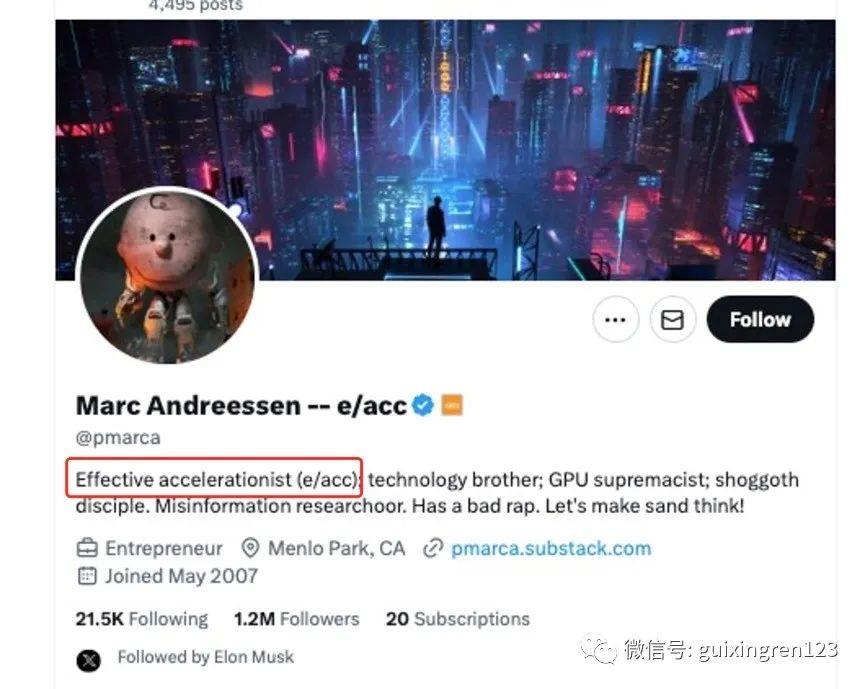
For instance, Marc Andreessen, founder of A16Z, and Garry Tan, CEO of YC, were among the first to add “e/acc” as a suffix to their social media profiles. On communities like Reddit and Spaces, discussions are heating up, and a quick search for “e/acc” on platforms like Twitter (now X) reveals that many users have already appended these letters to their names.

So, what exactly is “e/acc”? What does this concept have to do with AI, and why has it suddenly gained popularity?
01 The Rise of "Effective Acceleration" Amid the AI Boom
First, what does this strange combination of letters—"e/acc"—stand for?
E/acc is short for "Effective Accelerationism," a philosophical ideology that integrates biological, physical, economic, and social theories, emphasizing adaptability, evolution, intelligence, and acceleration as universal principles in the universe.
Sounds confusing? In practice, you just need to remember that the defining feature of "effective acceleration" today is its emphasis on technological innovation as a driving force for societal transformation.
"Effective Accelerationism" isn't a rigorously proven theory. Its conceptual roots are widely attributed to British conservative philosopher Nick Land, who introduced an abstract version of accelerationism back in 2018. Around May of last year, however, several Twitter users began collaboratively drafting definitions and principles of "effective acceleration," publishing them on Spaces and Substack communities.
They argue that technology is advancing with unstoppable momentum, and the core idea of e/acc is that in the technological age, society should maximize innovation and technological power to drive change.
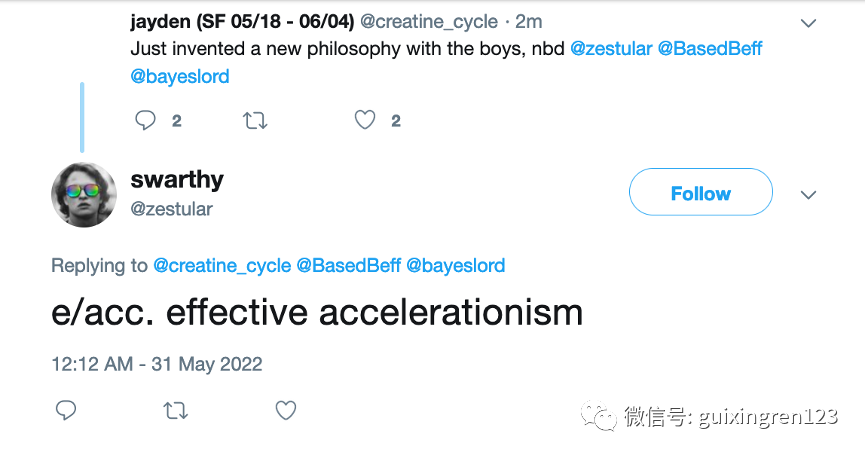
Notably, when e/acc was first conceived, ChatGPT had not yet been released, and artificial intelligence was still in a so-called "winter period." Yet the early proponents presciently emphasized the importance of AI to effective acceleration, viewing AI-driven progress as one of the most powerful engines for accelerating societal development.
Just months after e/acc emerged, generative AI exploded into public consciousness, drawing increasing attention to the concept and imbuing it with more concrete and immediate relevance.
In many ways, "effective acceleration" is a techno-utopian vision.
To followers of e/acc, no innovative idea that offers potential value should be dismissed—even if it currently seems absurd, far-fetched, or distant. They believe all imaginative technologies that promise to benefit humanity deserve support and could eventually become reality.
As one definition of e/acc puts it: "Technology can lead the next evolution, creating incredible new forms of life and silicon-based consciousness." This explains precisely why e/acc has surged in popularity now—because generative AI represents exactly the kind of disruptive technology they’ve long anticipated.
Zooming in further on artificial intelligence, “e/acc” can be seen as an unequivocal endorsement of accelerating the arrival of Artificial General Intelligence (AGI). It rests on several key tenets:
First, the advancement of AI technology is inevitable. Rather than trying to slow it down, we should unite to amplify its positive impacts while minimizing negative consequences.
Second, AI technology should be democratized—it must not be monopolized by a few individuals or corporations. The more people involved in its development, the better.
Third, AI has the potential to bring transformative leaps in social innovation, productivity, global stability, and economic prosperity. Despite certain risks, pursuing AGI as quickly as possible is an essential step forward for human civilization.
At a time when AI risk debates dominate discourse, the firm stance of “e/acc” in favor of technological advancement—and its optimistic societal vision—has resonated strongly with influential figures. For example, Marc Andreessen, co-founder of Silicon Valley venture capital firm A16Z, clearly identifies himself as a “supporter of effective acceleration” in the very first line of his Twitter bio.
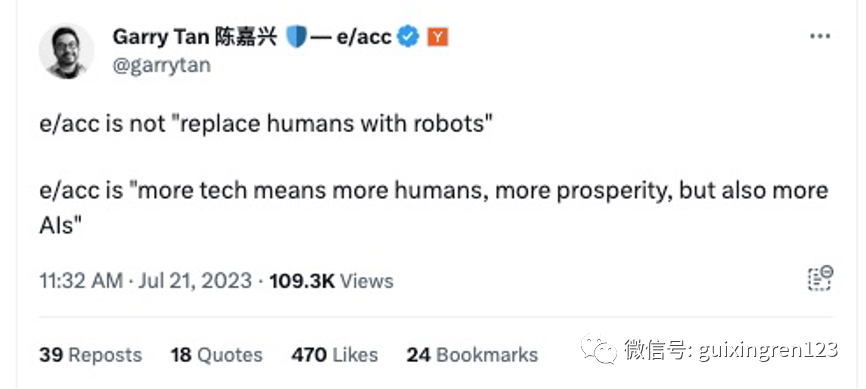
Garry Tan, head of YC, has also recently published multiple posts explaining his support for the e/acc ideology.
Garry Tan argues that concentrating technology in the hands of a few is dangerous; instead, more people must participate in and access this technological wave. Open-source development and accelerated innovation, he believes, are the right path forward.
He wrote, “e/acc doesn’t mean replacing humans with robots. e/acc means more technology will lead to more humane outcomes, greater prosperity, and more AI.”
Currently, San Francisco is considered the epicenter of e/acc thought, and supporters believe e/acc will, in turn, transform San Francisco itself.
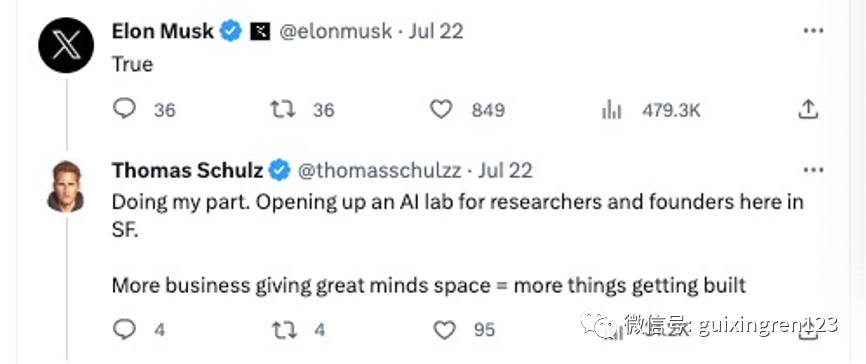
One netizen suggested that the most “e/acc” thing to do right now is to use it to revitalize San Francisco—helping create a breeding ground for new ideas and ushering in a golden era unlike anything the city has ever seen. The plan would begin by establishing AI research labs in San Francisco for researchers and founders, providing space for more businesses and groundbreaking ideas, enabling more innovations to be built there.
Elon Musk endorsed this view, replying “True” beneath the post.
02 From "Effective Altruism" to "Effective Acceleration": Shifting Ideological Ground from Web3 to AI
In fact, before “effective acceleration,” there was another overlapping, earlier concept known as “Effective Altruism.”
Originating around the year 2000, “Effective Altruism” is a philosophy and social movement advocating the use of scientific and rational methods to solve humanity’s most urgent problems. It encourages individuals to deploy their resources—time, money, careers—in the most impactful way possible to maximize positive social outcomes. In simple terms, it’s about leveraging personal assets to benefit humanity at large, with key causes including pandemic prevention, nuclear disarmament, environmental protection, and space colonization.
Previously, many notable tech figures supported Effective Altruism, including Facebook co-founder Dustin Moskovitz and Patrick Collison, CEO of the world’s second-largest unicorn Stripe. These individuals have collectively donated hundreds of millions of dollars to the cause. Many of Elon Musk’s ventures are also seen as embodying clear “effective altruism” principles.

Originally, “Effective Altruism” was clearly a positive concept, but over the past two years, it has come under scrutiny due to the downfall of Sam Bankman-Fried (SBF), founder of the FTX exchange.
SBF was one of the most vocal and prominent advocates of effective altruism. Before his collapse, he publicly pledged to donate the vast majority of his wealth to effective altruism causes over the next 10–20 years. Within the Web3 community, the principle of effective altruism一度 became highly fashionable, attracting many young followers and true believers.
But following SBF’s downfall, questions arose about the limitations of the “effective altruism” framework. Critics argue that SBF essentially stole from and sacrificed some people’s interests to fund his idealistic goals—a pattern mirrored by many other Web3 adherents. In essence, they harvested others’ investments, used part of the proceeds for charitable causes, and still lined their own pockets.
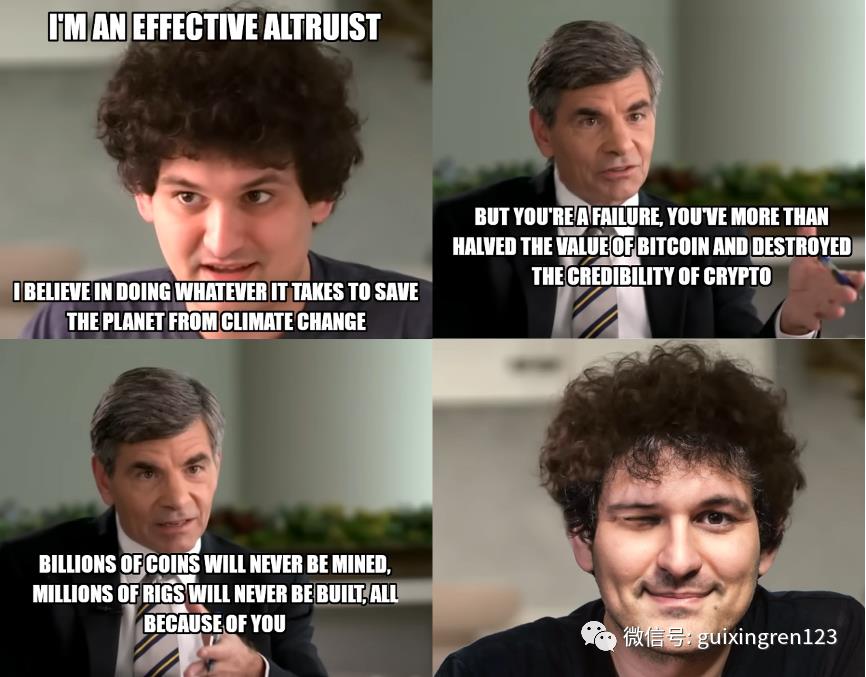
Overall, the concept of “Effective Altruism” is broad and lofty, and its overtly philanthropic tone has made it controversial. By contrast, today’s “Effective Acceleration” is more specific and focused.
Like “Effective Altruism,” “Effective Acceleration” starts from the premise of human well-being, but differs in its path—emphasizing technological innovation as the primary driver. Moreover, rather than urging people to donate money or time directly to charity, e/acc encourages participation in technological progress through various forms.
The e/acc philosophy resonates deeply with many AI enthusiasts today. Over recent months, growing numbers of AI fans have rallied around the term “e/acc” to express their support for accelerating AGI, adopting it as a theoretical banner against prevailing “AI doom” narratives.
Yet, is it truly beneficial for humanity’s future to remove all constraints on technology and allow it to grow unchecked? Will such unregulated growth lead to a fairer, better world? Do you agree with e/acc?
Join TechFlow official community to stay tuned
Telegram:https://t.me/TechFlowDaily
X (Twitter):https://x.com/TechFlowPost
X (Twitter) EN:https://x.com/BlockFlow_News


