








ERC-4337 Use Case Overview: 18 Projects Funded by the Ethereum Foundation
TechFlow Selected TechFlow Selected
ERC-4337 Use Case Overview: 18 Projects Funded by the Ethereum Foundation
The passionate and talented individuals driving these projects are at the heart of this funding round's success, demonstrating a deep understanding of Ethereum's ethos and a commitment to pushing the boundaries of what's possible.
 Navigating Web3 tides with focused insights
Author: ERC-4337
Compilation: TechFlow
The ERC-4337 Account Abstraction Grant Program has successfully concluded. This grant initiative will support 18 teams building diverse projects around ERC-4337 (also known as account abstraction).
Each team's project uniquely aligns with the goals of the ERC-4337 AA grant, and we believe the outcomes of these efforts will ripple across the entire ecosystem, sparking new ideas and collaboration opportunities.
At the heart of this round’s success are the passionate and talented individuals driving these projects forward—individuals who demonstrate a deep understanding of Ethereum's ethos and a commitment to pushing the boundaries of what’s possible. The grantees in this cohort bring diverse skills and experiences, united by a shared dedication to advancing Ethereum’s capabilities.
To learn more about each project and its leading team, we’ve compiled overviews provided directly by the teams themselves (listed in no particular order). As these projects progress, we eagerly anticipate their developments and their potential impact on Ethereum’s evolutionary trajectory.
ZeroDev Kernel
ZeroDev Kernel, or simply Kernel, is a smart contract account built from scratch with the following features:
-
AA Wallet - Kernel is compatible with ERC-4337;
-
Efficient - We place strong emphasis on optimizing gas usage;
-
Modular - Kernel can be extended via "plugins".
Plugins are smart contracts that customize account behavior. We recognize that it’s impossible to predict all user needs for smart contract accounts, especially as users interact with many different dApps. Therefore, the only solution is to make accounts extensible, allowing users to add new functionality to their accounts over time.
As of this writing, Kernel is the most widely used AA account across all major EVM networks (Ethereum/Polygon/Arbitrum/Optimism/Base). Kernel is a project by ZeroDev, which provides infrastructure and tools for developers integrating AA.
Etherspot’s Skandha Bundler
ERC-4337 introduces a separate mempool specifically designated for activities executed by account abstracted wallets. Additionally, it proposes a novel concept called the “bundler,” which bundles user operations into traditional transaction frameworks. This bundler-driven approach enables execution and implementation of account abstraction without altering the underlying protocol, laying the groundwork for future seamless integration. In this context, the importance of the P2P interface within the bundler becomes evident. By integrating a P2P interface, user operations received by a specific bundler will propagate across all interconnected nodes. Thus, even if a particular bundler behaves maliciously or engages in transaction censorship, these user operations can still be processed by other bundlers within the network.
The Etherspot team has helped the Ethereum Foundation develop the specification for a shared mempool protocol and is piloting the implementation of the shared mempool (P2P interface) using Etherspot’s bundler. Etherspot’s bundler, named Skandha, is already available on six testnets and eleven mainnets, including Ethereum, Polygon, Optimism, Arbitrum, Fuse, Mantle, Gnosis, Base, Avalanche, BNB, and Linea.
MynaWallet
MynaWallet is a contract account integrated with Japan’s government-issued ID card (Myna Card), currently held by approximately 100 million residents. MynaWallet enables users to seamlessly conduct token payments, transfer or receive NFTs, and execute any supported transactions—all without needing to be aware of cryptocurrency.
This has the potential to bring cryptocurrency access to the majority of Japan’s population. If this initiative sets a precedent that inspires other countries to conduct similar experiments—linking national identity infrastructure to Ethereum and introducing their citizens to crypto—we would be thrilled.
Blocto: AA Support for web3.js
We believe our Web3.js project not only aligns with the goals of the ERC-4337 AA grant but also plays a vital role in the broader landscape of dApp development.
To advance ERC-4337 adoption, we have decided to expose 4337-specific RPC methods through Web3.js, such as sendUserOperation, estimateUserOperationGas, getUserOperationByHash, getUserOperationReceipt, and supportedEntryPoints.
By doing so, developers can use these methods to focus on what truly matters: building amazing dApps. For instance, if dApps wish to offer a better user experience, they can switch their call method from sendTransaction to sendUserOperation, provided the wallet provider supports this feature.
Blocto firmly believes that simplifying these processes fosters the growth of a supportive dApp ecosystem and ultimately ushers in a new era of decentralized applications that prioritize both developers and users.
Silius
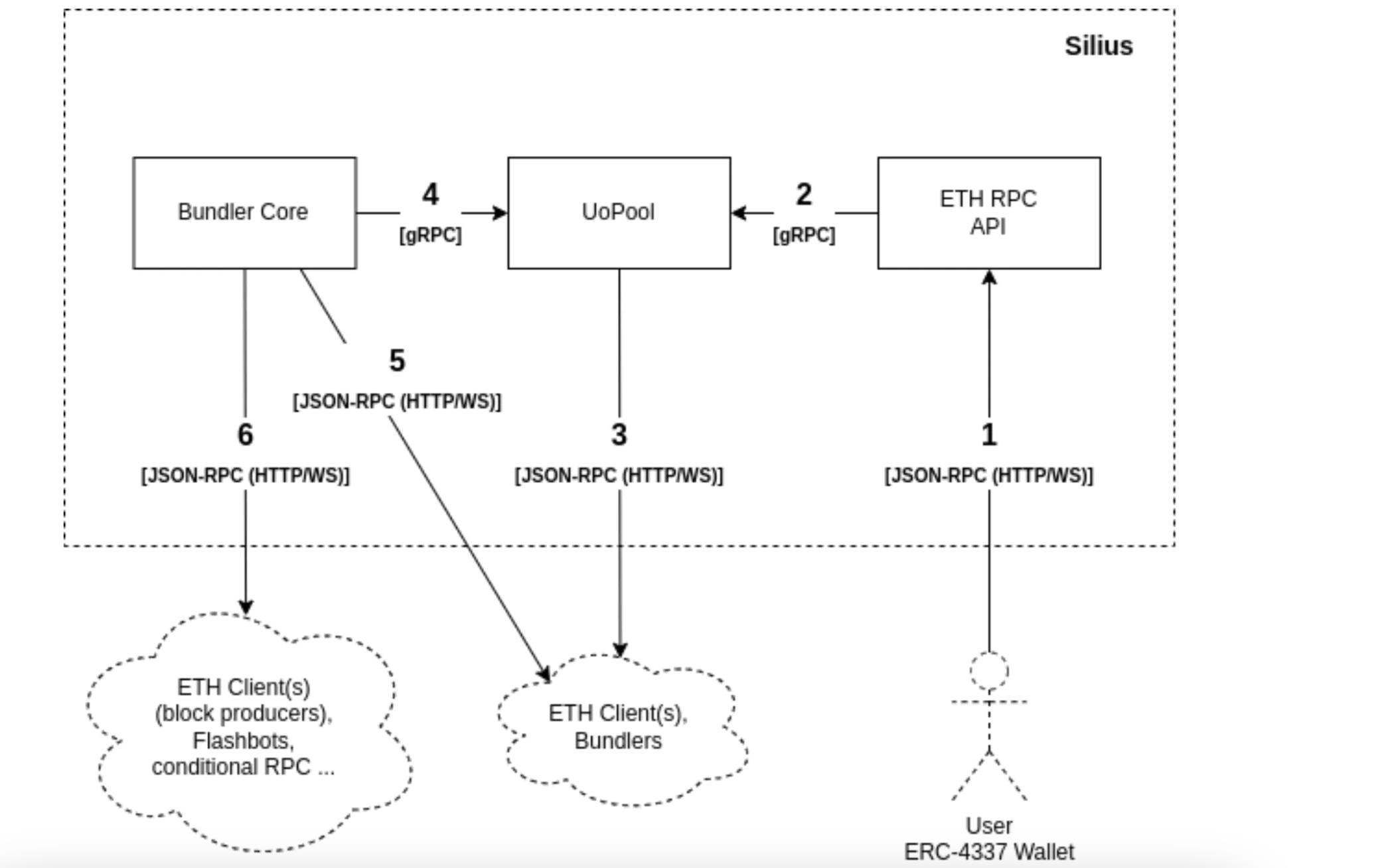
Silius is a modular and efficient Rust-based implementation of an ERC-4337 bundler. The project fully aligns with the broader ERC vision and ecosystem, stays synchronized with specification changes, and supports upcoming features like the P2P protocol and alternative mempools. The bundler’s architecture allows its core building blocks—main components and libraries—to be reused like Lego bricks in other AA projects within the ecosystem. Silius also contributes to the Rust Ethereum ecosystem by building upon and extending other Rust libraries and projects.
Schnorrkel.js
It should be emphasized that Schnorr signatures are enabled through account abstraction. Without account abstraction, every dApp would need to implement Schnorr signature handling within their contracts and explain to users and EOA wallets why they must sign two messages (ECDSA for the mempool, Schnorr for the actual transaction), making it very cumbersome. All these issues are resolved by account abstraction. Simply sign the UserOperation with Schnorr and pass it to the paymaster. Schnorr signature verification is handled by the AA smart contract. In other words, AA enables alternative signature schemes.
Why use multi-signature Schnorr?
-
Complexity is handled off-chain, making on-chain Schnorr verification extremely cheap (approximately 3k gas);
-
Privacy — on-chain, no one knows how many participants were involved, as they are represented by a single address.
QR-Seal is a fully ERC-4337-compatible Schnorr multisig wallet that uses the funded Schnorr library, with AA and paymaster functionalities implemented via Ambire Wallet contracts and Pimlico. We participated in ETH Prague Hackathon and won the award in the ETH Future category with QR Seal. This hackathon highlighted how two people can create a multisig wallet and exchange data via QR codes.
Ambire: Self-Custodial Email/Password Authentication via DKIM
Email-based registration is a viable method for onboarding new users into the crypto world, offering a familiar process accessible and recoverable via email. We aim to provide a simpler, more native way to add recovery mechanisms or transaction signing to account abstracted wallets while enhancing security. Such recovery or signing methods will improve self-custody and user experience for new users in Web3.
Such a library will reduce the workload for other developers focusing on AA solutions who want to offer more user-friendly UX applications to their users.
Moreover, we believe such applications will strongly attract new users to the Web3 world.
The library will be fully open-source and licensed under permissive terms like MIT, consistent with our current efforts in DKIM validation and email/password accounts.
Ambire is a web-based account abstracted wallet launched at the end of 2021, being the first wallet to offer self-custodial account creation via email/password authentication, powered by an underlying 2/2 multisig.
After running on mainnet and other EVM networks for a year, we believe email/password accounts demonstrate how account abstraction can make Ethereum more inclusive. We find that email-based registration is ideal for those lacking technical expertise or patience to manage seed phrases or browser extensions.
Ambire smart accounts support multiple signers. We support two types of signers: first, email/password signers; second, EOAs such as hardware wallets or browser extensions (Web3 wallets).
When using an email/password signer, Ambire creates a 2/2 multisig for you behind the scenes—one key stored on your device encrypted with your password, and another responsible for verifying email confirmation codes, stored on a backend HSM. Both keys are required to control the account, but only one is needed to initiate a time-locked recovery process.
We offer a recovery option for email/password accounts in case of lost password or email access. If only one key signs a transaction, the contract triggers a 72-hour timelock recovery. After 72 hours, the missing key in the transaction is replaced with a new key provided by the user in the same transaction.
IoTeX: ZK-Based Account Abstraction Wallet
Leveraging zero-knowledge proofs (ZKP), our ZK-based account abstraction wallet enhances and expands the potential of applications such as on-chain gaming, DeFi, DeSocial, and DePIN, establishing interoperability between Ethereum and real-world applications.
The wallet uses zkSNARKs to verify account access: if a user possesses the correct password, they can generate a valid proof via a prover to unlock the account. On-chain smart contracts then verify this proof to authenticate transactions.
Our forward-looking vision involves applying zero-knowledge proofs to multiple aspects of account abstracted wallets, including wallet operations via web2 authentication, social recovery using web2 social media status, and initializing zero-balance wallets via common web2 payment channels.
The project team consists of two senior researchers from the IoTeX team.
SixdegreeLab: On-Chain Data Analytics
The original vision of this project is to equip Web3 data analysts with the necessary knowledge and skills to adapt to the changes in Ethereum and EVM chain data structures caused by ERC-4337, maintaining effective on-chain data analysis. Specifically, the project will:
-
Provide several data metrics dashboards to help account abstraction practitioners understand ecosystem data conditions. Meanwhile, create an aggregated data table to assist analysts’ work.
-
Offer an educational tutorial document covering the impact of account abstraction on on-chain data analysis, accessible to Web3 data analysts, enabling them to adapt to new data structures and conduct effective on-chain analysis in Web3.
-
As more participants enter account abstraction—including infrastructure providers, dApps, and mainstream users—we need a data-driven report illustrating current ERC-4337 adoption trends.
By addressing the impact of ERC-4337 on on-chain data analysis and exploring native account abstraction mechanisms in other Layer2 and EVM chains, this project can provide valuable insights and resources for data analysts working in the Ethereum ecosystem. This, in turn, can more effectively identify and mitigate vulnerabilities and performance issues on the Ethereum platform, helping ensure its continued success and growth.
Overall, this project can help ensure on-chain data analysis remains a valuable and effective tool for the Ethereum community and contribute to the growth and success of the Ethereum ecosystem by providing insights and resources for data analysts working across Ethereum, Layer2, and EVM chains.
Jam: Picnic’s DeFi Transaction Batch Processor
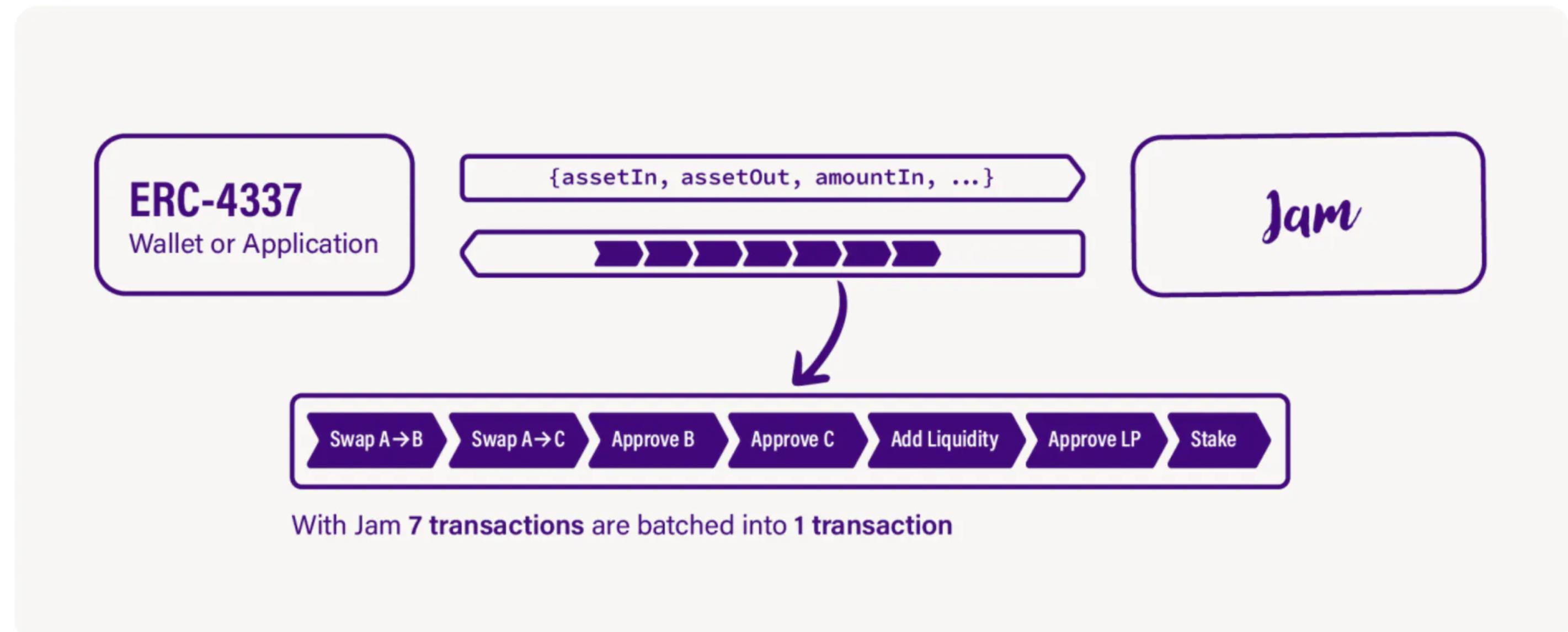
Jam is an open-source API for generating DeFi operations for ERC-4337 applications. The goal is to enable developers to easily offer various DeFi products through a simple API, while making DeFi more accessible to end users. You can ask Jam how to perform a specific DeFi operation and receive the calldata needed to execute all required steps in a single transaction.
Over the past two years, we (Picnic) have worked closely with various DeFi integrations and experienced firsthand the challenges of maintaining such infrastructure. We believe the best path forward is to transform it into a public good, and the Ethereum Foundation grant offers an excellent opportunity to coordinate with the community.
TokenSight: Multi-Factor Authentication for Account Abstraction Using WebAuthn
TokenSight aims to address issues related to on-chain smart contract wallet security, primarily focusing on two overlapping directions—creating an ERC-4337 smart contract wallet with WebAuthn devices, and providing developer tools for existing ERC-4337 wallets to integrate WebAuthn devices as a multi-factor transaction authorization mechanism.
Our approach is based on a fully on-chain, gas-optimized WebAuthn signature verification scheme, without relying on any MPC architecture, thereby offering maximum security and decentralization.
The project team consists of Nasi and Blagoj, who have years of experience in the blockchain industry. We are passionate about smart contract security and believe that providing maximum security and a seamless user experience for users’ funds in smart contract wallets is crucial for attracting the next billion users. We are currently building TokenSight, which will be the first application to use our open-source WebAuthn wallet.
ZK-Team: Team Privacy-Preserving Account Abstraction by PriFi Labs
A valuable aspect of account abstraction lies in its ability to facilitate shared ownership of accounts among team members, enabling them to transact seamlessly as a unified entity. Organizations can create an abstracted account and define predefined rules governing authorized individuals and their assigned spending limits. In a basic setup, team members’ addresses and corresponding allowances might be written directly onto the blockchain. However, this raises legitimate privacy concerns, as organizations may be reluctant to publicly disclose such sensitive information.
ZK-Team is a proof-of-concept for a privacy-preserving abstracted account that allows organizations to manage team members while preserving individual privacy. By leveraging zero-knowledge proofs, ZK-Team enables transactions that keep team members’ unique addresses and associated allowances confidential. We hope our project becomes a one-stop solution for organizations managing teams and assets, and serves as a reference for Ethereum developers wishing to protect the privacy of information stored in account abstraction using zero-knowledge proofs.
PriFi Labs is a startup based in Toronto, Canada, dedicated to researching ways to enhance security and privacy in blockchain applications.
Rhinestone: Modular Account Abstraction
Account abstraction promises enhanced security and meaningful user experience improvements without compromising Web3 principles. At Rhinestone, we believe the future of account abstraction is modular, where modules are smart contracts that extend smart account functionality, opening a new platform for permissionless wallet innovation.
However, opening smart accounts to third-party developers via modules increases the attack surface of user accounts. We are developing a standard for module registration and attestation—a mechanism to make statements about the security of these modules. This registry acts as a trust delegation mechanism, allowing smart accounts to query it before installing third-party modules, thereby increasing user security assurance.
AAA: Account Abstraction Afterhours
At AAA, it began with a simple idea—to raise awareness of AA and 4337. While we may no longer be coding hands-on, our passion for technology and commitment to mass crypto adoption remain as strong as ever. We firmly believe account abstraction is key to driving widespread adoption.
Starting from initial developer meetups, we've grown into a series of impactful events held across three continents. These events serve as platforms for knowledge sharing and community building, perfectly aligning with the goals of the ERC-4337 AA grant.
Looking ahead, we’re excited to expand our reach further. Educational videos and interactive tutorials are coming soon, empowering more people to engage with and understand crypto technology. We’re honored to be part of this journey and committed to making meaningful contributions to the crypto space.

Unpacking 4337 — A Series of Technical Articles
The author of this article series has received a grant aimed at helping understand how the components of EIP-4337 work. The goal is to reduce the time and effort required for developers and researchers to catch up and begin focusing on specific areas they wish to contribute to further.
The three topics are:
-
User Operation Lifecycle: The journey of a user operation within a bundler and the different functions the bundler calls in the entry point to validate and ultimately submit it on-chain.
-
Understanding Different Gas Parameters: Multiple gas parameters are specified at the bundler, mempool, and user operation levels (as listed below). Explaining these parameters and their implications.
-
Explaining Different Calldata Parameters: Input transaction calldata, UserOp.calldata, multi-send Txns calldata.
Hexlink: EIP-4972 – Linking ENS with ERC-4337 Accounts
Hexlink aims to provide every ENS user with an AA-compatible smart account that can be used directly via EIP-4972. With Hexlink, each ENS name can derive a unique AA-compatible smart account, deployable only by the domain owner and usable immediately for receiving cryptocurrency. Considering that most ENS names are currently controlled by EOAs, we believe this dual-account setup will facilitate migration from EOAs to smart accounts, transforming all existing ENS users into AA users and thus promoting broader AA adoption.
UniPass: OpenID Authentication Module
Account abstraction enables developers to customize validation logic and leverage various internet infrastructures for user authentication. Our UniPass team is introducing a novel user authentication solution that verifies OpenID Connect protocol ID tokens via on-chain signatures—a solution for new user onboarding and recovery using OpenID authentication.
Combined with ERC-4337, this solution offers new users the convenience of one-click OAuth login and account creation using social logins like Google and Apple. Additionally, it simplifies the recovery process when keys are lost or compromised. The project aims to build a library enabling ERC-4337 wallet developers to easily integrate OpenID authentication into their products.
Clave: Promoting secp256r1 Curve Support for AA
Despite emerging account abstraction solutions, providing better user experience without compromising security remains one of the primary challenges. The Clave team (formerly Opclave) is researching and developing tools that leverage native mobile device software and hardware solutions as signers, elevating mobile wallet UX to the security level of hardware wallets. Some objectives within this scope include:
-
Sharing research findings on leveraging Secure Enclave, WebAuthn, Passkeys, and similar solutions.
-
Providing sample code for using these solutions as transaction signers.
-
Providing sample smart contract code for handling transactions signed with these solutions.
-
Providing example account contracts managed by these solutions through integration of Solidity verifiers and precompiles.
-
Advocating for EIP-7212 to improve these solutions for efficient use within the EVM.
The Clave team includes developers and researchers who first introduced this concept at the “ETHGlobal Scaling Ethereum 2023” hackathon. Now, the team is working on delivering account abstraction-powered accounts using mobile devices' trusted execution environments as signers.
Join TechFlow official community to stay tuned
Telegram:https://t.me/TechFlowDaily
X (Twitter):https://x.com/TechFlowPost
X (Twitter) EN:https://x.com/BlockFlow_News
 @erc4337







