








Deep Dive into DeFi Options: Market Overview, Product Models, and High-Potential Protocol Analysis
TechFlow Selected TechFlow Selected
Deep Dive into DeFi Options: Market Overview, Product Models, and High-Potential Protocol Analysis
Higher capital efficiency translates into better futures pricing, lower slippage, and greater leverage opportunities, catering to the risk preferences of cryptocurrency traders.
 Navigating Web3 tides with focused insights
Written by: 0xKeyu
Translated by: TechFlow
Key Takeaways:
Given that the overall monthly trading volume of crypto options is only $40 billion (compared to about $1.6 trillion for perpetual futures), we may need another market cycle before on-chain options see significant development.
Currently, decentralized exchange (DEX) futures trading volumes account for about 2% of centralized exchange (CEX) volumes. If we assume that on-chain options will reach a similar market share as on-chain perpetuals, expected on-chain options volume would be around $800 million—likely insufficient to incentivize market makers to provide liquidity on-chain.
Derivatives leveraging concentrated liquidity LP positions could be one solution to the liquidity problem, as substantial liquidity already exists in concentrated liquidity pools. These products (Infinity Pool, Panoptic, Itos, Smilee, etc.) also offer CEXs meaningful product differentiation, such as enabling speculation on long-tail assets. Their main challenge is convincing concentrated liquidity LPs to redeploy their liquidity into these protocols.
In the long term, I am bullish on CLOB-based on-chain options protocols that initially use off-chain order book matching with on-chain settlement (similar to dYdX), gradually moving the order book fully on-chain as underlying blockchain infrastructure improves.
Overview of the Options Market
In traditional finance, options are the most widely used financial instruments. According to FIA data, global exchange-traded derivatives (ETD) volume grew 34% year-over-year in 2022, reaching an impressive 83.8 billion contracts. Options (54.5 billion) and futures (29.3 billion) accounted for 65% and 35% of total volume, respectively, with growth rates of 63.7% and 0.1%.
Contrary to TradFi, where options volume exceeds futures, current crypto derivatives volume is dominated by futures: in June 2023, ETH and BTC options volume (~$30 billion) was just 2% of futures volume (~$1 trillion). This dominance likely stems from BitMEX’s introduction of perpetual futures, which concentrate liquidity at a single expiry point, achieving higher capital efficiency than traditional futures. Higher capital efficiency translates to better pricing, lower slippage, and greater leverage opportunities—aligning well with crypto traders’ risk appetite. For emerging asset classes like crypto, capital efficiency is critical due to inherently lower starting liquidity compared to traditional equity markets. In the case of crypto options, liquidity dispersion across strike prices and expiries leads to significantly lower trading volumes than crypto futures.
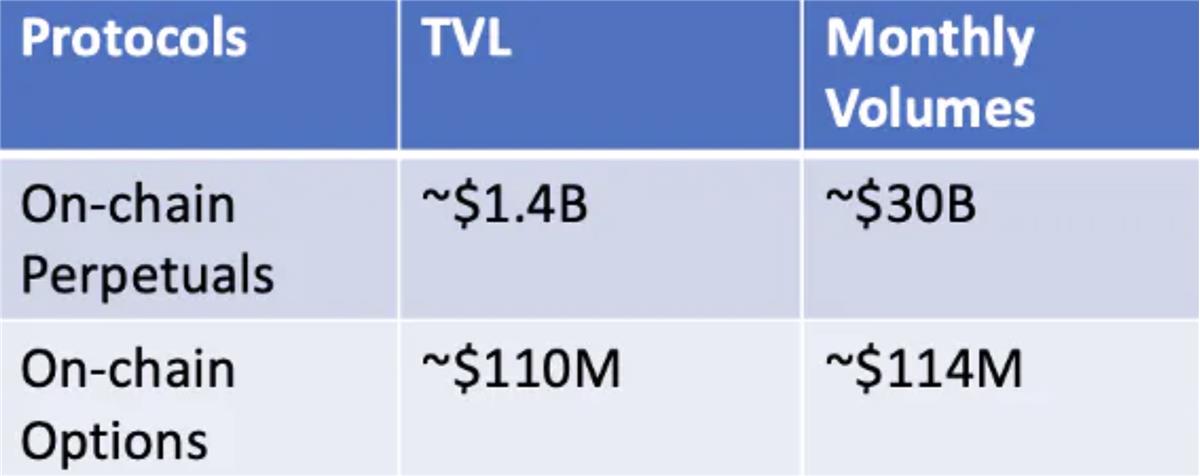
On-chain options represent only a small fraction of DeFi derivatives trading volume and total value locked (TVL).
Currently, the total TVL of on-chain derivatives protocols is approximately $1.5 billion, while on-chain options protocols hold only about $110 million in TVL—indicating a vast untapped market. In terms of volume, out of roughly $30 billion in monthly derivatives volume, DEX options account for only $114 million in notional volume (with $3.7 million in premiums). This suggests the on-chain options market remains in its infancy, with enormous potential.
Futures vs. Options
Since options grant the buyer a right—not an obligation—they must pay a premium upfront to secure this flexibility. This mechanism gives option buyers convex payoff functions (limited downside, unlimited upside), while sellers face concave payoffs (limited upside, unlimited downside). In contrast, both long and short positions in futures have symmetric payoff profiles. These differing payoff structures lead to distinct user profiles and use cases:
User Profile:
Options: Higher entry barrier; buyers: long gamma, short theta; sellers: short gamma, long theta.
Futures: Lower entry barrier (especially perpetuals, which eliminate physical delivery and expiry dates), suitable for typical crypto users seeking high leverage.
Use Cases:
-
Options: income generation (sellers), hedging, speculation, volatility exposure;
-
Futures: hedging, speculation, high leverage (for perpetuals).

Competitive Landscape

Based on their mechanisms, options protocols can be broadly categorized into five types: structured products, options infrastructure, automated market makers (AMMs), central limit order books (CLOBs), and protocols leveraging concentrated liquidity pools.
Structured products aim to generate returns for LPs through various yield strategies, often relying on options infrastructure to mint/settle on-chain options. Currently, structured products include vaults offering covered call/put positions (e.g., Ribbon, Psyoptions, etc.) and more complex yield products (Cega), incorporating exotic options along with staking, lending, and liquidity provision. Options infrastructure essentially acts as smart contract custodians allowing users to create, mint, and settle various derivatives. Options AMMs use liquidity pools to take the opposite side of traders, employing algorithms based on modified Black-Scholes formulas and supply-demand dynamics to automatically price options. Options CLOBs are markets that actively match buy and sell orders between option buyers and sellers. Protocols leveraging concentrated liquidity pools create derivative primitives by taking the opposite position of concentrated liquidity providers.
Currently, AMM-driven options exchanges dominate the majority of options trading market share, similar to early on-chain perpetual models. This is because AMM-driven options exchanges are generally easier to build and bootstrap liquidity compared to CLOB-based models. Fully on-chain CLOB options exchanges require a fast order book scanning and matching engine, which is difficult to implement on blockchains and demands significant business development resources to attract centralized market makers for initial liquidity.
As a result, most order books support only option minting and settlement, not trading—the latter typically occurring off-exchange via market maker auctions. Zeta addressed this by integrating with Serum’s order book infrastructure, checking its order book up to twice per second. However, due to FTX-related liquidity drain from Serum, all users and volume migrated to the community-forked Openbook, temporarily halting Zeta’s options trading. Another potential solution is a hybrid model with off-chain order books and on-chain settlement, exactly what Aevo is currently building. That said, given the market’s early stage, current market share isn’t indicative. As more CLOB-based models emerge and AMMs innovate further on delta-neutrality and capital efficiency, the landscape will shift dramatically. Next, I’ll outline the history of options protocols, identify key challenges they’ve faced, and improvements made.
First Wave: Barriers Faced by AMMs
Mispricing of Options: The core issue with pool-based AMM models is accurate option pricing. In traditional markets, option prices are determined by supply and demand. However, in pool-based models, there’s no real supply/demand dynamic because supply is fixed (the AMM automatically acts as the counterparty to option buyers). Thus, deriving an effective pricing model becomes the primary challenge for AMM liquidity pool designs.
The most common pricing method uses the Black-Scholes formula, factoring in asset price, strike price, risk-free rate, time to expiration, and implied volatility (IV). Of these five variables, IV is the only unobservable one—it reflects market expectations of a security’s future volatility. Traditionally, IV is derived from the supply and demand of options contracts: high demand and low supply lead to high IV, and vice versa. However, inconsistent flow of supply and demand makes IV difficult to determine on-chain. For example, in Hegic, IV is calculated off-chain and manually updated weekly. This means whether you open a $100 or $10,000 at-the-money option, the price remains identical. This is significant because unlike CLOB-based market makers who can dynamically repricing quotes based on new information, AMM LPs rely solely on embedded pricing functions within smart contracts. During volatile markets, LPs may face substantial impermanent loss when realized volatility significantly exceeds implied volatility. As shown below, most first-generation options AMMs use static volatility inputs without dynamic adjustment based on real-time trading activity.

Unhedged LP Positions: In the first wave of AMMs, protocols like Hegic, Dopex, and Premia offered poor LP experiences because collateral wasn’t hedged. This design stemmed from capital efficiency concerns, as delta hedging usually requires allocating part of the liquidity pool to go long/short based on net delta of short positions. However, this caused LPs to accumulate large exposures to the underlying asset, increasing liquidity costs and hindering pool growth.
From a trader’s perspective, they face limited choices in asset selection, strike prices, and expiries, along with inefficient pricing. Limited choices stem from constrained liquidity—broader selections would further fragment already scarce pool liquidity.
Second Wave: Improvements by AMMs
Emphasis on Delta-Neutrality to Attract Liquidity: Lyra’s Valon update introduced delta-hedged AMMs for the first time. Lyra takes offsetting hedge positions via GMX or Synthetix. For instance, when a trader opens a long ETH call position, Lyra’s Market Maker Vault (MMV) simultaneously enters an equivalent long ETH position based on net delta at position initiation. This shields MMV from potentially unlimited profits traders could make if ETH rises.
Similarly, Siren Flow introduced a delta-hedging system, partnering with Premia to hedge delta exposure for liquidity provision. Meanwhile, other AMM liquidity pool protocols attempted different solutions: Hegic, Premia, and Dopex split pools into call and put vaults, giving LPs more control over the options they underwrite. However, this approach is inferior to Lyra and Siren’s methods, as it still shifts hedging burden onto LPs and fragments liquidity.
Improved Pricing Models and Introduction of Partial Collateralization for Better UX: Compared to Hegic’s static IV issues, protocols like Lyra, Dopex, and Siren Flow implemented new strategies to enhance pricing efficiency. Lyra’s AMM core mechanism adjusts implied volatility (IV) and option cost based on market conditions. When option demand is high, the AMM increases IV; when supply is excessive, it reduces IV. This enables convergence toward market-clearing IV values for each strike and expiry.
When listing expiries on Lyra, baseline IV values and skew ratios (strike-to-IV) are initialized, derived from current market data based on 50-delta (at-the-money) strikes. After initialization, IV and skew ratios are determined by supply and demand for specific strikes and expiries. On the other hand, Siren Flow implements a hybrid on-chain/off-chain RFQ (request-for-quote) system to offer competitive pricing. This innovation allows Siren Flow to deliver pricing comparable to CEX derivatives while preserving self-custody and decentralized trading benefits. However, Siren’s reliance on CEX data for IV derivation means it cannot serve as a true price discovery platform.
Additionally, Lyra adopted an innovative partial collateralization model for option sellers, improving capital efficiency by 4–5x. Avalon allows traders to partially collateralize short positions, enabling them to sell 4–5x more options with the same capital. Partially collateralized shorts are important for two reasons: they offer option traders a more complete experience comparable to CeFi platforms, and allow AMMs to offer more efficient pricing. The main difficulty lies in calculating initial margin requirements based on various factors and establishing robust risk management systems to prevent bad debt.
CLOB: Limited Appeal So Far, But Promising Products Emerging
Following Zeta’s halt due to the FTX incident, Aevo stands out as a promising CLOB-based options exchange incubated by Ribbon, using a hybrid model of off-chain matching and on-chain settlement. Built on a custom EVM rollup, Aevo reportedly offers access to hundreds of instruments tradable across various strikes and expiries with deep liquidity. To bootstrap liquidity, beyond partnering with professional market makers, Aevo plans to integrate with Ribbon’s DOV as a settlement venue for written options. Currently, Ribbon generates around $30 million in monthly volume, laying a solid liquidity foundation for Aevo. Moreover, this addresses misalignment issues currently faced by DOV, potentially bringing more volume back to Ribbon. DOV depositors can now realize profits or cut losses before expiry, greatly enhancing Ribbon DOV’s flexibility. Finally, Aevo creates liquidity for market makers who currently buy DOV options off-chain, enabling direct hedging on the exchange. Aevo could also generate synergies as an infrastructure layer for other DOV protocols.
CLOB-Based vs. AMM Liquidity Pool Models: A Comparison
Overall, three key metrics matter most when evaluating on-chain options exchanges: liquidity, capital efficiency, and asset selection.
Liquidity: AMM liquidity pool models have a clear advantage in attracting initial liquidity, as they easily onboard retail participants as automatic market makers. However, in the long run, CLOB-based models have higher ceilings because they enable professional market makers to operate on-platform. Additionally, protocols like Elixir even allow retail users to function as market makers on CLOB-based systems. Thus, CLOB-based models ultimately hold an edge in liquidity attraction over AMM pool models.
Capital Efficiency: Both CLOB and AMM have distinct advantages. CLOB-based models can become price discovery platforms when options volume is sufficiently large, enabling more efficient pricing. They also avoid impermanent loss issues inherent in AMM models. Conversely, AMM-based options protocols can improve capital efficiency by combining LP positions.
Asset Selection: I believe CLOB-based models have a relative edge, as they resemble centralized exchanges and can potentially list many more assets. In contrast, AMM liquidity models will struggle with broader asset ranges because pricing deeply out-of-the-money options becomes extremely difficult. Furthermore, traders could exploit cross-option strategies to drain liquidity pools.
Structured products face two major issues: misaligned incentives and mismatched risk profiles:
Misaligned Incentives Between Market Makers and Structured Product Vaults: Currently, since on-chain options exchanges aren’t widespread, most options vaults build covered call strategies using LP deposits and auction them off to market makers. Market makers typically purchase call options from Ribbon depositors at negotiated premium prices, then hedge by selling equivalent calls (same expiry, strike) on Deribit. This allows them to capture the spread between purchase and sale prices. The problem is conflicting incentives: market makers want to buy calls as cheaply as possible, while depositors aim to outperform within risk tolerance. However, since DOVs can only sell options to a limited number of market makers, most sold options are undervalued, resulting in negligible returns for LPs.
Risk Profile Mismatch with Crypto Users: In practice, LPs in DOVs are long theta and short gamma, as most vaults write covered calls/puts. However, crypto is inherently volatile, causing LPs to underperform in bull markets and suffer similar losses in bear markets. This payoff structure mismatches most crypto users’ objectives—they join crypto for asymmetric upside, not trivial yields.
Future Outlook: The maturation of CLOB-based options exchanges can resolve incentive misalignments between market makers and structured products. With the emergence of CLOB-based exchanges like Aevo, DOVs gain a price discovery venue to find counterparties, resolving imbalanced power dynamics in OTC deals. Additionally, as noted earlier, integrating DOVs with on-chain CLOB options exchanges allows depositors to realize gains or reduce losses before expiry, offering greater flexibility.
To summarize, current on-chain options protocols—whether CLOB- or AMM-based—have made little progress in volume and liquidity. This presents a classic chicken-and-egg problem: without liquidity, there’s no volume, and vice versa. From the liquidity provider’s standpoint, on-chain LPs face mispricing issues, as realized volatility often exceeds calculated implied volatility, discouraging participation. For traditional market makers, trivial trading volumes offer insufficient incentive to provide liquidity. Long-term, I’m optimistic that CLOB-based models could capture market share in options trading similar to DyDx. However, current on-chain options protocols lack sufficient product differentiation compared to CEXs—leading us to the next wave: protocols leveraging concentrated liquidity pools to tap into the vast liquidity already present there.
Next Wave: Protocols Leveraging Concentrated Liquidity Pools
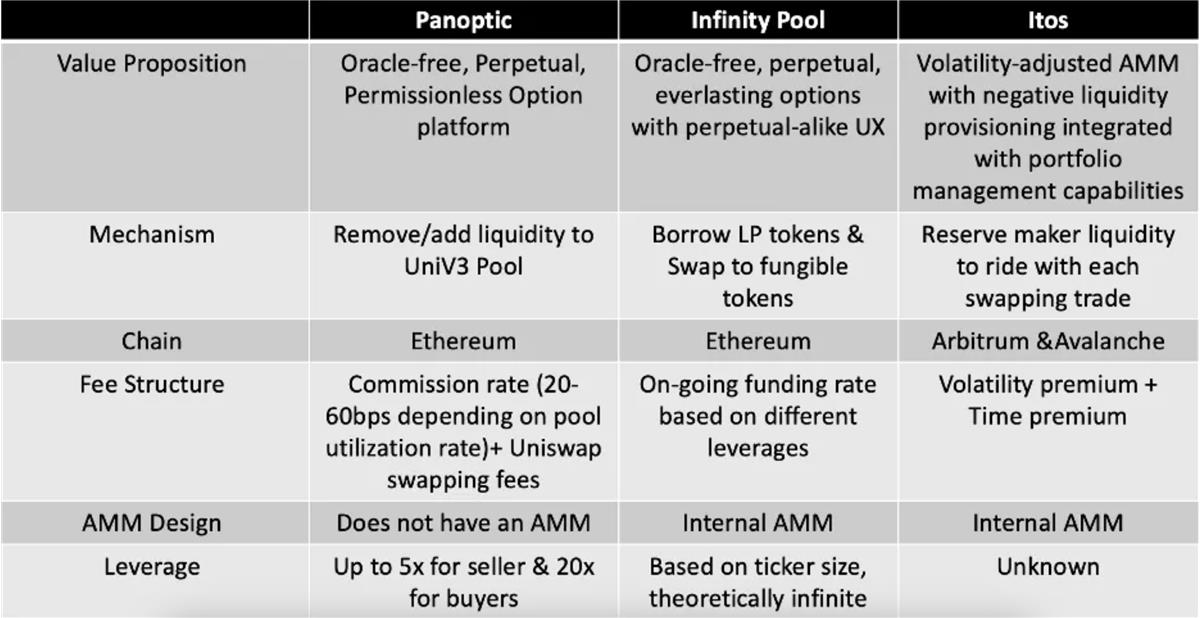
The core idea behind these new protocols is that Uniswap v3 liquidity provider (LP) positions can be viewed as tokenized short put options. Mathematically, an LP’s economic payoff function mirrors that of a short put. For Uniswap V3 LPs, they are effectively short gamma and long theta—losing value during rapid price movements but earning swap fees over time. Hence, various protocols including Panoptic, Infinity Pool, Smilee, and Itos attempt to leverage the massive short option positions embedded in concentrated liquidity pools to build derivative primitives. Despite conceptual similarities, these products differ significantly in design and execution.
Mechanism Overview
Panoptic
Overall, Panoptic consists of liquidity providers, traders (option buyers/sellers), and liquidators. Liquidity providers deposit fungible tokens into the Panoptic pool at any token1/token0 ratio. Option sellers can borrow this liquidity to create short options by depositing it into the corresponding Uniswap v3 pool. Similarly, traders can create long options by withdrawing liquidity from the Uniswap v3 pool. For example, suppose a trader wants to buy a put option with a strike price of 1000 USDC and a width of 10%. When the trader purchases this option, the portion of liquidity within the 909–1100 USDC range per ETH in the Uniswap V3 pool is withdrawn and returned to the Panoptic pool. The cost of the option equals the fees that would have been earned had the liquidity remained in the Uniswap pool. Now consider different scenarios:
If the ETH price is above 1100 USDC at purchase, the option is out-of-the-money (OTM)—not yet profitable, so no premium accrues.
If the ETH price stays between 909 and 1100 USDC during the option’s life, it remains OTM, and its cost stays zero. The user can close the position without paying any premium.
If the ETH price drops below 1100 USDC, the option starts gaining value—premium begins accruing. If ETH falls further below 909 USDC, the option becomes in-the-money (ITM), meaning it’s profitable. At this point, fee accrual stops, and the user may choose to exercise the option.
Upon exercise, the user must return the borrowed liquidity, now denominated in ETH. They send ETH back to the Panoptic pool and keep the USDC received when initially buying the put. Effectively, they sell their ETH at 1000 USDC regardless of the market price possibly being below 909 USDC.
On any available tokens in the Panoptic liquidity pool, option sellers receive up to 5x leverage, and buyers up to 20x leverage.

Itos
Unlike Panoptic, which relies on Uniswap V3 AMM to create long/short options, Itos builds its own concentrated liquidity AMM (CLMM) on top of positive liquidity provision, utilizing negative liquidity provision positions (“takers”) to offer similar products. The AMM structure includes three participants: maker, taker, and trader. In Uniswap V3, maker and trader are synonymous—makers are LPs depositing fungible token pairs, while traders swap one token for another. Unlike makers who provide liquidity, takers reserve liquidity for trades. Takers always trade against swaps, paying fees to ensure trades move into more valuable tokens. This enables creation of TakerPuts and TakerCalls analogous to puts and calls. For example, when a trade occurs on a DEX, takers profit from participating in the trade while paying funding fees to ensure sufficient liquidity. By consistently engaging every trade, their position gains value as prices move, while market maker positions tend to lose value. Thus, takers experience payoff functions similar to long options (green line in diagram below), effectively hedging any maker position.

Infinity Pool
Similar to Itos, Infinity Pool is a leveraged trading DEX built on its own CLMM (called float pool). LPs can directly deposit fungible token pairs or deposit their Uniswap V3 LP tokens into the float pool (the protocol converts LP tokens into fungible tokens on behalf of LPs). The float pool has two functions: 1) spot trading and 2) lending to leveraged traders. In the latter case, borrowed LP tokens are pulled from the float pool into private pools (swappers), where traders can perform unlimited free swaps at predetermined strike prices. In return, traders pay funding fees to LPs via fixed-term loans (1–40x leverage) or revolving loans (over 40x leverage). Further, traders can achieve leveraged exposure on any available asset in the float pool by borrowing required LP tokens at desired price ranges, converting them via off-chain matching engines into fungible tokens in private pools, and repaying loans with any subsequent external swaps if needed. For example, as outlined in their whitepaper, a trader could borrow $1000 worth of ETH/USDC LP tokens to go long ETH with 10x leverage within a tight liquidity band centered at 900 USDC, assuming ETH’s market price is 1000 USDC. Since ETH’s price is currently above the band, the trader can redeem the LP token for 1000 USDC and swap it for 1 ETH on any spot DEX (assuming no fees or slippage). If ETH drops below 900 USDC, the LP position contains 1.11 (1000/900) ETH, requiring the trader to buy an additional 0.11 ETH to close. Worst-case, at 900 USDC, the trader needs $99 to buy 0.11 ETH. Thus, in this example, the trader only needs $100 as collateral for 10x leverage.
Infinity Pool AMMs offer theoretically infinite leverage perpetual options on any listed token, delivering a user experience similar to perpetual futures.

Key Takeaways
Fundamentally, the main challenge these protocols face is convincing concentrated liquidity pool LPs to redeploy their capital into their protocols.
Among the three, Panoptic requires less liquidity bootstrapping compared to Infinity Pool and Itos, as its options are created through interaction with existing Uniswap V3 pools. Still, Panoptic needs sufficient liquidity for borrowers to enable leveraged trading. Therefore, each protocol employs different fee models to compensate LPs. In Panoptic, LPs earn 20–60 bps commission based on pool utilization. In Infinity Pool, LPs earn swap fees when not loaned out and interest payments based on trader leverage levels. In Itos, LPs (makers) are compensated with money market borrowing rates (carrying costs) based on taker liquidity utilization within active ranges. Theoretically, all three should offer competitive returns compared to Uniswap V3’s fixed swap yields, adjusted for expected volatility within quoted ranges.
The most exciting aspect of these derivatives is enabling speculation on small-cap tokens—an experience unavailable on any other DEX or CEX. Conversely, due to relatively high fees, these protocols may struggle competing with CEXs on major asset pairs. This is especially evident for Panoptic.
For any option created on Panoptic, users must pay at least 30 bps (20 bps commission + 10 bps Uniswap V3 swap fee), exceeding costs on many other derivative DEXs, let alone CEXs.
For Infinity Pool, traders still need to interact with external AMMs to successfully close positions, leading to relatively high fees. In contrast, Itos may offer more competitive pricing compared to the other two, as it doesn’t require interaction with external AMMs and adjusts swap fees based on volatility. That said, differing offerings mean these protocols can attract users with varying risk profiles: Infinity Pool’s theoretically infinite leverage may appeal more to perpetual futures traders, while Panoptic and Itos may suit more sophisticated retail traders and DAOs needing direct on-chain hedging.
Final Thoughts
Overall, this new wave of derivatives unlocks liquidity in concentrated liquidity pools by identifying the similar payoff functions between Uni V3 LP positions and option sellers. In short, all these protocols aim to take the opposite side of impermanent loss to solve the liquidity bottleneck constraining options market growth. Moreover, if they achieve sufficient scale, I look forward to seeing various structured products built atop these protocols.
While these new derivatives sound promising, it remains to be seen whether they can gain enough traction. The key challenge will be convincing AMM LPs to deposit funds into their protocols instead of Uniswap (or depositing their Uniswap LP tokens elsewhere). With both Panoptic and Infinity planning testnet launches by end of July, I’m eager to see how the market responds to this new wave of AMM-driven primitives.
Join TechFlow official community to stay tuned
Telegram:https://t.me/TechFlowDaily
X (Twitter):https://x.com/TechFlowPost
X (Twitter) EN:https://x.com/BlockFlow_News
 @0xkeyu






