Vitalik: Five Exciting Applications in the Ethereum Application Ecosystem
TechFlow Selected TechFlow Selected
Vitalik: Five Exciting Applications in the Ethereum Application Ecosystem
Money, DeFi, identity systems, DAOs, and hybrid applications.
 Navigating Web3 tides with focused insights
Author: Vitalik Buterin
Translation: Qianwen, ChainCatcher
Special thanks to Matt Huang, Santi Siri, and Tina Zhen for feedback and comments.
Ten years ago, five years ago, even two years ago, my view of what Ethereum and blockchain could do for the world was highly abstract. I would say, “It’s a general-purpose technology, like C++.” Certainly it had specific properties such as decentralization, openness, and censorship resistance, but beyond that, it was too early to say which particular applications would matter most.
The world today is no longer the same. By now, there are almost no ideas we haven’t explored at all: if something succeeds big, it’s likely some version of an idea that has already been discussed many times on blogs, forums, and conferences. We are also increasingly able to identify the fundamental limits of the space. Many DAOs have gained popularity among participants, despite their inconveniences and fee barriers, yet many still perform poorly. Industrial supply chain applications haven’t fully materialized, and a decentralized Amazon on blockchain hasn’t emerged. Yet we have seen some key applications steadily gaining adoption—applications that are meeting real human needs—and these are the ones we should focus on.
Thus, I’ve changed my perspective: what excites me about Ethereum is no longer undiscovered, unknown potential, but rather several concrete classes of applications that have already proven themselves and will only grow stronger. What are these applications, and which ones am I no longer optimistic about? That’s the subject of this article.
1. Money: The First and Most Important Application
I first visited Argentina in December last year. On Christmas Day, nearly every store was closed. While searching for a café, after passing five shut-down coffee shops, we finally found one open. When we walked in, the owner recognized me and immediately showed me his Binance account with ETH and other crypto assets. We ordered tea and snacks, then asked if we could pay in ETH. The café owner agreed and displayed a QR code of his Binance deposit address. I sent him about $20 worth of ETH from my Status wallet on my phone.
Of course, this isn’t the most meaningful use of cryptocurrency in the country. Many people use it for saving money, international transfers, large important payments, and more. But even so, the fact that I randomly found a café that happened to accept cryptocurrency shows how widely adopted crypto has become. In wealthy countries like the United States, financial transactions are easy, and 8% inflation is considered extremely high. In Argentina and many other countries around the world, connections to the global financial system are more limited, and extreme inflation is experienced daily. Right now, cryptocurrency is a lifeline.
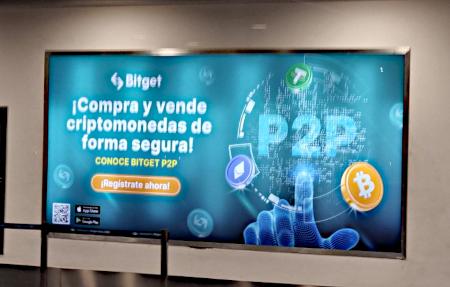
Besides Binance, there are increasingly many local exchanges whose ads you can see everywhere—even at airports.
One problem with my coffee transaction was that it wasn’t really practical. Fees were high—about a third of the transaction value—and confirmation took several minutes. At the time, Status didn’t support EIP-1559 transactions, which are more reliable and faster. If I had used a Binance wallet like many other Argentinian crypto users, the transfer would have been free and instant.
However, a year later, things are very different. After The Merge, transaction inclusion speeds improved significantly, and the blockchain became more stable, requiring fewer confirmations for secure transactions. Scaling technologies like Optimistic and ZK Rollups are advancing rapidly. With “account abstraction,” social recovery and multi-sig wallets are becoming more practical. These trends will take years to fully unfold, but progress is already being made. Meanwhile, a major catalyst has boosted interest in on-chain transactions: the collapse of FTX, which reminded everyone—including Latin Americans—that even seemingly most trustworthy centralized services may ultimately betray user trust.
Cryptocurrency in Wealthy Countries
In wealthy countries, the more extreme use cases around surviving high inflation or accessing basic financial services often don’t apply. But cryptocurrency still holds significant value. I use it for donations (to quite normal organizations across many countries), and I can personally confirm it’s far more convenient than traditional banking. It’s also valuable for industries and activities that might be banned from payment systems—industries that are completely legal under the laws of most countries.
Cryptocurrency as private money also represents a broader philosophical use case: many governments are using the transition toward a “cashless society” to introduce levels of financial surveillance unimaginable 100 years ago. Cryptocurrency is currently the only developed invention that realistically combines digitization with the privacy features of cash.
But regardless, cryptocurrency is far from perfect. Even if all technical, user experience, and account security issues are solved, volatility remains a reality, making it difficult to use for savings and commerce. Hence, we have stablecoins.
Stablecoins
The value of stablecoins has long been discussed in the Ethereum community. As quoted from a 2014 blog post:
“Over the past 11 months, Bitcoin holders have lost approximately 67% of their wealth, and quite often its price fluctuates by as much as 25% within a single week. Given these concerns, growing interest is turning toward a simple question: can we have the best of both worlds? Can we have the full decentralization provided by cryptographic payment networks, while also achieving a higher level of price stability without enduring such extreme swings?”
Indeed, stablecoins are very popular among pragmatic crypto users today. Ironically, the opposite of crypto’s core ideals—the most successful stablecoins today are centralized, primarily USDC, USDT, and BUSD.
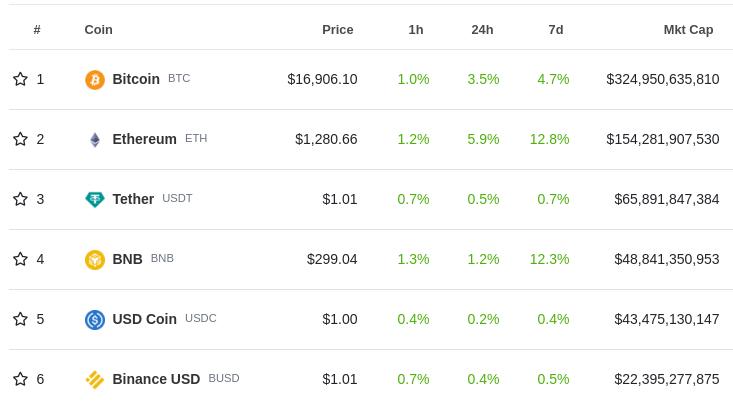
Top cryptocurrency market caps, data from CoinGecko, Nov 30, 2022—three out of the top six are centralized stablecoins
On-chain issued stablecoins offer many convenient features: they’re open to anyone, resistant to the largest-scale and most opaque forms of censorship (issuers can blacklist addresses and freeze funds, but such blacklists are transparent, and freezing each address incurs a literal transaction cost), and integrate well with on-chain infrastructure (accounts, DEXs, etc.). But it’s unclear how long this status will last, so it’s essential to continue researching alternative designs.
I believe the design space for stablecoins fundamentally falls into three distinct categories: centralized stablecoins, DAO-governed stablecoins backed by real-world assets (RWA), and minimally governed stablecoins backed by crypto assets.
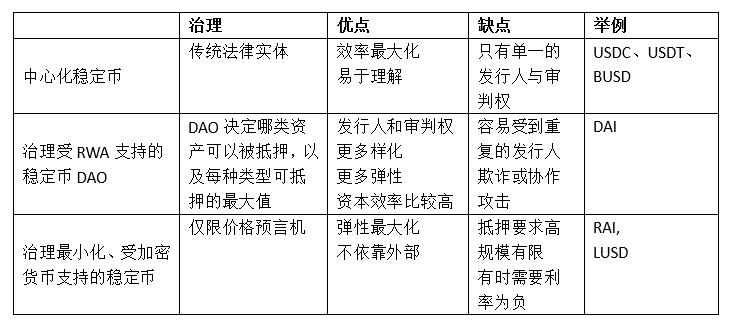
From a user’s perspective, these three types of tokens trade off efficiency versus resilience. USDC has worked reliably for years, but its long-term stability depends on macroeconomic and political stability in the United States, continued regulatory support for offering USDC to everyone, and the credibility of the issuing institution.
On the other hand, RAI can withstand all these risks, but it carries a negative interest rate—-6.7% at the time of writing. To keep the system stable (unlike LUNA, which collapsed easily), every RAI holder must be paired with a negative RAI holder (a.k.a. “borrower” or “CDP holder”) who puts up ETH as collateral. If more people engage in arbitrage—holding negative RAI while balancing with positive USDC or even interest-bearing bank deposits—the rate improves. But RAI’s rate will always remain lower than rates in normally functioning banking systems. And negative interest rates, along with their associated potential UX issues, will persist long-term.
The RAI model is ultimately ideal for more pessimistic experimenters (“lunarpunks”): it severs all ties with non-crypto financial systems, making it harder to attack. The negative rate makes it inconvenient as a dollar substitute, but accepting complete disconnection allows for innovation: a minimally governed stablecoin could track a non-monetary asset like the global average CPI index and position itself as representing an abstract “best effort at stable value.” This also reduces inherent regulatory risk, as such an asset wouldn’t attempt to provide a “digital dollar” (or other currency).
DAO-managed, RWA-backed stablecoins, if well-executed, could become a compelling middle ground. Such stablecoins could combine sufficient robustness, censorship resistance, scale, and economic utility to meet the needs of a large base of real-world crypto users. But achieving this requires both real-world legal work to ensure issuer stability and healthy, resilience-oriented DAO governance.
Regardless of the path, any well-functioning stablecoin benefits various monetary and savings applications that already serve millions of people effectively today.
2. DeFi: Keeping It Simple
Decentralized finance started with great promise but limited development, evolved into an overcapitalized monster dependent on unsustainable yield farming, and is now in an early phase transitioning toward becoming a stable medium—improving security and refocusing on particularly valuable applications. Decentralized stablecoins are now, and will likely remain, the most important DeFi product, but there are other products worth paying attention to.
- Prediction markets: Since Augur launched in 2015, these markets have been a niche but steady pillar of decentralized finance. Since then, adoption has quietly grown. The 2020 U.S. election demonstrated both the value and limitations of prediction markets. In 2022, crypto-based prediction markets like Polymarket and gamified funding platforms like Metaculus are seeing wider usage. Prediction markets are valuable as epistemic tools; using cryptocurrency makes them more trustworthy and easier to adopt globally. I expect prediction markets won’t explode into tens of billions overnight but will continue steady growth, becoming more useful over time.
- Other synthetic assets: The formula behind stablecoins can theoretically be replicated for other real-world assets, including major stock indices and real estate. The latter is constrained by inherent spatial heterogeneity and complexity, taking longer to deliver tangible results, but could still be valuable. The main challenge is whether someone can balance centralization and efficiency so users can access these assets at reasonable return rates.
- Glue layers for efficient trading between assets: On-chain, users want access to assets like ETH, centralized or decentralized stablecoins, and more advanced synthetics. A glue layer enabling seamless exchange between them becomes highly valuable. Some users may wish to hold USDC and pay gas fees in USDC. Others may hold one asset but want to instantly convert it to another when making payments. Another opportunity lies in using one asset as collateral to borrow another. Projects in this space are most likely to succeed if they maintain very low leverage ratios (e.g., no more than 2x).
3. Identity Ecosystem: ENS, SIWE, PoH, POAP, SBT
"Identity" is a complex concept meaning many things, such as:
- Basic authentication: Simply proving that action A (e.g., sending a transaction or logging into a website) was authorized by an agent holding a certain identifier, such as an ETH address or public key, without attempting to explain who the agent is.
- Attestations: Proving claims made by other agents about an agent (“Bob attests he knows Alice,” “the Canadian government attests Charlie is a citizen”).
- Names: Establishing consensus that a specific human-readable name refers to a specific agent.
- Proof of Personhood: Proving that an agent is human and ensuring each human gets only one identity through the system (this often overlaps with attestations, so it's not a fully independent category, but it's an especially important special case).
For a long time, I’ve been bullish on blockchain identity—but bearish on blockchain identity *platforms*. The use cases mentioned above are indeed important for many blockchain applications. Blockchain adds value to identity because of its independence from institutions and its interoperability advantages. However, trying to create a centralized platform to implement all these tasks from scratch doesn’t work. A more effective approach is incremental: many projects today focus on specific, valuable tasks and gradually increase interoperability over time.
And that’s exactly what has happened since. The Sign-In with Ethereum (SIWE) standard allows users to log into (traditional) websites, similar to how you can log in with Google or Facebook today. This is genuinely useful: it lets you interact with websites without giving Google or Facebook access to your private information or control over locking or seizing your account. Technologies like social recovery can help users recover accounts if they lose passwords—far superior to services offered by today’s centralized companies. Today, SIWE is supported by many applications, including Blockscan chat, end-to-end encrypted email and note service Skiff, and various blockchain-based alternative social media projects.
ENS gives users usernames. For example, I have vitalik.eth. Proof of Humanity and other personal identity systems let users prove they are unique humans—useful in airdrops, governance, and other applications. POAP (“Proof of Attendance Protocol”) is a general protocol for issuing tokens representing attestations: Did you complete an educational course? Attend an event? Meet a specific person? POAP can be part of an identity protocol or used to determine whether someone belongs to a certain community (valuable for governance or airdrops).
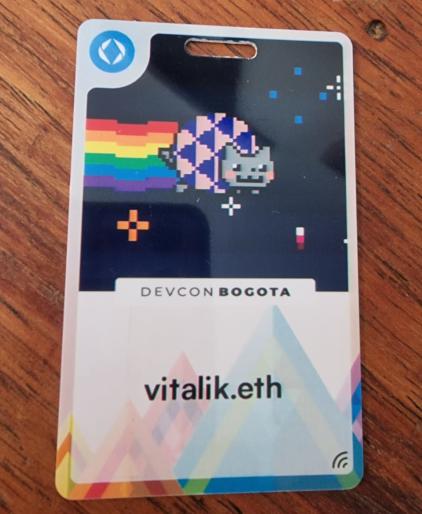
An NFC card with my ENS name and a POAP you received can prove you met me. I’m not sure I want to encourage more people to constantly seek me out just to get my POAP, but the idea seems interesting and useful to others.
Each of these applications is useful on its own. But what makes them truly powerful is how well they work together. When I log into Blockscan chat, I sign in via Ethereum. This means my name, vitalik.eth (my ENS name), is immediately visible to anyone chatting with me. In the future, to combat spam, Blockscan chat could examine on-chain activity or POAP ownership to verify accounts. Basic verification could involve checking whether an account has ever sent or received an on-chain transaction (since that requires paying fees). Higher-level verification might check balances of specific tokens, ownership of certain POAPs, proof-of-humanity status, or aggregators like Gitcoin Passport.
The network effects of these different services combine to create an ecosystem offering powerful options for users and applications. An Ethereum-based Twitter alternative (like Farcaster) could use POAPs and other on-chain activity proofs to create a verification feature that doesn’t require traditional KYC, allowing anonymous participation. These platforms could create rooms open only to members of specific communities, or use hybrid models where only community members can speak, but anyone can listen. This would allow Twitter-style polls to be restricted to specific communities.
Equally important are simpler applications helping people earn a living: verification through proofs can make it easier to demonstrate trustworthiness for renting, employment, or loans.
A major future challenge for this ecosystem is privacy. Currently, vast amounts of information are stored on-chain, which eventually becomes problematic—even if not directly risky for many individuals. Combining on-chain and off-chain data with extensive use of ZK-SNARKs can help solve this, but it requires dedicated effort; projects like Sismo and HeyAnon are early attempts. Scalability is also a challenge, addressable via rollups and possibly validity proofs. Privacy is the harder issue—each application must specifically tackle it.
4. DAOs
DAO is a powerful term representing many hopes and dreams that bring people into the crypto space—building more democratic, resilient, and efficient forms of governance. It’s also a very broad term whose meaning has evolved significantly over the years. Most commonly, a DAO is a smart contract representing a structure of ownership or control over certain assets or processes. But this structure can range from low-level multisig wallets to highly complex multi-chamber governance mechanisms like those envisioned for the Optimism Collective. Some of these structures work well; others don’t—or at least are poorly matched to their intended goals.
Two questions need answering:
1. What kinds of governance structures make sense, and for what use cases?
2. Does it make sense to implement these structures as DAOs, or through conventional companies and legal contracts?
A particularly subtle point is that “decentralization” is sometimes used to refer to two different aspects: a governance structure is decentralized if decisions require agreement among a large group of participants; a governance structure is decentralized if its implementation relies on decentralized systems like blockchains and does not depend on any single nation-state’s legal framework.
Decentralization Enhances Resilience
This refers to: decentralized governance structures protecting against internal attackers, and decentralized implementations protecting against powerful external attackers (“censorship resistance”).
For example:

The Pirate Bay and Sci-Hub are important case studies—they’re censorship-resistant without needing decentralization. Sci-Hub is mainly managed by one person; if parts of its infrastructure get censored, the operator can simply move it elsewhere. Over the years, Sci-Hub’s URL has changed many times. The Pirate Bay is a hybrid: it relies on BitTorrent, which is decentralized, but The Pirate Bay itself is a centralized convenience layer on top.
The key difference between these examples and blockchain projects is that they don’t protect users from the platform itself. If Sci-Hub or The Pirate Bay wanted to harm their users, the worst they could do is provide bad results or shut down—both causing minor inconvenience, after which users would switch to alternatives that inevitably emerge. They could expose users’ IP addresses, but even then, total harm would still be far less than, say, stealing all users’ funds.
Stablecoins are different. Stablecoins aim to build stable, trusted, neutral global commercial infrastructure, requiring independence from single centralized actors externally and protection against internal attackers. Poorly designed stablecoin governance could lead to attacks where users lose billions.
At the time of writing, MakerDAO holds $7.8 billion in collateral—over 17 times the market cap of its MKR token. Therefore, if governance were solely decided by MKR holders with no safeguards, someone could buy half the MKR, manipulate price oracles, and steal a large portion of the collateral. This actually happened to a smaller stablecoin! It hasn’t happened to MKR, mainly because MKR ownership remains highly concentrated, held by a small group unwilling to sell due to strong belief in the project. This works during early adoption phases but isn’t sustainable long-term. Thus, long-term operation of decentralized stablecoins requires innovation in decentralized governance to eliminate such vulnerabilities.
Two possible directions include:
1. Some form of non-financialized governance, or perhaps a bicameral hybrid, where decisions require approval not only from token holders but also from another class of users (e.g., Optimism Citizens' House, stETH holders as proposed in Lido’s bicameral model).
2. Intentional friction, delaying certain decisions long enough for users to observe negative outcomes and exit the system.
Designing governance optimized for resilience involves many subtleties. If a system’s resilience depends on emergency pathways activated only in extreme cases, the system might even intentionally test these occasionally to ensure they function—similar to the Ise Grand Shrine’s rebuilding every 20 years. Decentralized resilience still requires deeper thought and development.
Decentralization Enhances Efficiency
Decentralization for efficiency represents a different school of thought: this governance structure is valuable because it incorporates diverse viewpoints at different scales; its implementation is valuable because it can sometimes be more efficient and lower-cost than traditional legal-system-based approaches.
This implies different styles of decentralization. Governance for resilience emphasizes having many decision-makers to stay aligned with preset goals and deliberately makes actions harder. Governance for efficiency preserves the ability to act quickly and adapt when needed, but tries to shift decision-making away from the top to prevent organizational rigidity.
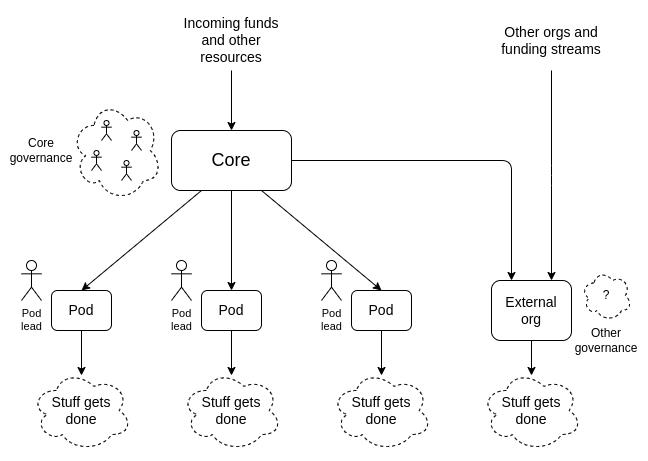
Pod-based governance in UkraineDAO, improving efficiency by maximizing autonomy.
Decentralized implementations for resilience and for efficiency share one similarity: both involve placing assets into smart contracts. But efficiency-focused implementations are much simpler—typically, a basic multisig wallet suffices.
Notably, “decentralization for efficiency” doesn’t hold up well for large projects in wealthy countries. But it makes more sense for very small-scale projects, highly international projects, or projects operating in countries with inefficient institutions and weak rule of law. Many “efficiency-driven decentralization” applications could potentially run on a central bank chain operated by a stable major country; I’m unsure whether decentralized or centralized approaches will dominate—it may depend on which becomes viable first.
Decentralization Enhances Interoperability
This is a somewhat mundane reason for decentralization, yet still important: interactions between on-chain items are easier, safer, and more seamless than interactions with off-chain systems, which inevitably require a (vulnerable) bridging layer.
If a large organization run via direct democracy holds 10,000 ETH in reserves, that’s a decentralized governance process—but not decentralized implementation: in practice, a few individuals would manage keys, and the storage system could be attacked.
From a governance standpoint: if a system serves other DAOs lacking rapid adaptability, the system itself should ideally lack rapid change capability to avoid “rigidity mismatch”—where dependencies break but the system’s rigidity prevents adaptation.
These three “decentralization theories” can be summarized in the following chart:
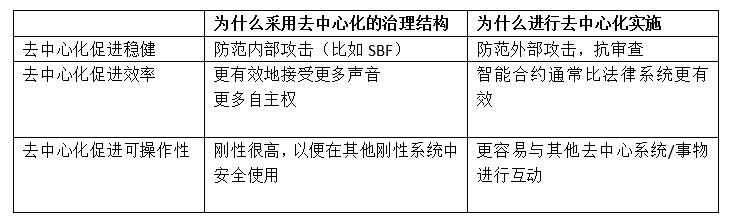
Decentralization and Novel Governance Mechanisms
Over the past decade, we’ve seen new experiments in governance mechanisms:
- Quadratic voting
- Futarchy
- Liquid democracy
- Decentralized dialogue tools like Pol.is
These ideas are important parts of the DAO story, valuable for both resilience and efficiency. Quadratic voting relies mathematically on accurately balancing strongly preferred proposals against more popular but less intense ones (or those favored by wealthy actors). But users report it also enhances resilience. Some novel ideas, like pairwise matching, deliberately sacrifice mathematical optimality for robustness when model assumptions break.
Case Study: Gitcoin Grants
We can analyze different styles of decentralization through an interesting edge case: Should Gitcoin Grants be an on-chain DAO, or just a centralized organization?
Arguments for Gitcoin Grants being a DAO:
- It holds and processes cryptocurrency, as most of its users and funders are Ethereum users
- Secure quadratic funding works best on-chain, reducing security risks if voting results feed directly into the system
- It interacts with global communities, benefiting from credible neutrality rather than being centered in one country
- Its value includes assuring users it’ll still exist in five years, so public goods funders can invest now expecting future returns
These arguments lean toward decentralization for resilience and infrastructural interoperability, though individual quadratic funding rounds align more with the “efficiency-driven decentralization” school (Gitcoin Grants’ theory is that quadratic funding is a more efficient way to fund public goods).
If resilience and interoperability arguments didn’t apply, treating Gitcoin Grants as a regular company might be better. But they do apply, so arguably, Gitcoin Grants qualifies as a DAO.
Many other examples fit this reasoning, including DAOs people increasingly rely on daily and “meta-DAOs” providing services to other DAOs:
- Proof of Humanity (quadratic funding design)
- Kleros (decentralized arbitration protocol for economic disputes)
- Chainlink (oracle protocol LINK)
- Stablecoins
- Layer 2 blockchain protocol governance
I don’t know enough about all these systems to claim they sufficiently optimize decentralization-for-resilience, but they should.
Where things fail are mainly DAOs whose core functions conflict with resilience and lack sufficient justification for “efficiency-driven decentralization.” Large corporations primarily serving U.S. users are an example. When building a DAO, first determine whether structuring as a DAO is worthwhile, then clarify whether the goal is resilience or efficiency: if the former, deeply consider governance design; if the latter, either innovate via mechanisms like quadratic funding or simply use a multisig wallet.
5. Hybrid Applications
Many applications aren’t fully on-chain but instead combine blockchain with other systems to improve trust models.
Voting is a prime example. High guarantees of censorship resistance, auditability, and privacy are all required. Systems like MACI effectively combine blockchain, ZK-SNARKs, and limited centralized (or M-of-N) layers to achieve scalability and enforceability while maintaining all guarantees. Votes are posted on-chain, giving users an independent method—outside the voting system—to verify their vote was included. But votes are encrypted for privacy, and ZK-SNARK-based solutions ensure final results correctly compute the tally without compromising other goals.
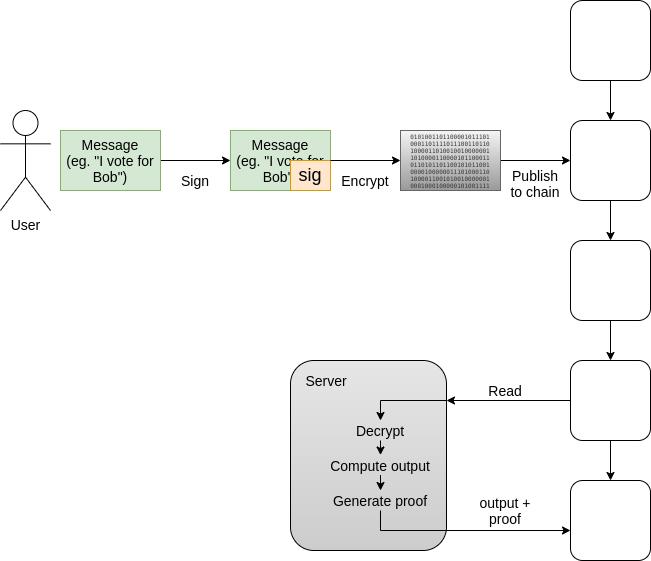
MACI diagram showing how blockchain combines with encryption and ZK-SNARKs to ensure censorship resistance, privacy, and correct results without sacrificing other objectives.
In existing national elections, voting is already a high-assurance process, and states and citizens may take a long time to trust any electronic voting method (blockchain or otherwise). But such technologies can soon add value in two other areas:
1. Enhancing assurance in already-existing electronic voting processes (e.g., social media polls, surveys, petitions).
2. Creating new forms of voting allowing citizens or group members to give rapid feedback, with high assurance built in from the start.
Beyond voting, there’s an entire potential domain of “auditable centralized services” where people can be well-served via hybrid off-chain verification architectures. The simplest example is exchange solvency proofs, but many other possibilities exist:
- Government registries
- Corporate accounting
- Gaming (see Dark Forest)
- Supply chain applications
- Tracking access authorization
- ...
As we go further down this list, use case value decreases, but it’s important to remember costs are also quite low. Validiums don’t need to publish everything on-chain. Instead, they can wrap existing software, maintain a Merkle root (or other commitment) of a database, occasionally publish the root on-chain, and use SNARKs to prove updates are correct. This is a strict improvement over existing systems, opening doors to cross-institutional verification and public auditing.
How Do We Get There?
Today, many of these applications are being built, though current technological limitations constrain their usability. Blockchains are not scalable, transactions take considerable time to be reliably included, and current wallets force users to choose between low convenience and low security. Long-term, many of these applications will need to overcome privacy challenges.
These are solvable problems, and we have strong incentives to solve them. FTX’s collapse showed many people the importance of truly decentralized solutions for holding funds, and the rise of ERC-4337 and account abstraction wallets gives us an opportunity to create such alternatives. Rollup technology is advancing rapidly to solve scalability, and transactions are being included faster than three years ago.
But equally important is clarifying where the application ecosystem itself should head. Many more stable and simpler applications haven’t been built because they attract less excitement and short-term profit: LUNA reached a $30+ billion market cap, while efforts pursuing stable, simple stablecoins were largely ignored for years. Non-financial applications often can’t generate $30 billion because they lack tokens. But in the long run, it’s precisely these applications that are most valuable to the ecosystem and will deliver the most lasting value to their users and to those building and supporting them.
Join TechFlow official community to stay tuned
Telegram:https://t.me/TechFlowDaily
X (Twitter):https://x.com/TechFlowPost
X (Twitter) EN:https://x.com/BlockFlow_News
 @VitalikButerin