









NGC Ventures: Why We Invested in Opside?
TechFlow Selected TechFlow Selected
NGC Ventures: Why We Invested in Opside?
Opside adopts a PoS & PoW hybrid consensus, providing Web3 developers with one-click generation of zkEVM application chains.
 Navigating Web3 tides with focused insights
Author: Henry Zhang
Opside is a decentralized ZK-RaaS (ZK-Rollup as a Service) platform and also the leading ZKP (Zero-Knowledge Proof) mining network in the industry. Opside adopts a PoS & PoW hybrid consensus mechanism, offering Web3 developers a one-click solution to generate zkEVM application-specific chains. Meanwhile, the massive volume of ZK-Rollups generates substantial ZKP computation tasks, creating significant demand for computing power and providing a meaningful mining opportunity for miners worldwide, effectively utilizing the vast amount of idle computational resources left behind after ETH abandoned PoW.
The Natural Synergy Between ZK and RaaS (Rollup as a Service) Enables Better Developer and User Experiences
As the current mainstream scaling solution, Layer2 enhances Ethereum's scalability. Developers are increasingly seeking blockchains with lower costs, higher performance, and customizable features—an evolving demand that will grow alongside market development. Enhancing the value capture of application-specific governance tokens through appchains has become a key direction in addressing this need. RaaS can serve as an effective solution to fulfill this requirement.
Most mainstream RaaS offerings today are based on optimistic rollups, primarily due to their low entry barriers and high compatibility. However, given the superior security, interoperability, and finality time offered by ZK-Rollup technology, we remain bullish on the development of ZK-Rollups. Opside’s ZK-RaaS provides underlying technical advantages for ZK-Rollups, delivering clear benefits in terms of security, withdrawal speed, and other aspects.
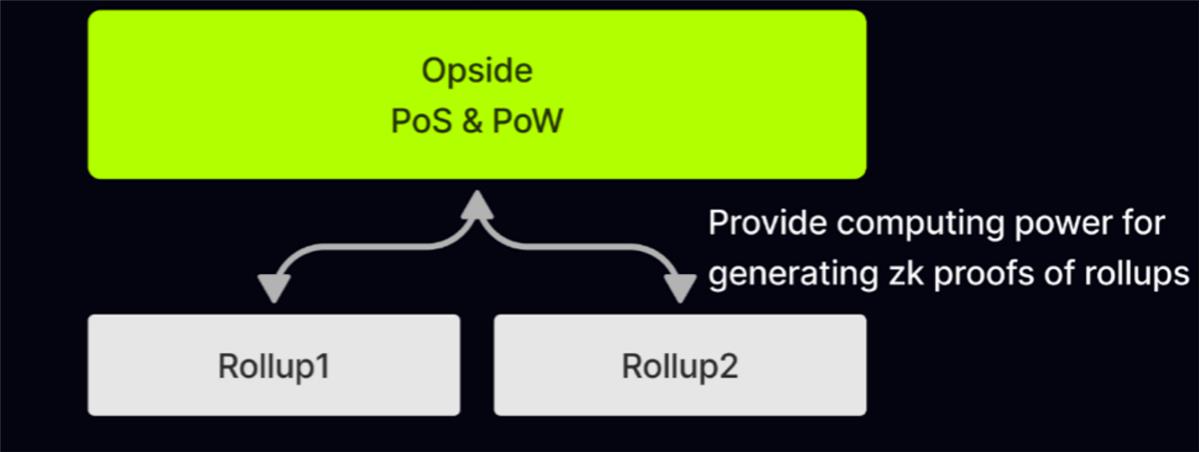
Opside offers a modular RaaS solution:
-
Opside Chain: Serves as both the consensus layer and data availability layer. All transactions and data generated are verified, packaged, and stored on-chain within Opside Chain. It enables fast transaction speeds and low fees.
-
Rollup Layer: An execution layer based on ZK-Rollups (especially zkEVM), where each application can have its own dedicated zkEVM chain. These ZK-Rollups are managed by a unified system contract, sharing standardized interfaces and data formats, enabling native cross-rollup communication.
Innovative Tokenomics Design Ensures Decentralization and Sustains PoW Computing Power
Opside employs a hybrid PoS + PoW consensus model. The main participants include Validators in PoS and Miners in PoW. Validators also act as Sequencers for Rollups and earn corresponding rewards. Specifically:
Opside Chain
-
PoS: Opside adopts the PoS algorithm from Ethereum 2.0 with necessary improvements. As a result, Opside’s consensus layer supports over 100,000 validators. Anyone holding IDE tokens can become a validator and earn block rewards and gas fees.
Rollup Layer
-
PoS (Sequencer): Validators not only propose blocks on Opside Chain but also submit Rollup blocks (i.e., data batches). Therefore, validators double as sequencers for Rollups and earn gas fees from Rollup transactions.
-
PoW (Prover): Anyone with sufficient computational power to perform ZKP calculations can become a prover (miner) for a Rollup. According to Opside’s PoW algorithm, provers can freely generate ZKPs for one or multiple ZK-Rollups and receive corresponding rewards.
Under the hybrid PoS & PoW consensus, block rewards are split between PoS and PoW components, allocated to Validators and Miners respectively. During the Pre-Alpha testnet phase, the reward ratio between PoS and PoW is temporarily fixed at 1:2—11% of IDE tokens go to Validators and 22% to Miners. In the future, this ratio will dynamically adjust based on the supply-demand balance of ZKP computing power across the network.
In summary, Opside Chain leverages Ethereum 2.0’s PoS consensus, supporting over 100k validators. Additionally, its permissionless PoW design attracts more miners to collectively enhance network security. Based on Opside’s innovative economic model, developers pay rent for rollup slots, thereby covering the cost of operating ZK-Rollups.
One-Click zkEVM Chain Deployment via ZK-RaaS Makes Scalability and Low Entry Barriers Achievable
To make it seamless for developers to build their own Rollups using Opside, the team has developed a highly streamlined frontend interface, achieving the following:
(1) Full Hardware Hosting. The two hardware resources required by ZK-Rollups—data availability (analogous to disk storage) and ZKP computing power (analogous to CPU)—are provided in a decentralized and permissionless manner by PoS and PoW respectively. Developers bear no hardware costs.
(2) Sovereignty. Developers retain full sovereignty over their ZK-Rollup, allowing them to customize the rollup’s economic model, including setting gas fees to zero if desired.
(3) EVM Compatibility. Developers can freely choose from various zkEVM SDKs, including Polygon zkEVM, Scroll, zkSync, StarkNet, etc., with minimal migration costs for existing applications.
With these capabilities, developers can easily launch their own ZK-Rollup (especially zkEVM) chains. Thanks to customizable gas fees, Opside helps drive broader adoption of fully on-chain applications.
Dedicated and Experienced ZK Development Team with Strong Product Execution
The team consists entirely of individuals with several years of experience in the blockchain field and a long-standing research focus on ZK technologies. This deep expertise enables strong execution capability and solid technical foundations in ZK-Rollup development.
Join TechFlow official community to stay tuned
Telegram:https://t.me/TechFlowDaily
X (Twitter):https://x.com/TechFlowPost
X (Twitter) EN:https://x.com/BlockFlow_News
 NGC Ventures







