After much buildup, Su Zhu of Three Arrows has emerged with his new trading platform GTX.
TechFlow Selected TechFlow Selected
After much buildup, Su Zhu of Three Arrows has emerged with his new trading platform GTX.
What does GTX do?
 Navigating Web3 tides with focused insights
According to a recent funding document circulating in the market, Su Zhu and Kyle Davies, the co-founders of the collapsed Three Arrows Capital, are reportedly building a new centralized crypto trading platform called "GTX," with a fundraising target of $25 million. In addition to the two key figures from Three Arrows, Sudhu Arumugam and Mark Lamb, co-founders of CoinFLEX, are also involved in launching GTX.
Since the FTX collapse, Su Zhu—previously silent after his own downfall—has suddenly become active again, frequently sharing on Twitter old disputes with FTX and Alameda. At the end of last year, he even posted chat logs from 2019 showing that he had long harbored doubts about Alameda. He even teamed up with the now-defunct Terra founder at one point to publicly criticize SBF. The recently leaked GTX funding document, whether by name or content, clearly indicates a platform deeply tied to FTX—or rather, GTX aims to enter the crypto trading space precisely by capitalizing on the aftermath of the FTX collapse.
What does GTX do?
In short, GTX is targeting the cryptocurrency claims market—also known as the creditor rights market—and plans to start with FTX-related claims.

Image source: GTX funding document
Su Zhu believes that just from the wreckage left behind by FTX’s collapse, there lies an entirely new frontier—home to 1 million creditors and a market size of $2 billion. FTX users are now creditors who cannot withdraw their assets from the platform. Current claim markets offer poor user experiences for small claimants due to rigid processes and high fees.
Platforms like GTX provide creditors with another option: instead of waiting years for court rulings (as seen in the Mt Gox case), they can now sell their claims for cash at around a 10% discount.
There are already similar platforms in the market today—for example, Xclaims, where creditors can currently transfer their claims at about a 13% discount. However, besides high fees, Xclaims lacks a true marketplace structure. What Su Zhu envisions is active trading—an order-book-based, deep liquidity market for claims, akin to BTC trading. This would have been difficult with only isolated cases like Mt Gox, but the wave of consecutive bankruptcies in 2022 has created the conditions for such a market to emerge.
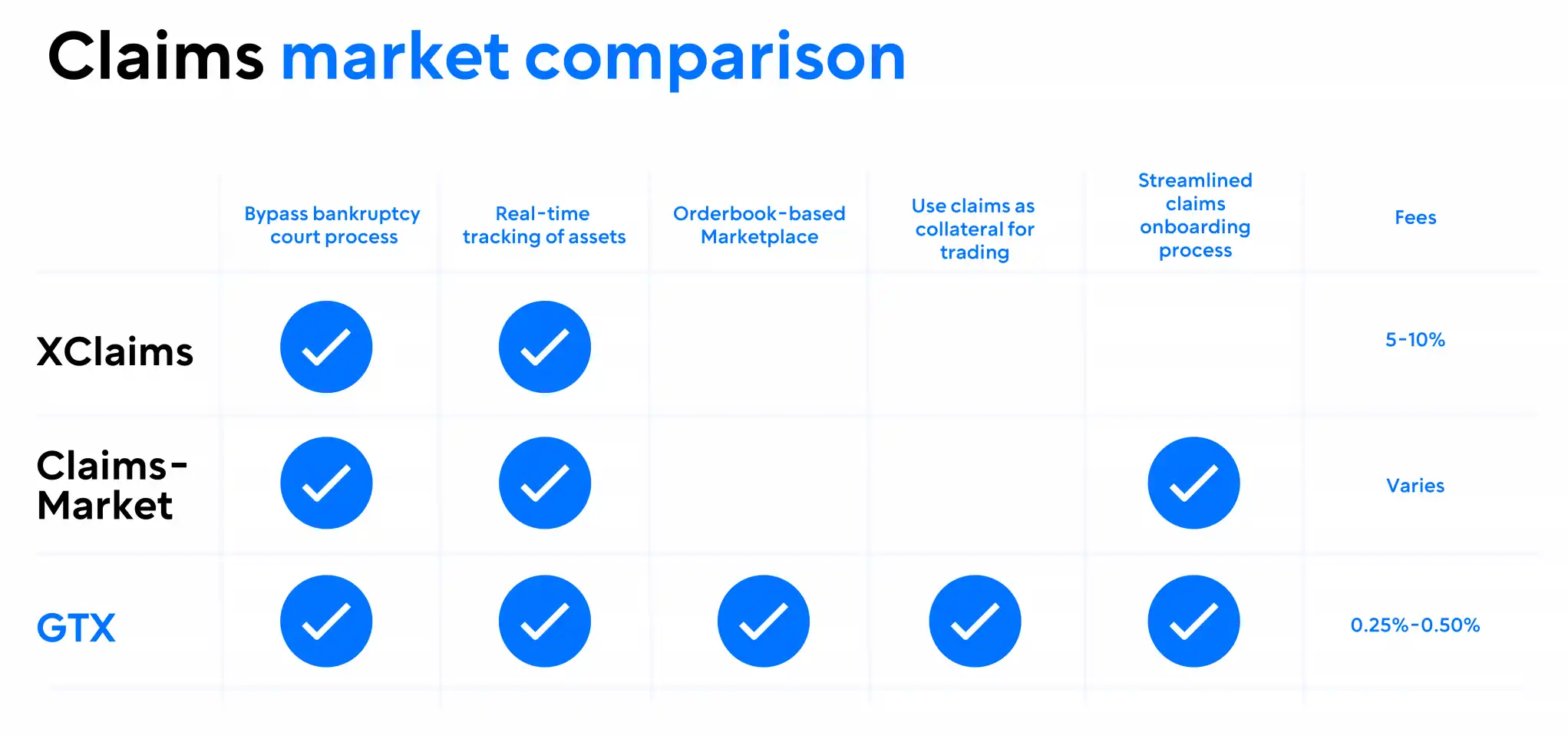
Image source: GTX funding document
To make it easier (though perhaps not perfectly accurate) to understand: some long-time crypto investors may remember how, after Algorand's Dutch auction, investors were granted refund rights. Subsequently, certain exchanges tokenized these refund rights and listed them for trading, creating price fluctuations and arbitrage opportunities against ALGO. Su Zhu’s vision for the claims market is somewhat similar.
Traditional finance certainly has debt markets, but none that are globally accessible platforms. Cryptocurrency offers advantages in tokenization and liquidity, opening up new possibilities for claims trading. FTX won’t be the last black swan event, and the market size will surely exceed $2 billion.
Team Members
The GTX document states that the team currently consists of over 60 members, including developers and professionals with 10 years of CEX operations experience.
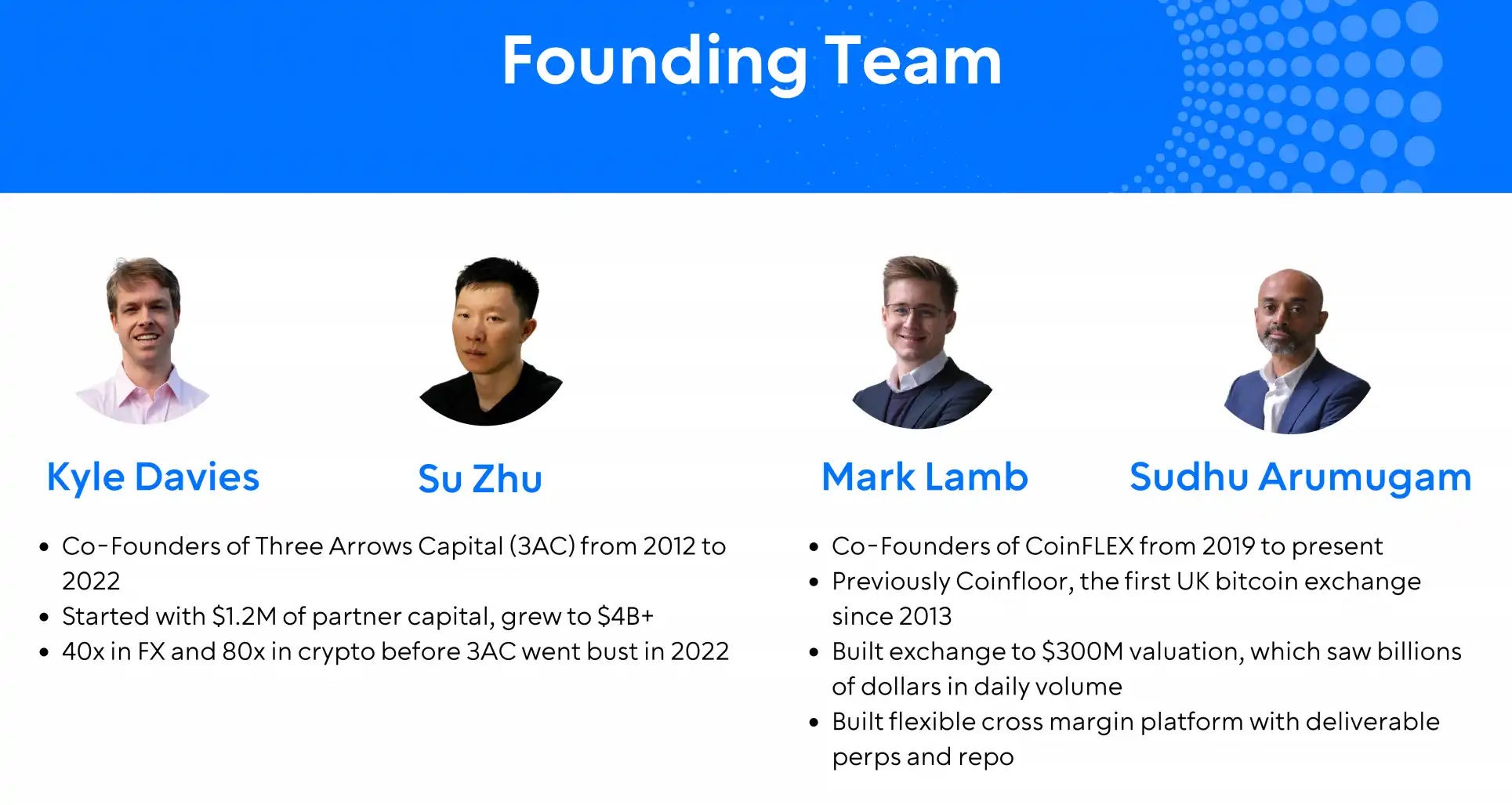
Image source: GTX funding document
Most notable are the co-founders: Su Zhu and Kyle Davies from Three Arrows Capital, along with Sudhu Arumugam and Mark Lamb, co-founders of the CEX platform CoinFLEX—their four portraits prominently featured in the document. While the collapse of Three Arrows is well known, CoinFLEX also announced bankruptcy restructuring last August.
Other executives include CTO Kent Deng, who previously worked at Alibaba, Tencent, Oracle, and Huawei.
CMO Leslie Lamb, formerly of Lehman Brothers and previously Head of Institutional Sales at Amber Group, is also the creator of Crypto Unstacked, a popular crypto podcast under Amber Group.
GTX plans to launch within 2–3 months. Beyond crypto claims, GTX also intends to expand into the stock lending market. Given the novelty of this market, many investors are likely to take interest. BlockBeats will continue to follow GTX developments closely.
Join TechFlow official community to stay tuned
Telegram:https://t.me/TechFlowDaily
X (Twitter):https://x.com/TechFlowPost
X (Twitter) EN:https://x.com/BlockFlow_News
 BlockBeats