








How to solve the impossible trilemma of NFTs and Web3 gaming?
TechFlow Selected TechFlow Selected
How to solve the impossible trilemma of NFTs and Web3 gaming?
There is a similar trilemma in Web3 gaming.
 Navigating Web3 tides with focused insights
Author: Yehoshua Zlotogorski
Translation: TechFlow
The "blockchain trilemma" refers to the idea that blockchains can only simultaneously achieve two out of three essential components: security, decentralization, and scalability.
A blockchain must compromise on one aspect—being strong in two areas inevitably means being weaker in the third.

A similar trilemma exists in Web3 gaming.
In traditional games, there are two stakeholders: game developers and players. Occasionally a "third party" intervenes, but the relationship between developers and players has always been the cornerstone of gaming.
Until Web3 arrived, introducing a new kind of "player" that dramatically changed the landscape.
This isn't to say "investor/trader"-type players didn't exist in traditional games—some major titles feature them, such as Magic: The Gathering (a trading card game), and more recently online games like Runescape and Eve Online.
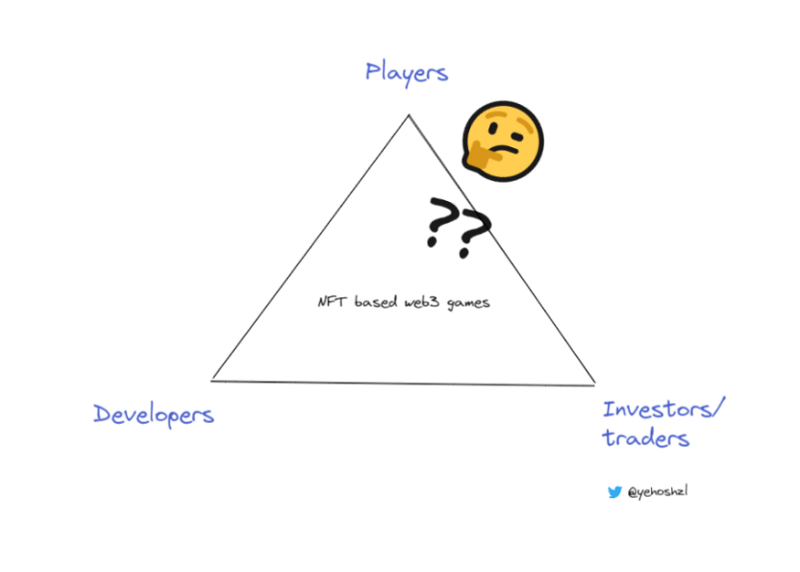
However, while trading and in-game economies are central to these games, they aren't the primary focus. Most players have never experienced games where ownership and trading are core gameplay elements. More importantly, it's the interoperable ownership economy—one that connects with the broader financial world—that lies at the heart of Web3.
Investor-Players
Investors and traders represent a new type of player. They care about ownership economics, return on investment, and speculation. They may also enjoy playing games, but their primary source of enjoyment comes from trading and winning. For them, finance *is* the game. While this might sound exciting, the biggest problem is that Web3 investors have the power to ruin the experience for regular players, making the trilemma less like a balanced triangle and more like a broken seesaw.
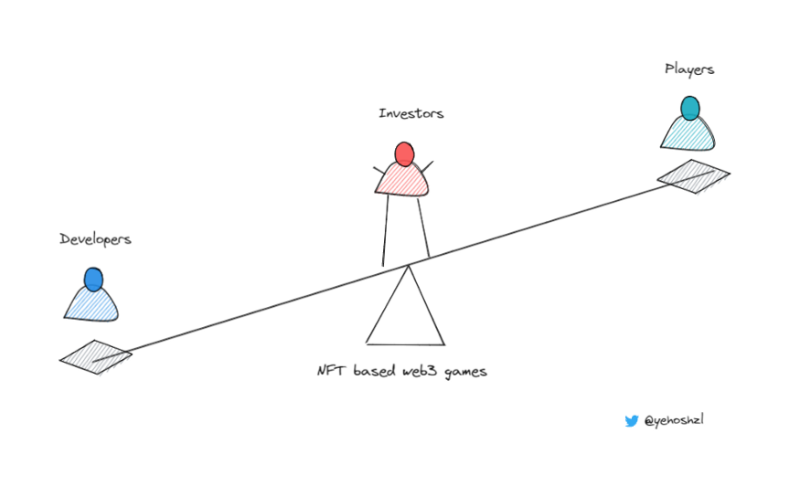
In traditional games, players and developers have a direct relationship; in Web3, investors become intermediaries.
Even a slight tilt from any side can throw the entire seesaw off balance.
This scenario has played out many times. When investors compete to drive up prices of Web3 game assets, it makes games expensive, boring to play, and sometimes unplayable altogether when blockchains become congested. In the worldview of traditional "free-to-play" games, these factors easily turn players away.
A simple example: characters, land, and items get bought up by early speculators, locking out genuine players from participating.
This naturally raises the question: Why do developers keep falling into the same trap? And how can we resolve this trilemma?
Solutions to the Web3 Gaming Trilemma
The root cause lies in Web3 game makers conflating investors and players, relying on the former to fund their games.
They need to stop doing this. They can raise funds through traditional means, or only accept investment once their game has proven its viability.
They must stop making games dependent on investor funding, separating game development financing from the gameplay itself. Let players play, and let investors and traders invest and trade separately.
You cannot expect an early-stage game to successfully serve both investors and players at once. If you're building a game, build a game first—add the financial layer later when monetization becomes relevant.
This doesn’t mean removing ownership economies—the core differentiator Web3 offers. We’re simply removing the financial aspects early on, making it Free to Own and Free to Play initially.
Fundraising should only be used to finance game development, keeping investors out of the actual gameplay experience. Then, once the game matures and aligns with financial systems—introduce tokenization and financialization.
One advantage of this approach: compared to Web2 whales, Web3 whales have significantly higher LTV (Lifetime Value—the projected net profit from an ongoing customer-product relationship). A simple example: iOS limits in-app purchases to $100 maximum. What was the last price point for BAYC? Much, much higher.
Therefore, successful games have enormous upside potential when eventually transitioning into Web3 and becoming tokenized.
In summary, the way to solve current problems in Web3 gaming is to build games centered around investment and trading mechanics—not real-world finance.
Join TechFlow official community to stay tuned
Telegram:https://t.me/TechFlowDaily
X (Twitter):https://x.com/TechFlowPost
X (Twitter) EN:https://x.com/BlockFlow_News






