A16Z: How Can Crypto Companies Manage Funds to Successfully Navigate a Bear Market?
TechFlow Selected TechFlow Selected
A16Z: How Can Crypto Companies Manage Funds to Successfully Navigate a Bear Market?
Fund management is a component of any project's long-term success. To maximize the chance of success, both cash management and long-term capital allocation should be well defined and executed.
 Navigating Web3 tides with focused insights
Authors: Jeff Amico, Maggie Hsu, Ed Lynch, and Emily Westerhold
Translated by: Wu Shuo Blockchain
The crypto market is highly volatile. Over the past year, prices plummeted dramatically before only recently rebounding from a harsh winter. While we cannot predict whether the future will bring further declines, recoveries, or sideways consolidation, investors can control how they prepare for such uncertainty.
Treasury management is the practice of managing a project’s resources over time. Generally, the goal is to ensure that an organization can remain solvent—meaning it has enough cash on hand to continue operations. This may involve covering near-term expenses like payroll and rent, or making long-term strategic investments such as acquisitions and R&D. Regardless of the type of expenditure, treasury management should be thoughtfully executed with the aim of achieving the project's core operational objectives.
Treasury management is a critical function for any organization and is especially important today given current market uncertainties. From decentralized autonomous organizations (DAOs) to traditional startups, teams are operating in a market environment marked by high inflation, low yields, and tighter financing conditions. In light of this new normal, teams should adopt more conservative cash management principles to weather the storm and emerge stronger afterward.
Below is a basic framework teams can follow.
1. Calculate Monthly Cash Burn
The first step is to build a realistic financial model. In accounting terms, this means tracking projected inflows and outflows on a monthly basis (i.e., net burn). It requires calculating how much cash a given project expects to spend each month relative to its expected income. This analysis should clearly break down components of both revenue and expenses. On the expense side, cash outflows should be categorized across key operational functions (engineering, business development, legal, etc.) as well as any anticipated non-operational costs (financing costs, taxes, one-time payments, etc.). Revenue should likewise be divided into operating and non-operating sources. This helps assess their relative predictability over time.
Conservative assumptions help ensure a project does not overestimate its revenue, which is particularly crucial when forecasting income. During economic downturns, revenues may decline—or at least grow more slowly—as customers tighten budgets or even go out of business. Even assumed recurring or contractually committed revenue may become harder to collect. While this kind of financial planning may not always apply to many pre-revenue crypto projects or early-stage companies, incorporating these considerations can help projects plan more realistically over the long term.
Prudent financial planning is standard practice among traditional startups and is increasingly relevant for DAOs. DAOs differ from traditional startups in many ways, including organizational structure and degree of decentralized control. In many cases, a DAO may consist of various unaffiliated entities collaborating toward shared goals and drawing budget allocations from a broader DAO treasury. By contrast, traditional companies are more likely to hold cash raised through multiple funding rounds directly on their balance sheets. However, as DAOs evolve and adopt more complex operational models, visibility into their overall financial health becomes equally critical. This ensures they can meet upcoming operational obligations—including contributor payments, incentive programs, and more—and provides transparency into the organization’s financial status, enabling better decision-making. While teams like MakerDAO have led the way in this type of analysis so far, we expect this capability to eventually become table stakes for all successful DAOs.
2. Fund Operating Expenses with Cash
Once the cash burn rate is established, a project can begin developing an overall treasury management strategy. The core priorities here are capital preservation, liquidity, and yield—in that order.
The primary objective is to cover near-term operating expenses. Before exploring yield-generating opportunities, it is essential to prioritize the safety and accessibility of capital. This typically means holding at least 12 months’ worth (ideally 18 months) of operating expenses in low-risk accounts such as bank deposits or money market funds—or, in the case of DAOs, maintaining reserves in high-quality stablecoins. These holdings generate relatively modest returns but serve as reliable funds to meet short-term liabilities. Be conservative.
In addition to maintaining sufficient cash for near-term expenses, projects should ensure assets and liabilities are matched by currency. In other words, if liabilities are denominated in U.S. dollars, then liquid assets should also be held in USD-denominated instruments. This is especially important for companies or DAOs that hold crypto assets but incur dollar-denominated expenses. To avoid being forced to sell depreciated assets during market downturns, teams should regularly convert assets into appropriate currencies to fund ongoing operations—ensuring all asset sales comply with applicable regulatory restrictions and are properly structured legally to meet tax obligations when due. Always keep what you need readily available.
Clearly, diversification remains uncommon. A recent study by Chainalysis, a crypto analytics firm, found that 85% of DAOs store their entire treasury in a single crypto asset—typically their native governance token. Among those holding stablecoins, most maintain less than 10% of their reserves in them. While some DAOs have limited operating expenses, those with substantial operations risk having to sell their native tokens at depressed prices to cover costs—or cutting back on core strategic initiatives.
Some projects may hesitate to sell crypto for fiat or stablecoins due to concerns about sending negative signals to the market. These are decisions specific to each project and depend on individual circumstances. However, regulatory and tax implications should always be considered.
Projects can avoid adverse outcomes—such as selling native tokens during downturns or scaling back strategic efforts—by maintaining adequate cash buffers. Proper cash management ensures a project can meet potential long-term obligations, which could be vital during economic downturns when accessing capital markets may be difficult. Advance planning also allows projects to stay focused on their core operational goals, knowing their working capital is secure.
3. Develop a Capital Deployment Plan
For organizations holding cash beyond their 12- to 18-month operating budget, exploring yield-generating opportunities may make sense. As with the operating reserve discussed above, this effort should take into account the project’s evolving liquidity needs over time. The chart below provides a high-level overview of various products and when they might be considered. Generally, as projects shift from operational cash (for day-to-day needs) to strategic cash (for growth and other opportunities), higher-yielding products become more appropriate.
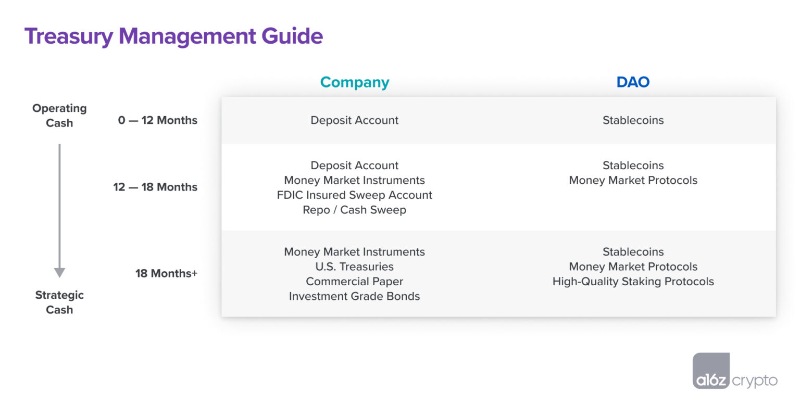
Each product carries different risk, return, and liquidity profiles. Before allocating capital to any of them, it’s useful to establish a foundational plan to guide the overall approach.
Below is a template investment policy we often share with traditional portfolio companies when discussing this topic—those listed in the left-hand column above. While some of these factors may not apply to early-stage companies, DAOs, or other projects, they offer valuable insight into how larger organizations approach cash management.
Generally, traditional firms allocate excess cash to safe assets, including instruments such as money market funds and investment-grade fixed-income securities (rated BBB or higher). Within a given portfolio, these firms typically diversify across maturity, credit quality, industry, and issuer. To illustrate, below is a breakdown of allocations for mid-to-late-stage companies with up to $100 million in assets at Silicon Valley Bank.
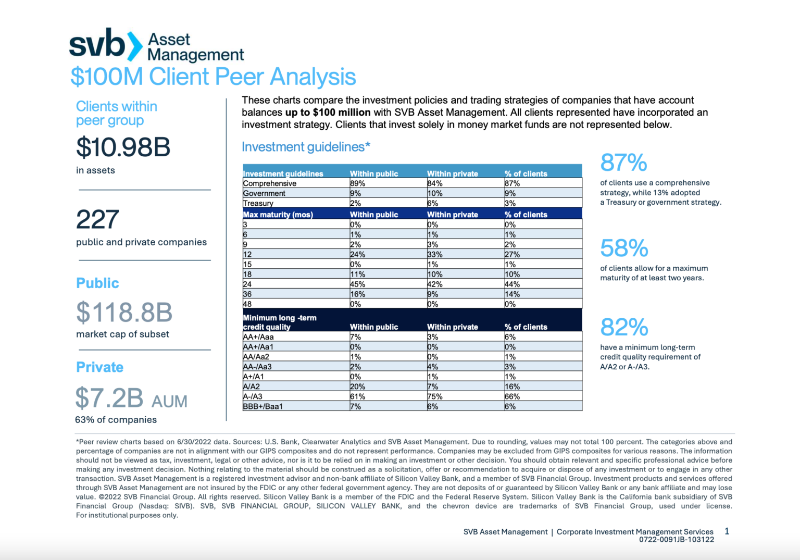
Although we’ve seen some corporate treasurers take on additional risk in recent years, a more conservative strategy is generally advisable—especially in the current interest rate environment, where yields on many traditional credit and banking products are beginning to rise. For example, certain money market instruments now yield close to 150 or 200 basis points in some cases, making them attractive options for cash management. Portfolios centered around these types of assets may be well-suited for many companies.
Meanwhile, for DAOs managing on-chain treasuries, a range of money market and fixed-income products have emerged in recent years that may be worth considering. These include platforms such as Compound, Element Finance, and Goldfinch. For longer-term cash, staking via high-quality protocols like Lido may also be a sensible option. However, as with more traditional products, it’s important to evaluate the risk, return, and liquidity profile of these options before allocation. Assessing any technical or operational risks associated with interacting with on-chain assets or protocols is also critical to ensure the project does not expose its assets to loss.
4. Build Operational Capabilities
With a strategy in place, it’s time to build the operational infrastructure needed to execute the plan. For companies following a more traditional treasury management approach, this includes selecting a banking partner and investment advisor, and establishing internal processes to ensure proper custody, reporting, valuation, controls, tax compliance, and audit requirements.
Teams don’t need to figure everything out alone—a banking partner should be able to provide access to investment vehicles aligned with the company’s investment policy. They may also recommend specialized investment advisors to help maximize yield within defined risk parameters. Always consult with an accounting or auditing firm regarding proper practices and procedures related to investment accounting and associated earnings.
For DAOs or crypto-native companies, the chart below outlines key operational components that may be required, along with some leading options for each.
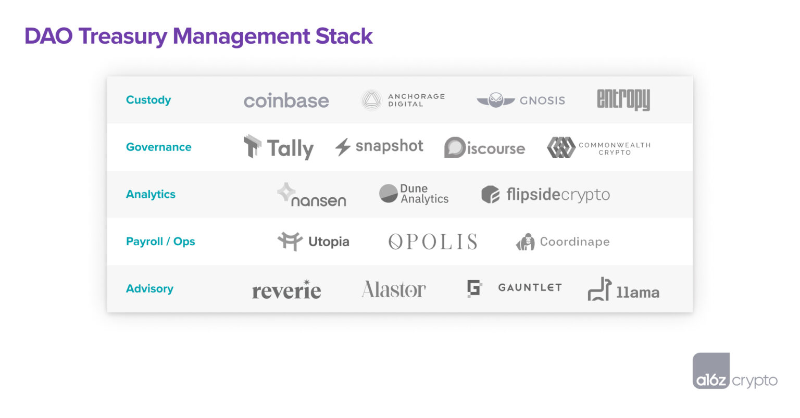
At a minimum, a secure wallet setup is essential to ensure assets are always safely held—especially when deploying assets to other protocols or moving them on-chain. Options range from traditional custodians like Anchorage or Coinbase to decentralized or multi-signature solutions such as Entropy or Gnosis.
Beyond custody, DAOs often require some form of governance approval from token holders before executing treasury strategies. Tools like Snapshot and Tally can facilitate voting, while forums such as Discourse and Commonwealth help foster community discussion.
DAOs can also leverage emerging suites of on-chain analytics tools—such as Nansen, Dune, and Flipside Crypto—to monitor the long-term performance of their strategies. Payroll and operations-focused tools like Opolis, Coordinape, and Utopia can assist with budget management and tracking spending over time.
Finally, given the complexity of the task, it may be worthwhile to consult firms offering advisory services in this space. These include traditional advisors like Silicon Valley Bank, as well as crypto-native firms such as Reverie, Alastor, Gauntlet, and Llama. Teams should also conduct regulatory assessments for various strategies and engage external advisors as needed.
5. Monitor and Adjust as Needed
Finally, teams should actively monitor their cash positions and adjust their strategies as necessary. This includes updating burn forecasts to ensure cash is properly managed. Teams should also periodically confirm that their strategy continues to align with core principles—capital preservation, liquidity, and yield. Doing so ensures they do not take on unnecessary risks as their strategy evolves over time.
Summary
Treasury management is a fundamental component of any project’s long-term success. To maximize the chances of success, both cash management and long-term capital allocation should be clearly defined and rigorously executed. The priority order should be capital preservation, liquidity, and yield.
Under current economic conditions, it is important to carefully consider potential unforeseen business expenses that may arise during normal operations. Once a project has a conservative estimate of the capital required to sustain operations, it should designate a cash buffer equal to at least 12 months (or preferably 18 months) of net cash outflows. Any remaining cash reserves can then be allocated according to a formal policy that clearly defines relevant stakeholders, each party’s responsibilities, institutions involved in executing the strategy, and reporting requirements for holdings. After implementation, asset performance should be monitored and the strategy’s suitability regularly evaluated in relation to the project’s evolving needs.
Preparation today prevents pain tomorrow.
Join TechFlow official community to stay tuned
Telegram:https://t.me/TechFlowDaily
X (Twitter):https://x.com/TechFlowPost
X (Twitter) EN:https://x.com/BlockFlow_News
 a16z
a16z