








Project Galaxy: Builder of Web3 credential data networks, a decentralized lightweight solution
TechFlow Selected TechFlow Selected
Project Galaxy: Builder of Web3 credential data networks, a decentralized lightweight solution
Web3 has become the most compelling narrative framework of the moment.
 Navigating Web3 tides with focused insights
Web3 has become the most compelling narrative of our time.
In the Web2 era, centralized entities such as Google and Facebook typically manage user data through account systems. As the internet ecosystem continues to evolve, people have gradually come to recognize the importance of individual data sovereignty.
The spirit of Web3 lies in individual ownership of identity and data sovereignty—every record of a person’s activity on the network should be controlled by themselves. These data credentials are often represented using NFTs as their carrier.
To explore the applications and empowerment potential of data credentials in the Web3 world, Project Galaxy was born.
Project Galaxy is the world's largest Web3 credential data network, built across multiple blockchains. Guided by principles of openness and collaboration, it helps Web3 developers and protocols deeply build products and communities using credential data.
Why Are Data Credentials Important?
In the Web2 world, we frequently receive personalized advertisements from platforms like Google and Facebook tailored to our preferences. These targeted ads are generated based on our past online behaviors—the hallmark application of credential data or big data analytics.
Digital credentials are already pervasive in our daily lives, and this holds true in Web3 as well. Moreover, due to blockchain’s traceability and immutability, it provides a more favorable environment for creating and tracking credential data.
There are numerous use cases for on-chain digital credentials—for example, your history of borrowing and lending on AAVE or Compound without ever being liquidated; records of participating in DAO proposals and voting within a protocol; or proof of providing liquidity to a specific protocol during a certain period. Such credentials can assist Project Galaxy’s partners in product development and community operations.
To understand the significance of Project Galaxy’s credential data network, we can draw an analogy with Discord’s architecture.
Discord offers community managers various tags for member management and different channels for distinct conversation scenarios. Thanks to its rich functionality, Discord has become the most scalable and highest-engagement community platform—making it one of the primary tools adopted by most Web3 protocols for community governance.
According to the Project Galaxy team: "Digital credentials are important because they offer high-frequency use cases. Protocol developers can leverage credentials to calculate users’ credit scores, identify target audiences, reward contributors, and more. As Web3 and DAOs continue to grow, participants' behavioral data will explode in volume. Project Galaxy aims to provide the essential infrastructure to help these new participants establish critical digital credentials."
Just as many people previously considered polishing their on-chain resumes, credential data will become an inseparable part of our interaction with the Web3 world. High-quality on-chain profiles will also enable us to participate more easily in Web3 projects and DAOs.
Project Galaxy’s vision is to become the foundational credential data service infrastructure for the future Web3 world, serving various Web3 protocols by offering low-barrier access to user behavior data collection.
This may also explain why Project Galaxy refers to itself as the “LinkedIn of the blockchain.”
Product Architecture
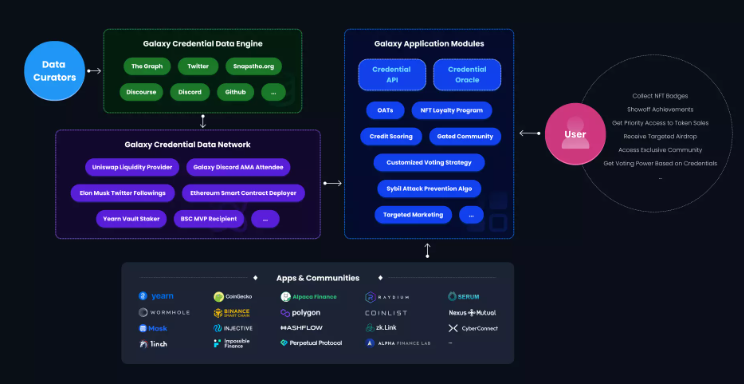
Project Galaxy primarily targets B2B users, offering developers three core services: Application Modules, Credential Oracle Engine, and Credential API.
Application Modules
Key application modules offered by Project Galaxy include: Galaxy OATs (on-chain achievement tokens), NFT Loyalty Programs, Growth Hacking Campaigns, Gated Communities, and Customized Governance.
Among them, Galaxy OAT is a lightweight on-chain credential solution for organizing and distributing NFT badges via the Project Galaxy network. Using Galaxy OAT, protocol developers can customize community events and reward members with NFT badges to drive growth and enhance engagement. All OAT NFT metadata is stored on NFT.Storage, powered by IPFS and Filecoin.
As a lightweight solution, developers only need to click “Create,” connect their wallet, and set up a dedicated event page. After submitting parameters and badge designs, they can launch the campaign and issue NFT credentials. Note that developers must first obtain a Project Galaxy Beta access pass (during the closed testing phase).
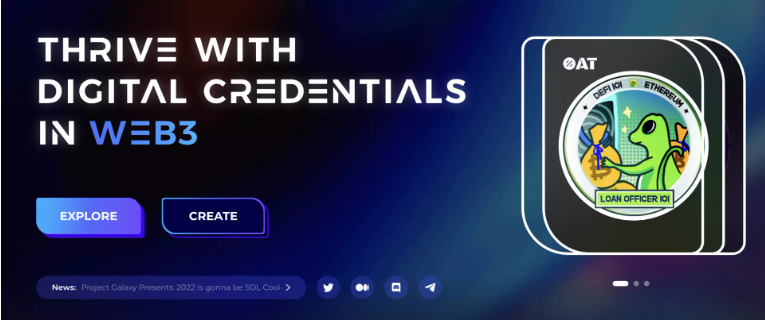
Notably, participants can receive event NFTs simply via email, without paying any gas fees.
Additionally, Project Galaxy mentions: "Developers can also use the Credential Oracle Engine and Credential API for more customized use cases, such as credit scoring and Sybil attack prevention algorithms."
Future plans include launching open APIs for integration into other Web3 apps, enabling QR code scanning to claim NFT badges (already tested in a limited capacity during the ETHDenver OAT treasure hunt), and sending notifications when new OAT NFTs are available.
Galaxy ID
Beyond NFT infrastructure, Project Galaxy is building a decentralized identity system powered by its robust credential data network—the foundation for becoming the “LinkedIn of the blockchain.”
However, this identity system encompasses more than just on-chain information.
By integrating data sources such as Snapshot.org, Twitter, and GitHub, Project Galaxy consolidates users’ off-chain social media data with on-chain multi-chain data (including EVM and heterogeneous public chains) into a unified account system.
Each user receives a Galaxy ID, representing their identity, behavioral data, and credentials in Web3. External parties can view a user’s cross-chain activities and off-chain social footprint through their Galaxy ID.
Developers can integrate the Galaxy ID toolkit to offer personalized features or enrich user profiles within their applications.
One of the most well-known implementations of Project Galaxy’s Web3 DID is CyberConnect. CyberConnect is a public, decentralized social graph protocol that establishes data standards, storage infrastructure, and recommendation indexing for social connections.
Besides CyberConnect, projects such as Unipass and Salad Venture have already integrated Galaxy ID into their products.
Comparison with POAP
Many tend to categorize POAP and Project Galaxy as similar products. However, in an interview with BlockBeats, Project Galaxy founder Charles responded: "I believe Project Galaxy’s NFT infrastructure is significantly more powerful than POAP’s—supporting features like NFT mystery boxes, synthesis, paid distributions, using NFTs for community voting, redeeming merchandise, unlocking content, and offering better UX for both project teams and end-users."
Past Activities on Project Galaxy
According to official data, over 100 protocols have launched more than 500 campaigns on Project Galaxy, including BSC, Polygon, Solana, CoinList, Yearn Finance, Alpaca Finance, CoinGecko, Perpetual Protocol, Multicoin Capital, Injective, Raydium, Serum, and others.
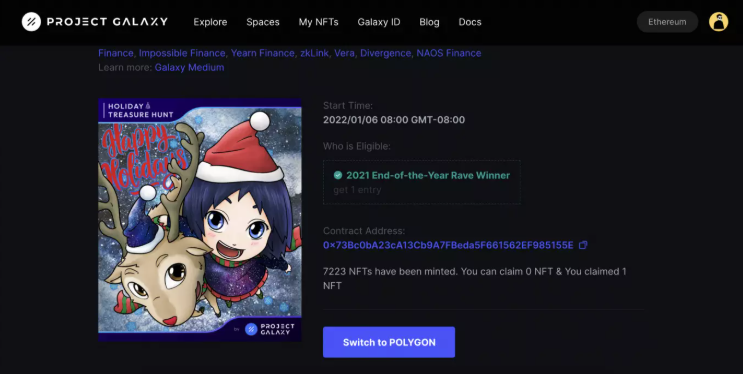
Project Galaxy’s largest and most popular campaign recently concluded on January 12: the Web3–2021 Project Galaxy EoY Rave growth hacking event (Growth Hacking in Web3–2021 Project Galaxy EoY Rave).
Participants completed a series of nine tasks—including executing $100 USDC worth of trades on Perpetual Finance, staking more than 10 MoonPot tokens ($POTS) into the Ziggy Pot pool, and locking over $100 worth of $WOO tokens into WOOFI—to claim the Galaxy Girl and Reindeer NFT. A total of 7,212 Project Galaxy community members completed all tasks and claimed the NFT.
In addition, Project Galaxy hosted two major events in 2022: SOL COOL 2022 on February 11 and the ETHDenver OAT Treasure Hunt on February 15.
SOL COOL 2022 was similar to the Galaxy Girl and Reindeer campaign, requiring interactions with designated Solana ecosystem protocols. Over 33,400 new users participated, with 4,826 completing all tasks.
The ETHDenver OAT Treasure Hunt was co-hosted by Polygon Studios, Sushi, Coinbase, Decentraland, and Aave. Attendees could find Project Galaxy team members at ETHDenver sporting events and scan QR codes via MetaMask Mobile to receive Galaxy OAT NFT badges.
GAL Token Economics
A total of 200 million GAL tokens will be issued. 5% of GAL will be publicly sold on CoinList. Ten million GAL tokens will be offered at $1.50 each, with weekly linear unlocking over 12 months post-sale. 1.83% of tokens will be airdropped to early users holding Project Galaxy NFTs.
The complete GAL token distribution is as follows:
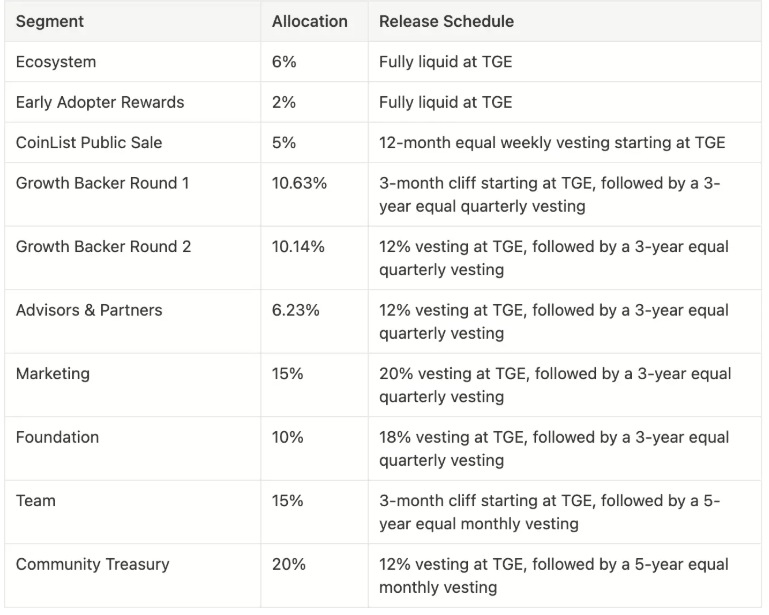
According to official documentation, GAL tokens will serve several key functions:
Governance
GAL tokens will be used for voting and governance within Galaxy DAO. GAL holders will control the community treasury and influence how platform fees are allocated.
Pay for Application Module Usage
Developers must pay GAL tokens when using Project Galaxy’s credential data network and application modules. Each interaction with Project Galaxy incurs a GAL fee. Most of these fees go to curators, while the remainder flows into the community treasury.
Payment for Galaxy Oracle Engine and Galaxy Credential API
Developers can pay GAL tokens to query participant credential data via the Galaxy Oracle Engine and Galaxy Credential API.
Curate Digital Credentials
Curators can use GAL tokens to signal the value of a credential dataset. Each dataset includes a revenue stream proportionally distributed to credential holders. Due to bonding curve mechanics, the value of credential shares increases as more users purchase them.
Curators who buy shares early can later sell them for profit in GAL tokens as the dataset appreciates in value—an incentive encouraging more curators to discover valuable credential datasets.
In the long run, the more credential data accumulates in the network, the more GAL tokens will be locked into the bonding curves of digital credentials.
Currently, the curation system is still under development.
It’s worth noting that while GAL has diverse utility, its value heavily depends on the growth of Project Galaxy’s own ecosystem—the more use cases emerge, the higher the potential value of GAL.
Investments and Partnerships
Project Galaxy has completed two funding rounds.
Its seed round was backed by institutions including Multicoin Capital, Divergence Ventures, Hard Yaka, and founders of various crypto projects.
On January 25, Project Galaxy raised $10 million, led by Multicoin Capital and Dragonfly Capital. Participating investors included Coinbase Ventures, Binance Smart Chain Growth Fund, Solana Ventures, Jump Capital, and APE NFT.
Conclusion
In the crypto space, many brilliant developers are exploring token governance and DAO architectures. The emergence of credential data networks is helping seamlessly integrate on-chain and off-chain behavioral data.
Protocol developers can use these credentials to identify genuine supporters and reward them economically. Leveraging real fans for DAO governance appears to be a superior approach—their decisions often align with the protocol’s long-term interests, making decentralization more democratic. This mechanism operates independently of token holdings, truly unlocking the power of NFTs.
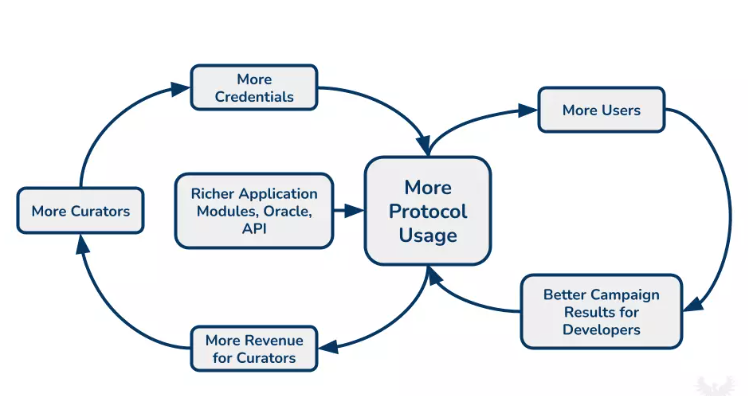
What Project Galaxy is building has massive network effects.
Multicoin Capital commented:
"Project Galaxy has created an organic flywheel:
1) With the richest data and easiest-to-use participation modules, Galaxy is now the go-to resource for projects seeking user acquisition;
2) As more users earn rewards based on credential data, others follow suit (generating desired behaviors), creating even more credential data;
3) This growing usage of the Galaxy Network incentivizes credential curators to contribute more datasets, as higher usage means greater earning potential for curators—creating a self-reinforcing cycle that attracts even more projects to adopt Project Galaxy."
Join TechFlow official community to stay tuned
Telegram:https://t.me/TechFlowDaily
X (Twitter):https://x.com/TechFlowPost
X (Twitter) EN:https://x.com/BlockFlow_News


