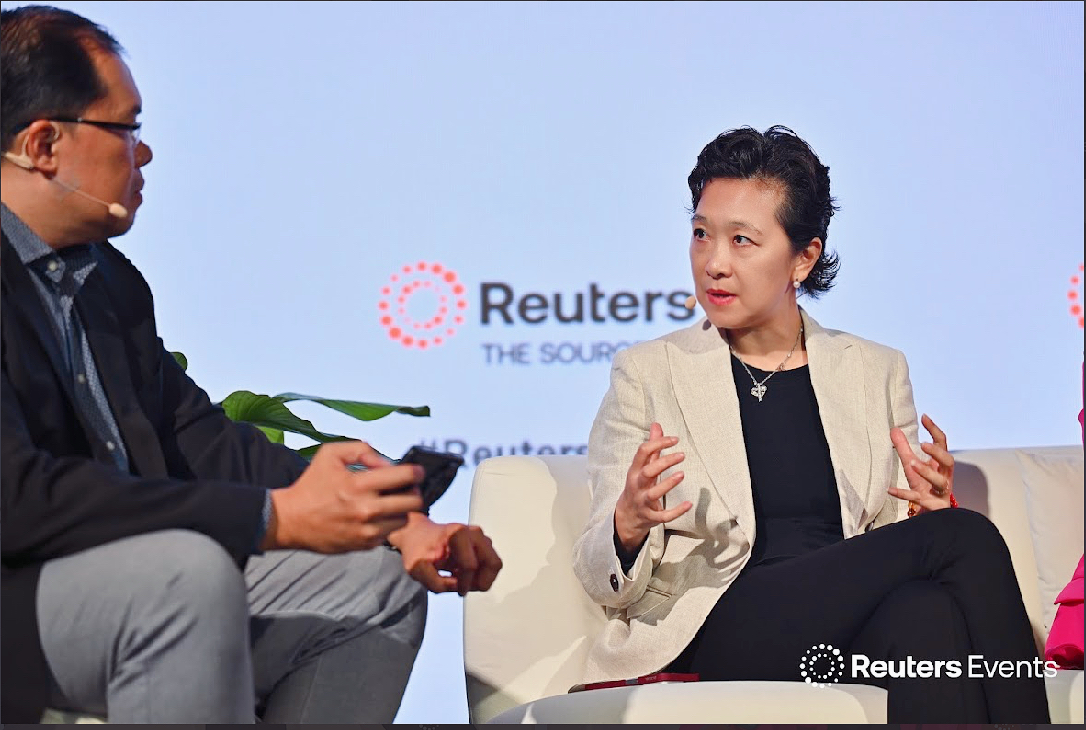
TechFlow news, at the roundtable forum held by Reuters NEXT Asia on July 9, Rachel Qiu, Head of Business Development of HashKey Group and COO of the On-Chain Business Group, along with industry representatives from institutions such as Schroders Investment Management, Invesco, Revo Digital Family Office, jointly discussed the development trends of the global digital asset market, institutional adoption paths, and the future direction of on-chain financial infrastructure.
Rachel stated that the U.S. is currently driving digital assets into the mainstream capital market mainly through mature financial products such as Bitcoin spot ETFs, while Asia is accelerating the on-chain integration of real economy scenarios such as Real World Asset (RWA) tokenization, stablecoin payments, and cross-border trade, building a more comprehensive on-chain financial ecosystem. These two development paths represent different stages of evolution in the digital asset industry and will jointly promote the development of the global digital asset market.
Rachel pointed out that currently, for the vast majority of enterprises in the process of going on-chain, the real obstacle is that multiple links such as asset issuance, legal compliance, custody, identity authentication, trading, and ecosystem collaboration remain highly fragmented. Addressing this industry pain point, HashKey On-Chain is building on-chain financial infrastructure oriented towards institutions. Among them, the HashKey Issuance Platform (HIP) breaks down the tokenization issuance process into seven standard steps through standardized and modular methods, providing enterprises with one-stop support covering the entire lifecycle of asset issuance.
At the level of practical business applications, taking cross-border trade financing as an example, when key trade documents such as electronic bills of lading in international trade are digitized and achieve on-chain circulation, goods delivery and fund settlement can rely on blockchain to achieve atomic synchronization. Cross-border settlement processes that previously took days or even weeks are expected to be shortened to the minute level. This will effectively improve the efficiency of global trade fund flow, is of significant importance to international trade and financial centers such as Hong Kong and Singapore, and will also become an important application direction for the development of Asian on-chain financial infrastructure.
Rachel stated that the core of future industry competition will no longer be limited to single products, but rather who can build on-chain financial infrastructure that combines openness, interoperability, and institutional-grade compliance capabilities.