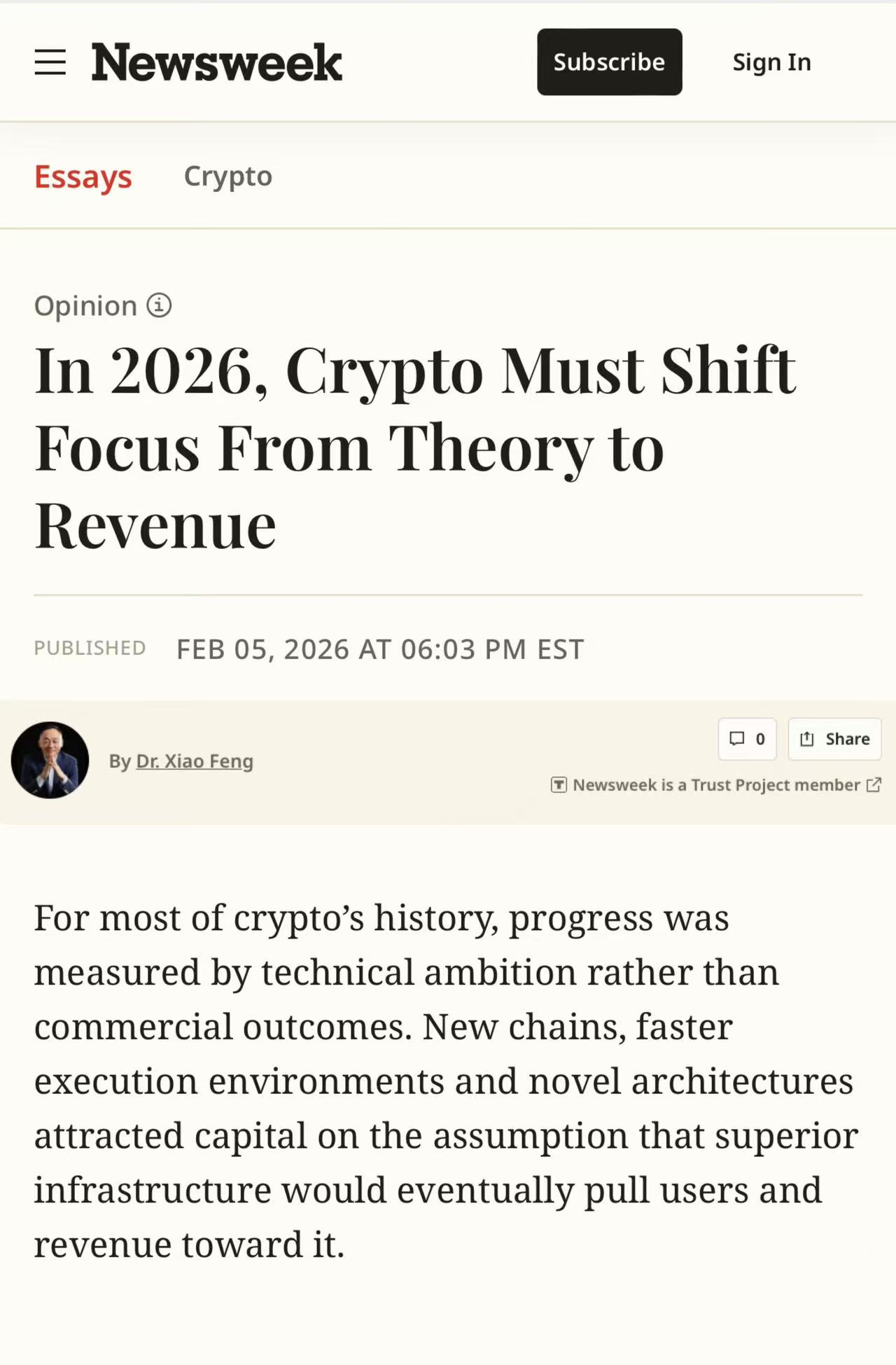
TechFlow News: On February 6, Dr. Feng Xiao, Chairman and CEO of HashKey (3887.HK), published an article in the U.S. news magazine Newsweek, stating: “The next generation of ‘killer applications’ in the crypto industry will not remain confined to internal cycles within the crypto ecosystem. Instead, they must integrate on-chain infrastructure with off-chain economic activities—bringing new revenue, users, and capital onto the network. The key to institutional adoption lies in whether blockchain systems can operate securely, compliantly, predictably, and at scale within high-risk, heavily regulated environments.”
He emphasized that blockchain’s value does not lie merely in replicating Web2 on-chain. Its incremental value resides in compressing financial processes—traditionally reliant on multiple intermediaries, lengthy settlement cycles, and repeated reconciliation—into automated clearing and execution on a shared ledger. This reduces transaction friction, improves efficiency and capital turnover, and reshapes organizational approaches to trading, settlement, risk management, and reconciliation—making them more automated, verifiable, and cost-effective.
At the institutional implementation level, the industry’s bottleneck is shifting from “performance” to “trust and operational capability.” Privacy-preserving computation, built-in compliance, auditable risk management, and bank-grade security will become critical components of the next-generation infrastructure. Compliance, monitoring, and risk management capabilities determine whether institutions can maintain regulatory consistency and control during expansion; without these capabilities, scalable growth will be unsustainable.
He concluded that future competition will no longer center on “who is faster,” but rather on “who can operate stably under real-world constraints and translate on-chain capabilities into sustainable adoption and value creation.”