
Bitget UEX Daily Report | Nasdaq Plunges Then Narrows; Inflation and Tariffs Disrupt Valuations; Bitcoin Reclaims $60,000 (November 26, 2026)
Author: Bitget
Featured Hot News
US Economy: PCE Inflation Remains Sticky, GDP Upgrade Cannot Replace Latest Consumption Signals
The US PCE price index rose 3.8% year-on-year in October, while core PCE increased 3.3% YoY. Both indexes saw a 0.3% month-on-month rise. Nominal consumer spending grew 0.3% MoM over the same period, with real consumption remaining essentially flat, indicating that spending growth did not fully translate into an expansion in consumption volume.
Third-quarter annualized GDP growth was revised up from 3.4% to 4.3%, primarily reflecting upward revisions in investment and consumption data. These two sets of data need to be viewed across different periods: stronger Q3 growth cannot be directly extrapolated to confirm continued acceleration in October demand; meanwhile, inflation remains above target and does not clearly signal easier interest rate expectations.
Trade Policy: US Proposes New Tariff Measures Against 14 Economies
On November 25, the Office of the U.S. Trade Representative issued findings under its Section 301 investigation regarding structural overcapacity in manufacturing, proposing countermeasures against 14 economies, including China, the EU, Japan, and South Korea. The tariff arrangements remain proposals and should not be described as fully implemented.
The transmission of this disruption lies in import costs, supply chain adjustments, and the risk of retaliatory measures from trading partners. If companies struggle to raise prices, margins may face compression; if costs are passed on to end consumers, inflationary pressures could linger, increasing the likelihood of simultaneous pressure on earnings and valuations.
International Energy: Claimed Refinery Attack Pushes Up Oil Prices, Actual Supply Impact Remains to be Confirmed
The Houthi group claimed an attack on Saudi Arabia's Ras Tanura refinery, prompting markets to reprice supply interruption risks. On November 25, Brent crude futures settled at $94.61 per barrel, while WTI climbed to $83.68 per barrel.
Currently, it is necessary to distinguish between claims of attacks and confirmed production losses. Rising oil prices will increase transportation and production costs, but future trends will depend on facility operations, export shipments, and supply recovery.
Market Review
Analysis of Notable Moves
On November 25, the Nasdaq intraday dropped over 4% before closing down 0.62%; the S&P 500 fell 0.25%, while the Dow Jones Industrial Average gained 0.33%. The Magnificent Seven tech stocks showed 2 gains and 5 losses, and the VIX rose to 28.29. While clear buying support emerged, volatility pressures have not yet dissipated.
First, inflation and tariffs present a dual constraint. The PCE data lacks sufficient evidence of cooling, and new tariff proposals add uncertainty to future costs; for assets reliant on distant profits to support valuations, the market needs to reassess the pace of profit realization versus financing costs.
Second, AI investing continues to differentiate between demand and investment returns. Dell's strong server orders prove genuine demand exists, but this does not automatically resolve customer financing, data center delivery, and capital recovery challenges; Nvidia's 3.91% drop and Micron's 4.53% decline overnight indicate that order growth alone is insufficient to erase valuation concerns across the entire supply chain.
Third, intraday recoveries indicate selling met buying interest, which is still insufficient to confirm a trend reversal. HPQ rose 11.49% and Meta gained 3.40%, occurring alongside declines in some AI names; investors are beginning to reallocate based on company performance and valuations. Meanwhile, the VIX remains elevated, and a single-day rebound ahead of holidays requires further trading confirmation.
Commodities and Foreign Exchange Performance
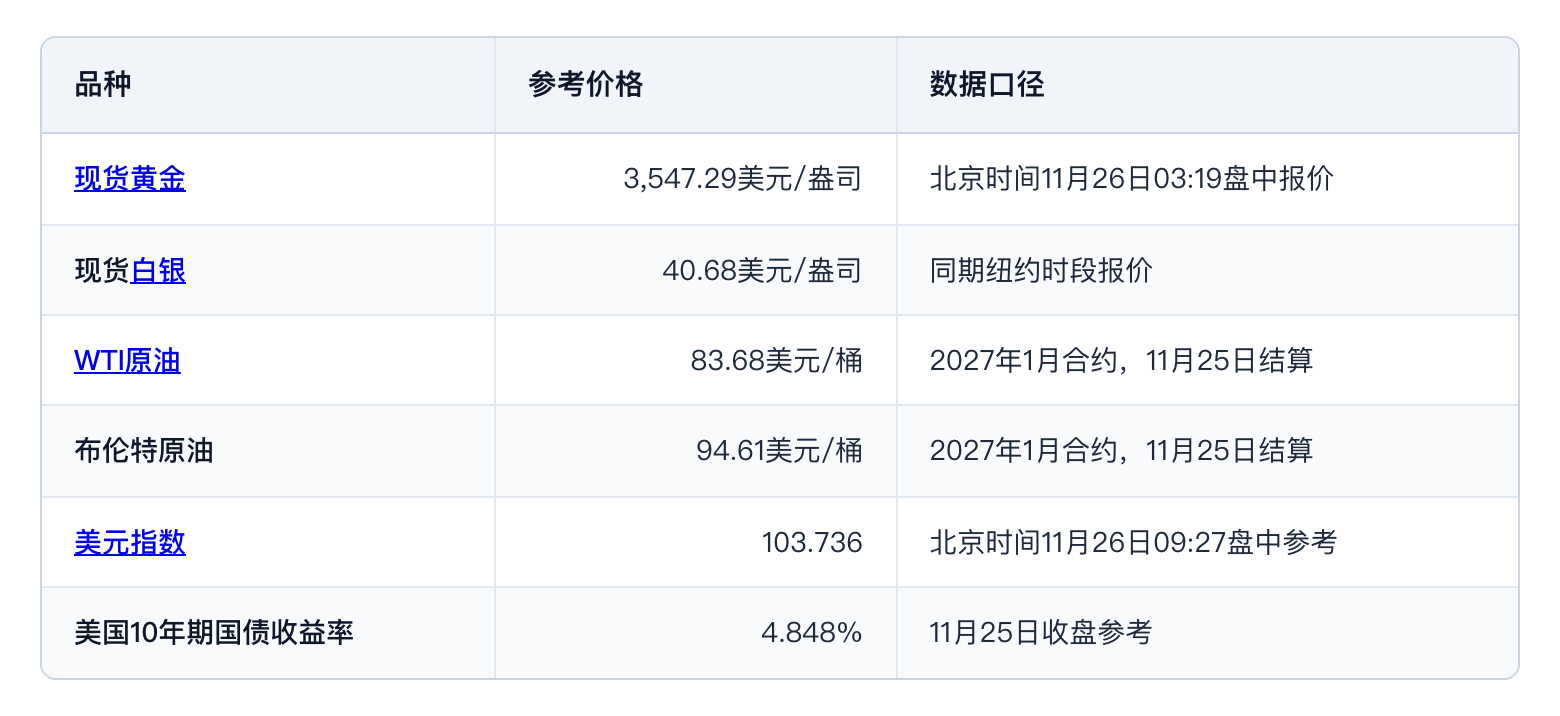
Precious metals under pressure alongside rising crude oil reflect different pricing dynamics: the former remains constrained by interest rate outlooks, while the latter is supported by supply risks. The pullback in 10-year US Treasury yields on the day indicates that equity market volatility cannot be simply attributed to rising bond yields; instead, assessments must incorporate policy uncertainty and earnings expectations.
Cryptocurrency Performance
As of 09:37 Beijing Time on November 26, BTC traded at approximately 60,694.54 USDT, up 1.99% over 24 hours; ETH stood at about 1,698.77 USDT, up 1.92%. The total cryptocurrency market cap was roughly 2.107 trillion USDT, down 0.96% in 24 hours (last updated at 09:28).
BTC | Liquidation Zone Observation: The more pronounced potential short liquidation cluster above is approximately $61,200-$61,700, about 0.95%-$1.77% away from current prices; the potential long liquidation cluster below is around $58,900-$59,800, roughly 1.36%-$2.85% away. We are currently closer to the upper zone; if prices continue higher, attention should be paid to how short covering amplifies volatility.
ETH | Liquidation Zone Observation: The clearer potential short liquidation cluster above is approximately $1,715-$1,730, about 1.07%-1.95% from current levels; the potential long liquidation cluster below is around $1,660-$1,680, roughly 0.99%-2.17% away. The distances above and below are similar, with the lower side slightly closer, requiring simultaneous observation of long deleveraging during pullbacks and short covering during rallies.
Institutional Holding Cost | BTC: Strategy disclosed on November 23 that as of November 22, it held 851,305 BTC, with an average all-in cost of approximately $75,446 per coin; the current price trades about 19.64% below this benchmark, representing a reference unrealized loss at the asset level. This holding cost is far from the current liquidation zones and has not formed nearby price resonance.
Quick Take: After reclaiming the $60,000 level, focus first on whether BTC can continue pushing near $61,200; for ETH, watch price action between $1,680 and $1,715. Neither coin's rebound has been accompanied by a synchronous strengthening in total market cap, making the sustainability of breakouts especially worth monitoring over the holiday period.
Major US Equity Indices Performance
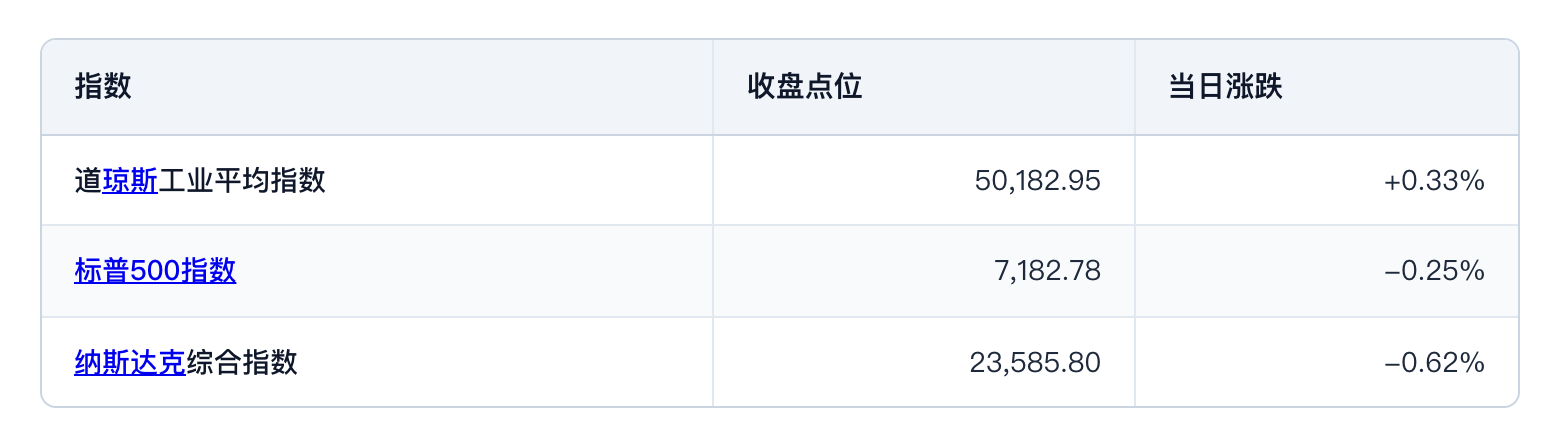
The closing decline was significantly narrower than the intraday drawdown, indicating improved buying support at lower levels. The Dow's continued outperformance vs. the Nasdaq also suggests the market is still distinguishing assets by earnings certainty, and a broad tech sector recovery has not yet materialized.
Magnificent Seven Tech Giants Performance
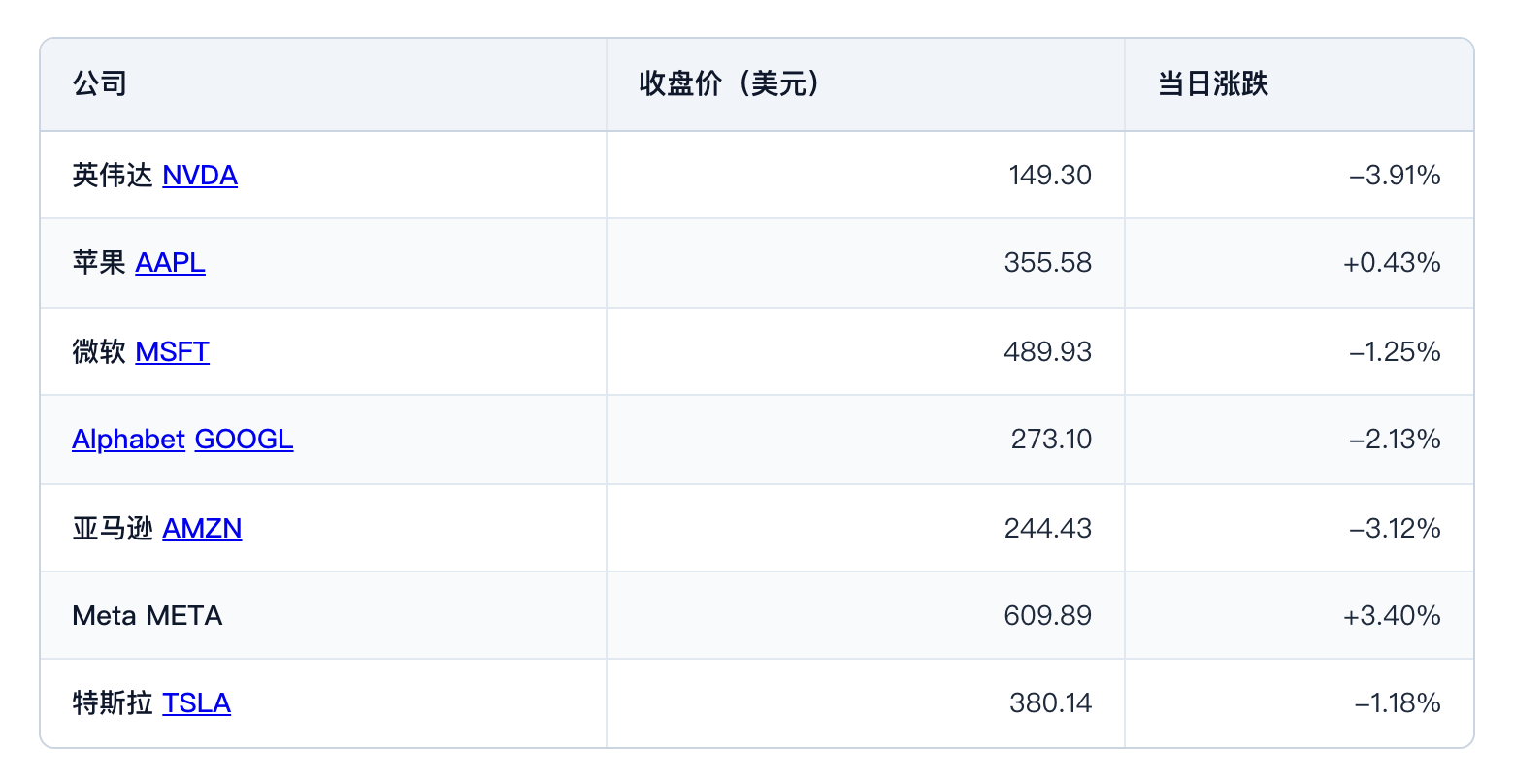
The seven giants saw 2 gainers and 5 losers combined, with Meta and Apple posting gains while Nvidia and Amazon faced noticeable pressure. Major tech stocks moved inconsistently, warranting separate tracking of profit realization across advertising, cloud services, and hardware businesses moving forward.
Sector Movement Observations
Chips and computing power-related stocks remain weak. Micron fell 4.53%, AMD dropped 1.75%, Nebius declined 2.66%, but CoreWeave only dipped 0.08%; the downward momentum differentiated from the previous day, so one cannot conclude that orders have broadly deteriorated or that risks have been fully priced in.
Hardware stocks reacted strongly post-earnings. HP surged 11.49%, while Dell recovered to close up 0.60% after intraday weakness; despite belonging to the same sector, differences in actual profitability, guidance, and market expectations continue to drive divergent reactions.
Crypto-linked equities repaired following spot price recoveries. Strategy rose 3.11%, Coinbase gained 1.34%, and Robinhood edged up 0.20%; this reflects a broader risk-asset bounce but cannot replace independent verification through ETF fund flows and corporate balance sheets.
Deep Dive Analysis of Key US Stocks
HPQ: Surges Post-Earnings, Profit Quality Remains the Next Test
Event Overview: HPQ rose 11.49% on Nov 25, closing at $31.15. Reported Q4 revenue came in at $16 billion, up 9.3% year-over-year; non-GAAP EPS was $0.83, which included a positive impact of $0.15 per share from tariff refunds.
Market Interpretation: The stock reaction indicates the earnings report received positive feedback, but revenue growth versus sustained profitability improvements require separate tracking. Tariff refunds do not imply synchronized growth in core business margins, making future monitoring of memory and storage costs essential.
Investment Implications: Key metrics to watch include product pricing, inventory levels, and cash flow. The company adjusted its non-GAAP methodology for fiscal 2027 to exclude share-based compensation expenses; cross-year comparisons should maintain consistency.
DELL: After Strong Orders, Stock Undergoes Initial Stress Test
Event Overview: Dell touched an intraday low of $265 on Nov 25, ultimately closing at $297.06, up 0.60%. Previously disclosed figures showing Q3 revenue of $54.9 billion, $60.2 billion in new AI server orders, and $132.3 billion in ending backlog provide a solid foundation for demand visibility.
Market Interpretation: The coexistence of strong fundamentals and severe intraday swings indicates the market is scrutinizing factors beyond order size, including delivery timelines, customer funding sources, and margin conversion. The closing recovery improved daily performance but did not resolve these underlying questions.
Investment Implications: Future focus should be on the speed of order-to-revenue conversion, server margins, and operating cash flow. Sustained alignment among these three factors will be key to translating demand proof into valuation support.
DE (Deere & Company): Market Focuses on Cyclical Stabilization, Operational Recovery Remains Uneven
Event Overview: Deere gained 4.44% on Nov 25, closing at $641.02. Q4 revenue totaled $12.115 billion, down 2% YoY, with net income of $1.051 billion; FY2027 net income guidance is set at $4.5B-$5.25B.
Management Commentary: Management noted early signs of improvement in North American heavy farm equipment, though guidance still reflects end-market uncertainty and includes one-time non-cash pension settlement charges. The stock rise is better interpreted as a market response to cyclical stabilization rather than evidence of comprehensive earnings acceleration.
Investment Implications: Monitor farmer purchase demand, dealer inventories, and production scheduling. Cyclical recovery will only gain traction when demand improvement coordinates effectively with inventory digestion.
Market and Project Developments
Bitcoin ETFs: Full Data Still Reflects Outflows, Latest Trading Day Reporting Incomplete
On Nov 24, US spot Bitcoin ETFs recorded a net outflow of $231.4 million, led by IBIT's $175.3 million outflow. For Nov 25, disclosed funds show a net outflow of $123.3 million, but figures for IBIT and others remain pending, so they should not be treated as final full-day results.
Corporate Treasury: BitDigital Sells Partial ETH Holdings to Repay Secured Borrowing
Bit Digital disclosed on Nov 25 that between Nov 15 and 23, it sold 29,825 ETH for net proceeds of approximately $50 million, entirely allocated to repaying the principal of a Galaxy borrowing facility, reducing outstanding debt to $50 million. This represents a clear asset sale and de-leveraging action, not a concentrated intraday dump.
On-Chain Finance: SBI Solana Global Officially Launches Operations
SBI, Sumitomo Mitsui Financial Group, and the Solana Foundation announced the completion of contracts for their new collaborative framework, with SBI R3 Japan commencing operations under the SBI Solana Global banner. Business initiatives span stablecoin payments, tokenization of financial and real-world assets, and on-chain asset management, with next steps focusing on specific product deployments and scale.
Crypto Investment Products: Fidelity Files Registration Application for Chainlink Fund
Fidelity submitted an S-1 filing on Nov 25 for its proposed Chainlink fund, which aims to hold LINK directly and list on NASDAQ under the ticker FLNK, without participating in LINK staking. A registration filing does not equal approval; the next phase involves monitoring document effectiveness and product launch progress.
Macro Tracker: Beige Book Reveals Mild Growth Amidst Cost Pressures
The latest Beige Book reports that eight of the twelve Federal Reserve districts experienced slight to mild growth, while four remained largely flat; consumer spending changed little, with wage/benefit growth accelerating somewhat. The report also notes that input costs for some enterprises are rising faster than sales prices, indicating resilient demand but potentially squeezed profit margins.
Today's Market Calendar

Key Events Outlook: US markets are primarily focused on holiday schedules today; watch for follow-up tariff details, energy supply developments, and crypto market independence. Shortened trading hours for US equities and certain hedging markets mean cross-asset price movements may not align; short-term volatility should not be prematurely extrapolated into trend shifts.
Institutional Viewpoint: Charlie Ripley, Senior Investment Strategist at Allianz Global Investors, noted on Nov 25 that this sell-off was largely sentiment-driven, making some companies attractive on a PE basis. This view supports evaluating individual companies' prices and earnings independently, without implying the entire AI sector has finished its correction.
This article is for market information purposes only and does not constitute investment advice.