Tokenized US Stocks Raised $2.4 Billion in Six Months: How Can Collateralized Lending Unlock New DeFi Markets?
Author: SeaLaunch (@sealaunch_)
Translated by: TechFlow
TechFlow: Over the past six months, tokenized US equities led all RWA sectors with net inflows exceeding +$2.4 billion, while US Treasuries faced net outflows of $1.4 billion. However, simply putting stocks on-chain is only the first step. The true breakthrough for on-chain finance lies in integrating them as collateral into lending markets, unlocking liquidity while retaining exposure to US equities.
On-chain data intelligence firm SeaLaunch provides an in-depth breakdown of the dedicated lending instance built by Coinbase and Aave V4 using a Hub & Spoke architecture. It analyzes how three leading strategy management firms construct US equity carry trades through 22 vaults, revealing the underlying mechanics that transform tokenized assets from simple holdings into efficiently circulating network capital.
US Equities Become the New King of RWA Net Inflows: From Simple Holdings to Collateralized Lending
Over the past six months, tokenized stocks surged ahead of all real-world asset (RWA) sub-sectors with total net inflows exceeding +$2.4 billion. Meanwhile, previously highly sought-after tokenized US Treasury bonds faced net outflows of $1.4 billion during the same period.
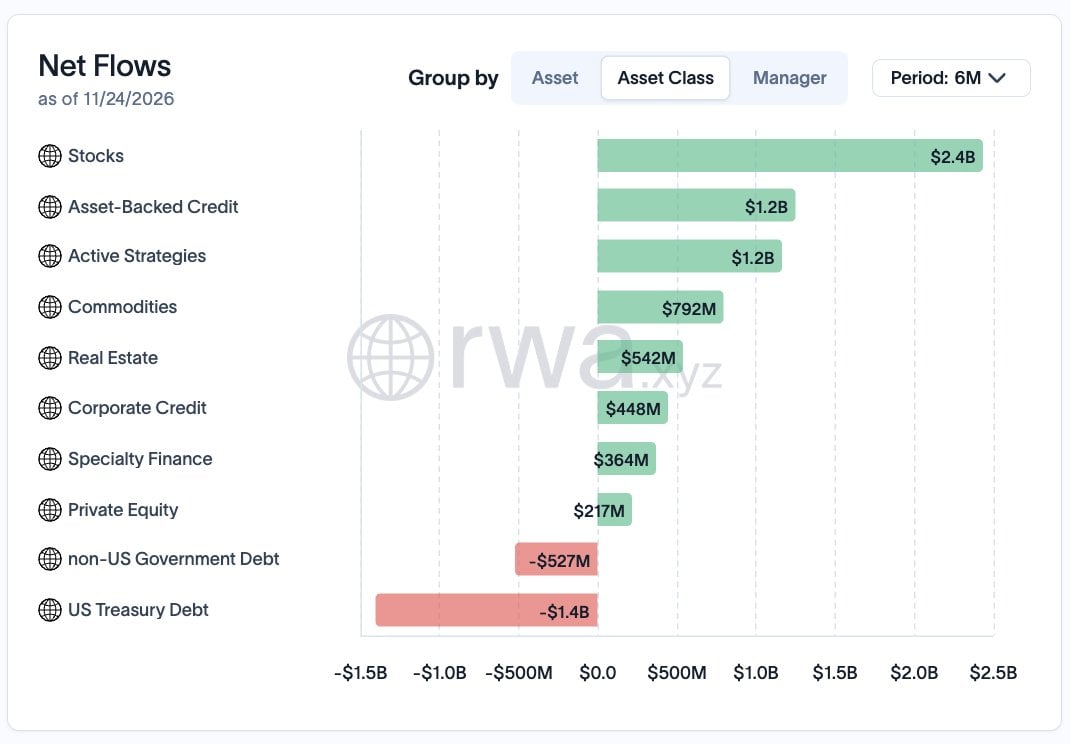
Chart: RWA category net inflow comparison over the past 6 months (tokenized stocks +$2.4B vs US Treasuries -$1.4B, source: rwa.xyz)
Holding stocks on-chain grants investors two inherent advantages: 24/7 instant settlement, and irreplaceable self-custody control over assets.
However, the ultimate holy grail for on-chain equities goes far beyond this: integrating them as qualified collateral into on-chain lending markets. By doing so, investors can fully retain their long-term upward price exposure to the underlying stocks while borrowing stablecoins against their collateral to unlock immediate liquidity, significantly boosting overall capital efficiency.
In this wave of financial infrastructure innovation, Coinbase has emerged as one of the early trailblazers. It has launched a custom Aave V4 lending instance exclusively for tokenized US equities on the Ethereum Layer 2 network Base, officially enabling users to borrow USDC using tokenized stocks as collateral.
Coinbase Tokenized US Equities: $45 Million Tapped in 3 Months
This August, Coinbase officially launched its tokenized stock product on the Base chain. Each on-chain stock token corresponds to the legal beneficial claim of a real US equity share, held at a 1:1 ratio in cash reserves with a heavily regulated custodian entity that maintains strict operational isolation from Coinbase’s own assets and ensures bankruptcy remoteness. After issuance on Base, users can seamlessly integrate into the broader DeFi ecosystem directly from their self-custody wallets.
Within just three months of launch, the protocol's on-chain total value scaled rapidly to $45 million, covering nearly 400 major US equities and ETFs, with independent holders surpassing 97,000. The top four largest tokenized stocks by market cap are:
• NVDAc (NVIDIA): $10.9 million
• GOOGLc (Alphabet/Google): $10.4 million
• METAc (Meta): $5.4 million
• SPCXc (SpaceX concept): $4.2 million
Aave V4 Architecture Decoded: How Does Hub & Spoke Solve Liquidity Fragmentation?
At the end of September, Coinbase deployed a custom Hub & Spoke lending architecture on Aave V4. This market quickly matured into the core lending venue for Coinbase tokenized stocks and currently stands as the fastest-expanding tokenized US equities lending platform across the entire network.
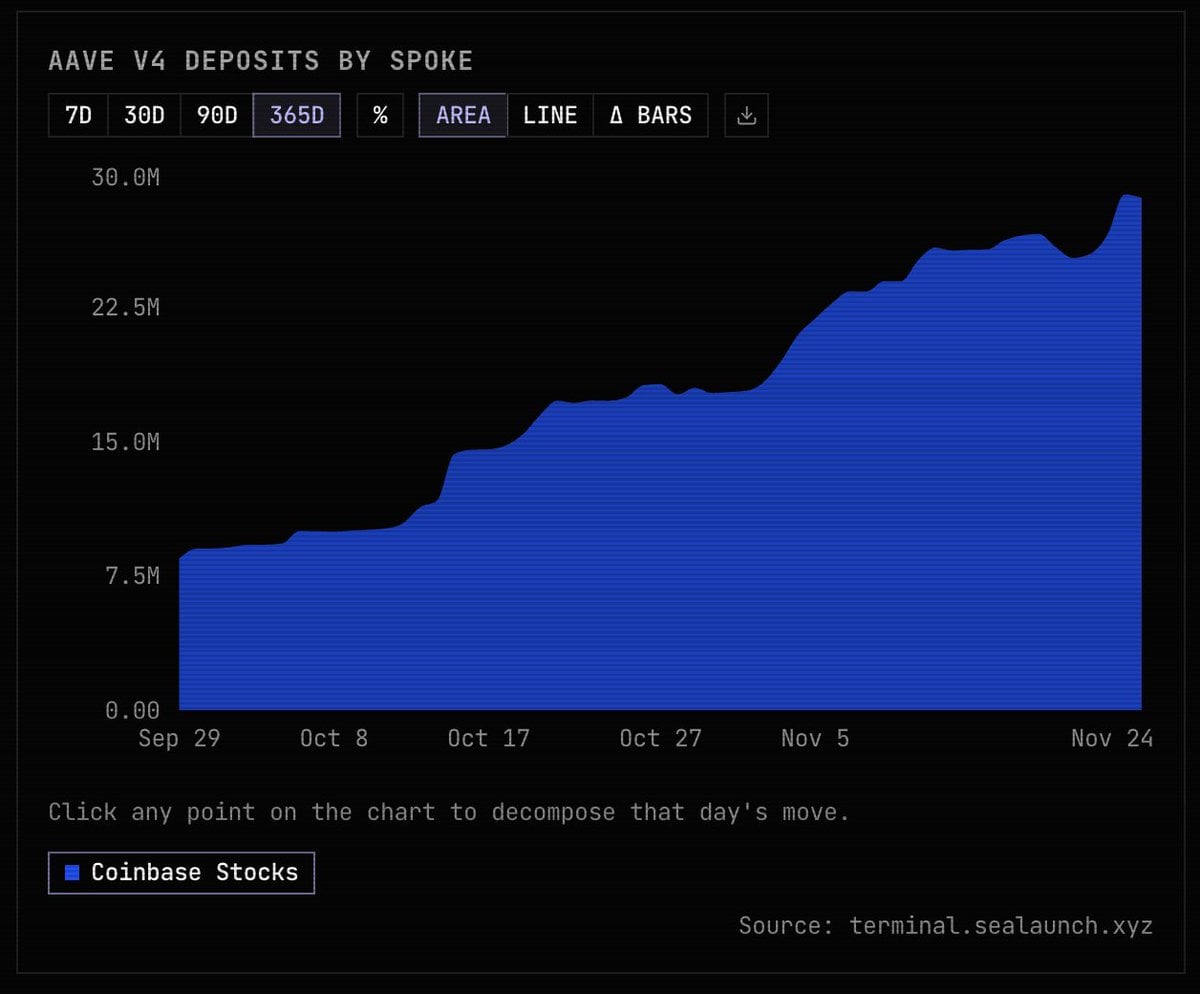
Chart: Operating principle of the Hub & Spoke architecture in Coinbase's dedicated Aave V4 lending instance for tokenized stocks
Its business model is straightforward: users deposit tokenized stocks as collateral and borrow USDC based on a dynamic loan-to-value ratio. There are no fixed maturity dates; borrowers only need to maintain a healthy LTV ratio and can repay on demand at any time.
The elegance of its underlying mechanism design lies in the decoupled division of labor between the Hub and Spoke:
The Hub (central liquidity pool) consolidates all USDC reserves, serving as the single source for all borrowing disbursements; while each Spoke (peripheral risk-control node) independently manages risk parameter configurations for a specific stock, including collateral factor, deposit cap, and liquidation thresholds.
In practice, a unified USDC liquidity pool simultaneously finances collateralized borrowing for eight major US stocks, while risk management for each asset remains completely separate. This means that whenever a new tokenized stock is listed, it can be seamlessly integrated simply by configuring the corresponding risk parameters on a Spoke. There is no need to establish isolated lending pools or solicit dedicated funding sources for each new asset.
For a long-tail asset matrix spanning nearly 400 stocks, this design is decisive. Under a traditional siloed market model, each stock would require a dedicated group of USDC lenders, causing most long-tail stocks to fail to facilitate actual lending due to insufficient pool depth. Conversely, under the shared Hub model, USDC lenders provide capital to all assets within a single pool. As more stocks are added, the system's overall liquidity is not diluted but rather becomes increasingly robust.
Currently, this instance locks approximately $19 million in tokenized stock collateral, representing roughly 40% of the total circulating supply of Coinbase tokenized US equities, with cumulative USDC loans reaching $8.3 million. GOOGLc ($6 million), NVDAc ($5.1 million), and METAc ($3.7 million) account for the vast majority of the collateral. Regarding utilization rates, NVDAc has reached 73% of its hard deposit cap, GOOGLc sits at 54%, while other assets remain safely below the 30% threshold.
Strategy Vaults Emerge as Core Borrowers: Three Steps to Execute On-Chain US Equity Carry Trades
Professional strategy vaults serve as the primary engine driving the rapid expansion of borrowing volume in this lending instance. Each vault collectively deposits its managed stocks as collateral and borrows USDC in bulk, thereby generating a steady stream of interest returns for USDC depositors. The vault layer abstracts and encapsulates complex on-chain execution and risk management for retail investors, allowing the lending market to accommodate large-scale institutional borrowing demand rather than fragmented micro-loans.
Currently, three core asset management firms oversee approximately $10 million across 22 tokenized stock vaults, collectively contributing nearly one-third of the total equity collateral in the Hub.
While these three firms share highly consistent strategic logic, their standardized execution framework follows four distinct steps:
1. Hold spot positions in target tokenized US equities;
2. Deposit them as qualified collateral into Aave V4;
3. Borrow USDC stablecoins at a targeted leverage ratio;
4. Deploy the borrowed USDC into external high-yield stablecoin investment strategies.
In its actual yield structure, vault investors not only fully retain the long-term capital appreciation of the underlying US equities but also capture the net interest margin (spread) between external stablecoin yield rates and Aave borrowing costs. This carry trade structure, historically confined to yield-bearing stablecoins, has now been successfully replicated onto real US equity assets.
Breakdown of Top 3 Strategy Managers: IPOR, Dialectic, and Superform
The three core strategy firms deeply embedded in this lending ecosystem currently exhibit distinct, differentiated allocation profiles:
1. 628 Labs (IPOR): AUM $4.8 million
Heavily concentrated in Google (GOOGL) and NVIDIA (NVDA) vaults. Within its asset allocation, 65% remains locked as collateral in Aave V4, while 30% is deployed into IPOR’s USDC Lending Optimizer to capture fine-tuned, dynamic rate alpha.
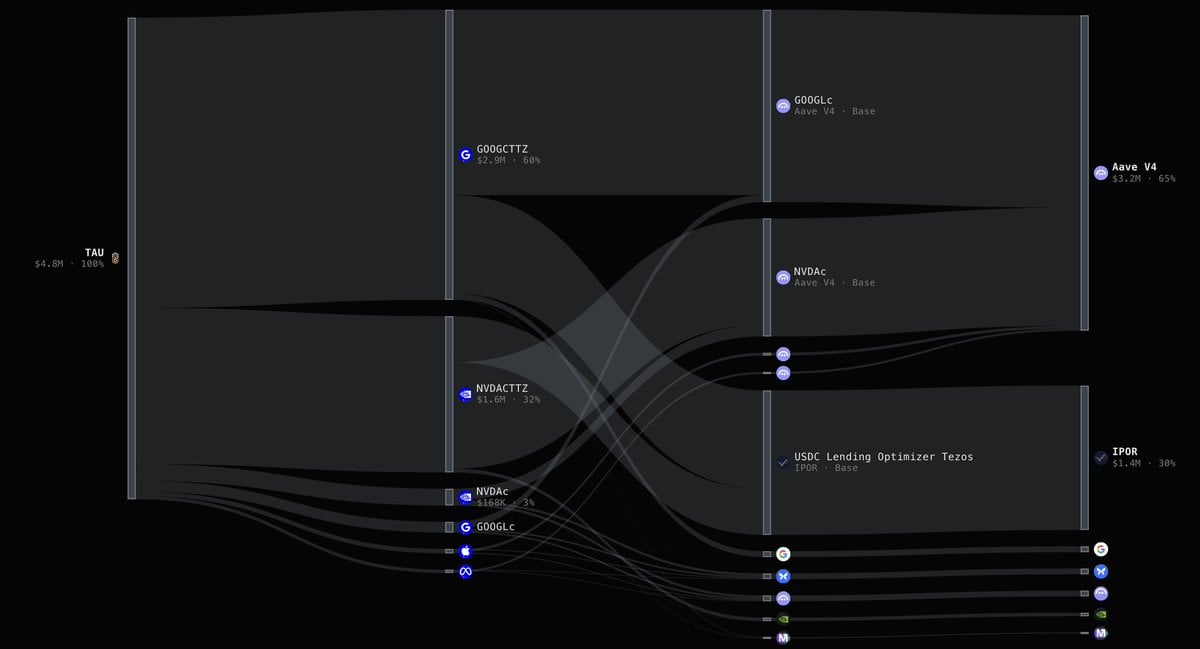
Chart: Breakdown of fund flows and collateral allocation for 628 Labs (IPOR) tokenized stock vaults
2. Dialectic Group: AUM $3.1 million
Spanning eight dedicated vaults, led by the $1.5 million yGOOGLc vault. Regarding capital distribution, 64% is pledged to Aave V4, while the remaining 36% flows to Makina Finance for multi-strategy yield aggregation.
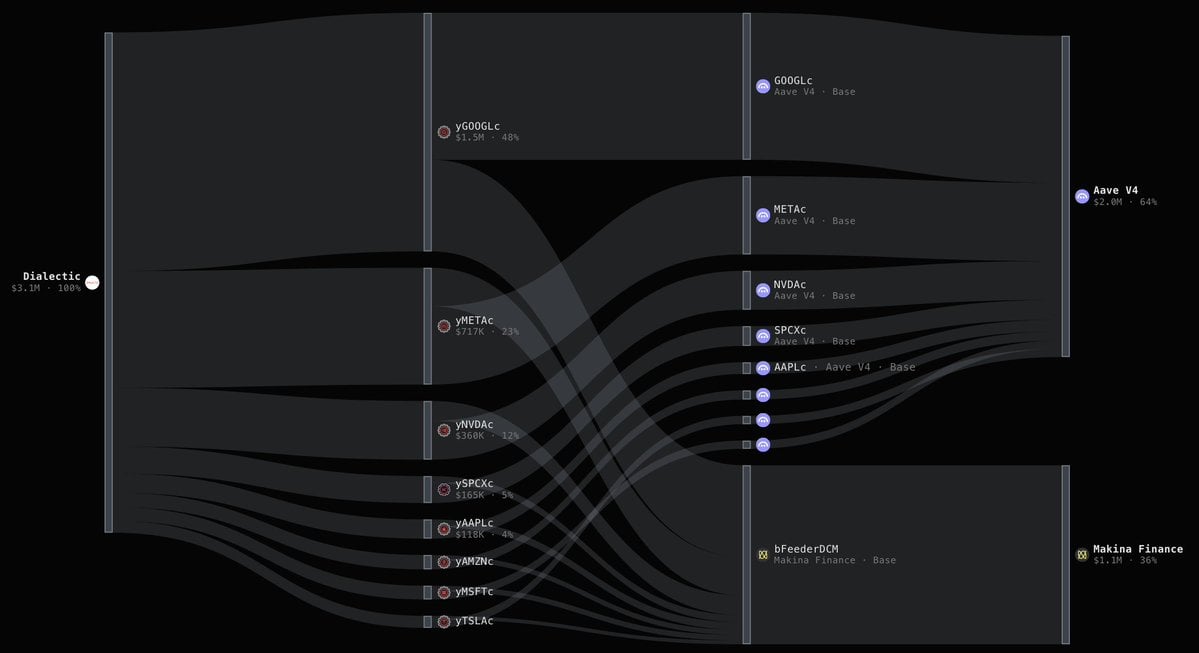
Chart: Portfolio structure of the 8 major US equity vaults managed by Dialectic Group
3. Superform: AUM $2.2 million
Similarly operates eight specialized vaults, headlined by the $680,000 superNVDA vault. In its capital allocation, 60% is locked in Aave V4 collateralized lending, while 28% is deployed into the Clearstar high-yield USDC vault on the Morpho platform.
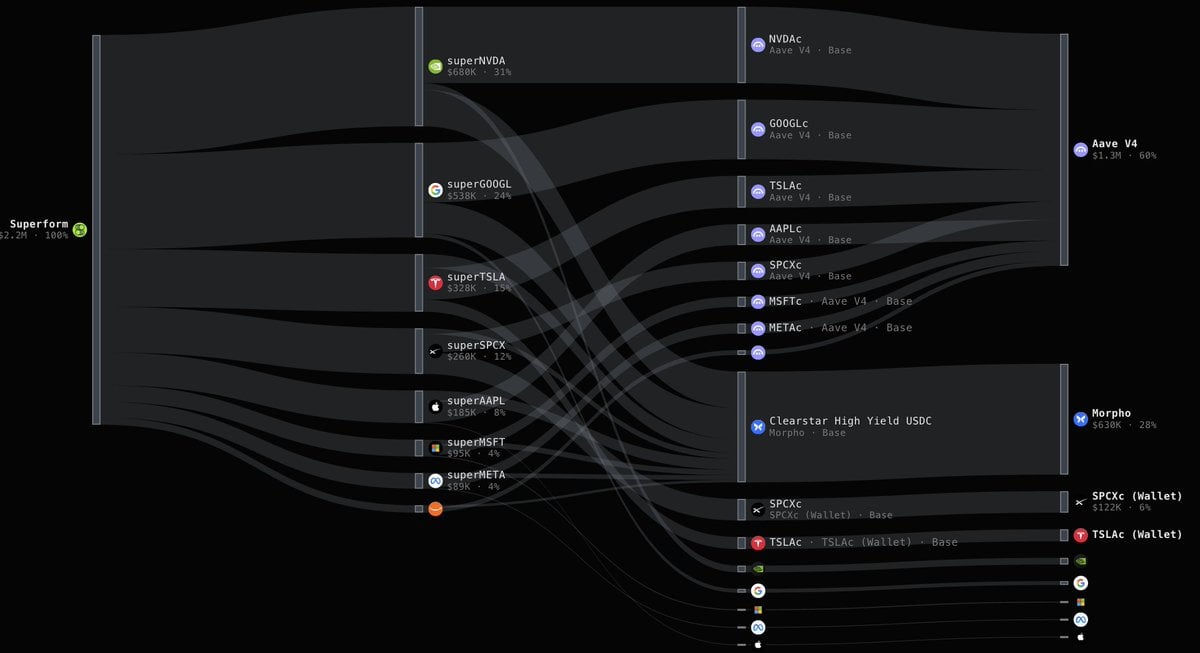
Chart: superNVDA and other US equity strategy vaults under Superform alongside Morpho lending structures
Evolution of Derivative Strategies: Basis-Hedged Indices and Hyperliquid Integration
As lending infrastructure solidifies, increasingly complex on-chain derivative products are rapidly emerging, built upon tokenized equities as their foundational bedrock.
A prime example is the Equity-Basis Index being developed by decentralized compliance protocol Keyring in partnership with Bitget and its RWA platform, Reality.
This strategy employs leveraged staking of spot tokenized US equities issued by Reality via permissioned DeFi lending markets, while simultaneously taking short positions on stock contracts of equivalent size on decentralized perpetual exchange giant Hyperliquid. Since spot long positions and contract shorts perfectly hedge price fluctuations, assets are insulated from systematic shocks tied to underlying stock volatility. Instead, the index continuously harvests funding rates paid by long-position traders around the clock. Within this closed loop, USDC lenders earn steady interest from overcollateralized lending, while index holders secure highly predictable net funding rate yields after financing costs.
Profound Implications for Issuers, Brokerages, and Fund Managers
The on-chain collaboration between Coinbase and Aave V4 is driving disruptive paradigm shifts across different participant segments in the entire RWA sector:
• Asset Issuers: Tokenized stocks eligible for deposit into lending markets as qualified collateral hold vastly superior utility and market liquidity compared to static assets that can only be passively held. Only issuers that successfully integrate into high-depth lending venues and gain widespread adoption by institutional vaults can truly achieve the critical leap from issuance volume to real-world usage.
• Brokerages & Exchanges: Platforms where users already hold tokenized US equities alongside crypto assets inherently possess massive deposit bases and diverse collateral types. Activating stock collateralized lending for users today simply requires direct integration with existing Aave V4 Hubs for one-click deployment, entirely sparing the platform from bearing the enormous engineering and risk management costs of operating complex lending markets.
• Strategy Managers: US equity assets introduce a brand-new class of collateral for on-chain carry trades and basis-hedging strategies, with liquidity channels now fully interconnected. More importantly, they provide crucial portfolio diversification for current strategies overly concentrated in stablecoins, ETH, and BTC. This enables managers to capture independent alpha driven by traditional stock market supply/demand dynamics and funding rates, decisively breaking free from sole reliance on native crypto bull/bear cycles.
Join TechFlow official community to stay tuned
Telegram:https://t.me/TechFlowDaily
X (Twitter):https://x.com/TechFlowPost
X (Twitter) EN:https://x.com/BlockFlow_News
 sealaunch_